2025 CSR Amendments India: New CSR-1 Form & Compliance Rules
This guide explains the current compliance essentials for corporate social responsibility (CSR) so that company boards, finance teams and compliance officers can align CSR activity with statutory expectations and internal controls. You will learn which companies typically fall within the regulatory scope, how CSR projects should be evaluated against the statutory list of permitted activities, and practical governance and recordkeeping steps that reduce regulatory risk and improve program outcomes. The guidance is framed to help decision-makers design processes that ensure CSR decisions are documented, projects clearly map to the recognised Schedule of activities, and board-level oversight is effective. While CSR is an important avenue for delivering social impact, it also carries compliance obligations and reputational exposure when projects are poorly documented or do not demonstrably match the statutory activity list. This guide focuses on what matters in practice: identifying when heightened governance is typically expected by regulators and stakeholders, interpreting the requirement that CSR projects map to Schedule VII, and putting in place simple, audit-ready procedures. Use this as a practical checklist to review your current CSR framework, tighten decision logs and ensure that every rupee spent can be linked to an eligible activity and clear governance approval.
Which companies typically face stronger CSR governance expectations
Regulatory frameworks set different governance expectations depending on company size and economic scale. Large companies with higher turnover, paid-up capital or net worth are generally expected to demonstrate stronger board-level oversight of CSR decisions, while smaller firms have proportionately simpler obligations. The thresholds commonly referenced in corporate governance discussions include Rs. 500 crore, Rs. 1000 crore and Rs. 5 crore, which serve as markers for when more formal structures and disclosure practices are expected.
Practically, companies that meet or exceed these thresholds should treat CSR as a board-level compliance area: ensure documented approvals, maintain a transparent process for selecting projects and implement measurable monitoring. Smaller companies that fall below these markers still benefit from consistent processes, simpler governance can still provide a clear audit trail and reduce downstream risk.
Mapping CSR projects to Schedule VII
A central compliance requirement is that CSR projects must map to the activities listed in Schedule VII. This list defines the types of social, environmental and community activities that are recognised for CSR purposes. When designing or approving a project, companies should explicitly document how the project aligns with one or more Schedule VII activities.
Alignment means more than a general description, it requires a clear explanation of the activity’s objective, target beneficiaries and outputs in terms that correspond to a Schedule VII category. This mapping is the primary justification used in internal approvals and external disclosures, and it underpins the ability to defend project choices to auditors, regulators and stakeholders.
Governance and board/committee responsibilities
For companies where stronger governance is expected, the board or a dedicated committee should record reasoned approvals for project selection, choice of implementing partners and monitoring arrangements. The written record should explain how each project maps to Schedule VII and why the chosen approach is the most appropriate way to achieve the stated social objectives.
Even for companies with simpler governance structures, leadership should set a transparent approval route and periodic reviews. Clear delegation of authority, timelines for implementation and predefined monitoring indicators reduce ambiguity and create an auditable decision trail.
Documentation, due diligence and audit-readiness
Maintain a consistent folder of documents for every CSR project: project proposals, beneficiary descriptions, budget and expenditure records, implementing partner credentials and periodic progress reports. This file should include the explicit mapping to Schedule VII so auditors can quickly verify statutory alignment.
Implement a standard due diligence checklist for prospective implementing partners and projects so decisions are repeatable and defensible. Such a checklist reduces the risk of funds being spent on activities that cannot be clearly linked to Schedule VII and supports both internal and external reviews.
Practical checklist for compliance and better outcomes
Before approving expenditure, confirm that: (a) the project description explicitly maps to one or more Schedule VII activities, (b) the governance route and approvals are recorded, (c) the implementing partner has been evaluated with a due diligence checklist, and (d) monitoring indicators and reporting timelines are defined. These simple steps both reduce compliance risk and improve the likelihood of measurable social impact.
On an ongoing basis, preserve evidence of implementation, such as receipts, progress reports and beneficiary verification, and review projects periodically to confirm continued alignment with Schedule VII. Consistent recordkeeping and clear approvals make annual disclosures and audits smoother and reduce legal and reputational risk.
Strong CSR compliance rests on two linked pillars: clear mapping of projects to Schedule VII activities and proportionate governance that fits the company’s size. Use the thresholds commonly referenced as a prompt for when to tighten board oversight, but apply disciplined documentation and due diligence in every case. That approach protects the company, strengthens program outcomes and simplifies audits and disclosures.
Frequently asked questions
What are the key changes in the 2025 CSR rules I should know about?
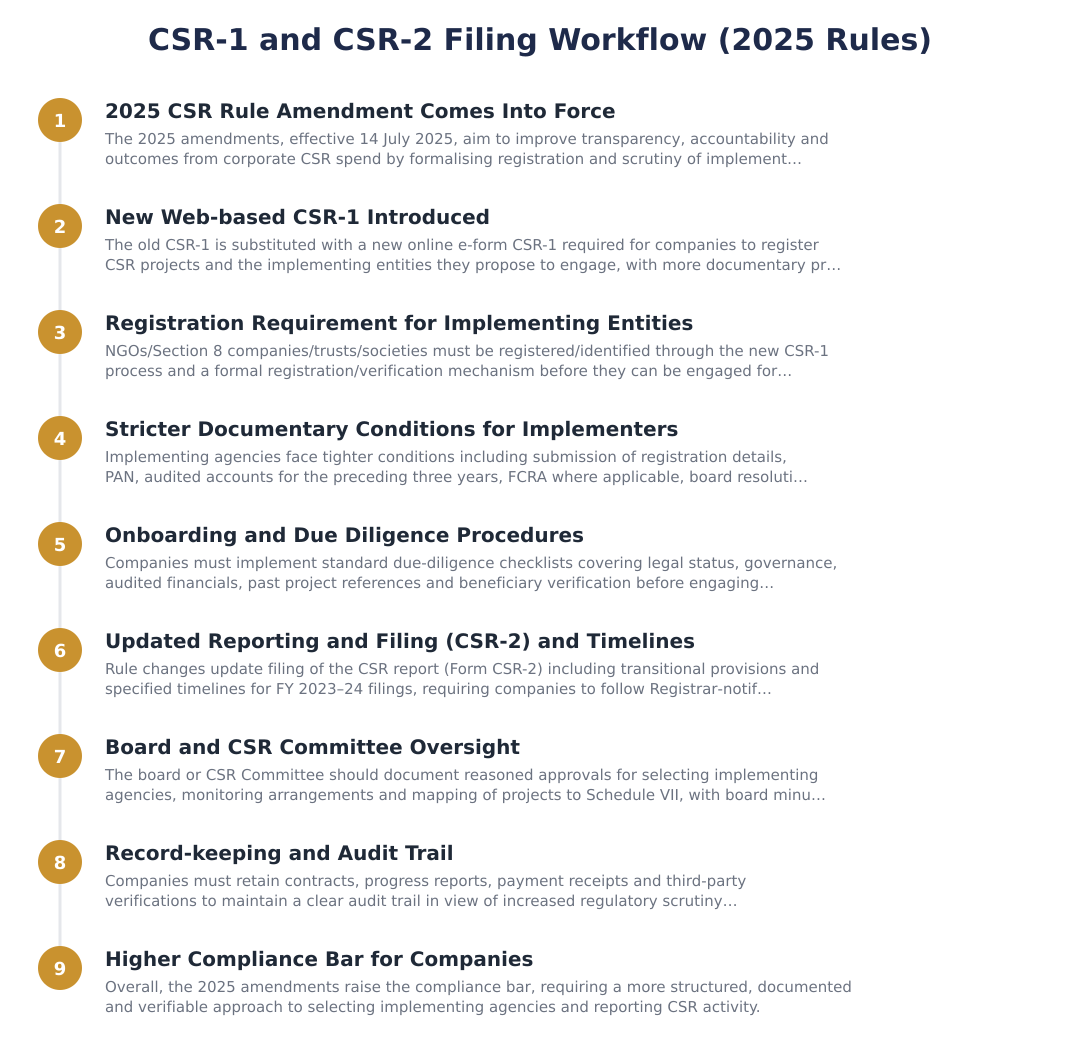
The 2025 CSR amendments introduce a web-based CSR-1 e-form, formal registration/verification of implementing agencies, and tighter reporting and documentary requirements that came into force on 14 July 2025. The amendments require companies to register CSR projects and implementing entities through the new online CSR-1, demand more proof from NGOs/Section 8 companies/trusts (like registration details and audited accounts), and update filing obligations such as the CSR-2 timelines. These changes aim to reduce diversion of funds and improve monitoring, so companies must strengthen due diligence, board oversight and record-keeping to avoid enforcement risk. Transitional provisions for FY 2023–24 filings may apply, so check MCA notifications for exact dates and deadlines.
Do I have to register an NGO or implementing agency before engaging them for CSR work?
Yes, under the 2025 rules an implementing agency must be registered/identified through the new CSR-1 process (or appear on the CSR registry) before a company engages them for CSR projects. The new CSR-1 e-form is web-based and requires documentary proof of the implementing agency’s legal status, PAN, audited financials and other credentials; companies should retain these documents before making payments. Engaging an unregistered agency increases regulatory and enforcement risk, so complete CSR-1 submission and verification first unless the MCA guidance provides a permitted exception. Keep the CSR-1 acknowledgement and the implementing agency’s records in your compliance file for audits.
What documents should I collect from a trust/NGO/Section 8 company before funding them?
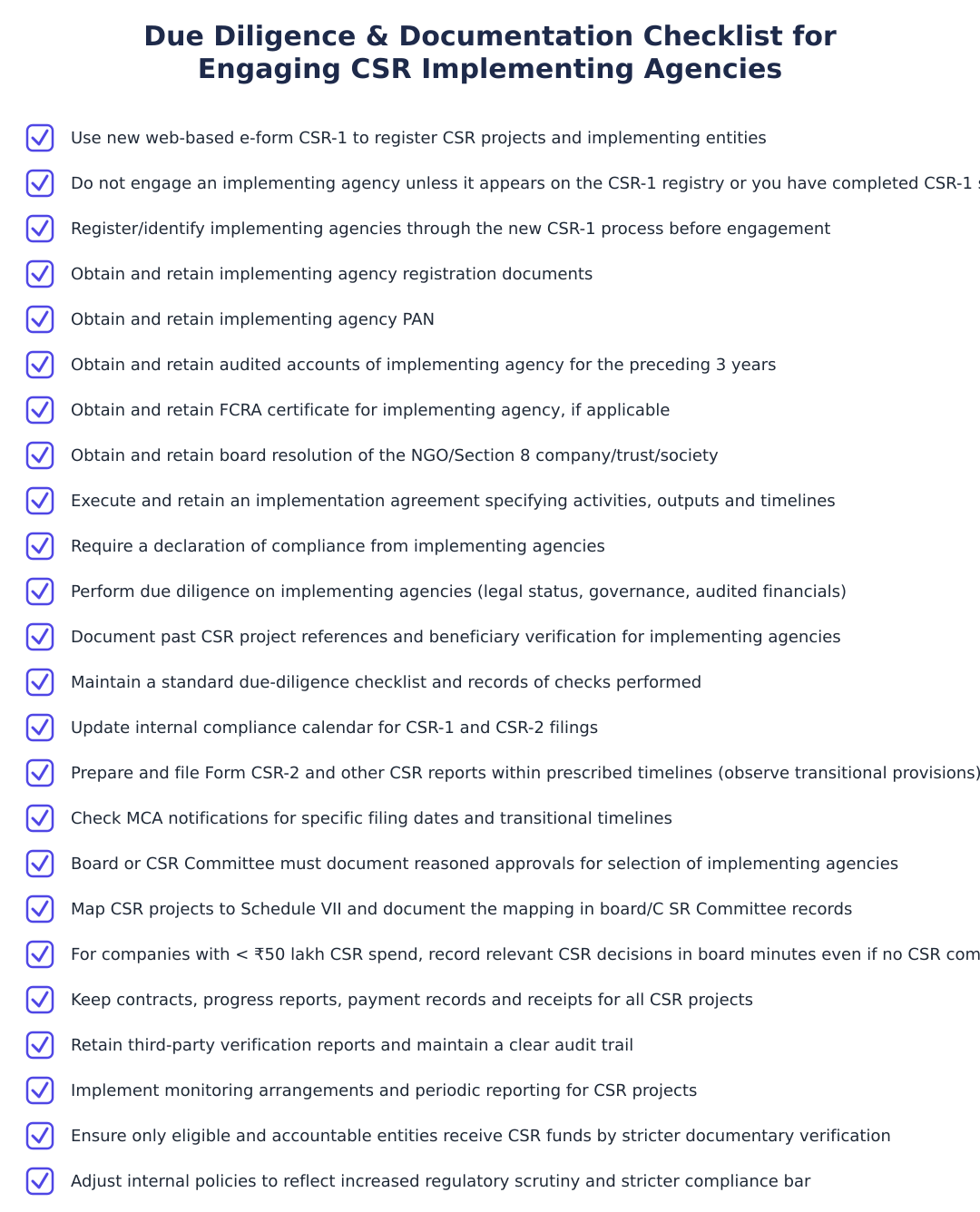
Collect and retain the implementing entity’s registration documents, PAN, audited financial statements for the preceding three years, FCRA certificate if foreign funding is involved, board resolution of the NGO and a formal implementation agreement detailing activities, outputs and timelines. The 2025 Rules expressly require this documentary evidence as part of the new due‑diligence regime and CSR-1 submissions, so these records must be kept to demonstrate eligibility and proper use of funds. Also obtain references or evidence of past CSR work, beneficiary verification procedures and any third‑party monitoring reports to strengthen your audit trail and defence against regulatory queries. Maintain hard and electronic copies as part of the company’s CSR files for at least the statutory record retention period.
How has CSR reporting and filing changed under the 2025 rules (CSR-2 and timelines)?
CSR reporting and filing requirements have been updated, including amendments to Form CSR-2 and revised timelines with transitional provisions for earlier years such as FY 2023–24; companies must follow the Registrar’s notified deadlines to avoid late‑filing penalties. The changes require companies to file CSR activities in the prescribed format and may demand more granular information about implementing agencies and project outcomes. Because MCA periodically issues timelines and transitional instructions, companies should update their compliance calendars, confirm the current Rule text and monitor Registrar notifications for exact due dates. Failure to comply with the updated timelines or formats can attract notices and enforcement action, so plan filings in advance.
Do small companies with CSR spend below ₹50 lakh need a CSR committee under the new rules?
Companies with CSR spend below ₹50 lakh remain exempt from constitution of a CSR Committee, but the board must still document and approve CSR decisions in board minutes under the 2025 rules. Even without a committee, the board should record reasoned approvals for selection of implementing agencies, monitoring arrangements and how projects map to Schedule VII to ensure compliance. The amendments increase scrutiny on selection and monitoring of implementing agencies, so companies under the threshold should maintain the same documentary rigor (due‑diligence records, agreements, progress reports) as larger companies. Retaining a clear audit trail helps defend decisions if regulators seek explanations.
What due‑diligence process should a company follow before onboarding a CSR implementing agency?
Adopt a standard due‑diligence checklist that verifies the agency’s legal status, governance, audited financials (last 3 years), PAN, FCRA (if applicable), past project references, beneficiary verification methods and capacity to deliver the proposed outputs. The 2025 Rules and MCA guidance make company-level due diligence a frontline compliance step, and these checks should be documented, retained and referenced in the CSR-1 submission and board approvals. Also require an implementation agreement with defined deliverables, timelines, monitoring and payment milestones, and consider third‑party verification or periodic site visits for high-value projects. Proper due diligence reduces diversion risk and strengthens the compliance record in case of regulatory scrutiny or enforcement.
How should companies maintain records and an audit trail for CSR compliance after the 2025 amendments?
Companies should maintain contracts, implementation agreements, CSR-1/CSR-2 filings, progress reports, payment receipts, beneficiary lists and third‑party verification reports as part of a structured CSR file to create a clear audit trail. The 2025 amendments increase documentary requirements and enforcement activity, so keeping organised, contemporaneous records (both physical and electronic) is essential to demonstrate proper use of funds and monitoring. Ensure backup of digital files, version‑controlled board minutes and evidence of funds transfer tied to project milestones; these records support internal and statutory audits and any regulatory queries. Retain records for the statutory retention period and make them readily available for MCA or auditor review.
Are there stricter eligibility criteria for NGOs and Section 8 companies after the 2025 CSR Rules?
Yes, the 2025 Rules prescribe stricter eligibility and documentary requirements for NGOs, Section 8 companies, trusts and societies that implement CSR, including proof of registration, audited accounts, PAN and declarations of compliance. The intent is to ensure only eligible and accountable entities receive CSR funds and to allow companies to verify implementing agencies through the CSR‑1 registration/verification mechanism. Non‑compliant or unregistered entities may be excluded from receiving CSR funds until they meet the requirements, increasing the need for prior verification. Check the CSR‑1 instructions and MCA guidance for specific documentary lists and any registration pathways introduced by the government.
How do the 2025 CSR changes affect mapping activities to Schedule VII?
The 2025 amendments continue to emphasise that CSR projects must map to Schedule VII activities, and boards must document how chosen projects align with Schedule VII in approvals and reports. Companies should clearly record the Schedule VII clause(s) that each project addresses in the project proposal, board resolutions and CSR-2 filings to satisfy scrutiny of purpose and eligibility. The stricter implementing‑agency checks and enhanced reporting mean companies should ensure project designs and output indicators clearly reflect Schedule VII objectives to avoid rejection or challenges during audits. If in doubt, obtain legal or CSR advisory input to justify the Schedule VII alignment before approving funds.
Need help staying Compliance compliant?
MoneyGence's AI Finance OS tracks your compliance, wallet share, and finances in one place, built for agencies and growing businesses.
Get started with MoneyGence