Accounting Principles: Meaning, Importance & Types Explained
Accounting principles are the foundational ideas and guidelines that shape how financial transactions are identified, recorded, measured and reported. For business owners, finance teams and users of financial statements, understanding these principles matters because they create a consistent basis for preparing accounts, enable comparability across reporting periods and between entities, and support transparency for investors, creditors and regulators. In this guide you will learn what accounting principles are in plain language, why organisations rely on them, the common categories of principles that practitioners apply, characteristic features to expect in an accounting framework, and practical limitations to keep in mind when interpreting financial statements. Rather than focusing on a specific technical framework, this article emphasises the practical role of accounting principles in everyday reporting decisions: how they affect revenue and expense recognition, presentation of assets and liabilities, selection of valuation bases, and disclosure practices. By the end you will be better equipped to read financial statements with a critical eye, ask the right questions of preparers and advisers, and recognise where judgements and estimates are likely to influence reported results. This foundation is useful for business owners, students, investors and anyone who uses financial information to make decisions.
What Are Accounting Principles?
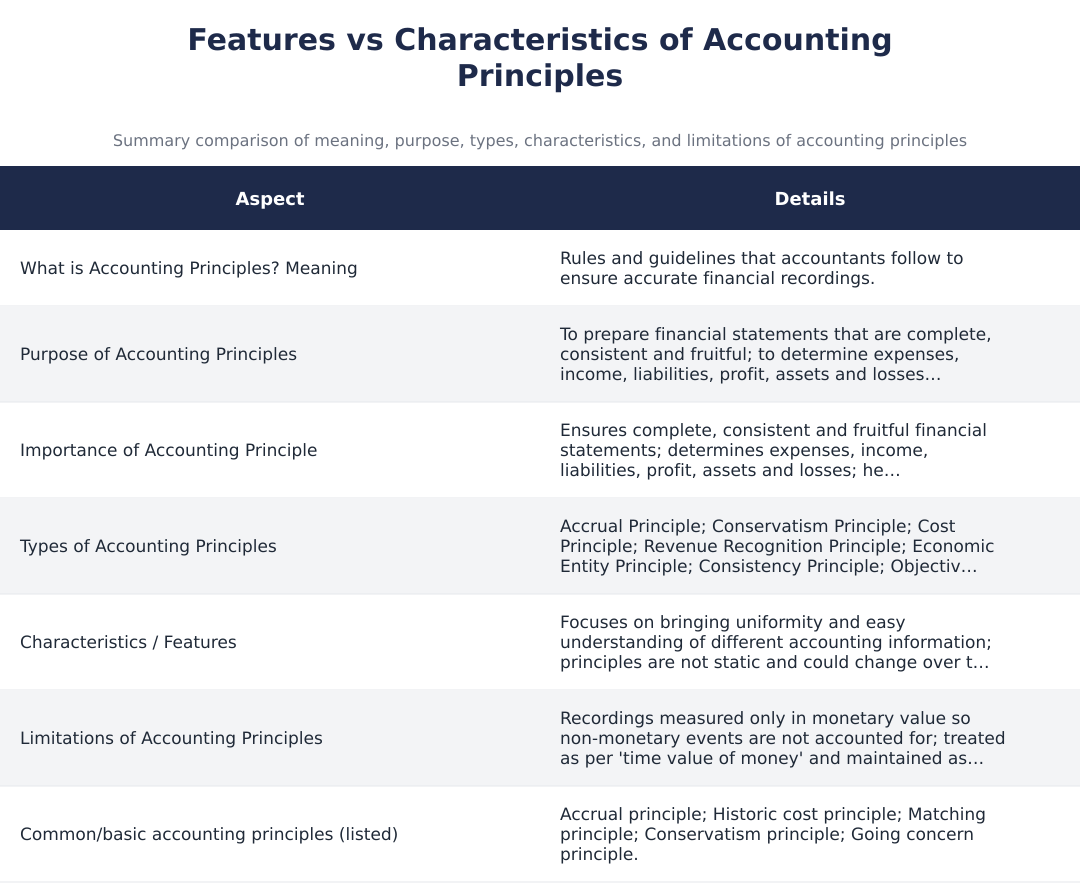
Accounting principles are a set of guiding concepts that help ensure financial information is recorded and presented in a way that users can rely on. They do not prescribe every technical detail, but they provide the logic and rationale behind measurement choices, classification, timing and disclosure of transactions. In practice, principles help decide which events should be reflected in the accounts and how those events should be portrayed so that readers can form informed judgements.
These principles are embedded in the policies companies adopt when preparing financial statements. Such policies influence day-to-day bookkeeping as well as higher‑level decisions about estimation, recognition and measurement. Because accounting seeks to translate a wide range of economic activity into monetary terms, principles are necessary to bring uniformity and to reduce arbitrary differences in reporting between entities.
Purpose of Accounting Principles
The primary purpose of accounting principles is to provide a consistent framework so that financial information is meaningful and comparable. A consistent approach to recognising income and expenses, valuing resources and presenting obligations enables users to track performance over time and compare different organisations on a like-for-like basis.
Beyond consistency, principles promote clarity and transparency. By setting expectations about measurement and disclosure, they make it easier for users to understand what lies behind reported numbers, assess risks and opportunities, and hold management accountable for stewardship of resources.
Importance of Accounting Principles
Accounting principles are important because they help produce financial statements that are complete, consistent and useful. When organisations follow common guiding concepts, it reduces the chance that similar transactions will be treated very differently, which in turn increases confidence in the reported information among lenders, investors and other stakeholders.
They also support effective decision‑making. Clear principles make it easier to identify the sources of profit or loss, to evaluate liquidity and solvency, and to detect anomalies or potential misstatements. Finally, by encouraging uniform presentation and disclosure, accounting principles facilitate external analysis and reduce information asymmetry between management and users.
Types of Accounting Principles
Accounting principles can be grouped into several broad categories based on their focus. One category addresses recognition and measurement, when items should be recorded in the accounts and how they should be measured. Another category deals with presentation and disclosure, how information should be organised and what explanatory notes are necessary to make the numbers intelligible.
A further category concerns valuation and prudence, guidance on selecting conservative versus optimistic measurement approaches, and how to account for uncertainty and potential losses. Finally, there are concepts that relate to consistency and comparability, rules about applying accounting policies uniformly across periods and providing explanations when policies change. Together, these types help professionals balance relevance, faithful representation and comparability in financial reporting.
Characteristics and Features of Accounting Principles
Characteristic features of accounting principles include generality and flexibility. Principles are usually expressed at a high level so they can be adapted to a wide range of transactions and industries; however, they often require judgement when applied to specific facts. This balance allows frameworks to be useful across diverse entities while still guiding consistent treatment.
Another key feature is their focus on monetary measurement: accounting records translate economic events into currency amounts. This makes financial statements comparable and quantifiable, but it also means non‑monetary information and qualitative factors may be less visible unless specifically disclosed. Additionally, good accounting principles encourage clear disclosure of assumptions and estimates so users can understand the basis for the numbers.
Limitations of Accounting Principles
While accounting principles bring many benefits, they also have limitations. Because they prioritise measurement in monetary terms and often rely on historical information, financial statements may not fully capture current market conditions or future prospects. Certain events that affect the long‑term value of a business may be difficult to reflect promptly or accurately.
Another limitation is reliance on judgement and estimates. Different preparers may reach different conclusions when applying broad principles to complex transactions, which can affect comparability. Finally, emphasis on standardised presentation can sometimes place form over substance if users focus only on headline numbers rather than the underlying explanations and disclosures that provide context.
Accounting principles are the conceptual backbone of financial reporting. They provide structure and discipline to the recording and presentation of financial information, helping users interpret results and make decisions. At the same time, users should be aware of the principles’ limitations and read financial statements with attention to key judgements, estimates and disclosures that drive the reported figures.
Frequently asked questions
What are accounting principles in simple terms?
Accounting principles are the standardized rules and guidelines accountants follow to record, classify and report financial transactions. They form the foundation of financial statements by ensuring transactions are measured in monetary terms, recorded consistently over time and presented in a comparable way for users like investors, lenders and regulators. Common frameworks that embody these principles are called GAAP (Generally Accepted Accounting Principles), and they cover concepts such as accrual accounting, historical cost, conservatism and going concern. By following these principles, organisations produce financial information that is reliable, transparent and useful for decision-making.
Why are accounting principles important for a business?
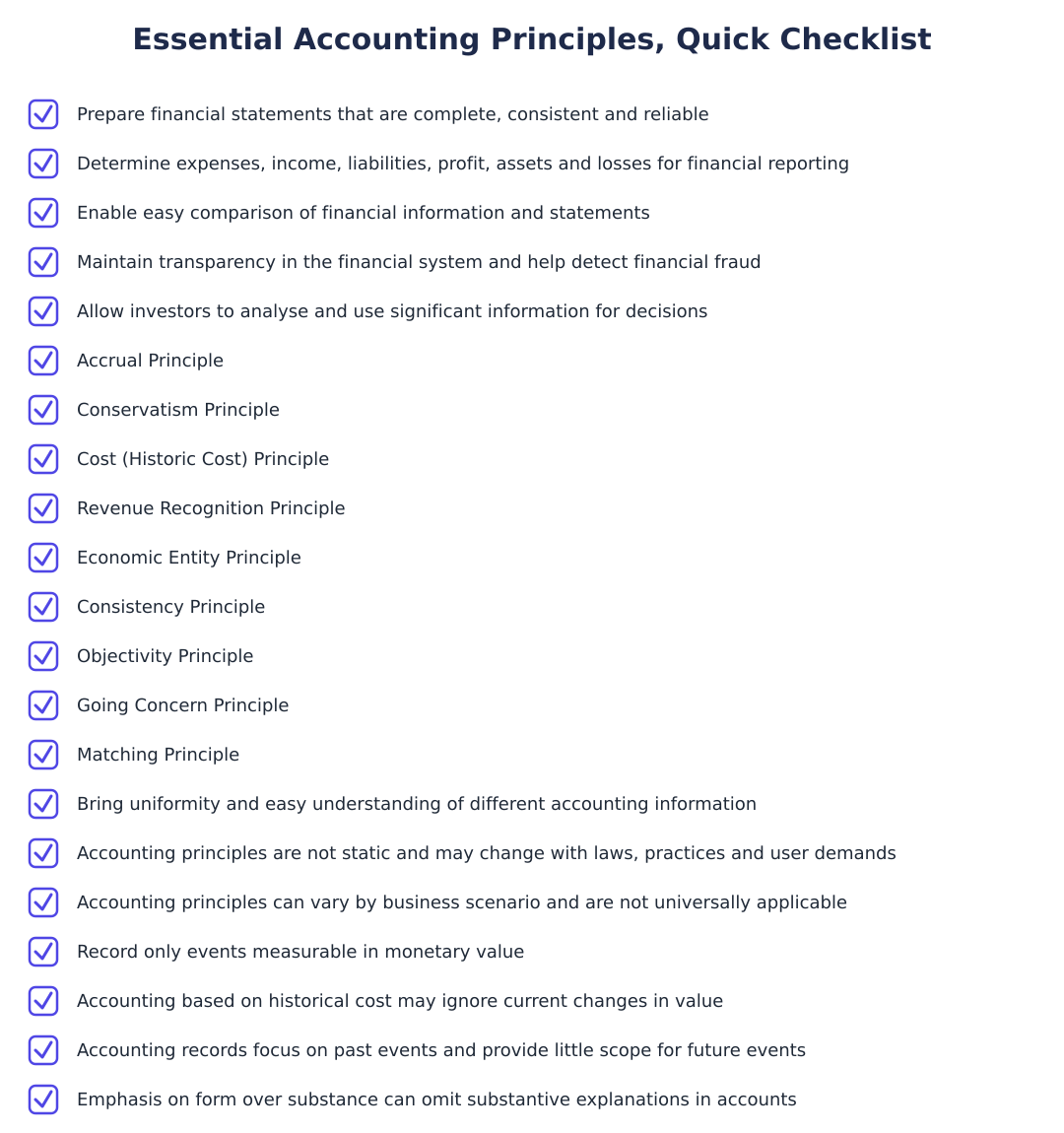
Accounting principles are important because they ensure financial statements are complete, consistent and comparable across periods and companies. They help determine expenses, income, assets, liabilities and profits for accurate financial reporting and enable investors and stakeholders to analyse and compare financial information easily. These principles also support transparency in the financial system, facilitating detection of fraud and better decision-making by management and external users. Without them, financial information would be inconsistent and unreliable.
What is the purpose of accounting principles?
The primary purpose of accounting principles is to provide a uniform framework for recording and presenting financial transactions so users can understand and compare financial data. They aim to bring consistency and clarity to financial statements, guide judgment in recognising revenues and expenses, and establish objective measurement rules like historical cost and accrual recognition. These principles also serve to protect stakeholders by promoting transparency and reducing the risk of misleading or biased reporting. In practice, they are adapted to changing laws, business practices and user needs over time.
What are the main types of accounting principles I should know?
The main types of accounting principles include the Accrual Principle, Conservatism Principle, Cost (Historical Cost) Principle, Revenue Recognition Principle, Economic Entity Principle, Consistency Principle, Objectivity Principle and Going Concern Principle. These principles guide when to record transactions (accrual), how to value assets (cost/historical cost), when to recognise revenue, and whether to present conservative estimates for uncertain events. Together they form the basic rules that accountants use to prepare reliable financial statements and are often grouped under frameworks such as GAAP. Some lists emphasise five core principles: accrual, historical cost, matching, conservatism and going concern.
What is the accrual principle and why does it matter?
The accrual principle states that revenues and expenses must be recorded when they are earned or incurred, not when cash is received or paid. This matters because it matches income with related expenses in the period they occur, giving a more accurate picture of a company's financial performance than cash-basis accounting. For example, a sale made on credit in March is recognised as revenue in March even if cash is collected in April. Accrual accounting is a cornerstone of most accounting frameworks and is required for accurate period-to-period comparison.
What are the key characteristics and features of accounting principles?
Key characteristics of accounting principles are uniformity, objectivity, reliability and adaptability to changing business practices and legislation. They focus on producing consistent, understandable information that users can compare across businesses and time, and are generally grounded in objective evidence (invoices, contracts) rather than subjective estimates. Features include being non-static (they can change with law or business needs), being based on experience and reasoning, and not always universally applicable to every unique business scenario. These traits help balance practical recording needs with the goal of faithful financial representation.
What are the common limitations of accounting principles?
Common limitations of accounting principles include reliance on monetary measurement, use of historical cost which may ignore current market values, and inability to record or predict future non-monetary events that affect a business. They also tend to emphasise form over substance in some situations, meaning presentation or formats may be prioritised over explanatory context, and principles can vary in applicability across different business scenarios. Because principles evolve and are sometimes based on judgment, they cannot eliminate all subjectivity or fully capture economic reality, so users should interpret financial statements with these limitations in mind.
How do accounting principles ensure transparency and comparability?
Accounting principles ensure transparency and comparability by prescribing standard methods for recognising, measuring and presenting financial transactions so that different organisations use similar rules. When entities follow consistent principles like accrual accounting, historical cost measurement and consistent presentation policies, users can compare financial statements across companies and time periods. Additionally, requirements for objective evidence and disclosures reduce the opportunity to hide or distort information, increasing transparency for investors, lenders and regulators. Disclosures and consistent application of principles also make it easier to detect anomalies or potential fraud.
Are accounting principles the same as accounting concepts and how do they relate?
Accounting principles are the practical rules and guidelines used to prepare financial statements, while accounting concepts are the underlying assumptions (like monetary measurement, going concern and consistency) that support those principles. In other words, concepts provide the theoretical foundation and principles translate those ideas into actionable rules for recording and reporting transactions. For example, the going concern concept (assumes the business will continue) underpins the going concern principle used to value assets and liabilities, and both are essential for coherent financial reporting. Together, concepts and principles form the framework accountants use to produce reliable and comparable financial information.
Need help staying Accounting compliant?
MoneyGence's AI Finance OS tracks your compliance, wallet share, and finances in one place, built for agencies and growing businesses.
Get started with MoneyGence