Advance Tax FY 2026-27: Due Dates, Calculate & Pay Online
This guide explains advance tax for FY 2026-27, who must pay it, the due dates and instalment percentages, how to calculate the amount you need to remit, the online payment process and the interest consequences of short or late payments. For taxpayers in India, advance tax is a pay-as-you-earn system requiring payment of tax in instalments across the year instead of a single lump-sum at the time of filing returns. Understanding the instalment schedule, the minimum percentages that must be paid by each due date, and the interest applied for shortfall is essential to avoid avoidable penalties. In this article you will learn: (1) the statutory due dates for FY 2026-27 instalments; (2) which categories of taxpayers typically need to estimate and pay advance tax; (3) a stepwise online payment flow; (4) how interest is computed when instalments are short or delayed; and (5) an illustrative computation showing how advance tax is derived from gross income, deductions, TDS and final tax liability. This guide is targeted at salaried taxpayers with additional income, freelancers, investors with capital gains (including crypto), businesses and those under presumptive taxation who may need to make advance tax payments. Follow the due dates and instalment percentages closely to minimise interest exposure and ensure the payments are correctly recorded in the e‑filing portal.
What is Advance Tax?
Advance tax is a pay-as-you-earn framework under which taxpayers remit their estimated tax liability in instalments during the financial year instead of waiting until filing the income-tax return. The objective is to spread tax payments over the year and improve revenue flow for the government, while also aligning payment timing with the taxpayer’s cash flows.
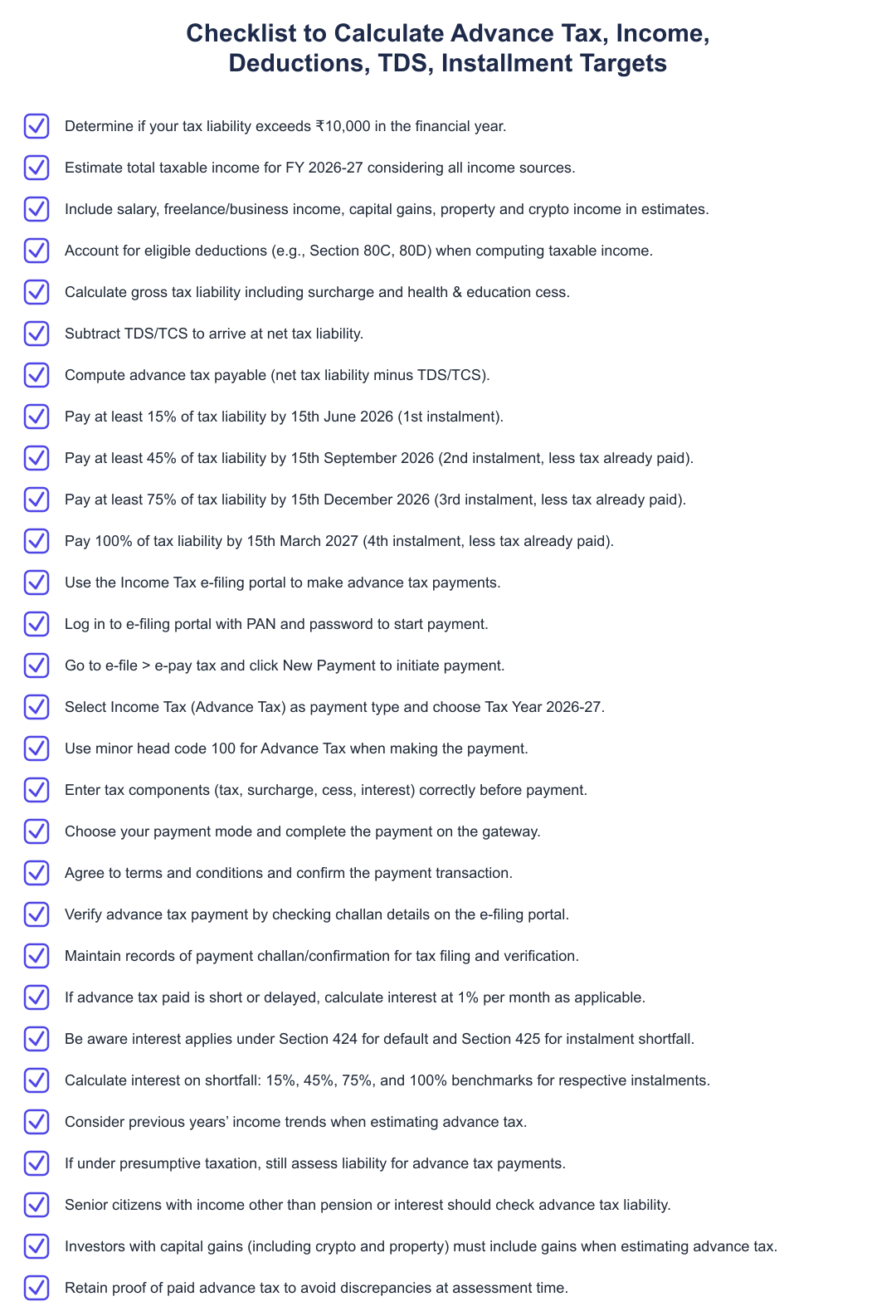
Practically, advance tax requires you to estimate your total tax liability for the year after accounting for expected deductions and TDS/TCS. If the estimated liability after TDS/TCS exceeds Rs. 10,000, you are required to pay advance tax in instalments as per the statutory schedule. Paying on time and in the required proportions avoids interest charges that apply to short or late payments.
Who Should Pay Advance Tax?
Any taxpayer whose estimated tax liability for the financial year, after accounting for TDS/TCS, exceeds Rs. 10,000 must pay advance tax. This threshold makes it relevant to a wide range of taxpayers beyond those with large incomes: salaried individuals with significant additional income, freelancers, professionals, investors with capital gains (including gains from crypto assets), and businesses.
The guide discusses several common categories: salaried taxpayers who have income beyond employer TDS; senior citizens (who may still be liable if they have taxable income beyond TDS/thresholds); investors receiving capital gains from investments, property or crypto; and freelancers, businesses and those under presumptive taxation who must estimate taxable profits and remit advance tax accordingly. The key practical point is to review all income streams and deductions, estimate the net tax after TDS/TCS, and if it exceeds Rs. 10,000, plan instalment payments per the schedule.
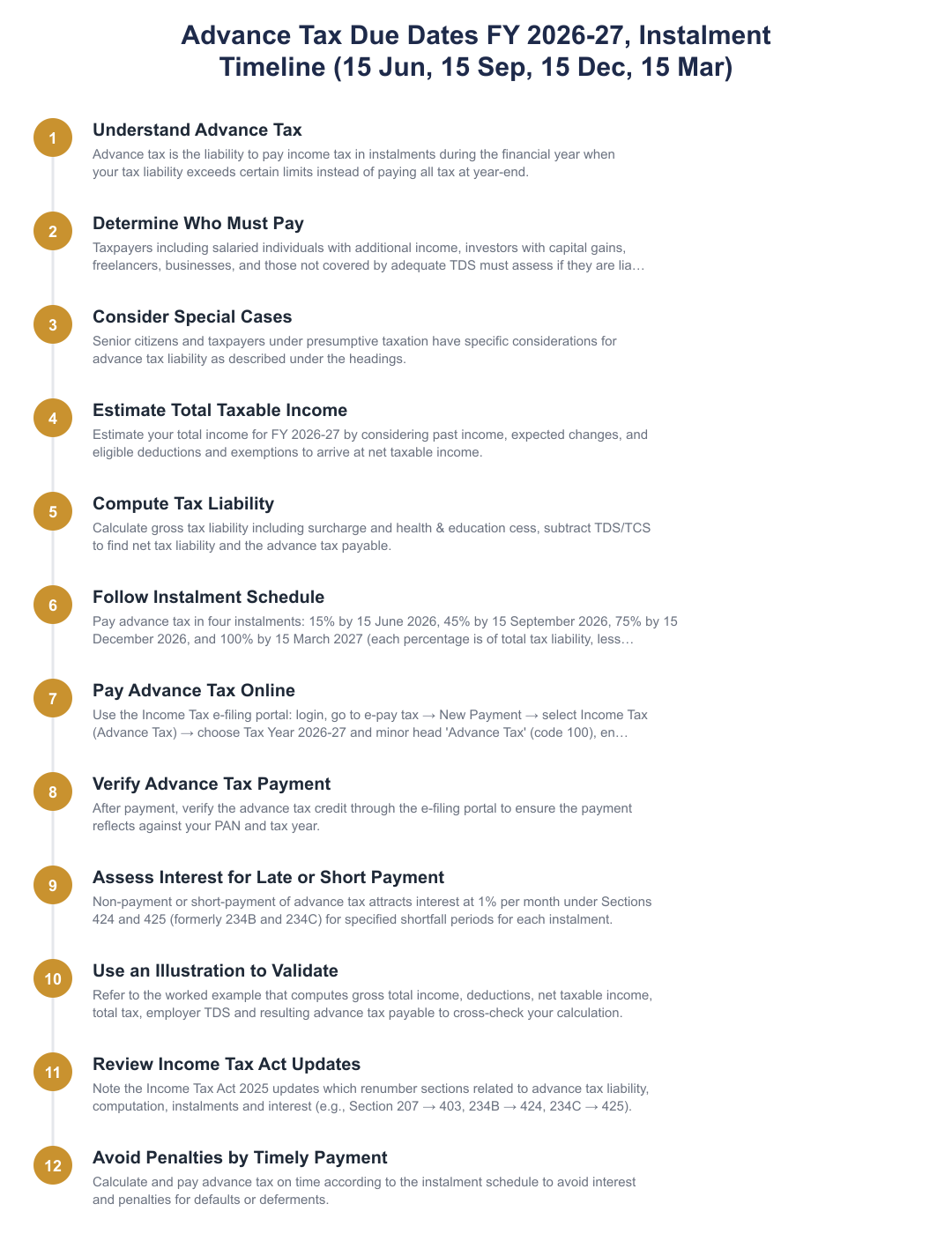
Advance Tax Instalment Schedule for FY 2026-27
| Instalment | Due Date | Minimum Advance Tax Payable |
|---|---|---|
| 1st Instalment | On or before 15th June 2026 | 15% of tax liability |
| 2nd Instalment | On or before 15th September 2026 | 45% of tax liability (less advance tax already paid) |
| 3rd Instalment | On or before 15th December 2026 | 75% of tax liability (less advance tax already paid) |
| 4th Instalment | On or before 15th March 2027 | 100% of tax liability (less advance tax already paid) |
How to Pay Advance Tax Online
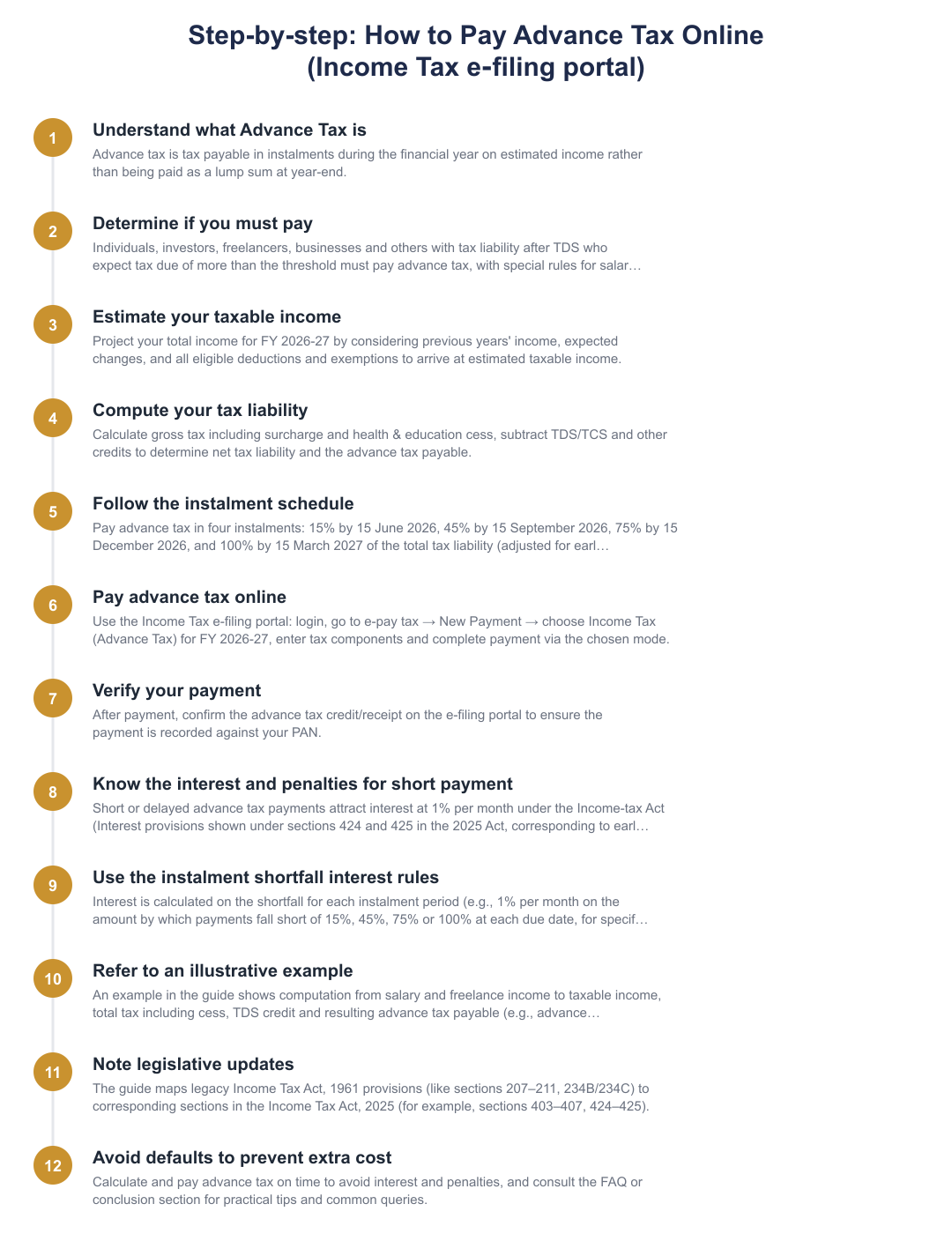
Sign in to the Income Tax e‑filing portal using your PAN as user ID and your password.
Go to 'e-file' and select 'e-pay tax'. Click 'New Payment' to begin a fresh challan.
Choose the Income Tax option that contains advance tax and select Tax Year 2026-27. Use the minor head 'Advance Tax' with code 100.
Fill in tax, surcharge, cess and interest components as applicable, choose your payment mode and complete the transaction.
After successful payment you will receive confirmation on the email and mobile registered with the e‑filing portal and Payment History will show CIN, BSR code and challan serial number.
Interest on Short or Late Payment of Advance Tax
| Particulars | Rate of Interest | Period of Interest | Amount on which interest is calculated |
|---|---|---|---|
| If Advance Tax paid by 15th June is less than 15% | 1% per month | 3 months | 15% of Amount (-) tax paid before June 15 |
| If Advance Tax paid by 15th September is less than 45% | 1% per month | 3 months | 45% of Amount (-) tax paid before September 15 |
| If Advance Tax paid by 15th December is less than 75% | 1% per month | 3 months | 75% of Amount (-) tax paid before December 15 |
| If Advance Tax paid by 15th March is less than 100% | 1% per month | 1 month | 100% of Amount (-) tax paid before March 15 |
How to Calculate Advance Tax
Estimating advance tax begins with preparing an estimate of gross total income for the year, then deducting eligible deductions to arrive at net taxable income. From this net taxable income you compute the total tax liability for the year (including applicable surcharge and cess). Deduct any expected TDS/TCS to find the net balance that would be payable as advance tax.
If the net liability after expected TDS/TCS exceeds Rs. 10,000, you must pay advance tax in instalments per the schedule and minimum percentages. In practice, taxpayers often use prior year income as a baseline, adjust for known changes, and separately consider incomes that attract no TDS or low TDS (such as certain freelancing receipts, interest, or capital gains) when estimating the portion that requires advance payment.
Illustrative Advance Tax Computation (Example)
| Particulars | Amount |
|---|---|
| Salary income (less ₹50,000 standard deduction) | ₹11,50,000 |
| Freelance income + FD interest | ₹6,20,000 |
| Gross Total Income | ₹17,70,000 |
| Less: Deductions (80C ₹1,50,000 + 80D ₹25,000) | (₹1,75,000) |
| Net Taxable Income | ₹15,95,000 |
| Total tax (incl. 4% cess) | ₹3,02,640 |
| Less: Employer TDS | (₹60,000) |
| Advance tax payable | ₹2,42,640 |
How to Verify Advance Tax Payment
Once you complete an online payment, the e‑filing portal’s Payment History will display the challan with CIN, BSR code and challan serial number. This serves as the primary electronic record that the advance tax payment has been received and recorded.
You should keep the payment confirmation sent to your registered email and mobile as proof. These details are useful when reconciling tax paid against your tax liability during filing, and in case you need to demonstrate timely payment to avoid interest assessments.
Advance Tax, Income Tax Act Updates
Recent legislative updates have re-numbered several advance-tax related provisions under the Income-tax Act. The law continues to require instalment payments and prescribes interest for defaults, but relevant section numbers have changed in the updated Act framework.
The practical obligations, estimating annual tax, paying if net liability after TDS/TCS exceeds Rs. 10,000, following the instalment schedule and being subject to interest on shortfall, remain central to compliance despite renumbering of specific provisions.
For FY 2026-27, check whether your estimated net tax after TDS/TCS exceeds Rs. 10,000. If it does, plan payments across the four instalments due on or before 15 June 2026, 15 September 2026, 15 December 2026 and 15 March 2027, paying at least the minimum percentages by each date. Use the Income Tax e‑filing portal flow to pay and retain the challan confirmation. Missing or underpaying instalments attracts interest at 1% per month on the defined shortfall periods, so timely and accurate estimation is the simplest way to minimise extra costs.
Frequently asked questions
What is advance tax and why do I need to pay it for FY 2026-27?
Advance tax is a pay-as-you-earn system where taxpayers pay their estimated tax liability for FY 2026-27 in instalments during the year instead of a lump sum at filing, and you must pay it if your estimated tax liability after TDS/TCS exceeds ₹10,000. The scheme spreads the tax payment across four instalments (15% by 15 June 2026, 45% by 15 Sept 2026, 75% by 15 Dec 2026 and 100% by 15 Mar 2027) to reduce year-end burden and avoid interest under Sections 424 and 425 of the Income-tax Act, 2025 for short or late payments. It applies to all types of taxpayers, individuals, professionals, businesses and investors, who expect taxable income above the threshold. Failure to pay or underpaying advance tax attracts interest at 1% per month on the shortfall for specified periods under the new Act.
Who should pay advance tax for FY 2026-27, do salaried people need to?
Any taxpayer whose estimated tax liability after deducting TDS/TCS exceeds ₹10,000 must pay advance tax for FY 2026-27, including salaried individuals if their residual tax due exceeds this limit. Salaried taxpayers with adequate TDS deducted by the employer often don’t need to pay separate advance tax, but if you have significant non-salary income (freelance fees, interest, capital gains, rent, or crypto gains) that raises your net tax due above ₹10,000 you must pay. If your employer’s TDS is insufficient or you expect tax on investments or capital gains, compute the shortfall and pay instalments as per the schedule to avoid interest. Senior citizens without business income who rely only on pension and TDS-covered salary generally aren’t required to pay advance tax if TDS covers the liability.
What are the due dates and minimum percentages for advance tax instalments in FY 2026-27?
The due dates for advance tax FY 2026-27 are 15 June 2026, 15 September 2026, 15 December 2026 and 15 March 2027, with minimum cumulative payment targets of 15%, 45%, 75% and 100% of the total tax liability respectively. Each instalment amount is calculated on the estimated gross tax liability after considering deductions, surcharge and health & education cess, less TDS/TCS already deducted. If you fall short of these cumulative percentages by the deadline, interest is chargeable on the shortfall as per Sections 424 and 425 of the Income-tax Act, 2025. For example, by 15 Sept you must have paid at least 45% of your total estimated tax liability (including amounts paid earlier).
How do I calculate my advance tax liability for FY 2026-27?
To calculate advance tax for FY 2026-27, estimate your gross total income for the year, subtract Chapter VI-A deductions to get net taxable income, compute tax including surcharge and 4% cess, then subtract expected TDS/TCS to arrive at net tax liability and pay instalments based on required percentages. Use the provided illustrative table: Gross Total Income -> (-) Deductions -> Net Total Income -> Tax Liability -> (+) Surcharge/Cess -> Gross Tax Liability -> (-) TDS/TCS -> Net Tax Liability, and then apply 15%, 45%, 75% and 100% thresholds for instalments. For example in the illustration, net taxable income of ₹15,95,000 produced gross tax of ₹3,02,640, less employer TDS ₹60,000, giving advance tax payable ₹2,42,640. Recalculate if income or deductions change during the year to avoid interest on shortfall.
How can I pay advance tax online for FY 2026-27 step-by-step?
You can pay advance tax online via the Income Tax e-filing portal by logging in with your PAN, going to e-File > e-Pay Tax > New Payment, selecting Tax Year 2026-27 and minor head ‘Advance Tax’ (code 100), entering tax components and completing payment by netbanking, debit/credit card or other available modes. After choosing the payment mode and clicking ‘Pay Now’, follow the bank/payment gateway instructions, note the BSR code and challan serial number displayed on success, and save the tax receipt for your records and ITR filing. Ensure you correctly select the tax head as Advance Tax (not Self Assessment Tax) and enter the components, tax, surcharge, cess and any interest, so the challan reflects accurate amounts. Keep the CIN/BSR and challan number handy when filing your return to claim the payment.
How do I verify that my advance tax payment was successful?
You can verify advance tax payment success by checking for a confirmation email/SMS from the e-Filing portal and by viewing the Payment History section on the portal where the payment status and CIN/BRS/Challan number will be displayed. The bank also provides a challan serial number and BSR code on successful payment which you should save; these appear in your e-Filing account under ‘View Saved/Filed Forms’ or Payment History and are needed for ITR reconciliation. Additionally, you can check Form 26AS (tax credit statement) after the bank processes the payment to ensure the advance tax credit is reflected against your PAN. If the payment does not appear, contact the bank used for payment and the e-Filing helpdesk quoting the challan/CIN details.
What interest and penalties apply if I underpay or delay advance tax for FY 2026-27?
If you underpay or delay advance tax for FY 2026-27 you will be liable to pay interest at 1% per month on the shortfall under Sections 424 and 425 of the Income-tax Act, 2025, calculated for specified periods based on the instalment missed. Section 424 (replacing old 234B) applies if you have not paid at least 100% of the tax by financial year-end and interest is charged from April 1 of the assessment year at 1% per month on the amount of tax shortfall; Section 425 (replacing old 234C) levies 1% per month on the instalment shortfall for each instalment period, typically 3 months for June, Sept and Dec shortfalls and 1 month for March shortfall. The interest is computed on the difference between the prescribed percentage (15%, 45%, 75%, 100%) of your total tax liability and the tax actually paid by the due date; repeated shortfalls compound your interest burden. There may also be penalties if the default is prolonged or deemed wilful by tax authorities.
Are there special rules for freelancers, presumptive taxpayers and those with capital gains for advance tax?
Yes, freelancers and those with business income must pay advance tax based on estimated profit, while taxpayers under presumptive taxation (Sections under the Act) should pay advance tax as per the presumptive scheme or actual estimated liability if opting out; capital gains and crypto gains must be included when estimating total taxable income for advance tax. Freelancers should estimate gross receipts, deduct allowable expenses and deductions to compute taxable income; presumptive taxpayers normally follow the presumptive percentage to calculate taxable income and then apply instalment percentages, but if their actual income differs they must revise estimates and pay accordingly. Capital gains from sale of property, shares or crypto are taxable for the year of transfer and should be included in the advance tax computation in the same year to avoid interest. If TDS/TCS on these incomes is insufficient, pay the shortfall as advance tax to meet the ₹10,000 threshold and instalment requirements.
What changed about advance tax rules in the Income-tax Act, 2025 for FY 2026-27?
The Income-tax Act, 2025 re-numbered and updated provisions relating to advance tax: liability, conditions, computation, instalments and interest provisions now appear under Sections 403–410 and interest for default and deferment are covered under Sections 424 and 425 respectively, replacing older section numbers from the 1961 Act. The substantive instalment schedule and interest rate (1% per month for shortfall) remain similar, but statutory references and some procedural sections (for when an assessee is deemed in default and computation rules) have been moved, e.g., earlier Section 207 is now 403, Section 211 is now 407 and Sections 234B/234C correspond to 424/425. Practically, taxpayers should continue to follow the same instalment dates and percentage thresholds for FY 2026-27 while citing the new section numbers in communications or showcause responses. Always check updated portal guidance and circulars for any procedural clarifications tied to the new Act.
Can you show a simple illustration of calculating advance tax for FY 2026-27?
Yes, an illustration: if your salary income after ₹50,000 standard deduction is ₹11,50,000 and freelance income plus FD interest is ₹6,20,000, your gross total income is ₹17,70,000; after deductions of ₹1,75,000 (80C ₹1,50,000 + 80D ₹25,000) net taxable income is ₹15,95,000, producing total tax (incl. 4% cess) of ₹3,02,640; after employer TDS ₹60,000 your advance tax payable is ₹2,42,640. Based on instalment rules, you would need to have paid at least 15% (₹36,396) by 15 June, 45% (₹1,09,188 cumulative) by 15 Sept, 75% (₹1,81,980 cumulative) by 15 Dec and 100% (₹2,42,640) by 15 Mar 2027; any shortfall at each date attracts interest at 1% per month on the gap. This example demonstrates including all income heads, deductions, TDS credit and then applying the instalment percentages to determine required payments.
Need help staying Income Tax compliant?
MoneyGence's AI Finance OS tracks your compliance, wallet share, and finances in one place, built for agencies and growing businesses.
Get started with MoneyGence