Appeal against Demand Order under GST: Complete Online Guide
This guide explains how taxpayers typically approach an appeal against a demand order under GST, what to expect during the appeal lifecycle, and practical tips to prepare effective submissions. If you’ve received a demand order and believe it is incorrect, understanding the appeal process helps protect your rights, manage cash flow implications, and maintain compliance while contesting the demand. This article walks through the common stages of filing a first appeal, responding during appeal proceedings, seeking rectification if needed, and the common statuses you may see after submission. You will also get answers to frequently asked questions that clarify procedural points and document considerations. The aim is to demystify the journey from receiving a demand order to obtaining a resolution, so you can decide when to engage tax professionals, how to organise supporting evidence, and how to maintain records of all filings and communications. While procedural specifics and statutory timelines can vary depending on rules and notifications, the guidance below focuses on practical actions and documentation that are universally helpful during an appeal. Use this guide to prepare a clear case, avoid common procedural pitfalls, and understand the administrative steps you will likely encounter. Keep in mind that for precise timelines, deposit requirements, and legal provisions you should consult the current law or a tax advisor, since those specifics are not covered here.
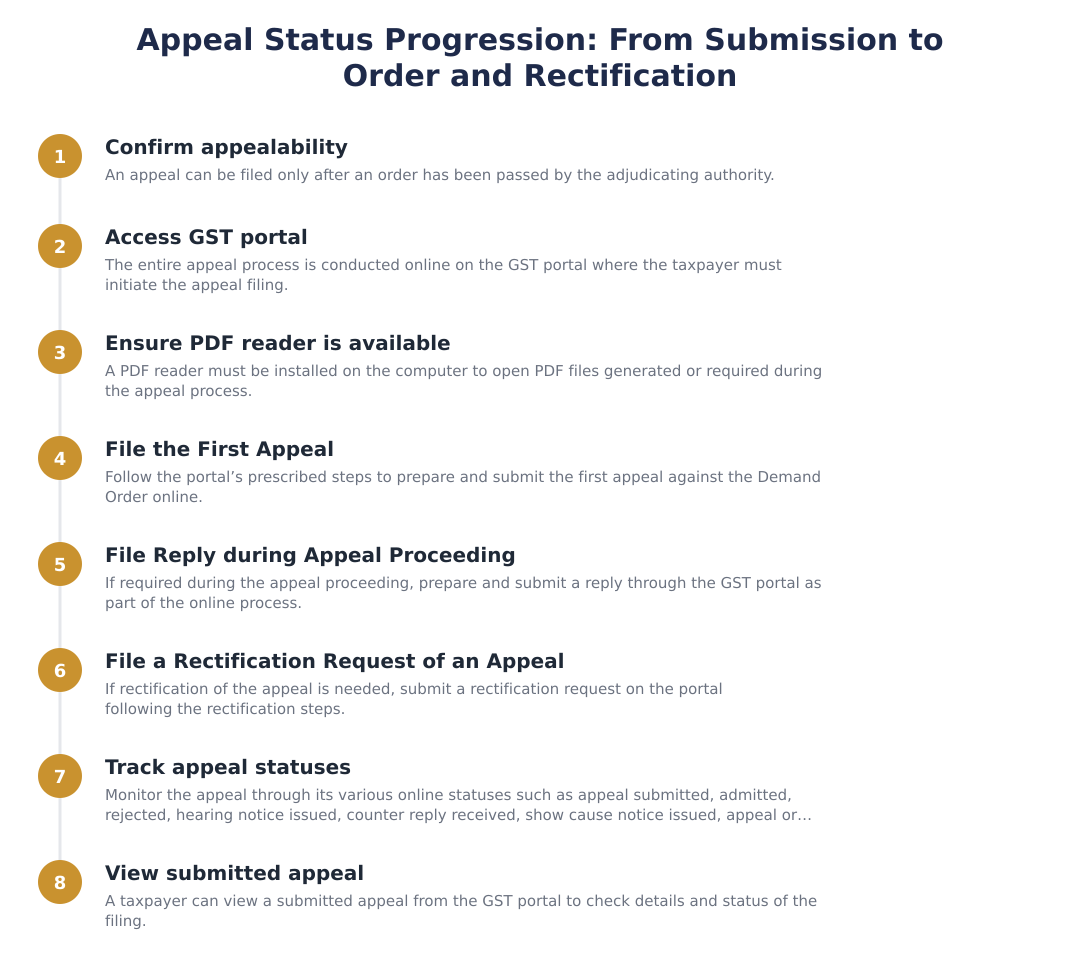
Steps to file the First Appeal against Demand Order
Filing a first appeal typically begins with reviewing the demand order and any related adjudication order to identify the grounds on which you will challenge the decision. Organise all relevant documents such as invoices, contracts, returns, and correspondence that support your position. Draft a concise statement of facts and grounds of appeal that explains why the demand is incorrect, referencing the evidence you will rely on during the appeal.
The appeal submission normally requires completing a prescribed form or application and attaching supporting documents. Before filing, verify that the appeal is being made to the correct appellate authority and that the applicant has the necessary authorisation to act on behalf of the taxpayer. Keep clear copies of every page submitted and note any acknowledgement or reference number provided on submission for future tracking and follow-up.
Steps to file Reply during an Appeal Proceeding
Once an appeal is admitted, the appellate process may include notices or opportunities to reply to issues raised by the adjudicating authority or by the respondent. When you receive a notice, read it carefully to understand the points raised and the deadline for response. Structure your reply to address each issue succinctly, attaching documentary proof and legal or factual explanations as appropriate.
If additional time is needed to collate evidence, consider requesting an extension in writing with reasons and an outline of the materials still to be gathered. Maintain copies of all communications and ensure submissions are delivered through the accepted channel so they are officially recorded in the appeal file.
Steps to file a Rectification Request of an Appeal
A rectification request is typically used to correct clerical mistakes or inadvertent omissions in an appeal application or appeal order. Before filing such a request, clearly identify the error, explain how it occurred, and provide the corrected information and supportive documents. Be precise about the specific portion of the appeal record or order that requires correction so the appellate authority can act efficiently.
Submit the rectification request via the prescribed channel and keep proof of submission. If the rectification request is complex or could materially change the nature of the appeal, it may be prudent to accompany it with a short explanation of why the correction does not amount to a new or separate appeal.
Frequently Asked Questions on filing Appeal against Demand Order
Common questions relate to timelines, deposit obligations, document access, and the consequences of non-filing. While exact procedural timelines and any monetary conditions for filing an appeal depend on applicable rules, taxpayers often want to know where to view their appeal records, how to check the status, and what next steps to take if an appeal is not filed within a prescribed period. It is good practice to document all actions and keep track of official acknowledgements.
If you are uncertain about any procedural requirement, consult a tax professional or the relevant authority’s helpdesk for clarifications. Professional advice helps when deciding whether to contest a demand, assessing the strength of the evidence, or planning parallel strategies such as deposit and interim relief applications where the law provides for them.
What are various appeal statuses?
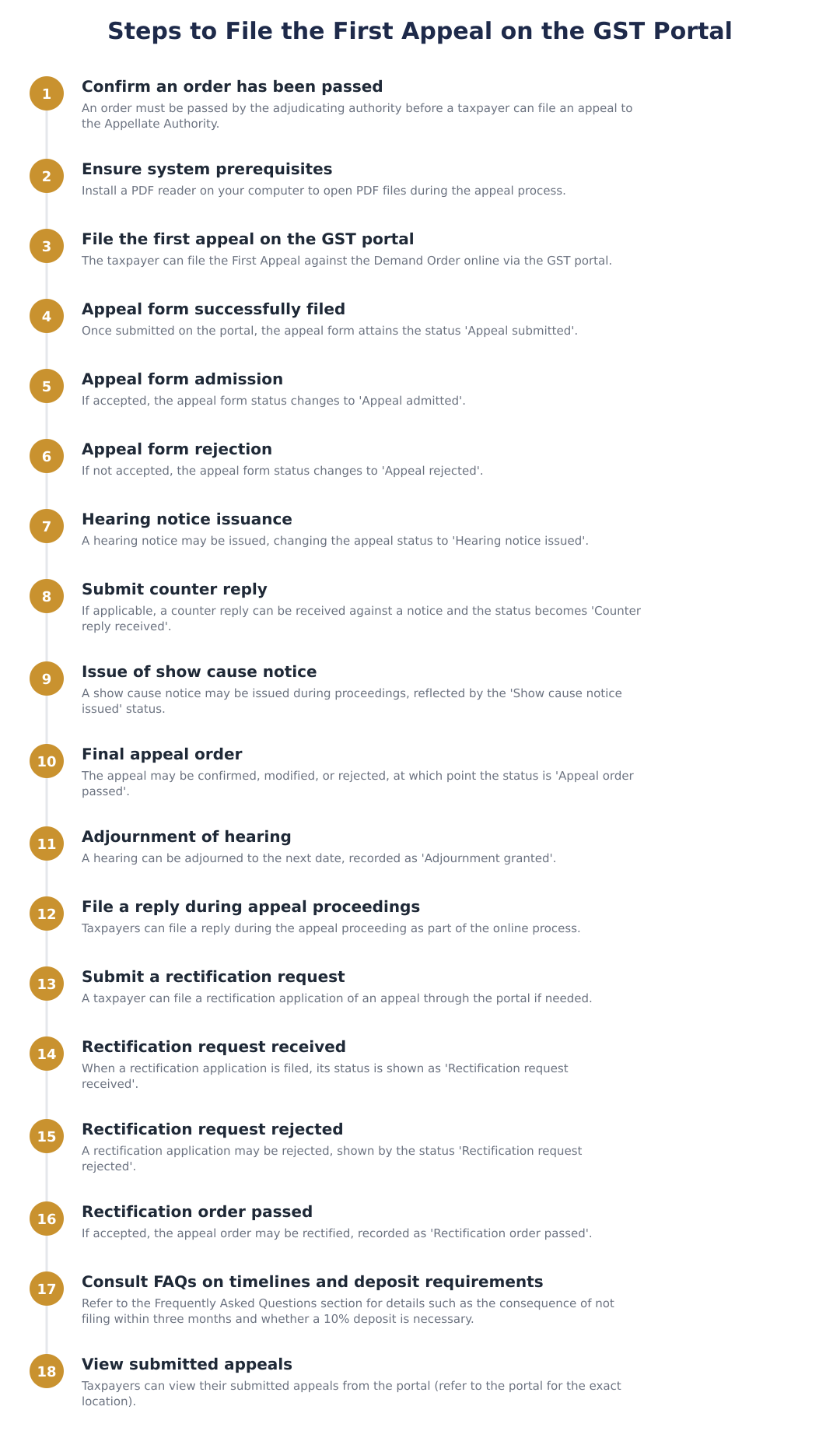
Appeals typically move through a sequence of administrative statuses that indicate progress: submission acknowledgement, admission or rejection, notices issued, replies received, hearings scheduled, orders passed, and any rectification actions. Each status serves as a log point for the case, helping the taxpayer and the authority track what has happened and what remains to be done.
Monitoring the status regularly lets you respond promptly to notices and avoid procedural defaults. Maintain a timeline of events and retain copies of all notices, replies, and orders so you can quickly produce them if any query arises during the course of the appeal.
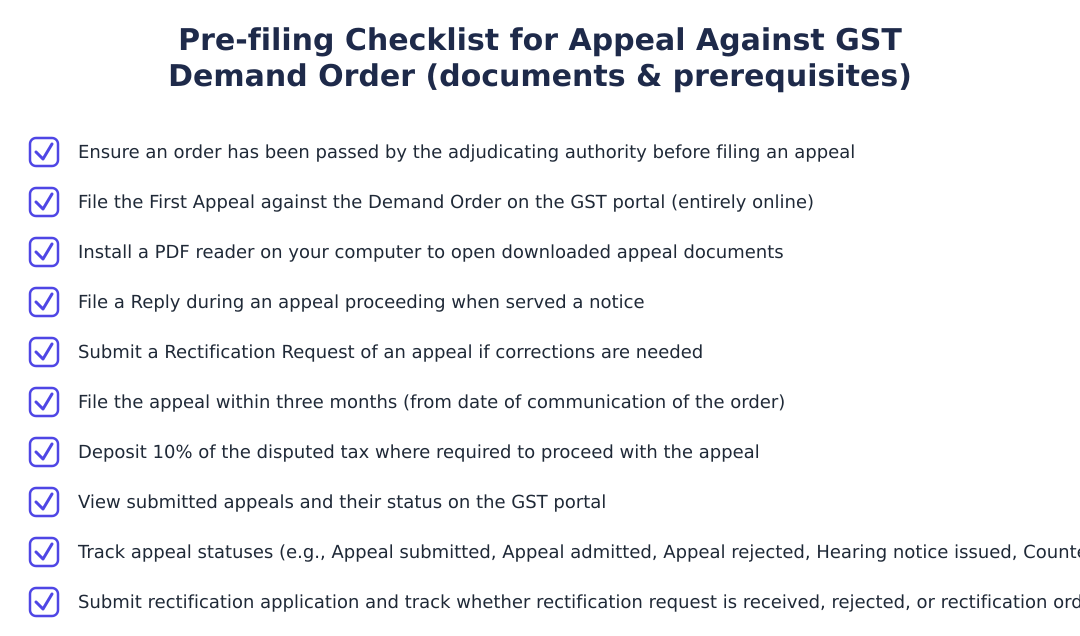
What happens if the taxpayer does not file the appeal within three months?
Missing the timeframe for filing an appeal can have serious consequences for preserving appellate remedies. If the prescribed period lapses without filing, options such as seeking condonation of delay (where available) may exist, but these depend on the applicable provisions and are not guaranteed.
Given the potential risks, act promptly when you receive a demand order. If you anticipate delay, consult a tax advisor immediately to explore possible reliefs or procedural avenues that may be open in your situation.
Is it necessary to deposit 10% of disputed tax and whether the disputed tax balance remains on filing an appeal?
Requirements about depositing a portion of disputed tax or staying recovery while an appeal is pending depend on the specific legal provisions and notifications in force. Such financial conditions, if applicable, are intended to balance revenue protection with the taxpayer’s right to contest an order.
Before taking any decision about payment or deposits, check the current procedural rules or obtain professional advice. Accurate knowledge of the deposit rules is important to plan cash flow and evaluate the cost-benefit of pursuing the appeal.
From where can a taxpayer view a submitted appeal?
Taxpayers can usually view the status and details of an appeal through the official portal or platform designated for filing appeals. The portal typically provides acknowledgement receipts, filed documents, any hearing notices, and orders issued.
If the portal access is unclear, check official guidance or help resources provided by the tax authority. Keep all login credentials secure and maintain an organised folder with downloaded copies of every submission and communication for easy reference.
Appealing a demand order under GST involves careful preparation of grounds, timely filing, and diligent follow-up during the appellate process. Organise supporting documents, respond promptly to notices, and maintain records of every submission. For detailed timelines, deposit conditions, and statutory provisions, consult the current law or a professional advisor so your appeal strategy aligns with the applicable procedural requirements.
Frequently asked questions
How do I file a first appeal against a GST demand order on the GST portal?
You file the first appeal online on the GST portal by logging in and submitting Form GSTR-? (Appeal form) with grounds, supporting documents and payment proof where applicable. The process requires you to select the demand order you are contesting, enter the grounds of appeal, upload documentary evidence as PDF and submit the form; a digital signature or EVC may be required depending on your taxpayer category. After submission you will get an acknowledgement and the appeal status will show as 'Appeal submitted' while the Appellate Authority processes admission. Make sure a PDF reader is available to open generated PDFs and retain the acknowledgement for future reference.
What are the exact steps to file a reply during an appeal proceeding on the GST portal?
To file a reply during an appeal proceeding you must log in to the GST portal, navigate to the appeals or e-communication section and select the specific appeal to which you need to respond. Prepare a concise written reply addressing the points in the hearing notice or counter and attach relevant documents in PDF format, then submit the reply through the portal within the timeframe specified in the notice. The portal will record your submission and update the appeal status (for example to 'Counter reply received'); keep the acknowledgement and check for further notices or adjournments. If you miss the deadline you can request adjournment or explain delay, but timely, complete replies improve chances of favorable consideration.
How can I file a rectification request for an appeal already submitted on the GST portal?
You can file a rectification request online on the GST portal to correct errors in a submitted appeal by selecting the appeal and choosing the 'Rectification' or 'Amend' option to submit corrected information and documents. The rectification application will be recorded as 'Rectification request received' and the Appellate Authority will either accept it ('Rectification order passed') or reject it ('Rectification request rejected') after scrutiny. Rectification is typically for clerical or factual mistakes and should be filed promptly with explanation and supporting evidence to improve the chance of acceptance. Keep the rectification acknowledgement and monitor the appeal status for the outcome.
What are the various appeal statuses I might see on the GST portal and what do they mean?
Common appeal statuses on the GST portal include 'Appeal submitted' (form filed), 'Appeal admitted' (appeal accepted for hearing), 'Appeal rejected' (appeal dismissed at admission), 'Hearing notice issued', 'Counter reply received', 'Show cause notice issued', 'Appeal order passed' (order confirmed/modified/rejected), 'Adjournment granted', 'Rectification request received' and 'Rectification order passed' or 'Rectification request rejected'. Each status reflects a specific stage in the appeal lifecycle, for example 'Hearing notice issued' means a hearing date has been scheduled, while 'Appeal order passed' means the Appellate Authority has disposed of the appeal. Monitor these statuses on the portal to know what action (reply, attend hearing, file rectification) you must take next and retain portal acknowledgements as proof of compliance.
What happens if I do not file my GST appeal within three months of the demand order?
If you do not file the GST appeal within three months of communication of the demand order, you can still apply for condonation of delay by filing the appeal beyond three months with a written explanation for the delay and supporting reasons. The Appellate Authority has discretion to admit a delayed appeal if it is satisfied with the cause for delay; there is no automatic right to file late without condonation. Filing for condonation promptly and providing credible grounds (for example medical emergency, postal delay) improves the chances of the appeal being admitted; failure to obtain condonation will lead to dismissal of the appeal as time-barred. Always attempt to file within the three-month period to avoid the additional burden of proving delay.
Do I need to deposit 10% of the disputed tax amount when filing an appeal against a GST demand order?
Yes, as a rule you are required to deposit 10% of the disputed tax amount at the time of filing the appeal unless the Appellate Authority directs otherwise or a stay is granted. The deposit is meant to provide partial security while the appeal is adjudicated; the exact sum and payment method will be shown on the portal when you submit the appeal. The balance of the disputed tax remains payable and may be subject to recovery unless the Appellate Authority suspends recovery or grants other directions; failure to deposit may affect admission of the appeal. Always keep the payment acknowledgement and check the appeal order for any adjustments to the deposit requirement.
From where can I view a submitted appeal and all related communications on the GST portal?
You can view a submitted appeal and related communications by logging into the GST portal and navigating to the Appeals/First Appeal section or the 'My Applications'/'Case Records' area where appeals and e-communications are listed. The portal provides access to the appeal form, uploaded documents, hearing notices, counter replies, orders and rectification status, each item has an acknowledgement and timestamp for reference. Use filters or the appeal registration number to quickly find a specific appeal and download PDFs of notices and orders (ensure a PDF reader is installed). Regularly check this section for updates and to ensure deadlines are met.
What should I include in the grounds of appeal to make my GST appeal effective?
You should include concise, specific grounds of appeal that state the legal and factual errors in the demand order, cite applicable provisions of law, and reference supporting documents or evidence that contradict the authority's findings. Clearly numbered grounds, timelines, summary of facts, and exact relief sought (for example, deletion or reduction of demand) help the Appellate Authority and make the appeal easier to adjudicate; attach corroborative documents such as invoices, payment proofs and legal opinions as PDFs. Avoid vague statements; instead explain how the assessing authority erred in applying law or facts and quantify the disputed tax where possible so the portal can calculate any deposit requirement. Well-structured grounds increase the likelihood that the appeal will be admitted and fairly considered.
Need help staying GST compliant?
MoneyGence's AI Finance OS tracks your compliance, wallet share, and finances in one place, built for agencies and growing businesses.
Get started with MoneyGence