Applicability of IND AS - Indian Accounting Standards Guide
This guide explains the applicability of Indian Accounting Standards (Ind AS) and what companies need to consider when moving from Indian GAAP to Ind AS. You will learn how applicability was phased in, why a phased approach matters for financial reporting and comparability, what "first-time adoption" implies under Ind AS, and which major Ind AS standards companies typically need to consider when preparing Ind AS financial statements. The guide also points to the core Ind AS standards relevant across industries, from revenue and financial instruments to consolidation and impairment, so you can quickly identify the standards likely to affect your accounting policies. Understanding these points helps management, auditors and investors evaluate readiness, disclosure requirements and the practical impact on financial statements when a company transitions to Ind AS.
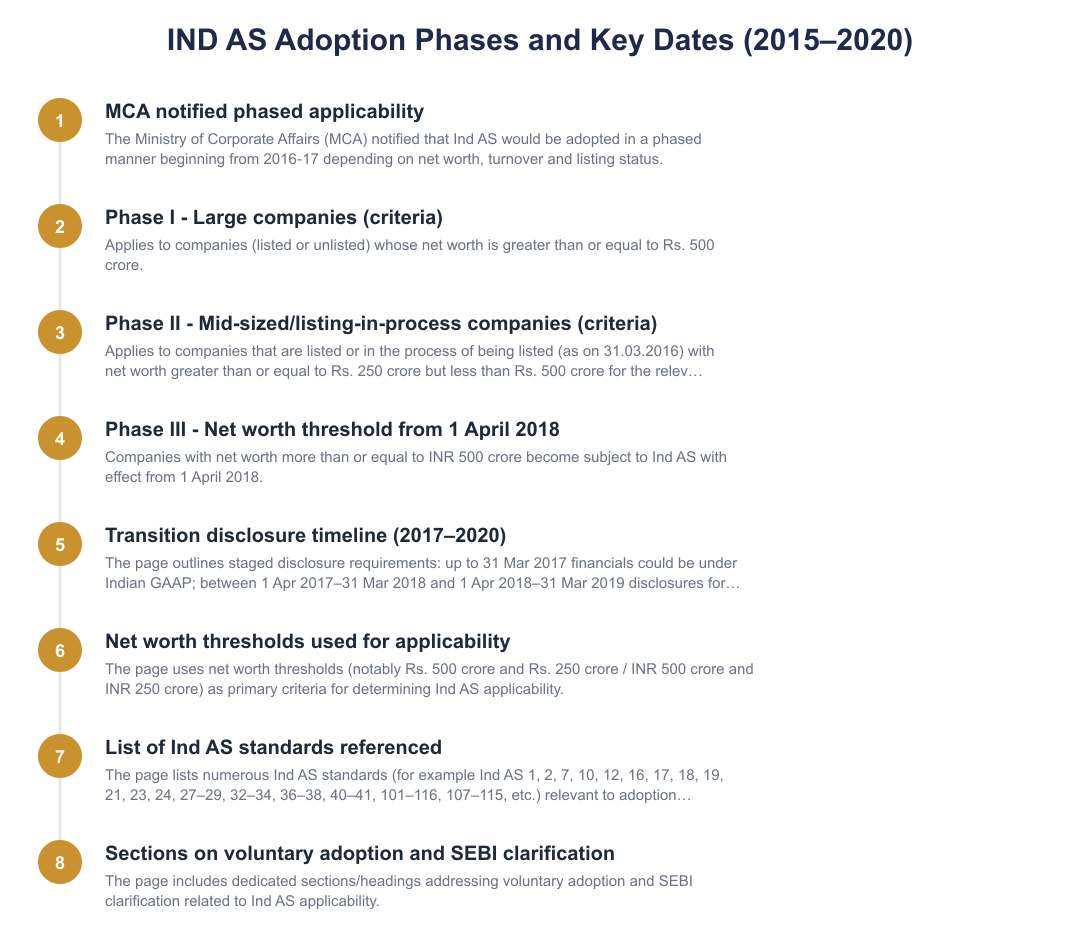
Phases of adoption
India adopted Ind AS through an incremental, phased approach. The idea behind phasing was to manage the transition for companies of different sizes and public accountability, allowing preparers, auditors and users of financial statements time to adapt to new recognition, measurement and disclosure requirements.
A phased rollout also ensured regulators and standard-setters could address implementation issues as they arose and provide targeted guidance for different groups of entities. Practically, companies needed to determine in which phase they fell, plan system and process changes, and ensure appropriate disclosure of comparative information in the opening Ind AS balance sheet.
Regardless of phase, companies undertaking transition needed to consider the set of Ind AS standards that apply to them, and to apply the relevant transition provisions, including those in Ind AS 101, First-time Adoption of Ind AS.
Phase I
Phase I typically covered entities with the highest public accountability and complexity of operations. For those entities, adopting Ind AS often required early and detailed planning because the move affected many accounting areas such as consolidation, financial instruments and revenue recognition.
Key practical considerations for entities in this phase included identifying differences between previous accounting policies and Ind AS requirements, preparing an opening Ind AS balance sheet in line with Ind AS 101, and ensuring required disclosures under standards like Ind AS 110 (Consolidated Financial Statements) and Ind AS 107 (Financial Instruments: Disclosures).
Phase II
Phase II extended applicability to a broader group of companies that might include large unlisted companies or listed companies at an earlier date in the overall rollout. Transition work in this phase often mirrored that of Phase I but on a larger scale, with added emphasis on comparatives and stakeholder communication.
Entities in Phase II needed to pay special attention to areas such as revenue recognition and financial instruments; standards like Ind AS 115 (Revenue from Contracts with Customers) and Ind AS 109 (Financial Instruments) are typically significant for reporting revenue, measurement and hedging disclosures.
Phase III
Phase III generally brought additional companies within the Ind AS net, including many mid-sized entities. The phase allowed preparers to learn from earlier implementers and to adopt improved processes for accounting policy selection, internal controls and disclosure generation.
Companies in this phase had to align accounting for items such as leases, employee benefits and impairment with Ind AS requirements, specifically Ind AS 17 (Leases), Ind AS 19 (Employee Benefits) and Ind AS 36 (Impairment of Assets). These standards often required judgement and strengthened disclosures.
Phase IV
The final phase typically brought the remaining companies into the Ind AS framework. By this stage, market practice, regulator guidance and illustrative disclosures were more developed, helping late adopters better manage the transition.
Even in later phases, entities needed to take care with first-time adoption mechanics under Ind AS 101 and to ensure consistent presentation and disclosures across reporting periods in accordance with Ind AS such as Ind AS 1 (Presentation of Financial Statements) and Ind AS 34 (Interim Financial Reporting).
Please Note:
Transition to Ind AS is standard-specific: some standards directly affect recognition and measurement (for example Ind AS 16 Property, Plant and Equipment; Ind AS 38 Intangible Assets), while others primarily affect presentation and disclosure (for example Ind AS 1, Ind AS 107 and Ind AS 108 Operating Segments).
Ind AS 101 provides guidance for first-time adopters, including how to prepare opening Ind AS financial statements. Entities should use Ind AS 101 alongside the other applicable Ind AS standards to ensure a complete and compliant transition.
Net Worth Calculation
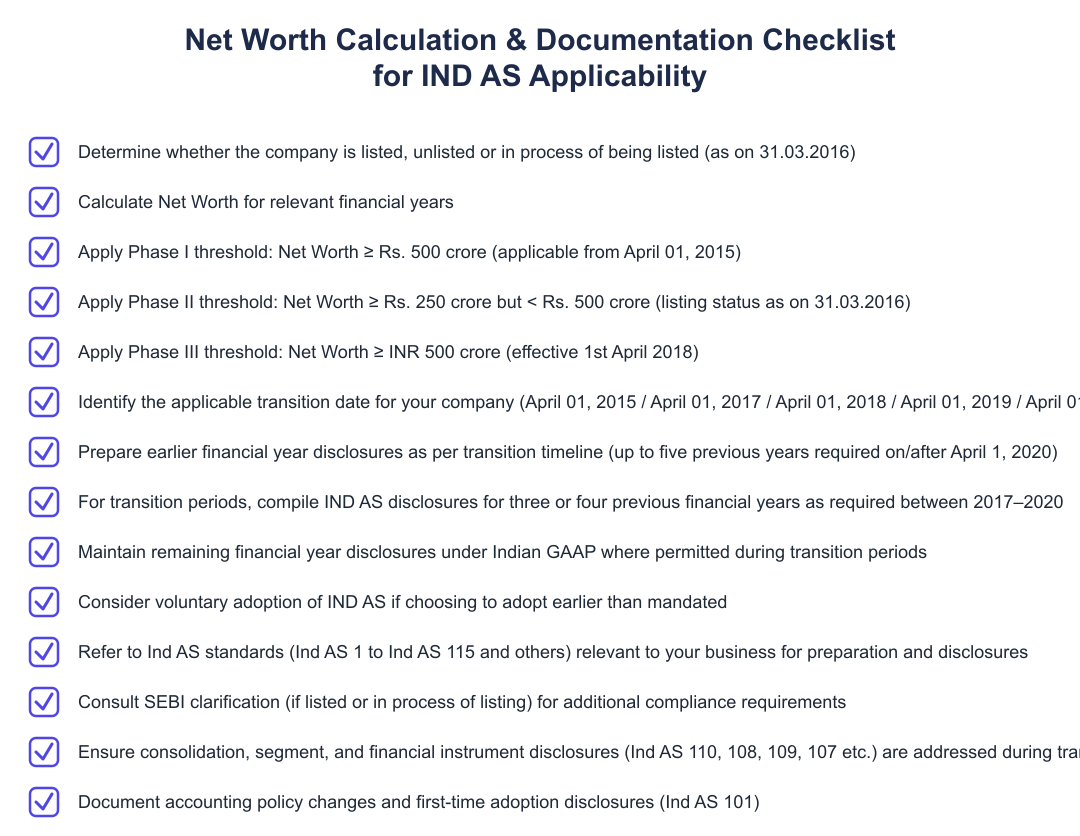
Net worth is commonly used as a metric in regulatory frameworks and can influence which entities are required to adopt Ind AS. Preparing an opening Ind AS balance sheet requires management to reconcile previous GAAP equity to Ind AS net worth, taking into account adjustments arising on first-time adoption.
Calculating net worth on transition therefore involves identifying recognition and measurement differences across standards, for instance, differences in treatment of financial instruments under Ind AS 109, revenue adjustments under Ind AS 115, impairment under Ind AS 36, and consolidation impacts under Ind AS 110, and reflecting those in equity as at the transition date.
Voluntary adoption
Some entities may consider voluntary adoption of Ind AS ahead of any mandatory applicability date. For first-time adopters, Ind AS 101 sets out the framework and transitional provisions to be followed when electing to apply Ind AS.
Voluntary adopters should ensure comparatives are prepared in accordance with Ind AS and should be mindful of disclosure expectations from stakeholders. Early adoption can have both accounting and commercial implications, so management should assess the impact on reported results, covenants and stakeholder communications.
SEBI Clarification
Market regulators have issued clarifications and guidance during the Ind AS transition period to help listed entities interpret applicability and disclosure requirements. Such clarifications typically aim to reduce diversity in practice and to ensure consistent application of Ind AS across market participants.
Companies should track regulator updates and apply clarifications in conjunction with the Ind AS text and Ind AS 101 transition provisions to ensure compliance with both accounting standards and market disclosure expectations.
Key Ind AS standards to consider on transition
| Ind AS Number | Title |
|---|---|
| Ind AS 101 | First-time adoption of Ind AS |
| Ind AS 102 | Share Based payments |
| Ind AS 103 | Business Combination |
| Ind AS 104 | Insurance Contracts |
| Ind AS 105 | Non-Current Assets Held for Sale and Discontinued Operations |
| Ind AS 106 | Exploration for and Evaluation of Mineral Resources |
| Ind AS 107 | Financial Instruments: Disclosures |
| Ind AS 108 | Operating Segments |
| Ind AS 109 | Financial Instruments |
| Ind AS 110 | Consolidated Financial Statements |
| Ind AS 111 | Joint Arrangements |
| Ind AS 112 | Disclosure of Interests in Other Entities |
| Ind AS 113 | Fair Value Measurement |
| Ind AS 114 | Regulatory Deferral Accounts |
| Ind AS 115 | Revenue from Contracts with Customers |
| Ind AS 1 | Presentation of Financial Statements |
| Ind AS 2 | Inventories Accounting |
| Ind AS 7 | Statement of Cash Flows |
| Ind AS 8 | Accounting Policies, Changes in Accounting Estimates and Errors |
| Ind AS 10 | Events after Reporting Period |
| Ind AS 11 | Construction Contracts |
| Ind AS 12 | Income Taxes |
| Ind AS 13 | Fair Value Measurement |
| Ind AS 16 | Property, Plant and Equipment |
| Ind AS 17 | Leases |
| Ind AS 18 | Revenue |
| Ind AS 19 | Employee Benefits |
| Ind AS 20 | Accounting for Government Grants and Disclosure of Government Assistance |
| Ind AS 21 | The Effects of Changes in Foreign Exchange Rates |
| Ind AS 23 | Borrowing Costs |
| Ind AS 24 | Related Party Disclosures |
| Ind AS 27 | Separate Financial Statements |
| Ind AS 28 | Investments in Associates and Joint Ventures |
| Ind AS 29 | Financial Reporting in Hyperinflationary Economies |
| Ind AS 32 | Financial Instruments: Presentation |
| Ind AS 33 | Earnings per Share |
| Ind AS 34 | Interim Financial Reporting |
| Ind AS 36 | Impairment of Assets |
| Ind AS 37 | Provisions, Contingent Liabilities and Contingent Assets |
| Ind AS 38 | Intangible Assets |
| Ind AS 40 | Investment Property |
| Ind AS 41 | Agriculture |
Transitioning to Ind AS is a substantive project that touches many accounting areas. Use Ind AS 101 as the starting point for first-time adoption, map out the standards most relevant to your business from the list above, and consider phased implementation, disclosure requirements and regulator clarifications when planning the change. Early planning and clear communication with auditors and stakeholders will ease the move to Ind AS.
Frequently asked questions
Who has to adopt Ind AS and from when did it start in India?
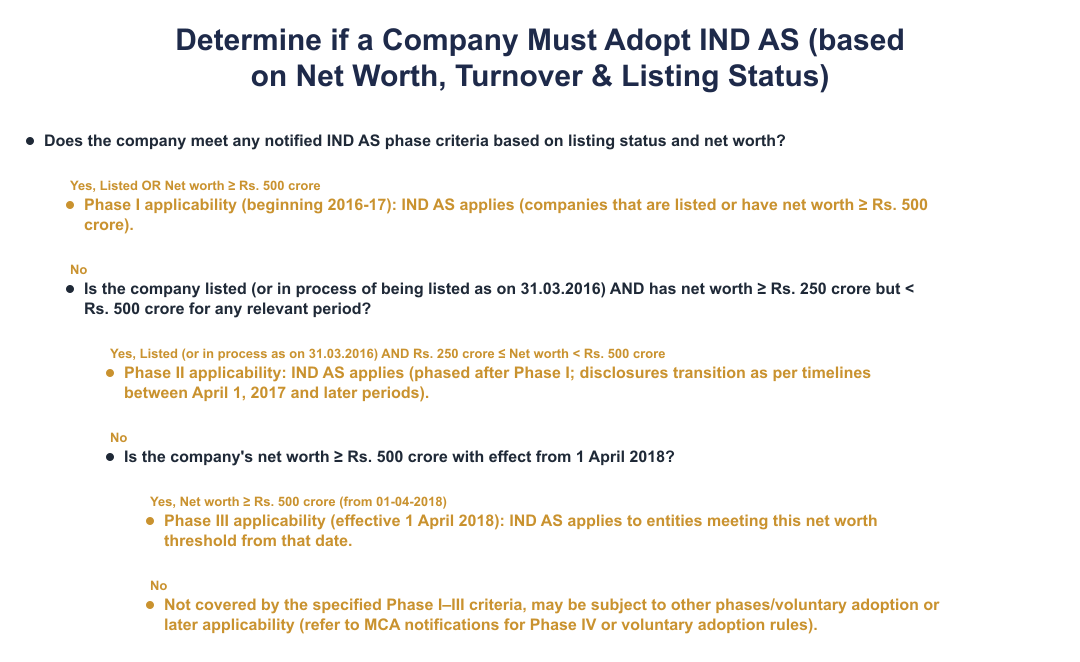
Companies meeting specified net worth, turnover or listing criteria had to adopt Ind AS in phases starting from financial year 2016-17. The Ministry of Corporate Affairs (MCA) notified phased applicability beginning 1 April 2016 for Phase I entities (listed/unlisted with net worth ≥ Rs.500 crore), with subsequent phases covering companies with lower net worth thresholds and listed status in later years through to 2019-20 and beyond. The effective dates differ by phase, for example, Phase II applied from 1 April 2017 for companies listed or in process of listing with net worth between Rs.250 crore and Rs.500 crore, and Phase III/IV covered other thresholds with effective dates in later years.
What were the Phase I Ind AS adoption criteria?
Phase I required a company to be listed or unlisted with net worth greater than or equal to Rs.500 crore as of the specified date, with Ind AS applicable from 1 April 2016. This meant those companies prepared financial statements under Ind AS for periods beginning on or after that date, and they had to follow Ind AS 101 for first-time adoption and other applicable standards from the Ind AS suite. The Phase I list included large corporates across industries and those entities were the first to prepare comparatives and disclosures as per Ind AS.
What were the Phase II Ind AS adoption conditions and timeline?
Phase II applied from 1 April 2017 to companies that were listed (or in process of being listed as on 31.03.2016) and had net worth between Rs.250 crore and Rs.500 crore. These entities had to prepare financial statements and disclosures under Ind AS for the relevant periods beginning on or after that date, with transitional disclosures as specified for comparative years. The rule specifically captured companies with listing intent as of 31 March 2016 even if not yet listed at that snapshot date.
What is the Phase III/IV applicability mentioned for Ind AS?
Phase III and Phase IV covered further rounds of applicability where entities with net worth thresholds and other conditions became subject to Ind AS in later years, including a reference that net worth ≥ INR 500 crore would apply effective 1 April 2018 for certain entities. The phased approach progressively extended Ind AS to more companies, with transitional disclosure requirements increasing across years, for example, by April 1, 2020, disclosures for all previous five financial years were required under Ind AS. Companies needed to track the exact phase and effective date applicable to their net worth and listing status.
How do I calculate 'net worth' to determine Ind AS applicability?
Net worth for Ind AS applicability is calculated as the aggregate of paid-up share capital plus reserves created out of profits, but excluding revaluation reserves and miscellaneous expenses not written off, as per the MCA guidance used for thresholds. Practically, companies use their balance sheet figures at the relevant assessment date to determine whether they meet the Rs.500 crore or Rs.250 crore thresholds; the snapshot date used for listing intent was 31 March 2016 for Phase II. Accurate net worth calculation is essential because even a small difference can move a company into a different applicability phase with distinct effective dates and disclosure requirements.
Can a company voluntarily adopt Ind AS before being mandated to do so?
Yes, a company could voluntarily adopt Ind AS earlier than its mandatory date, provided it follows Ind AS 101 (First-time Adoption of Ind AS) and complies with all applicable Ind AS disclosure and transition requirements. Voluntary adopters must present comparatives and transitional disclosures as if they had always applied Ind AS for the comparative periods, and once they opt to adopt Ind AS voluntarily for a given period they cannot revert to previous Indian GAAP for that period. Voluntary adoption is often used to align with investor expectations or parent company reporting and must be consistently applied across financial statements.
What transitional disclosure timeline did MCA prescribe for comparatives when moving to Ind AS?
The MCA prescribed a phased timeline for transitional disclosures so that early comparative years could remain under Indian GAAP initially, but gradually more previous years had to be restated under Ind AS; by April 1, 2020 all five previous financial years had to be disclosed as per Ind AS. For example, up to March 31, 2017 companies could file financial statements under Indian GAAP; between April 1, 2017 and March 31, 2018 the previous three financial years had to be disclosed under Ind AS while two could remain under Indian GAAP, and the extent of restatement increased each year until full five-year comparatives were required. These staged disclosure requirements applied to entities adopting Ind AS according to the notified phases and effective dates.
What did SEBI clarify about Ind AS applicability for listed companies?
SEBI clarified that listed companies and companies in the process of being listed as of the snapshot date were subject to the Ind AS applicability rules appropriate to their net worth, which influenced Phase II coverage for firms with net worth between Rs.250 crore and Rs.500 crore. This meant that a company that was in the process of listing as on March 31, 2016 could be treated as listed for applicability purposes and therefore required to adopt Ind AS according to the prescribed timeline. SEBI’s clarification helped determine which companies fell into the listed-company buckets for phased implementation.
Which Ind AS standards were included in the notified list for applicability?
The MCA notification included a comprehensive suite of Ind AS covering topics from first-time adoption (Ind AS 101) to agriculture (Ind AS 41), financial instruments (Ind AS 109), consolidation (Ind AS 110) and revenue (Ind AS 115), among others, effectively aligning Indian standards with many IFRS principles. The list provided by the MCA includes core standards such as Ind AS 1 (Presentation of Financial Statements), Ind AS 2 (Inventories), Ind AS 16 (Property, Plant and Equipment), Ind AS 19 (Employee Benefits) and sector-specific standards like Ind AS 104 (Insurance Contracts). Companies adopting Ind AS must apply all applicable standards from the notified list to their financial statements and related disclosures.
Need help staying Accounting compliant?
MoneyGence's AI Finance OS tracks your compliance, wallet share, and finances in one place, built for agencies and growing businesses.
Get started with MoneyGence