Balance Sheet: Importance, Components, Examples & Features
A balance sheet is one of the core financial statements that summarises a company’s financial position at a specific point in time. This guide explains what a balance sheet is, why it matters to stakeholders, how its main components fit together, and practical considerations when preparing one. You will learn the difference between assets, liabilities and shareholders’ equity, key features that make a balance sheet useful for analysis, and how a balance sheet relates to other accounting reports used in business. The guide also outlines a sample format and a simple preparation approach that accountants and business owners can follow. Understanding balance sheets helps you evaluate a firm’s capital structure, liquidity and solvency, information that banks, investors and managers rely on to make lending, investing and operational decisions. Finally, the guide touches on presentation standards and references the role of Indian AS 101 for entities adopting Indian Accounting Standards for the first time, so you know where to look for formal guidance on first-time adoption. Whether you are a small-business owner, an investor, or someone preparing accounts, this guide will give you the conceptual grounding to read, prepare and use balance sheets effectively.
What is a Balance Sheet?
A balance sheet is a snapshot of a company’s financial position at a given date. It organises and presents the resources a business owns (assets) alongside the obligations it owes (liabilities) and the residual interest of owners (equity). The balance sheet follows the basic accounting relationship that assets are financed by liabilities and equity.
Unlike an income statement, which records performance over a period, the balance sheet is point-in-time: it answers the question ‘what does the business own and owe right now?’ This makes it especially useful for assessing liquidity (ability to meet short-term obligations), capital structure (mix of debt and equity) and the book value of the business.
Components of a balance sheet
A standard balance sheet has three broad sections: assets, liabilities and shareholders’ equity. Assets list the economic resources controlled by the business that are expected to bring future benefit. Liabilities record present obligations arising from past events that are expected to require an outflow of resources. Equity represents the owners’ claim on the business after liabilities are settled.
Within those broad sections, items are commonly grouped by liquidity and maturity, for example, separating assets and liabilities expected to be realised or settled in the near term from those that are longer-term. Presentation formats vary by jurisdiction and reporting framework, but the conceptual division into assets, liabilities and equity is universal.
What are the features of a balance sheet?
Balance sheets present information in a structured and classified way that supports comparison across periods and with other entities. Typical features include classification of current and non-current items, disclosure of accumulated adjustments (such as accumulated depreciation), and aggregation of related line items so a reader can assess totals for categories like property, plant and equipment or short-term payables.
Another important feature is that a properly prepared balance sheet is balanced: the total of assets equals the total of liabilities plus equity. Professional standards and accounting policies dictate recognition, measurement and disclosure practices, which help ensure consistency and comparability.
What is the importance of a balance sheet?
For creditors and banks, the balance sheet provides a view of solvency and collateral, it helps in evaluating whether a borrower has sufficient assets and an appropriate capital structure to support lending decisions. For investors, it offers insight into the firm’s financial strength, how profits are retained or distributed, and the quality of resources backing future earnings.
Internally, managers use balance sheet information for working capital management, investment planning and monitoring leverage. Analysts and auditors rely on the statement to perform ratio analysis, trend analysis and to assess whether the financial position has changed materially from prior periods.
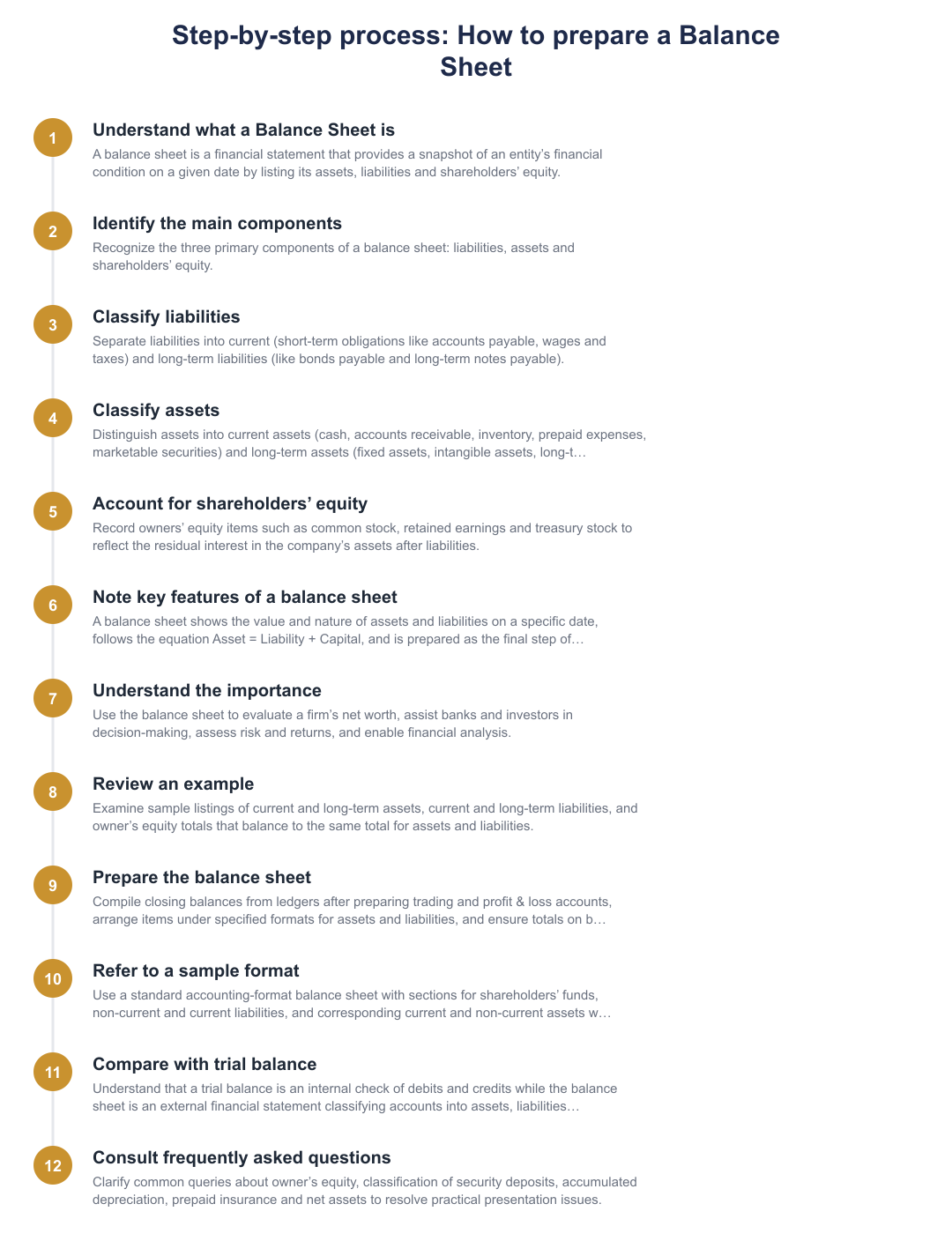
How to prepare a balance sheet?
Preparing a balance sheet begins with aggregating closing balances from the ledger: list all assets and liabilities and classify each as current or non-current. Adjust for items that require recognition or measurement at period end, such as allowance for doubtful accounts or accumulated depreciation, following the entity’s accounting policies.
Next, compute equity by starting with opening equity balances, adding retained results from the period (after transferring profit or loss), and accounting for owner transactions such as contributions or distributions. Finally, ensure the statement balances, if totals differ, investigate classification or posting errors and correct them before finalising disclosures.
Sample format of an accounting balance sheet
A typical format lists assets on one side and liabilities plus equity on the other, or presents them in sequence on a single page with suitable headings and subtotals. Current assets and current liabilities are shown separately from non-current items, and notes are referenced for more detail on particular line items.
Presentation typically includes comparative columns to show figures for the current and prior reporting periods and footnotes that explain accounting policies, judgments and significant balances. Entities adopting formal accounting standards will follow the disclosure requirements of those standards.
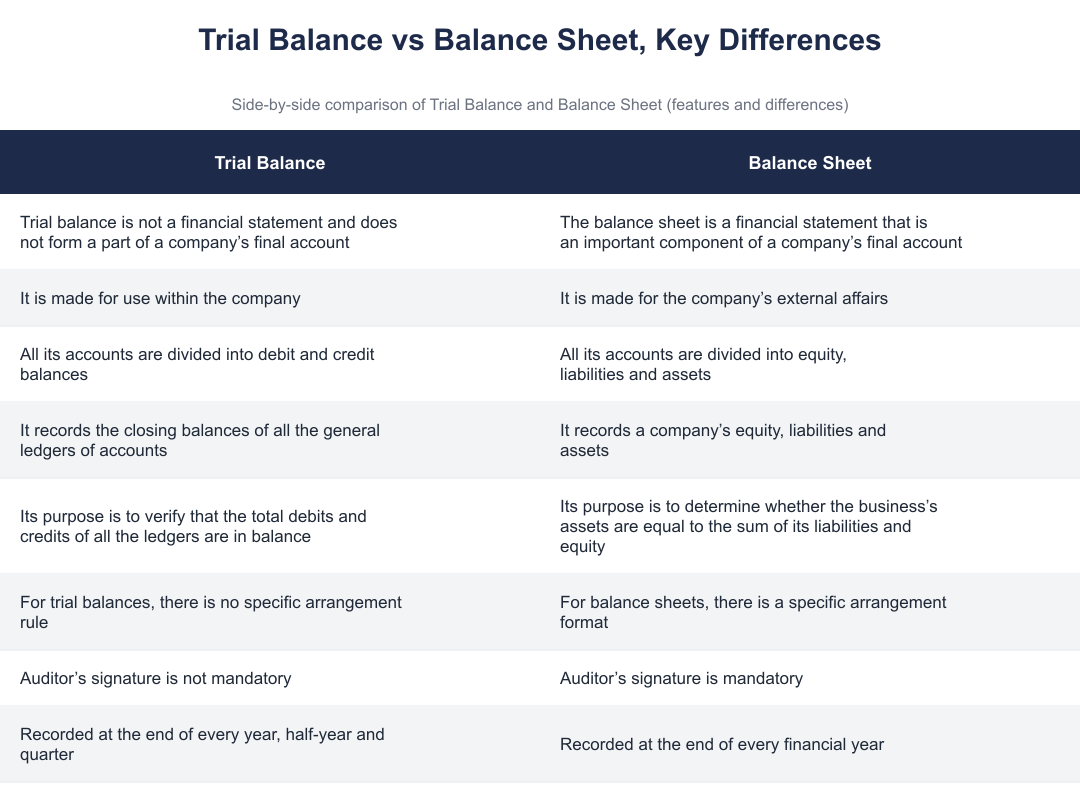
What is the difference between trial balance and balance sheet?
A trial balance is an internal report that lists ledger balances to verify that debits equal credits after posting. It is part of the bookkeeping process and is used to detect arithmetic or posting errors before preparing formal financial statements.
A balance sheet is a formal financial statement prepared for external and internal users that organises assets, liabilities and equity according to accounting standards. While the trial balance feeds information into the balance sheet, the balance sheet presents classified totals and disclosures required for reporting.
Balance sheet example
Examples of balance sheets typically show grouped line items such as cash and cash equivalents, inventories, trade receivables, property and equipment, trade payables, borrowings and equity components like share capital and retained earnings. Each example emphasises classification and presentation so that assets equal liabilities plus equity.
When reviewing examples, focus on how the example organises short-term versus long-term items and how accompanying notes explain measurement and significant estimates. Examples under recognised accounting frameworks will also align with disclosure requirements for transparency and comparability.
Frequently Asked Questions
Common queries include the meaning of owner’s equity, treatment of deposits and prepaid items, the concept of accumulated depreciation, and how net assets are calculated. Answers typically relate back to basic principles: equity is the residual interest in assets after liabilities; prepaid items are payments made in advance and recognised as assets until consumed; accumulated depreciation is the aggregate allocation of an asset’s cost to expense over time; and net assets equal total assets less total liabilities.
For entities transitioning to or preparing statements under Indian Accounting Standards, Indian AS 101, First time adoption of Indian Accounting standards, provides guidance on first-time adoption issues and required reconciliations. Users should consult that standard when a change in reporting framework occurs.
A well-prepared balance sheet is indispensable for understanding a business’s financial position. By classifying assets, liabilities and equity and following consistent presentation and disclosure practices, organisations provide stakeholders with reliable information for decision-making. When changing accounting frameworks or adopting formal standards, refer to the relevant guidance such as Indian AS 101 to ensure correct first-time adoption procedures and disclosures.
Frequently asked questions
What is a balance sheet in simple terms?
A balance sheet is a financial statement that shows a company's assets, liabilities and shareholders' equity at a specific date. It provides a snapshot of the entity's financial condition on that date and follows the basic equation Asset = Liability + Capital, so both sides always balance. Unlike an income statement, it does not show revenues or expenses but records the closing balances of ledger accounts used to evaluate solvency and capital structure. Companies typically prepare the balance sheet at the end of the accounting year as part of the final accounts and it is used by banks, investors and management for decision-making.
What are the main components of a balance sheet?
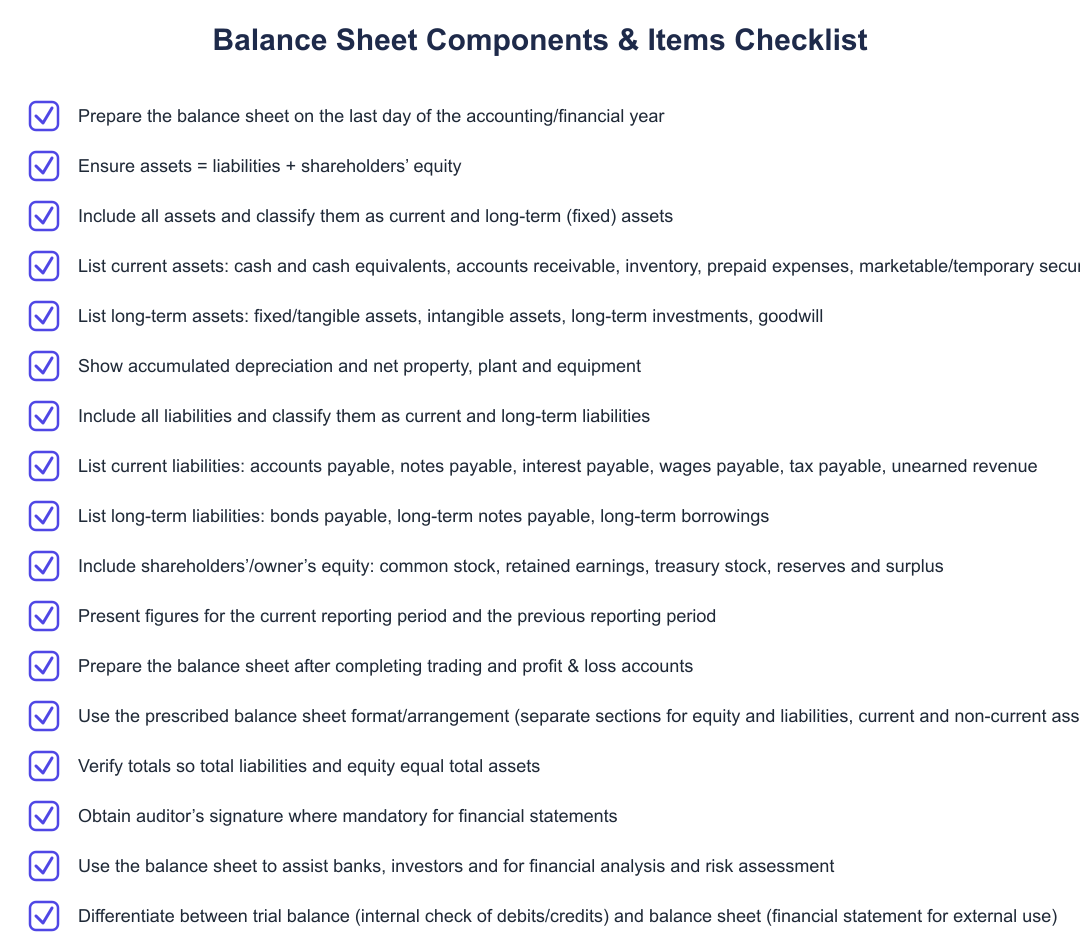
The main components of a balance sheet are assets, liabilities and shareholders' equity. Assets are split into current assets (cash, accounts receivable, inventory, prepaid expenses, marketable securities) and long-term assets (fixed assets, intangible assets, long-term investments); liabilities are split into current liabilities (accounts payable, notes payable, wages payable, tax payable, unearned revenue) and long-term liabilities (bonds payable, long-term notes payable); shareholders' equity includes items such as common stock, retained earnings and treasury stock. Each component is presented so total assets equal the sum of total liabilities and owner's equity, providing a clear picture of capital structure and net worth.
What is included under assets on a balance sheet?
Assets on a balance sheet include resources owned by the company that have economic value, such as cash and cash equivalents, accounts receivable, inventory, prepaid expenses and marketable securities for current assets, and fixed assets (machinery, buildings, property), intangible assets (patents, goodwill, trade names) and long-term securities for non-current assets. Current assets are those convertible into cash within a year, while long-term assets provide benefits beyond one year; accumulated depreciation is shown to reduce the carrying value of fixed assets. The sum of all assets is presented to match total liabilities plus owners' equity.
What are liabilities on a balance sheet and how are they classified?
Liabilities are obligations the company owes to outside parties and are classified as current liabilities (due within one year) and long-term liabilities (due after one year). Examples of current liabilities include notes payable, accounts payable, interest payable, wages payable, tax payable and unearned revenue, while long-term liabilities include bonds payable and long-term notes payable. Total liabilities are combined with shareholders' equity to show how assets are financed and to calculate net worth and solvency ratios.
What is shareholders' equity (owner's equity) on the balance sheet?
Shareholders' equity, also called owner's equity, represents the owners' residual interest in the company after liabilities are deducted from assets and includes items like share capital, reserves and surplus, retained earnings and less treasury stock. It is calculated as Total Assets minus Total Liabilities and shows how much of the company's assets are financed by owners rather than creditors. Shareholders' equity is an important indicator of net assets and is required to reconcile the balance sheet so assets equal liabilities plus equity.
What are the key features of a balance sheet?
Key features of a balance sheet are that it lists all assets and liabilities with their values, shows the company's capital position at a specific date, follows the accounting equation Asset = Liability + Capital so both sides always balance, and does not include revenues or expenses. It takes into account debit and credit balances from general ledgers, arranging accounts into assets, liabilities and equity in a prescribed format, and is typically prepared at the end of the accounting year as the final step of financial statements. The balance sheet is audited and the auditor's signature is mandatory when presented as part of the company’s final accounts.
How do you prepare a balance sheet step-by-step?
To prepare a balance sheet, first create a trial balance by transferring the closing balances of every general ledger account into a spreadsheet; then arrange and adjust the trial balance with any required adjusting entries and remove all revenue and expense accounts so only assets, liabilities and equity remain. Next, classify and list current and non-current assets and liabilities in the prescribed order, calculate totals (including accumulated depreciation to arrive at net fixed assets), and compute shareholders' equity items like common stock and retained earnings so that Total Assets = Total Liabilities + Equity. Finally, present the figures in the standard balance sheet format and obtain the auditor's sign-off if the statement is part of the company's final accounts.
What is the difference between a trial balance and a balance sheet?
A trial balance is an internal accounting report that lists debit and credit balances of general ledger accounts to verify that total debits equal total credits, whereas a balance sheet is a formal financial statement prepared for external use that presents assets, liabilities and equity. The trial balance is not part of final accounts and has no specific arrangement or auditor's signature requirement, while the balance sheet follows a specific format, records closing balances as assets/liabilities/equity, and normally requires auditor approval when issued as part of financial statements. Trial balances are prepared periodically (year-end, half-year, quarter) to check bookkeeping accuracy; the balance sheet is prepared at the end of the financial year as a key component of final accounts.
What does accumulated depreciation mean on a balance sheet?
Accumulated depreciation is the total amount of depreciation expense charged against an asset since it was put into use, and it is shown on the balance sheet as a contra-asset that reduces the carrying value of property, plant and equipment. For example, if equipment cost Rs.20,00,000 and accumulated depreciation is Rs.5,00,000, the net carrying amount reported under property, plant and equipment would be Rs.15,00,000. Accumulated depreciation helps users understand the original cost, the amount expensed to date and the net book value of long-lived assets.
Need help staying Accounting compliant?
MoneyGence's AI Finance OS tracks your compliance, wallet share, and finances in one place, built for agencies and growing businesses.
Get started with MoneyGence