Bank Reconciliation Statement – How to Prepare & Benefits
A Bank Reconciliation Statement (BRS) is a fundamental internal-control tool that helps businesses ensure the balance shown in their books matches the bank’s records. This guide explains what a BRS is, why it matters to every organisation that uses a bank account, how to prepare one in a systematic way, the practical benefits you gain from regular reconciliation, and tips to make the process efficient and reliable. You will learn a clear step-by-step reconciliation workflow, how to identify and resolve common differences between your cash book and bank statement, and how maintaining a disciplined reconciliation routine can detect errors, fees, and possible fraud early. Whether you are a small business owner, an accounts executive, or someone responsible for cash management, mastering bank reconciliation reduces surprises at month-end, improves cash visibility, and strengthens audit readiness. The sections that follow include a concise rationale for preparing a BRS, a practical stepwise procedure you can adopt, the main benefits you can expect, and actionable suggestions to streamline the reconciliation process. Read on to adopt a systematic approach that keeps your accounting accurate and your bank relationships transparent.
Why Prepare a BRS?
A bank reconciliation statement explains and documents the differences between the balance shown in your accounting books and the balance shown by the bank. Differences arise for many benign reasons, timing differences, bank fees or interest entries not yet recorded in your books, and items issued but not yet cleared by the bank. Preparing a BRS regularly gives you a clear, reconciled view of available cash and outstanding items.
Beyond matching figures, reconciliation is an important control activity. It helps detect bookkeeping errors, omissions, or duplicated entries. It also highlights unexpected bank charges or credits and can reveal unauthorised transactions. Regular reconciliations support accurate financial reporting, better cash-flow planning, and smoother audits because they provide a documented trail of adjustments and explanations.
How to prepare a BRS
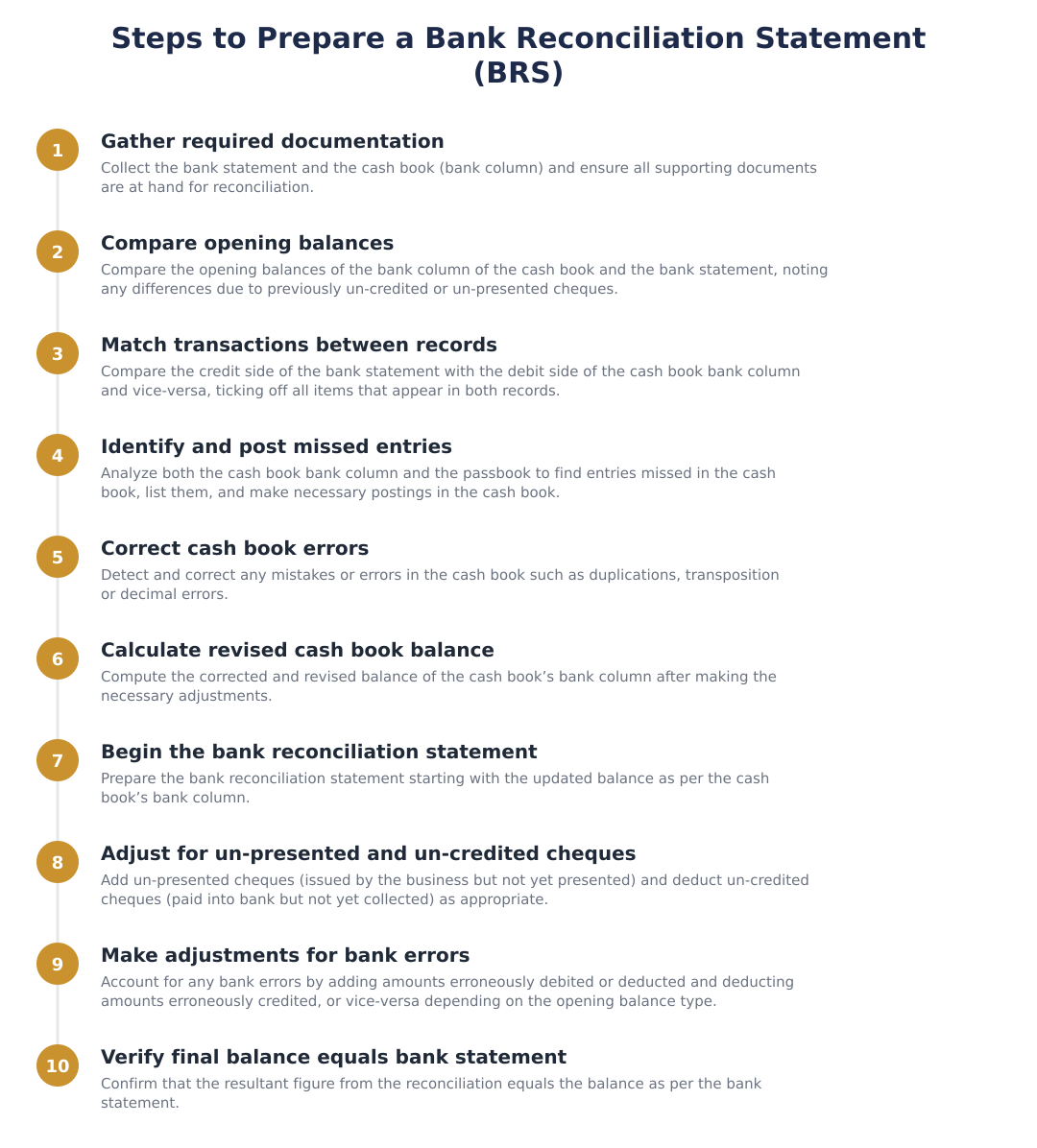
Collect the bank statement for the period under review and the bank column of your cash book or ledger. Ensure both records cover the same date range and that opening balances are available for comparison.
Compare credits and debits on the bank statement with entries in your books, ticking off items that appear in both records. Work systematically by date or by amount to avoid missing matches.
Prepare lists of unpresented cheques (issued but not yet cleared) and deposits in transit (paid into bank but not yet credited). These timing differences explain many reconciliation variances.
Scan both records for transactions that have not been posted to your cash book and for arithmetic or transposition errors. Make corrective entries in your books where appropriate.
Note any bank charges, interest, or incorrectly handled items on the bank statement that aren’t in your books, and record adjusting entries. If you detect a bank mistake, contact the bank with supporting documentation.
Start with the updated balance per your cash book, add or deduct outstanding items and adjustments as required, and arrive at a reconciled figure. This result should agree with the closing balance on the bank statement after accounting for all reconciling items.
Post all adjusting entries in your accounting system and keep a clear list of outstanding items to follow up in subsequent periods until they clear. Retain the reconciliation and supporting documents for audit and controls.
Benefits of preparing a BRS
Regular bank reconciliation provides confidence that cash balances in your accounting records are accurate. It improves cash management by making it easier to spot timing differences, confirm receipts, and understand the true available balance. This clarity supports better payment planning and avoids surprises when issuing cheques or making transfers.
Reconciliation also serves as a fraud and error detection mechanism. By independently verifying bank entries against your books, you can identify unauthorised withdrawals, duplicate payments, missed collections, and bank errors early. Maintaining a routine reconciliation process creates a documented control trail that strengthens internal control and supports external audits.
Tips to ensure efficient BRS
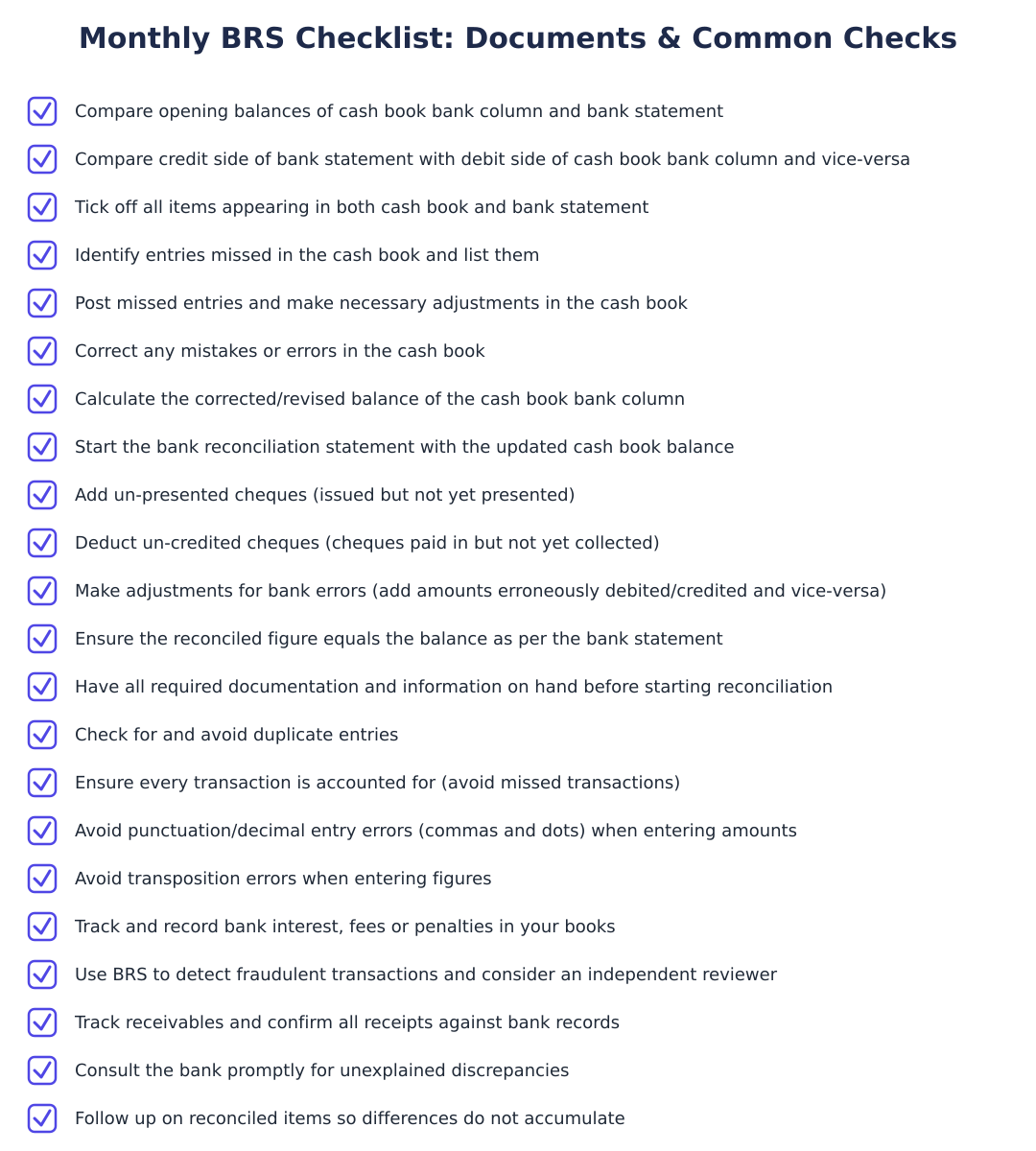
Standardise the process and frequency. Decide on a rhythm that suits your business, monthly is common, and use a consistent checklist and template so reconciliations are comparable period to period. Keep your bank statements and cash book entries current to reduce backlog work.
Automate where practical and segregate duties. Use bank feeds or accounting software to import bank transactions, which reduces manual rekeying and lowers the risk of transposition errors. Where possible, separate the person who performs reconciliations from those who record cash transactions to strengthen internal controls. Finally, maintain clear documentation for each reconciling item and follow up outstanding items until they are resolved.
A disciplined bank reconciliation practice is a small, regular effort that yields outsized benefits: accurate cash records, early detection of problems, and stronger internal controls. Adopt a consistent process, document your adjustments, and follow up on outstanding items, over time this will simplify month-end close and improve the reliability of your financial information.
Frequently asked questions
What is a bank reconciliation statement (BRS)?
A bank reconciliation statement (BRS) is a statement that explains and reconciles the difference between the balance shown in your cash book’s bank column and the balance shown on the bank statement (passbook). It lists items like un-presented cheques, un-credited lodgments, bank charges, interest, and errors that cause the two balances to differ and adjusts the cash book or bank balance accordingly so both match as of a particular date. A typical BRS starts with the corrected cash book balance and then adds un-presented cheques and deducts un-credited cheques (or vice‑versa if starting with a credit balance) until the resultant equals the bank statement balance. Preparing a BRS regularly helps ensure your recorded cash position is accurate and catches mistakes or fraud early.
Why should I prepare a bank reconciliation statement every month?
You should prepare a BRS every month because it detects errors, bank charges, fees and unrecorded receipts so your books reflect the true bank balance. Monthly reconciliation helps spot addition/subtraction mistakes, missed or double payments, interest or penalty entries by the bank, and potential fraud by employees. Regular BRS also ensures receivables and deposits are tracked and prevents small unreconciled items from accumulating into material discrepancies. For these reasons many businesses reconcile monthly or at least periodically after receiving the bank statement.
How do I prepare a bank reconciliation statement step by step?
Prepare a BRS by first comparing opening balances in the cash book’s bank column and the bank statement, then tick off matching entries on both records and identify missing entries. Update the cash book for missed receipts/payments and correct any cash book errors, compute the revised cash book balance, and start the reconciliation with that updated balance. Add un-presented cheques (issued but not presented) and deduct un-credited cheques (lodged but not collected), make adjustments for bank errors (add amounts wrongly debited or deduct amounts wrongly credited), and the final figure should equal the balance per the bank statement. Keep a list of reconciling items so they can be followed up and cleared in subsequent periods.
What are common causes for differences between cash book and bank statement balances?
Common causes include un-presented cheques (issued but not yet cleared), un-credited cheques (deposits not yet collected), bank charges or interest recorded by the bank but not in the cash book, and posting or arithmetic errors in the cash book. Transposition errors (e.g., recording INR 221,200 as INR 212,200), mistakes in commas or decimal places (e.g., INR 2,401.30 entered as INR 240.13), and duplicated or missed entries also create discrepancies. Banks may also make mistakes by debiting or crediting wrong amounts, so unexplained items should be taken up with the bank.
What is an un-presented cheque and how should I handle it in BRS?
An un-presented cheque is a cheque issued by your business to a supplier or creditor that has not yet been presented to the bank for payment, and you should add it back to the cash book balance when reconciling to the bank statement. Because the cheque amount has already been recorded as a payment in your cash book but not yet cleared by the bank, it causes the bank statement balance to be higher; adding un-presented cheques adjusts the cash book-based reconciliation so both balances agree. Keep a running list of un-presented cheques and follow up with suppliers if they delay presenting them, and remove them from subsequent BRS once cleared.
What is an un-credited cheque (deposit not collected) and how do I record it?
An un-credited cheque is a cheque or deposit paid into the bank that has not yet been credited or collected by the bank, and you should deduct such amounts from the cash book balance when preparing the BRS. These deposits are recorded as receipts in your cash book but do not appear in the bank statement until the bank processes them, so deducting them ensures the reconciled balance matches the bank’s recorded balance. Maintain a list of un-credited items and confirm with the bank if they remain outstanding beyond the normal clearing period.
How do I deal with bank errors when preparing a BRS?
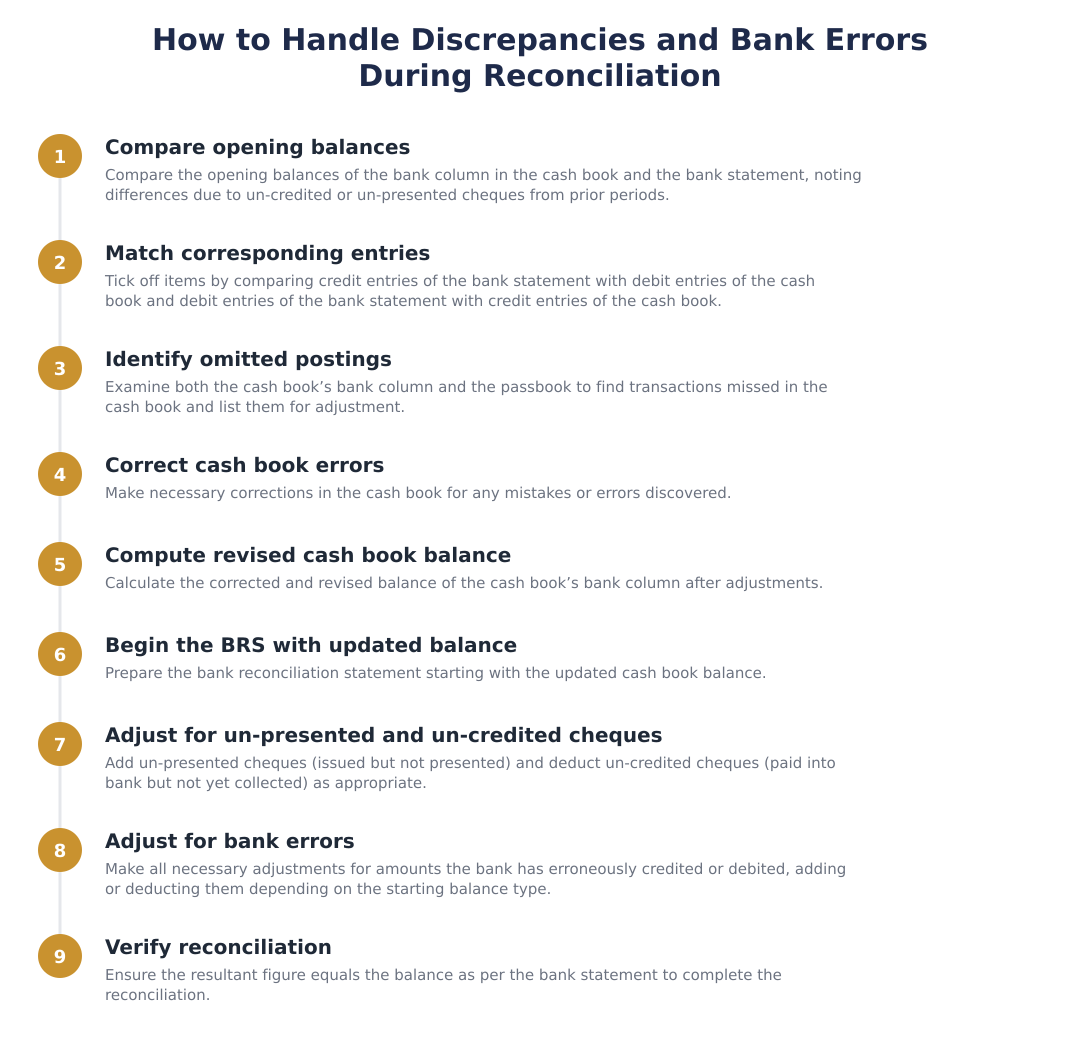
When the bank makes an error, adjust the reconciliation by adding amounts the bank wrongly debited or deducting amounts the bank wrongly credited so the reconciled figure matches the corrected cash book balance. If you begin the BRS with a debit balance in the cash book’s bank column, add bank errors where the bank wrongly debited you and deduct errors where the bank wrongly credited you; reverse the treatment if you start with a credit balance. Always follow up with the bank to get formal correction and documentary evidence, and record the journal entry in your books only after verifying the bank’s correction if required.
What tips help make bank reconciliation more efficient and accurate?
To make BRS efficient, keep all supporting documentation handy, avoid common data-entry errors (duplication, missed transactions, misplaced decimals), and maintain an up-to-date list of reconciling items so they don’t accumulate. Be aware banks can make mistakes, so query unexplained items promptly with the bank, and assign an independent person to perform reconciliations to reduce risk of internal fraud. Regular reconciliation, careful attention to commas/decimals and transposition errors, and timely posting of cleared items in the cash book will keep your reconciliations short and accurate.
What should I do if the reconciled balance still doesn’t match the bank statement?
If the reconciled balance doesn’t match, review for missed postings, errors in the cash book (including transposition and decimal mistakes), and un-presented or un-credited items you may have overlooked, then follow up with the bank for possible bank errors. Re-check arithmetic, compare every entry line-by-line, update the cash book for any bank charges or interest not recorded, and maintain a checklist of reconciling items to ensure none are forgotten. If unexplained differences persist after those steps, escalate to the bank with supporting evidence and consider having an independent reviewer re-perform the reconciliation to detect overlooked mistakes or fraud.
Need help staying Accounting compliant?
MoneyGence's AI Finance OS tracks your compliance, wallet share, and finances in one place, built for agencies and growing businesses.
Get started with MoneyGence