Bookkeeping for Small Business: Guide & Practical Tips
Good bookkeeping is the backbone of a healthy small business. This guide explains practical bookkeeping choices and routines that help business owners stay organised, make informed decisions, and simplify compliance. You will learn how to choose a bookkeeping method and the mode of accounting that suits your business, why separating business and personal finances matters, how to manage incoming payments and expenses, and best practices for timely recording and regular review of your books. Whether you are a sole proprietor handling books yourself or running a small team, the techniques covered here will make record-keeping less time-consuming and more reliable. The goal is to help you create a system that accurately reflects your business activity, supports cash flow management, and reduces surprises when you reconcile accounts or prepare financial reports.
Tips for Efficient Bookkeeping
Efficient bookkeeping starts with a simple, consistent structure. Establish a set of categories for common income streams and expense types, and use them consistently so that records remain comparable over time. Clear naming conventions for invoices, receipts, and accounts reduce confusion and speed up searches and reconciliations.
Automation and routine are powerful allies. Where possible, use recurring templates for invoices and scheduled payments, and set aside dedicated time each week or month to record transactions and reconcile accounts. Regular small efforts are easier to maintain than infrequent large catch-ups, and they help you spot errors or unusual items early.
Keep documentation for every transaction, whether digital or physical. Properly filed receipts, bills, and bank statements make it much simpler to verify entries later and support any reporting or audit needs. A consistent filing system, by date, vendor, or expense type, saves time and reduces stress when you need to retrieve documents.
Decide on the Method of Bookkeeping
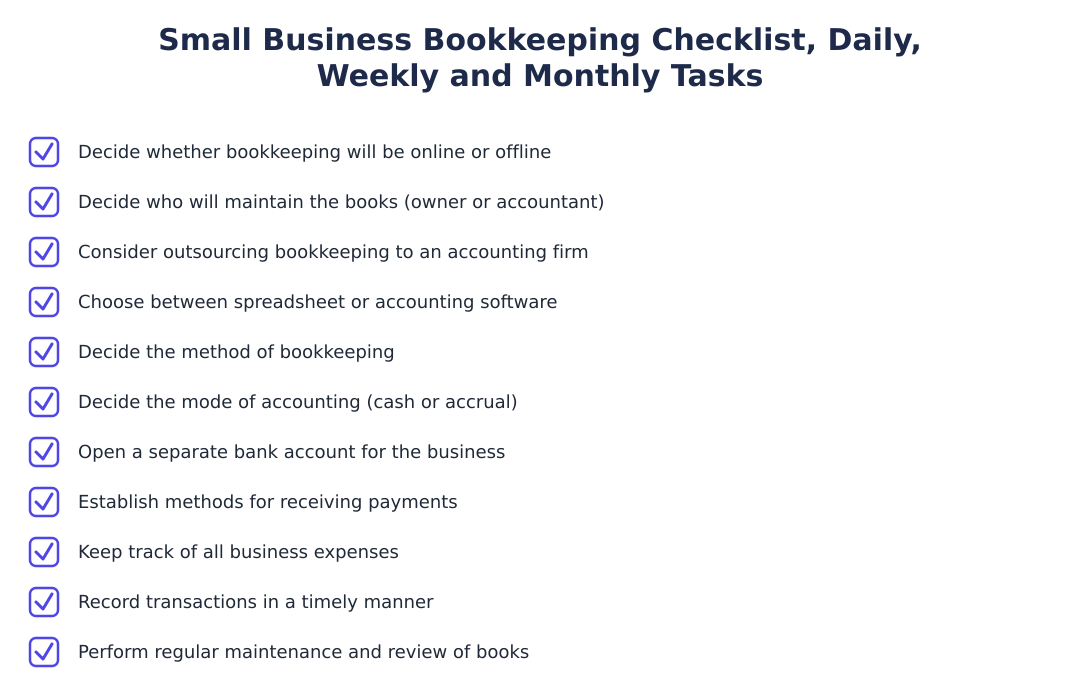
Choose between a cash-based or an accrual-style mindset for how you record income and expenses. The right approach depends on how you receive payments and when you incur costs, as well as how you want financial information presented for decision-making. Consider how each method affects visibility into cash flow and profit over time.
Simpler businesses often start with a straightforward cash-focused approach because it tracks money actually received and paid. Businesses that invoice customers, hold inventory, or extend credit may find it helpful to record transactions as they are earned or incurred to better match revenue and related expenses.
Whatever method you choose, apply it consistently so your reports remain meaningful. Switching methods should be a deliberate decision made with clear reasons and a plan to adjust historical records if necessary, so comparisons remain valid.
Decide the Mode of Accounting
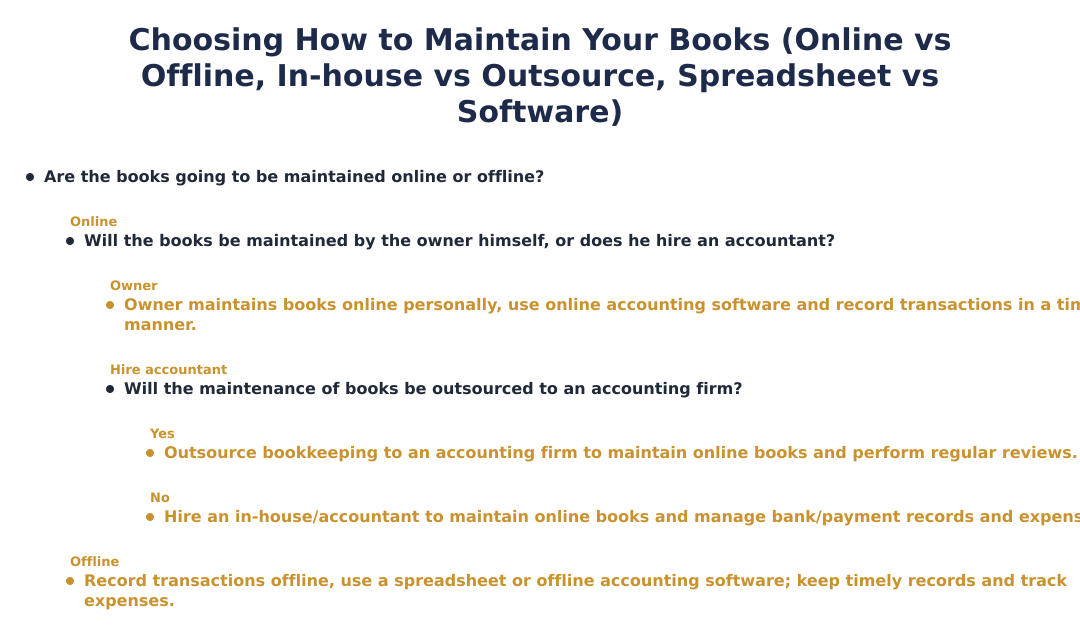
You can keep books offline, for example on spreadsheets or paper, or use cloud-based accounting software. Offline methods may feel familiar and low-cost at first, but they can be time-consuming to maintain and risk versions getting out of sync. Cloud tools often automate bank feeds, invoicing, and reconciliations, reducing manual data entry.
When evaluating software, consider ease of use, the ability to scale as the business grows, reporting features, and how it handles backups and data security. If you work with an accountant, check that the system allows easy data sharing or provides accountant access.
If you prefer a hybrid approach, ensure you have reliable procedures to transfer offline records into any system you use for reporting and compliance. The priority is accuracy and a workflow that you can sustain consistently.
Open a Separate Bank Account
Separating business and personal finances makes bookkeeping far simpler and more accurate. A dedicated business bank account creates a clear transaction trail for revenue and costs, reduces the risk of missing deductible expenses, and makes reconciliation straightforward.
Using a separate account also makes it easier to review cash flow and understand the true financial position of the business at any point. This separation is helpful when preparing financial statements, applying for credit, or working with advisors, because the account history reflects only business operations.
If you accept card payments or use third-party payment platforms, link them to the business account so funds flow directly into the correct place. That reduces manual transfers and the need to explain mixed transactions when reconciling.
Establish your Methods of Receiving Payment
Decide which payment methods you will accept, cash, cheques, bank transfers, cards, or digital wallets, and standardise how each is recorded. Clear invoicing terms and accepted payment channels help reduce delays and make tracking receivables simpler.
Implementing multiple payment options can improve customer convenience but adds complexity to reconciliation. Ensure each payment source is identifiable in your records so you can match receipts to invoices quickly.
Set internal policies for payment follow-up: specify when to send reminders, how to escalate overdue accounts, and who handles customer queries. Strong receivables management protects cash flow and reduces the time you spend chasing unpaid invoices.
Keep Track of the Expenses
Track all business expenses systematically and capture supporting receipts or invoices for each. Categorise expenses in a way that reflects how you manage the business, by department, project, or expense type, so you can analyse where money is being spent.
Regularly reconcile expense claims and reimbursements if you or employees make personal payments on behalf of the business. Clear policies on approvals and required documentation reduce disputes and ensure the accounting records stay accurate.
Review recurring costs periodically to identify opportunities to reduce unnecessary spending or negotiate better terms with vendors. Accurate expense tracking also helps when budgeting and forecasting future cash needs.
Record Transactions in a Timely Manner
Enter transactions as soon as practical, daily or weekly rather than monthly, so the books reflect current activity and small errors are corrected quickly. Timely recording helps you monitor cash flow and spot anomalies before they grow into bigger problems.
Make use of bank statements, payment platform reports, and supplier invoices to confirm transactions and avoid duplication. Regular reconciliation between your ledger and bank records ensures that all transactions are captured and correctly classified.
If manual entry is necessary, maintain a checklist for each recording session to ensure consistency. If you outsource data entry, set deadlines and quality checks so records are complete and accurate on a regular cadence.
Regular Maintenance and Review of Books
Schedule periodic reviews of your books, monthly or quarterly, to reconcile accounts, review cash flow trends, and assess profit and expense patterns. Regular reviews make year-end reporting easier and reduce the stress of last-minute clean-ups.
Use these reviews to prepare concise internal reports that answer key questions: Is the business generating enough cash? Which products or services are most profitable? Are expenses in line with expectations? These insights support better operational and strategic decisions.
If you work with an accountant, provide clean, well-organised records ahead of meetings to make consultations more productive. Even small businesses benefit from periodic professional reviews to ensure records meet necessary standards and to identify process improvements.
Good bookkeeping is a combination of simple rules, consistent habits, and the right tools. By deciding on methods early, separating personal and business finances, recording transactions promptly, and reviewing records regularly, small business owners can reduce administrative burden and make clearer decisions. Start with a process you can sustain and refine it as your business grows.
Frequently asked questions
Why should I keep a separate bank account for my small business?
You should keep a separate bank account to clearly separate personal and business finances, simplify accounting, and make tax filing and audits easier. A dedicated business account makes it straightforward to track income, deposit payments, and reconcile expenses without combing through personal transactions; banks also provide business-specific services like merchant payment links and statements. Using a separate account can help establish a clear paper trail for deductions and improves credibility with vendors and lenders. For formal entities (like a company or LLP) it is mandatory to maintain a separate account and beneficial for sole proprietors too.
Should I use cash or accrual accounting for my small business?
Choose accrual accounting if you need to match income and expenses when they are earned or incurred, and choose cash accounting if you want simplicity and recognise transactions only when cash changes hands. Cash accounting is simpler and suitable for very small businesses with straightforward cash flows, while accrual gives a more accurate picture of profitability and is preferable when you offer credit, carry inventory, or seek external financing. Tax rules and turnover thresholds can also influence the choice, so check regulatory or GST applicability before switching. Many businesses start with cash accounting and migrate to accrual as they grow or when required by lenders or tax laws.
Should I maintain my books online using software or offline on spreadsheets?
Maintaining books online using accounting software is generally recommended for efficiency, automation, and easier backups, but spreadsheets or offline ledgers can work for very small operations. Online software offers automated bank feeds, invoicing, reconciliation, and ready reports for tax filing, while spreadsheets require manual updates and carry higher risk of errors; choose offline only if you have simple transactions and strong discipline. Consider factors like cost, internet access, data security, and whether you will hire an accountant or outsource bookkeeping when deciding between online and offline modes. You can also combine approaches, use software for core records and spreadsheets for ad-hoc tracking, but consistency is key.
Who should maintain my business books, me, an in-house accountant, or an outsourced firm?
You can maintain books yourself if transactions are few and you are comfortable with accounting, hire an in-house accountant for regular day-to-day bookkeeping, or outsource to an accounting firm for scalability and expertise. Owner-maintained books save cost but consume time and risk mistakes; an in-house accountant provides immediate control and understanding of operations; outsourcing can reduce overheads and give access to specialized knowledge like GST and tax compliance. Consider transaction volume, complexity (inventory, payroll, GST), cost, and the need for timely reports when deciding. Many small businesses begin with owner bookkeeping, move to a part-time/accountant as they grow, and eventually outsource to a firm for compliance and advisory services.
How should I establish methods for receiving payments from customers?
Establish multiple clear payment methods, cash, bank transfer (NEFT/RTGS/IMPS), UPI, and card/merchant payment, to suit customer preferences and ensure timely receipts. Document standard invoicing terms (due dates, discounts, late fees) and use digital payment links and receipts to create verifiable records for bookkeeping and reconciliation. Having consistent payment methods and terms reduces delays, simplifies bank reconciliation, and improves cash flow forecasting; note that digital payments generate electronic records useful for GST and income-tax documentation. Also specify preferred methods in invoices and on your website or physical outlets to reduce confusion.
How do I keep track of business expenses effectively?
Keep track of business expenses by collecting and categorising all invoices and receipts, recording them promptly, and maintaining expense categories aligned with tax-deductible heads. Use accounting software or a spreadsheet to enter date, vendor, purpose, amount, payment mode, and attach scanned receipts; this ensures you can justify expenses during audits and claim eligible deductions. Reconcile expenses with bank and card statements regularly to catch omissions or errors, and separate personal expenses from business ones to avoid disallowance. For GST-registered businesses, preserve tax invoices and input-tax-credit supporting documents as per GST rules.
How often should I record transactions and why is timely recording important?
You should record transactions as soon as possible, ideally daily or weekly, to keep books accurate, maintain cash flow visibility, and reduce errors or missed entries. Timely recording ensures bank reconciliations are straightforward, invoices and bills are paid on time, and management reports reflect the true financial position for decision-making; delays increase the workload and risk of omissions. Frequent entries help in complying with GST and tax filing deadlines and make year-end closing faster and less error-prone. If daily posting isn’t feasible, set a strict schedule (e.g., twice weekly) and stick to it to avoid backlog.
How often should I review and maintain my accounting books?
You should review and maintain your books at least monthly, with more detailed quarterly and annual reviews for tax and audit readiness. Monthly reviews include bank reconciliation, outstanding receivables and payables checks, expense categorisation, and GST filing readiness; quarterly reviews examine profitability, cash flow trends, and compliance requirements. Annual review prepares for tax returns, depreciation schedules, inventory valuation, and statutory filings; regular reviews reduce last-minute pressure and uncover discrepancies early. Establish a checklist and calendar for reconciliations, GST/IT deadlines, and meetings with your accountant to ensure consistent maintenance.
What bookkeeping method should I choose for a home-based small business?
For a home-based small business, many owners start with simple cash-basis bookkeeping and a separate business bank account, then upgrade to accrual and accounting software as complexity grows. Cash-basis is easy to manage for small volumes and primarily cash transactions, but if you issue credit invoices, hold inventory, or need loans, accrual accounting gives a clearer financial picture. Even for home businesses, maintain separate accounts, keep receipts, and record transactions regularly; using a basic accounting app or spreadsheet for income, expenses, and invoicing improves record-keeping and tax compliance. Consider outsourcing periodic reviews to an accountant if you are unsure about deductions or GST applicability.
Need help staying Accounting compliant?
MoneyGence's AI Finance OS tracks your compliance, wallet share, and finances in one place, built for agencies and growing businesses.
Get started with MoneyGence