Capital Gains Calculator, LTCG & STCG Calculator for India
This guide explains how capital gains on equity-oriented instruments and listed shares are treated under Indian tax rules and how a capital gains calculator (specifically a ClearTax-style LTCG calculator) helps you estimate tax impact. You will learn how holding period determines whether a gain is short term or long term, the important compliance date when long-term capital gains (LTCG) rules came into effect, and the special grandfathering rule that requires use of a fair market value as on 31 January 2018 for certain purchases. These facts affect how gains are computed and therefore influence decisions such as when to sell shares or equity mutual fund units. While this guide does not provide tax rates or numeric examples, it focuses on the rule-set you must apply before using any calculator: the holding-period classification for listed shares and equity-oriented mutual funds, the introduction of LTCG rules for transactions on/after 1 April 2018, and the FMV rule for purchases made on or before 31 January 2018. By the end of the article you will understand what inputs a capital gains calculator needs, how the calculator applies the grandfathering/FM V treatment, and practical steps to use such a calculator to get an immediate estimate of whether a sale generates short-term or long-term capital gains.
What is Capital Gain?
A capital gain arises when an asset, such as listed shares or units of an equity-oriented mutual fund, is sold for an amount higher than its purchase price. Capital gain is not a single-category concept in the tax code: the tax treatment depends primarily on how long the asset was held before sale.
For equity-oriented instruments, the distinction between short-term and long-term is crucial because different tax rules apply to each category. Before running numbers through any calculator, you must be clear whether your transaction falls into the short-term or long-term bucket, since that classification determines which provisions of the tax law apply to the gain.
Holding period classification (listed shares and equity-oriented mutual funds)
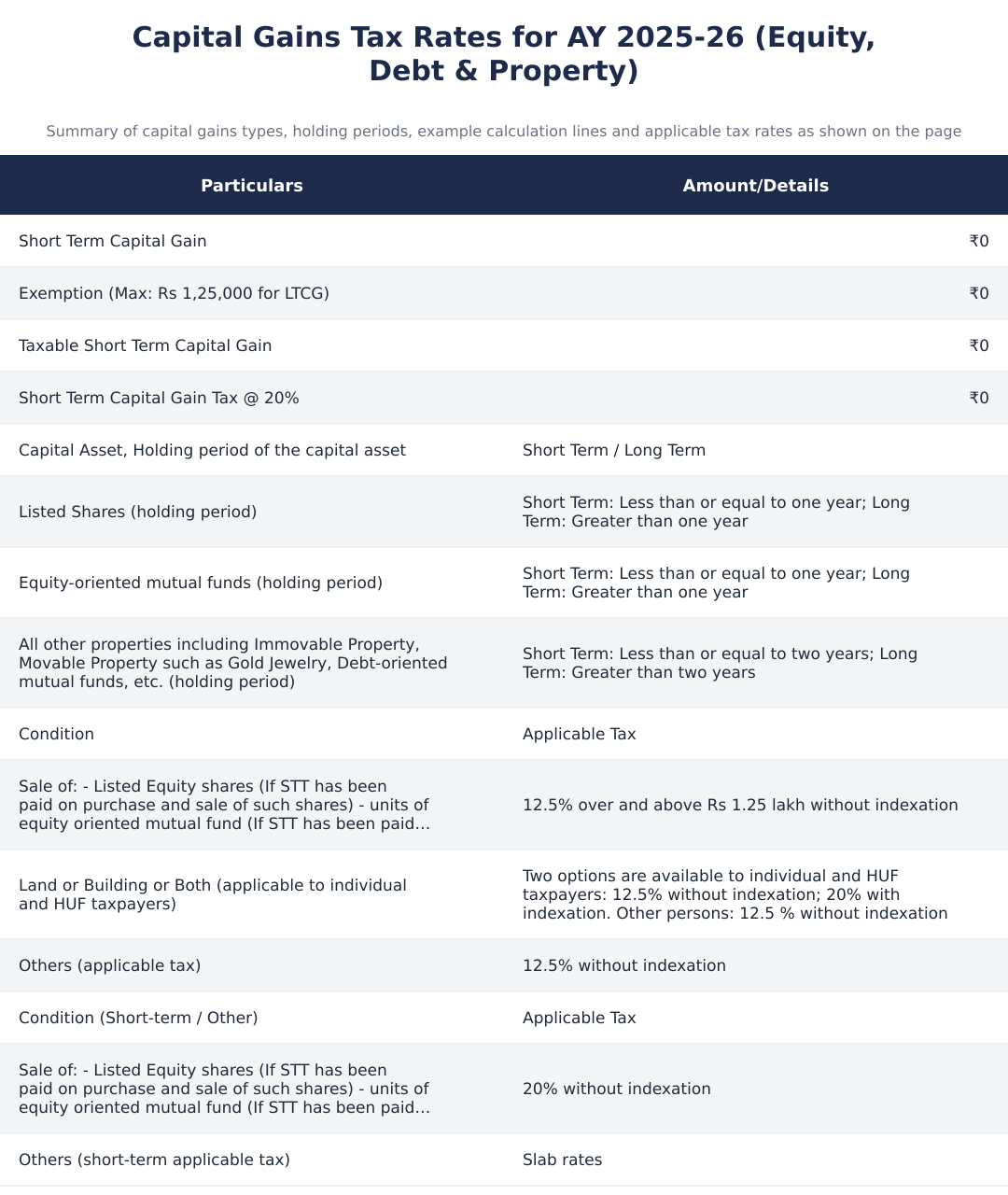
| Asset type | Short term | Long term |
|---|---|---|
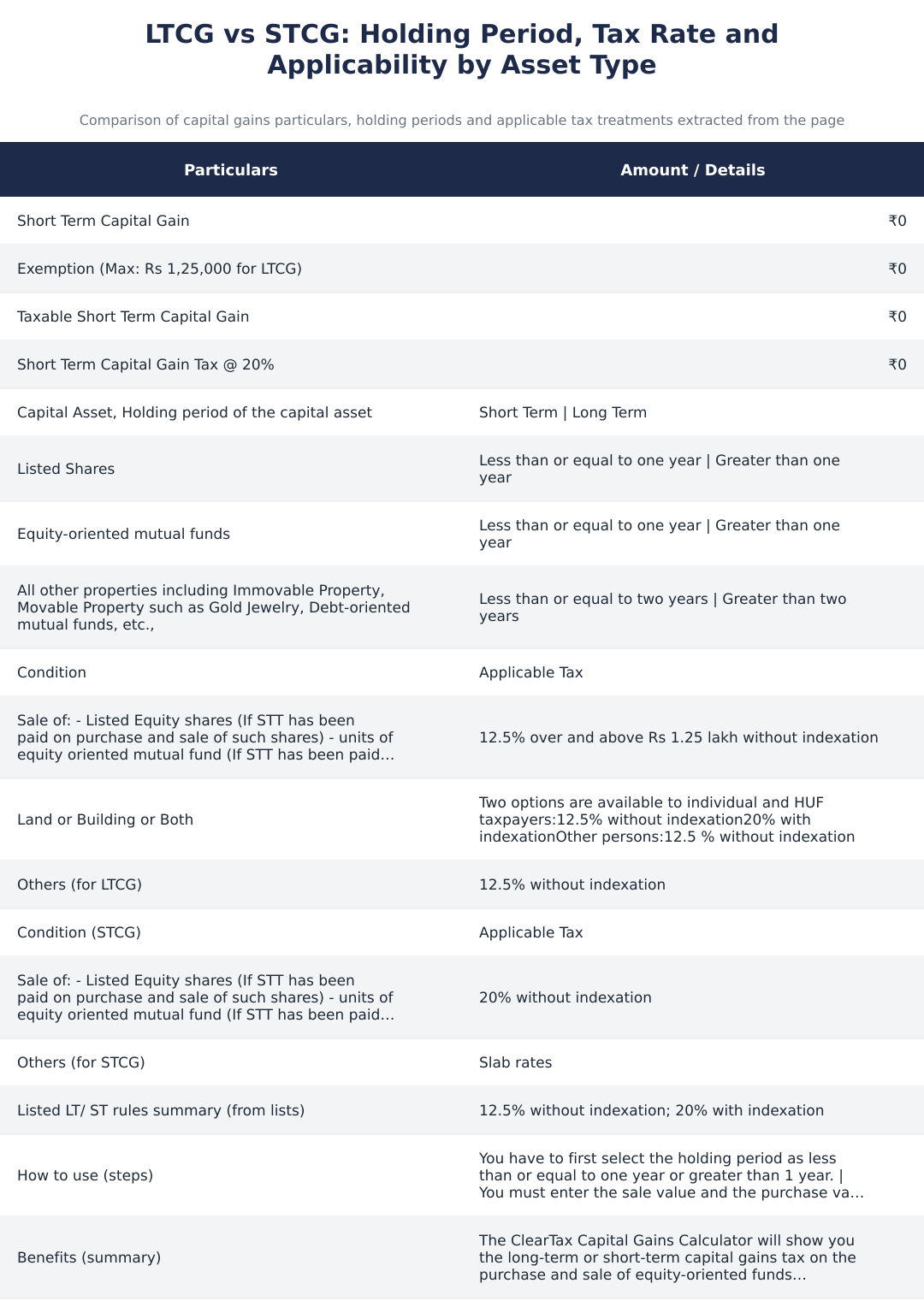
| Listed shares and equity-oriented mutual funds | Less than or equal to one year | Greater than one year |
Taxation of Long Term Capital Gain
A specific long-term capital gains framework for equity-oriented instruments and shares was introduced by the government during the Union Budget 2018. The new rule became applicable for transactions made on or after 01 April 2018, so any sale on or after that date must be evaluated under the post-2018 LTCG provisions.
An important practical element of the LTCG treatment is the grandfathering (FMV) provision: if shares were purchased on or before 31 January 2018, the fair market value as on 31 January 2018 is used in computing capital gain for the purposes of the post-2018 rule. This FMV step protects gains accrued up to that reference date from the new regime and must be accounted for when you use a calculator or prepare your tax computation.
Taxation of Short Term Capital Gain
Short-term capital gain (STCG) occurs when listed shares or equity-oriented mutual fund units are sold within the short-term holding period defined by law. The classification itself, what counts as short term versus long term, is determined by the Income Tax Act, 1961.
Because the holding-period test is the gateway to taxation, you should first establish whether your sale falls into the short-term category before considering tax rates or exemptions. A calculator will need the purchase date and sale date (or the holding period) alongside purchase and sale values to determine if the gain is short term.
What is the Capital Gains Calculator?
A capital gains calculator is an online tool that takes details of purchase and sale, such as dates and amounts, and applies tax rules to estimate whether the gain is short term or long term and to compute the taxable gain. For equity-oriented instruments it must also apply the FMV rule where applicable.
Such calculators speed up what would otherwise be manual computations and help investors get a quick view of tax consequences before they execute a trade or file returns. They are particularly useful when you own multiple lots bought on different dates or when the FMV on 31 January 2018 needs to be considered for grandfathering.
How to Use the ClearTax LTCG Calculator?
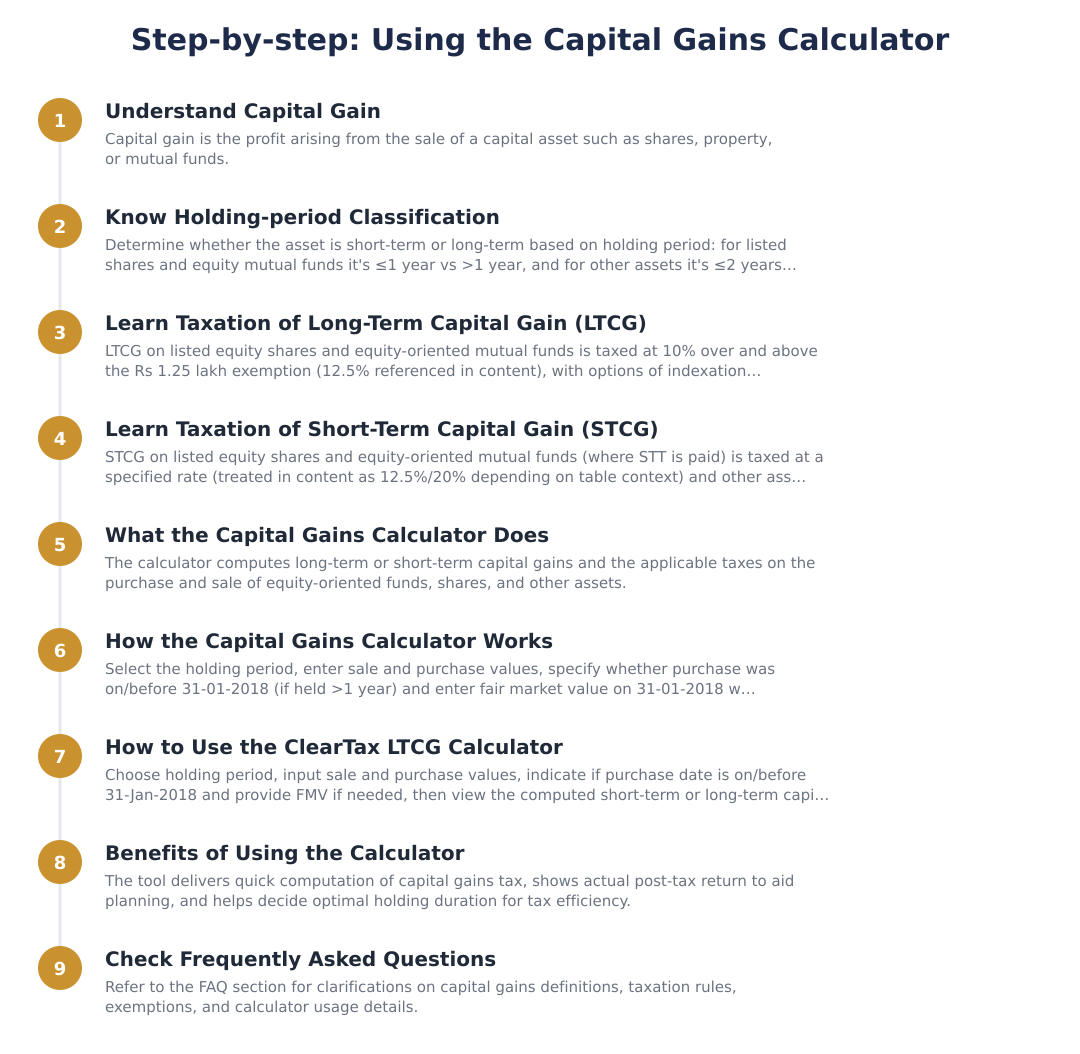
Indicate whether the holding period for your listed shares or equity-oriented mutual fund units is less than or equal to one year or greater than one year so the calculator can classify the gain as short term or long term.
Provide the original purchase price and the sale value; the calculator uses these to compute the raw gain before any FMV adjustment or other rule.
If the shares were purchased on or before 31 January 2018, select that option and enter the fair market value as on 31 January 2018; the calculator will use this FMV in place of the actual purchase price for computing LTCG under the post‑2018 rules.
The calculator will display whether the gain is short term or long term and show the computed capital gain based on the inputs and the FMV grandfathering where relevant.
Benefits of Using a Capital Gains Calculator
A calculator gives a quick, consistent estimate of whether a sale produces short-term or long-term capital gain by applying the holding-period rules automatically. This eliminates confusion around multiple purchase dates and reduces manual calculation errors.
It also helps apply the FMV grandfathering for purchases on or before 31 January 2018 without needing to manually adjust the purchase cost, making post‑2018 LTCG computations easier and faster.
Frequently Asked Questions
When did the LTCG rule for equity-oriented instruments take effect? The introduction of the long-term capital gains tax on equity-oriented instruments and shares was announced in the Union Budget 2018 and the new rule applies to transactions made on or after 01 April 2018.
What if I bought shares before 31 January 2018? If shares were purchased on or before 31 January 2018, the fair market value as on 31 January 2018 must be used for computing gain under the post‑2018 LTCG rule, this is commonly referred to as the grandfathering or FMV rule.
Where is the holding period definition found? The period of holding, that determines short term or long term, is defined in the Income Tax Act, 1961.
Use a capital gains calculator after gathering accurate purchase dates, sale dates and amounts, and the FMV as on 31 January 2018 if your purchases were on or before that date. The calculator automates the holding-period test and FMV adjustment so you can quickly see whether a sale generates short-term or long-term capital gains under the post‑2018 framework. For legal specifics and rate details consult the Income Tax Act and the notifications that implemented the post‑2018 changes.
Frequently asked questions
What is 'capital gain' in simple words?
Capital gain is the profit you make when you sell a capital asset such as shares, mutual funds, property, bonds or jewelry for more than you paid for it. The gain is classified as short-term or long-term depending on the holding period: listed shares and equity-oriented mutual funds held for more than one year are long-term, while other assets (like immovable property, gold, debt mutual funds) become long-term only after two years. Tax treatment differs for short-term capital gains (STCG) and long-term capital gains (LTCG), so the classification affects how much tax you pay. Personal-use items (like clothing and furniture) and agricultural land in rural areas are generally excluded from capital gains rules.
How is Long-Term Capital Gain (LTCG) on shares and equity mutual funds taxed?
Long-term capital gains (LTCG) on listed equity shares and equity-oriented mutual funds are taxed at 12.5% on gains above the exemption limit of Rs 1,25,000 in a financial year. If you purchased the shares on or before 31 January 2018, you can choose fair market value as of 31‑Jan‑2018 as the cost of acquisition for computing LTCG to benefit from the grandfathering provision. The LTCG rate and the Rs 1.25 lakh exemption apply to transactions on or after 1 April 2018; gains up to the exemption are tax-free. Different types of assets (like property or debt funds) have their own long-term definitions and tax options (see indexation options below).
How is Short-Term Capital Gain (STCG) taxed?
Short-term capital gains are taxed differently depending on the asset: gains on equity instruments may attract a specific flat rate while gains on other assets are taxed at your slab rate. For non-equity assets (for example, debt funds or property sold within the short-term holding period) the STCG is added to your total income and taxed as per your income‑tax slab. For certain cases listed in the guide, a 20% rate (without indexation) is shown for short-term gains; always check the exact asset class and whether Securities Transaction Tax (STT) applies, since that changes the applicable tax treatment. Also note that STCG calculation uses actual purchase and sale values without indexation benefits available to long-term gains.
What holding periods define short-term and long-term for different assets?
Holding periods vary by asset: for listed shares and equity-oriented mutual funds, holding for more than one year makes the gain long-term; for other assets, including immovable property, gold jewellery and debt-oriented mutual funds, holding for more than two years qualifies as long-term. If you hold listed shares or equity funds for one year or less, gains are short-term; for other assets, two years or less is short-term. These holding-period thresholds determine whether indexation and special long-term tax rates can be applied when computing tax.
What inputs do I need to use the Capital Gains Calculator?
You need to enter the holding period (short-term or long-term), the purchase value (or cost of acquisition), and the sale value (or sale consideration) to compute capital gains and tax using the calculator. If you held the shares for more than one year and purchased them on or before 31‑Jan‑2018, you should select that option and enter the fair market value (FMV) as on 31‑Jan‑2018 instead of the original purchase price to apply the grandfathering rule. The calculator then computes the gain (sale minus cost or FMV), applies the Rs 1.25 lakh LTCG exemption where relevant, and shows the taxable gain and tax amount. For some non-equity assets you may need to indicate whether you want indexation applied (where applicable) to calculate long-term gains correctly.
How does the Capital Gains Calculator compute the tax, does it handle exemptions and indexation?
Yes, the calculator determines whether your gain is short-term or long-term based on the holding period, applies the Rs 1.25 lakh LTCG exemption for equity instruments where applicable, and computes taxable gain and tax using the relevant rate or slab. For assets eligible for indexation (typically long-term non-equity assets), the calculator can apply indexed cost of acquisition so you can choose between indexation and specified tax options (for example for property, individual/HUF taxpayers can compare 12.5% without indexation vs 20% with indexation, per the guide). If you purchased listed shares on or before 31‑Jan‑2018, the calculator lets you use the FMV as on 31‑Jan‑2018 for computing LTCG under the grandfathering provision. The output shows taxable gain, tax payable and the post-tax return so you can see actual investment returns after tax.
Can you give a quick example of how LTCG tax is computed with the calculator?
Example: if you bought 200 shares at Rs 1,000 each in May 2018 and sold them at Rs 1,800 each in January 2025, your total gain is Rs 1,60,000 (200×1,800 − 200×1,000) and this is long-term. The calculator applies the Rs 1,25,000 LTCG exemption, so only Rs 35,000 is taxable, and at the 12.5% LTCG rate you pay Rs 4,375 as tax (Rs 35,000×12.5%). The tool shows both the gross return and the post-tax return, making it easy to see how much tax reduces your effective profit. This example assumes the equity rules and rates shown in the guide and that STT conditions for equity transactions are met where required.
What are the benefits of using this Capital Gains Calculator?
The calculator quickly shows whether your transaction results in short-term or long-term capital gains and computes the exact tax payable, including the Rs 1.25 lakh LTCG exemption for equity instruments where applicable. It gives a clear view of your post-tax returns so you can compare holding periods and tax-efficiency before selling, and helps in planning investments in equity instruments and other assets. The tool also handles special inputs like FMV as on 31‑Jan‑2018 for grandfathering and lets you compare indexation vs non-indexation options for long-term non-equity assets, saving manual computation errors. Overall it helps you make faster, tax-aware decisions about selling investments.
Do I need to pay capital gains tax in the same assessment year I sold the asset?
Yes, capital gains tax is payable in the financial year in which the sale happens and must be reported in the corresponding income tax return for that assessment year. For example, if you sell in FY 2025‑26, you report the gain and pay tax when filing your ITR for AY 2026‑27, unless you have to pay advance tax during the year because of the liability. The calculator shows the tax amount for the transaction so you can plan for advance tax or tax deducted at source (if applicable) and ensure correct disclosure in the return. Remember to account for exemptions, indexation choices and any taxes already withheld against the gain when filing.
Need help staying Calculators compliant?
MoneyGence's AI Finance OS tracks your compliance, wallet share, and finances in one place, built for agencies and growing businesses.
Get started with MoneyGence