Capital Gains Tax on Sale of Property in India, Rules & Exemptions
This guide explains how capital gains tax applies when you sell immovable property in India. You will learn how to classify a property as a short-term or long-term capital asset, how the tax rates differ between short-term and long-term gains, the components used to compute gains, and the basic rules on setting off and carrying forward losses. The guide also summarises the principal exemptions available for long-term capital gains on property under the Income Tax Act and provides practical clarity on what those exemptions cover. Understanding these rules matters because the tax treatment can materially change the amount of tax payable on a sale. For example, whether your property is treated as a short-term asset or a long-term asset determines if gains are taxed at slab rates or at the special long-term capital gains rate with indexation. Knowing which expenses you can deduct when computing gains, and how losses may be used, helps you plan timing of sale, reinvestment decisions, and tax-saving strategies. Finally, the exemptions under Sections 54, 54EC and 54F provide options to defer or reduce tax on long-term gains when certain reinvestment conditions are met. This guide focuses on the legal positions and computation framework you need to make informed decisions when selling property.
Classification of Capital Assets and Tax Treatment
| Type of Capital Asset | Holding Period | Tax Treatment |
|---|---|---|
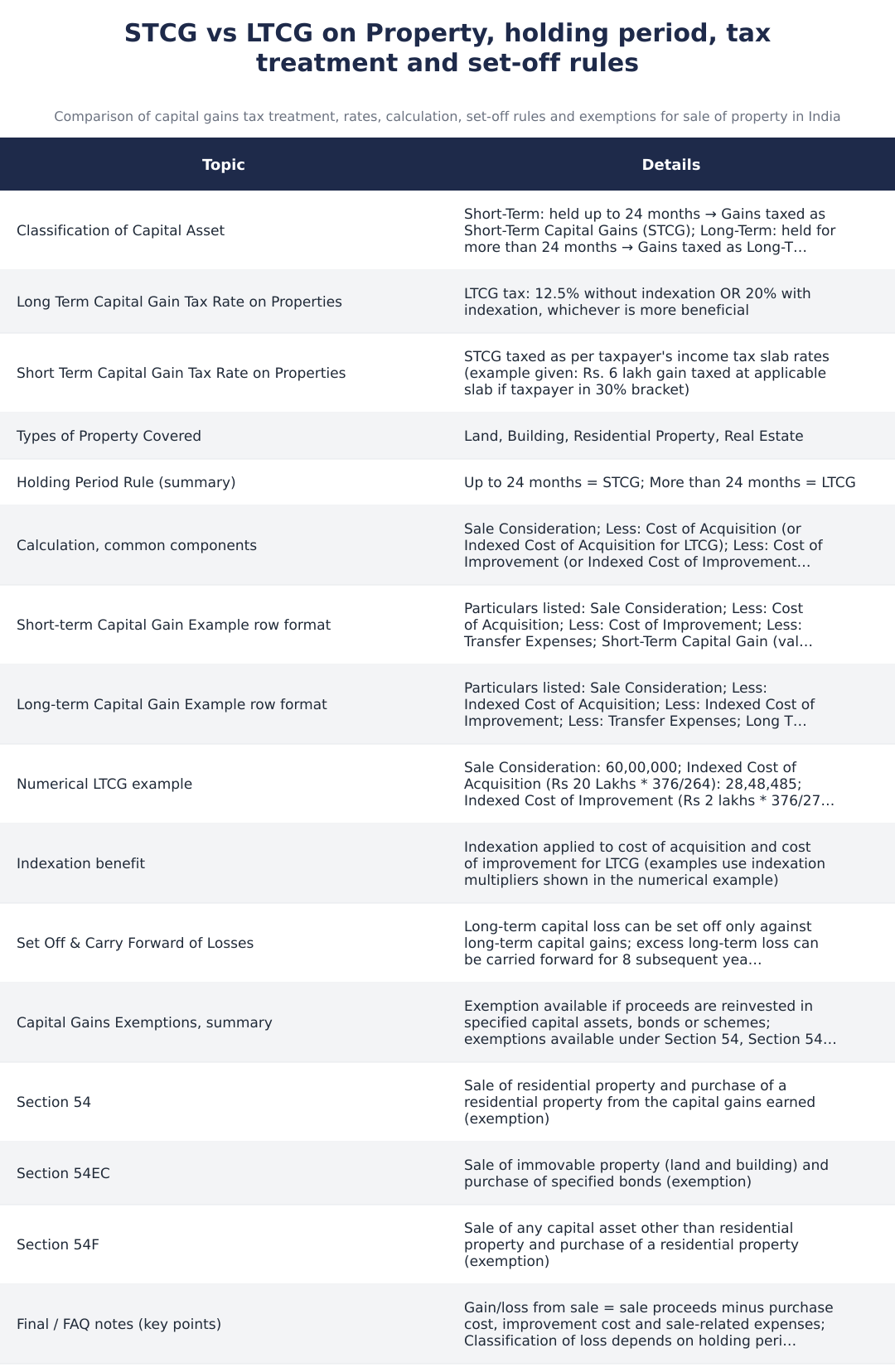
| Short-Term Capital Asset | Up to 24 months | Gains taxed as Short-Term Capital Gains (STCG), taxed as per taxpayer's income tax slab rates |
| Long-Term Capital Asset | More than 24 months | Gains taxed as Long-Term Capital Gains (LTCG), taxed at 20% with indexation benefit |
Long Term Capital Gain Tax Rate on Properties
When an immovable property is held for more than 24 months it qualifies as a long-term capital asset. The statutory tax treatment for gains arising on such assets is long-term capital gains (LTCG). LTCG on immovable property is taxed at a special flat rate distinct from normal slab rates.
Specifically, long-term capital gains on immovable property are taxed at 20% and the taxpayer may avail of the indexation benefit when computing the cost components. Indexation adjusts the cost of acquisition and cost of improvement for inflation, which typically reduces the taxable gain compared with not indexing. The availability of indexation is a key reason why LTCG are taxed at a separate percentage rate rather than slab rates.
Short Term Capital Gain Tax Rate on Properties
If a property is held for up to 24 months, it is a short-term capital asset and any gain on its sale is characterised as short-term capital gain (STCG). Unlike LTCG, there is no flat special percentage for STCG on property.
Short-term capital gains on sale of property are taxed according to the individual taxpayer's income tax slab rates. In practice that means the effective tax on the gain depends on the taxpayer's total taxable income and their applicable slab, for example, if the short-term capital gain is Rs 6 lakh and the person falls in the 30% tax bracket, then the Rs 6 lakh gain will be taxed at the slab rate applicable to that individual rather than at a single fixed rate.
Calculation of Capital Gains
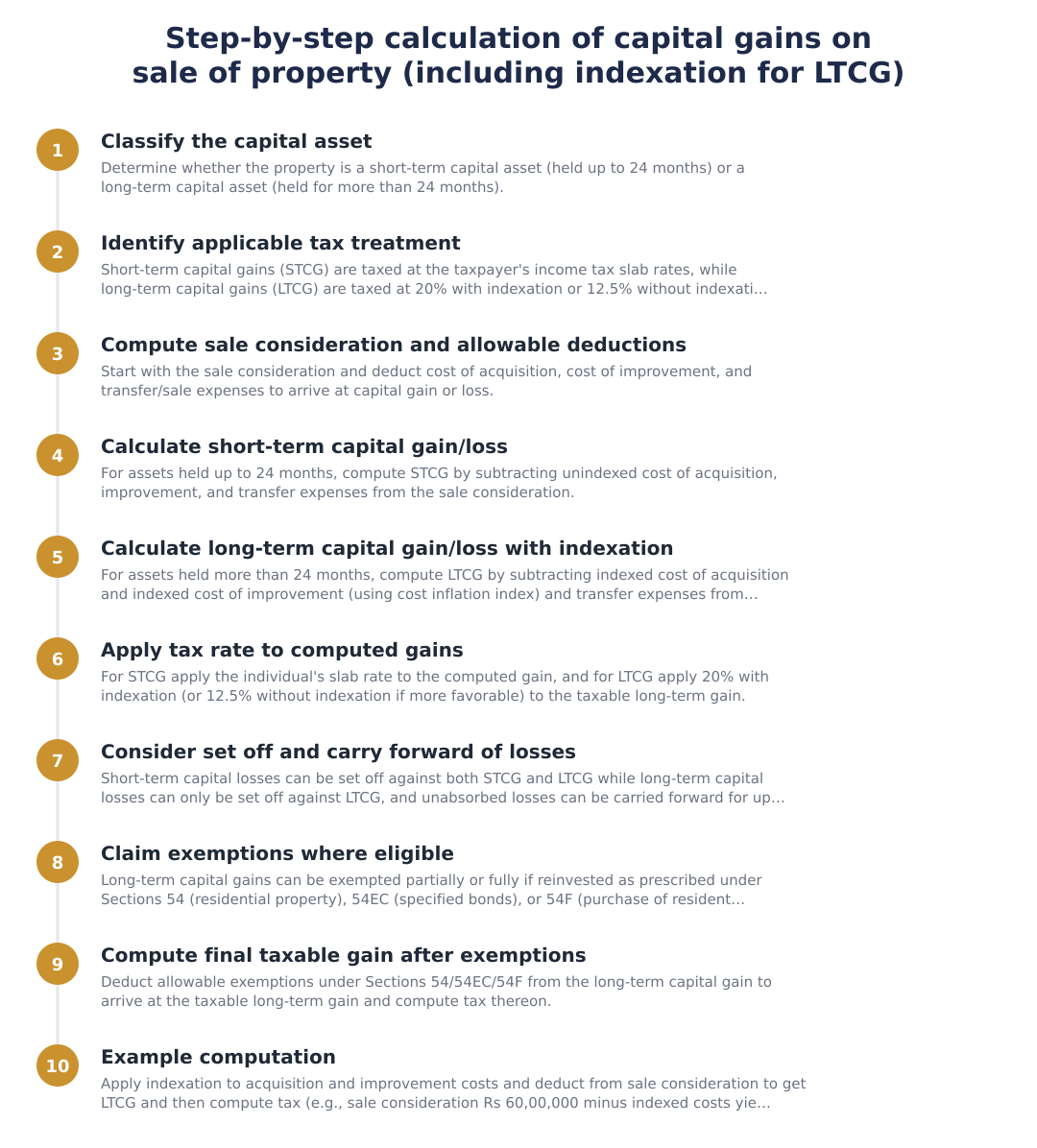
Classify the asset as short-term or long-term based on whether it was held for up to 24 months (STCG) or more than 24 months (LTCG).
Start with sale consideration and deduct cost of acquisition, cost of improvement and transfer expenses. For LTCG use indexed cost of acquisition and indexed cost of improvement.
If STCG, include the computed gain in income and tax it at the taxpayer's slab rate. If LTCG, apply the 20% rate after applying indexation to the cost components.
Set Off & Carry Forward of Losses on Sale of Immovable Property
Losses arising from sale of immovable property are treated as capital losses and the rules for set-off and carry forward depend on whether the loss is short-term or long-term. The classification of the loss follows the holding period of the asset that generated it.
A long-term capital loss can be set off only against long-term capital gains. If the loss cannot be fully absorbed in the year of the sale, the unadjusted portion may be carried forward for up to 8 subsequent assessment years to be set off against future long-term capital gains. Conversely, a short-term capital loss is more flexible: it can be set off against both short-term and long-term capital gains in the year of the loss, and any remaining short-term loss can also be carried forward for 8 years.
Capital Gains Exemptions For Properties
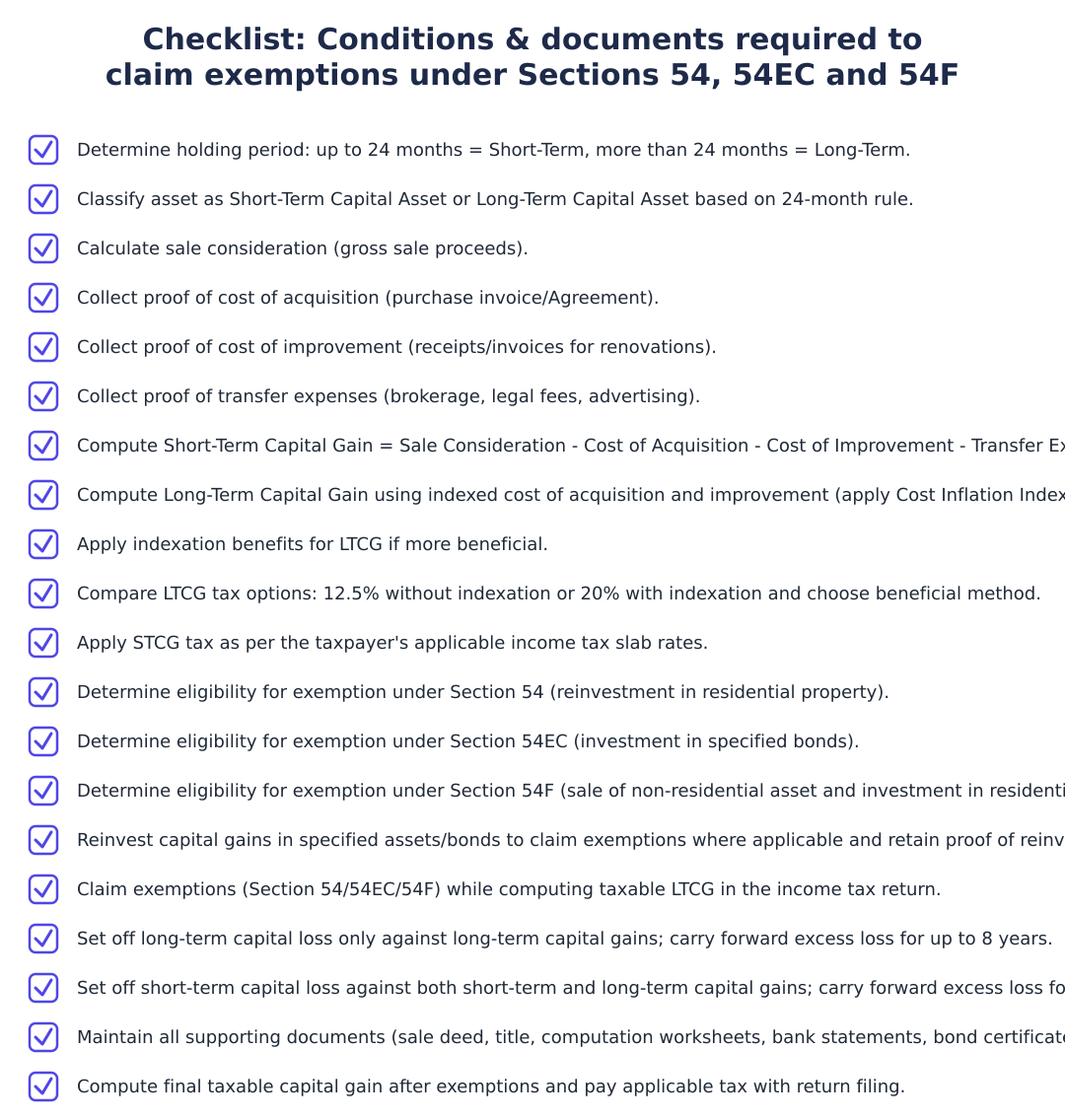
There are specific exemptions available to reduce or defer tax on long-term capital gains from sale of property, subject to conditions laid down in the Income Tax Act. The principal provisions often used are Sections 54, 54EC and 54F.
Section 54 applies when long-term capital gains arise from sale of a residential property and the taxpayer reinvests the gains in another residential property as specified in the section. Section 54EC provides an exemption where the gains from sale of immovable property (land and building) are invested in certain specified bonds within the prescribed time. Section 54F applies where long-term gains arise from sale of any capital asset other than a residential house and the taxpayer uses the net sale proceeds to purchase a residential property. Each exemption has its own qualifying conditions and timelines that must be met to claim relief.
In summary, tax on gains from sale of property hinges primarily on the holding period: up to 24 months leads to STCG taxed at slab rates, while holdings beyond 24 months attract LTCG taxed at 20% with indexation. The computation requires deduction of acquisition, improvement and transfer costs (with indexation for LTCG). Losses follow set-off rules that differ for short-term and long-term losses and can be carried forward for up to 8 years. Where applicable, Sections 54, 54EC and 54F offer routes to exempt or defer tax on long-term gains subject to their specific conditions.
Frequently asked questions
How do I know if the sale of my property is a short-term or long-term capital gain?
If you held the immovable property for more than 24 months, the sale is treated as a long-term capital gain (LTCG); if held for up to 24 months, it is a short-term capital gain (STCG). The 24-month holding period applies to land, buildings and residential property for classifying the asset. This classification matters because STCG is taxed at your applicable income-tax slab rate, while LTCG gets special taxation and indexation benefits. For example, selling a house held for 30 months will be LTCG, while selling it after 18 months will be STCG.
What tax rate applies to short-term capital gains on property?
Short-term capital gains (STCG) from sale of property are taxed at the seller’s applicable income-tax slab rates. There is no separate flat percentage for STCG on property, the gain simply adds to your total taxable income and is taxed according to your slab (for example, 5%, 20%, or 30% depending on total income). To compute STCG, subtract cost of acquisition, cost of improvement and transfer expenses from the sale consideration to arrive at the gain. If you incur a short-term capital loss, it can be set off against both short-term and long-term capital gains and any excess can be carried forward for 8 years.
What is the long-term capital gains tax rate on property and does indexation apply?
Long-term capital gains (LTCG) on property are taxed at 20% after allowing indexation of the cost of acquisition and improvement, or at 12.5% without indexation if that is more beneficial, with the taxpayer required to choose the method that gives the lower tax. Indexation adjusts historical costs using cost inflation index (CII) to reflect inflation, which can substantially reduce taxable gains (for example, Rs. 20 lakh indexed to a later year's CII may become Rs. 28.48 lakh as shown in the example). LTCG is calculated by deducting indexed cost of acquisition, indexed cost of improvement and transfer expenses from the sale consideration, and specified exemptions under Sections 54/54EC/54F can further reduce taxable LTCG.
How do I calculate short-term capital gain from selling a property?
Short-term capital gain (STCG) is calculated by subtracting the cost of acquisition, cost of improvement and transfer expenses from the sale consideration to arrive at the net gain, which is then taxed at your income-tax slab rate. For example, if sale consideration is Rs 60 lakh and your allowable acquisition plus improvement and transfer costs total Rs 54 lakh, the STCG is Rs 6 lakh and this amount will be added to your taxable income. Ensure you retain proof of purchase price, receipts for improvements and bills for transfer expenses (brokerage, advertising, legal fees) to claim these deductions. Short-term capital loss can be set off against both STCG and LTCG and the unabsorbed portion can be carried forward for 8 years.
How do I compute long-term capital gain from sale of property with indexation?
Long-term capital gain (LTCG) is computed by taking the sale consideration and deducting the indexed cost of acquisition, indexed cost of improvement and transfer expenses, where indexation applies using the Cost Inflation Index (CII). For example, selling for Rs 60,00,000 with original acquisition cost of Rs 20,00,000 indexed (20,00,000 * 376/264 = Rs 28,48,485) and indexed improvement cost (2,00,000 * 376/272 = Rs 2,76,471) yields LTCG of Rs 28,75,045, and LTCG tax at 20% would be Rs 5,75,009. You must use the CII figures relevant to the year of acquisition and the year of transfer, and keep supporting documents for all claimed costs and indexation calculations.
What exemptions are available to save tax on long-term capital gains from property sale?
Exemptions on LTCG from property sale are available under Sections 54, 54F and 54EC if you reinvest the gains in specified assets within prescribed timelines. Section 54 allows exemption when you reinvest capital gains from sale of a residential property into another residential property (purchase within 1 year before or 2 years after sale, or construction within 3 years), Section 54EC allows exemption by investing up to Rs 50 lakh in specified bonds (such as certain NHAI or REC bonds) within 6 months of transfer, and Section 54F applies when you sell any capital asset other than a residential house and invest proceeds in a residential property. The exemption amount depends on the amount reinvested and certain conditions (e.g., holding the new asset for specified periods), so partial reinvestment limits the exempt amount proportionately.
How do I claim Section 54 exemption when I buy a new house after selling an old one?
You can claim Section 54 exemption by reinvesting the long-term capital gains from the sale of a residential property into the purchase of one or more residential properties within specified time limits, purchase within one year before or two years after the sale, or construction within three years after the sale. The exemption amount equals the lower of the capital gain or the cost of the new residential property purchased (or amount deposited in a Capital Gains Account Scheme before filing return if you haven’t yet bought). You must retain sale deed, purchase/construction documents or CGAS deposit proof and disclose the exemption claim in your income tax return; if you sell the new property before the prescribed holding period (usually 3 years for Section 54), the exemption may be reversed.
How does set off and carry forward of losses work for property sale losses?
If you incur a long-term capital loss from sale of immovable property, it can only be set off against long-term capital gains, and any unabsorbed long-term loss can be carried forward for 8 assessment years; a short-term capital loss can be set off against both short-term and long-term capital gains and the balance carried forward for 8 years. For example, an LTC loss in Year 1 can’t be set off against a salary or business income but can be carried forward to be adjusted against future LTCG in subsequent years up to 8 years. To carry forward capital losses you must file your income-tax return within the due date for that assessment year; otherwise the loss cannot be carried forward.
Is TDS applicable when I sell a property and how does it affect capital gains tax?
Yes, TDS at 1% under Section 194-IA is applicable on sale of immovable property (other than agricultural land) if the sale consideration exceeds Rs 50 lakh, and this TDS is deductible by the buyer at the time of payment and can be claimed as tax paid against your capital gains tax liability. The TDS amount is independent of the capital gains computation, you still compute STCG or LTCG as per law and pay any balance tax after adjusting TDS already deducted; if excess TDS was deducted, you can claim refund while filing the return. Note that if the buyer does not deduct TDS when required, the buyer may be liable, but the seller should ensure Form 26AS reflects the TDS credit before filing returns.
Need help staying Income Tax compliant?
MoneyGence's AI Finance OS tracks your compliance, wallet share, and finances in one place, built for agencies and growing businesses.
Get started with MoneyGence