CBIC GST Rate Notification 2026: Finance Act Amendments (from May 1)
This guide explains what it means when the Central Board of Indirect Taxes and Customs (CBIC) revises a GST rate notification in light of changes introduced through a Finance Act. You will learn how such revisions typically affect pricing, compliance, invoicing and GST returns, and what practical steps businesses and tax professionals should consider when a rate notification is modified. The goal is to help readers understand the operational and compliance implications so they can prepare, adapt accounting systems, communicate with customers and suppliers, and reduce risk of errors or disputes. While this guide does not rely on specific numeric rates or dates, it outlines the typical types of changes that a CBIC notification may implement, the common downstream impacts for different business functions (billing, contracts, procurement and IT), and the prudent actions that businesses can take to respond in a structured way. Whether you are a GST practitioner, a finance head at a mid-size firm, or an owner-operator running accounting for a small business, this guide will help you prioritise tasks and coordinate with colleagues, advisors and software vendors. It also highlights common pitfalls and how to monitor for further clarifications from tax authorities. By the end, you will have a practical checklist and framework to manage a GST rate notification revision with minimal disruption to operations and compliance workflows.
What a GST rate notification revision typically covers
When the central tax authority issues a revision to a GST rate notification after changes in law, the notification commonly clarifies which goods and services are taxed at which rates and may amend earlier lists, descriptions or applicability conditions. Such revisions can also include transitional provisions and clarifications about how the change should apply to supplies made before and after the effective date, though the exact content varies with each notification.
For businesses, the important aspects are the scope of the amendment (which items are affected), whether the change is prospective or retrospective, and any conditions attached to eligibility for the revised rate. Professionals often need to read the notification together with accompanying explanatory material from the tax department to interpret how the change affects composite supplies, bundled offerings and exempt or zero-rated supplies.
Practical impacts on business operations
A rate revision can affect pricing strategy, margins and customer communications. Businesses must assess whether their catalogue prices include GST or are listed as exclusive of tax, and decide whether to absorb the change, pass it to customers, or adjust base prices. This decision can have commercial and contractual implications, especially where long-term contracts or quoted rates are in place.
Operationally, accounting masters, such as product tax codes, billing rules and ERP GST configuration, need review and update. IT and billing teams must ensure invoices reflect the correct tax classification and rate, and that return filings capture the reclassified transactions correctly. Reconciliation between sales registers and returns becomes crucial to avoid mismatches and notices.
Compliance actions to prioritise
First, obtain and review the official notification and any explanatory circulars or FAQs released by the tax authority. Cross-check the affected product or service descriptions against your catalogue and identify items needing reclassification. Engage your tax adviser or in-house compliance team to interpret any ambiguous drafting and to decide on the correct tax treatment.
Second, update internal documentation and systems: tax code mappings, pricing sheets, invoice templates and your ERP or billing software. Test sample transactions end-to-end to confirm that invoices, ledger entries and return-level summaries align. Finally, communicate changes to sales, procurement and customer-facing teams so they can respond to queries and implement revised pricing or contract amendments as needed.
Common pitfalls and how to avoid them
A frequent pitfall is treating a descriptive change as a mere drafting tweak when it actually alters the scope of the tariff entry. To avoid misclassification, map your actual goods and services to the notification language rather than relying on legacy labels or internal nomenclature. If items straddle different categories, document your rationale and maintain contemporaneous evidence.
Another issue arises with transitional supplies and timing: businesses sometimes misapply a new rate to supplies made before the effective date or overlook the need to issue credit/debit adjustments when required. Clear process owners, a documented cutover plan for system changes, and test runs help reduce such errors. Retain audit trails for decisions and communications in case of later queries from tax authorities.
Staying updated and next steps
Monitor official channels for any follow-up clarifications, corrigenda or implementation guidance issued after a rate notification. Tax departments frequently publish FAQs or circulars to resolve common interpretational questions; these can materially change how an amendment should be implemented in practice.
Coordinate with software vendors and tax consultants to schedule timely updates and regressions tests. Maintain an internal change-log recording when tax masters were updated, who authorised the change, and the test results. Finally, prepare to respond to any downstream queries from customers and auditors by having clear documentation and a consistent, defensible approach to the new tax treatment.
A CBIC revision to a GST rate notification can have widespread operational and compliance implications even when the change appears technical. The recommended approach is to promptly review the notification, map it to your product and service catalogue, update systems and processes, document the rationale for tax treatment and maintain clear communications with stakeholders. These steps will reduce disruption and help ensure accurate reporting under GST.
Frequently asked questions
What did the CBIC change in the GST rate notification under the Finance Act 2026?
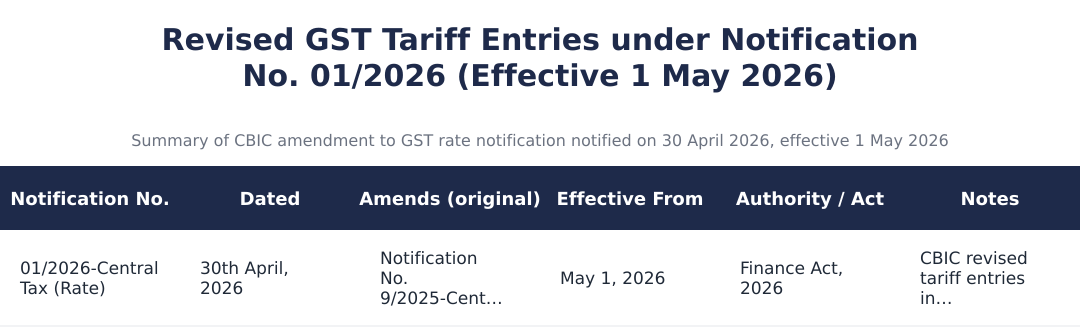
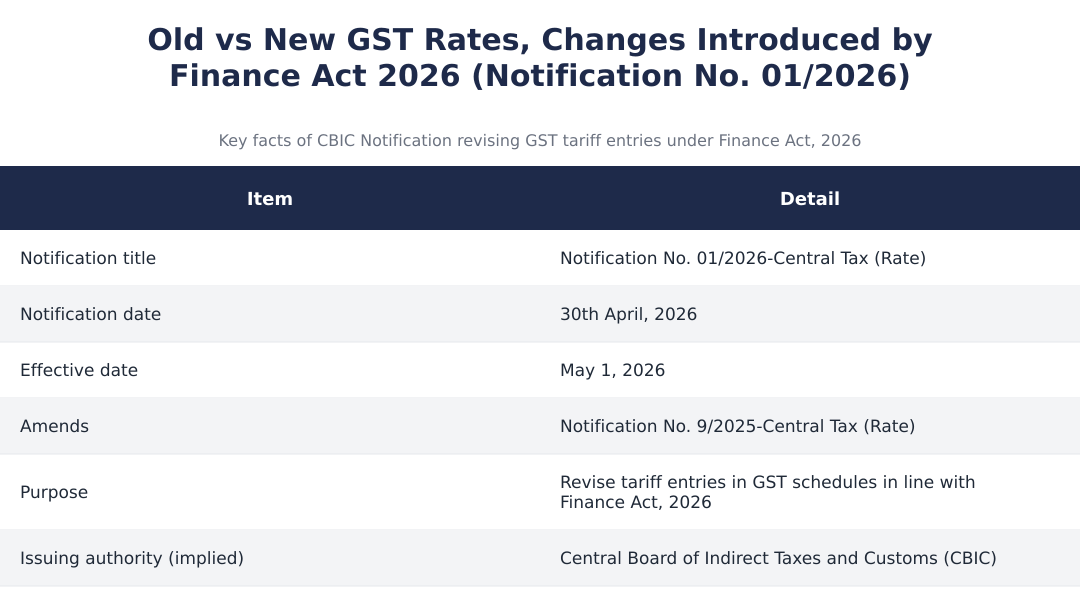
The CBIC amended Notification No. 9/2025-Central Tax (Rate) by issuing Notification No. 01/2026-Central Tax (Rate) dated 30th April 2026 to revise tariff entries in the GST schedules so they align with the Finance Act, 2026. The amendment updates the tariff entries and rates in the GST schedules rather than introducing a new tax, and is intended to bring statutory rate tables in line with the Finance Act. These changes apply to the entries and items listed in the amended notification and will affect tax treatment from the effective date specified.
When do the revised GST tariff entries take effect?
The revised tariff entries take effect from 1st May 2026 as stated in the CBIC amendment. Notification No. 01/2026-Central Tax (Rate) dated 30th April 2026 specifies that the revisions to Notification No. 9/2025 apply from that date. Businesses must apply the updated rates and descriptions for supplies or invoices dated on or after 1st May 2026, unless a specific transitional provision in the notification provides otherwise.
Which official notification documents these GST rate changes?
The changes are documented in Notification No. 01/2026-Central Tax (Rate), dated 30th April 2026, which amends Notification No. 9/2025-Central Tax (Rate). Notification No. 01/2026 explicitly revises tariff entries in the GST schedules to align them with the Finance Act, 2026 and is the authoritative legal instrument for the rate revisions. Taxpayers should refer to this notification text for the exact amended entries and any specified conditions or effective dates.
Who is affected by the CBIC revision of GST tariff entries?
Suppliers, service providers, manufacturers, traders and any person or business dealing in goods or services listed in the amended GST schedules are affected by the revision. The revised tariff entries change the taxable classification or rate for specific goods/services, which impacts pricing, invoicing, tax collection, and compliance obligations from the effective date of 1st May 2026. Input tax credit, accounting systems and GST returns may also need updates to reflect the new entries and rates.
Does the amendment change GST rates across all schedules or only specific entries?
The amendment revises specified tariff entries in the GST schedules rather than blanket changes across all schedules; it aligns listed entries with the Finance Act, 2026. Notification No. 01/2026 updates particular HS/tariff lines or descriptive entries in Notification No. 9/2025, so only those entries explicitly mentioned are affected. Taxpayers should consult the notification text to identify which specific schedule lines and rates were revised.
How should businesses implement the revised tariff entries in their billing and accounting?
Businesses should update their product/service master data, billing templates, and accounting/GST return software to reflect the revised tariff entries and rates effective 1st May 2026. Review invoices, price lists and contracts to determine if the changed entries affect taxable classification or rates, and communicate any price or tax changes to customers and vendors. It is also prudent to reconcile stock, apply any transitional provisions noted in the notification, and consult a tax advisor for items where classification is unclear.
Are there transitional provisions or exceptions in Notification No. 01/2026 for supplies straddling the effective date?
Notification No. 01/2026-Central Tax (Rate) is the amending instrument that may include specific transitional provisions or exceptions, but the summary states the tariff revisions apply from 1st May 2026; any detailed transitional rules will be in the notification text. Where supplies or contracts span the effective date, taxpayers should check the precise wording of the notification for guidance on invoice dates, supply dates and stock on hand treatment, and follow standard GST date-of-supply rules if no special transition is provided. When in doubt, obtain a professional advisory or refer to CBIC clarifications.
Will the revision affect input tax credit (ITC) claims for earlier purchases?
The revision to tariff entries affects rates going forward and does not retroactively change the ITC entitlement for past purchases; ITC on invoices issued prior to 1st May 2026 should be claimed under the rules and rates applicable at the time of the invoice. For supplies or invoices dated on or after 1st May 2026, ITC will be available subject to the revised classification and rate, and taxpayers must ensure their GSTR filings and purchase records reflect the updated entries. If reclassification causes disputes, documentation and advisory support will be necessary to substantiate ITC claims.
Where can I check the exact list of items and rates changed by the CBIC notification?
You can check the exact amended tariff entries and rates by reading Notification No. 01/2026-Central Tax (Rate) dated 30th April 2026, which amends Notification No. 9/2025-Central Tax (Rate); the full text lists the specific schedule entries and conditions. The official CBIC website and Gazette publication will host the notification PDF, and tax portals or professional services (like TaxGuru summaries) typically provide searchable lists and explanations of the revised lines. For authoritative interpretation or complex cases, consult the notification text and/or a GST practitioner.
Need help staying GST compliant?
MoneyGence's AI Finance OS tracks your compliance, wallet share, and finances in one place, built for agencies and growing businesses.
Get started with MoneyGence