Complete Annual ROC Compliance Checklist: Private Limited Company
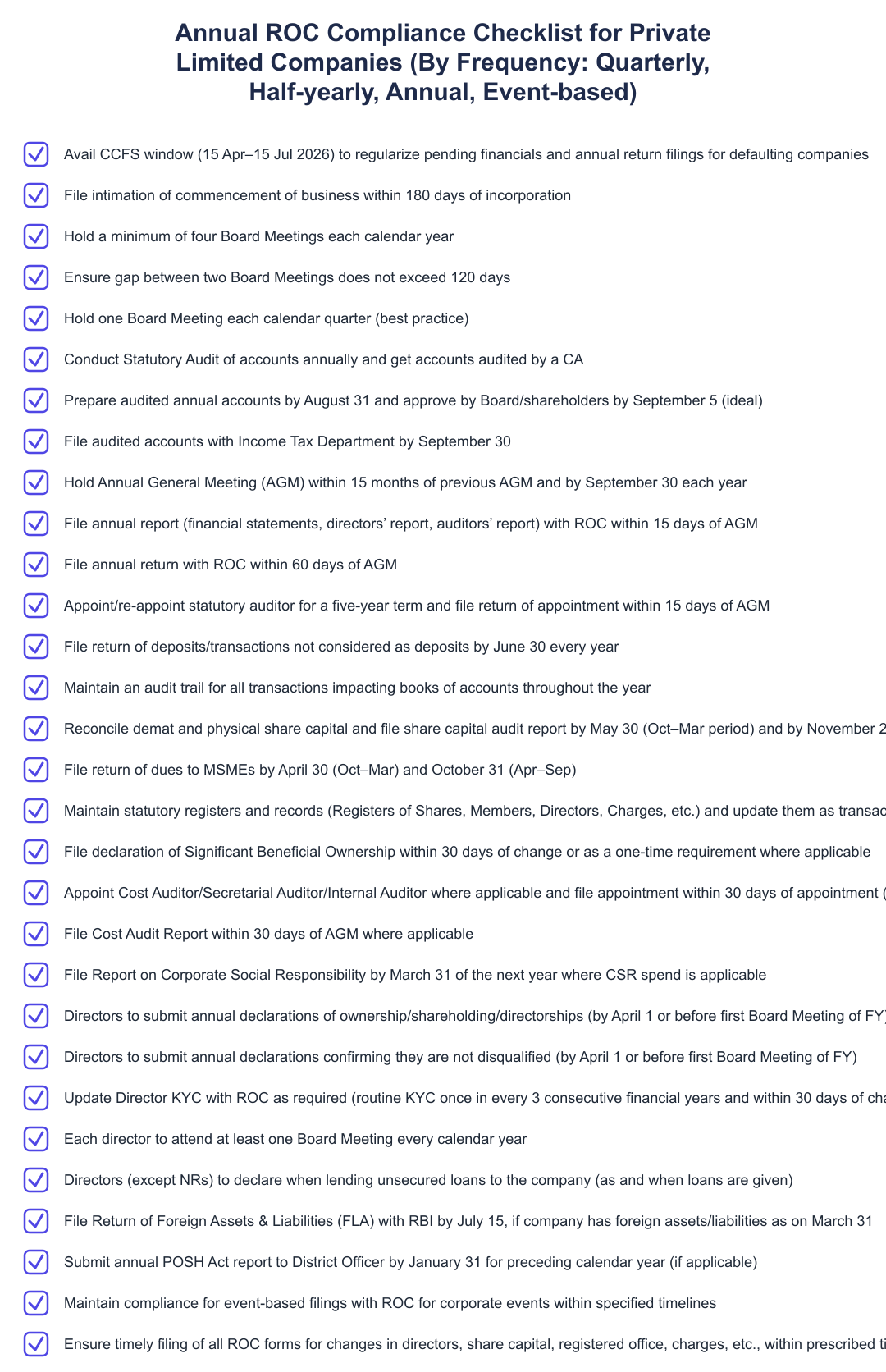
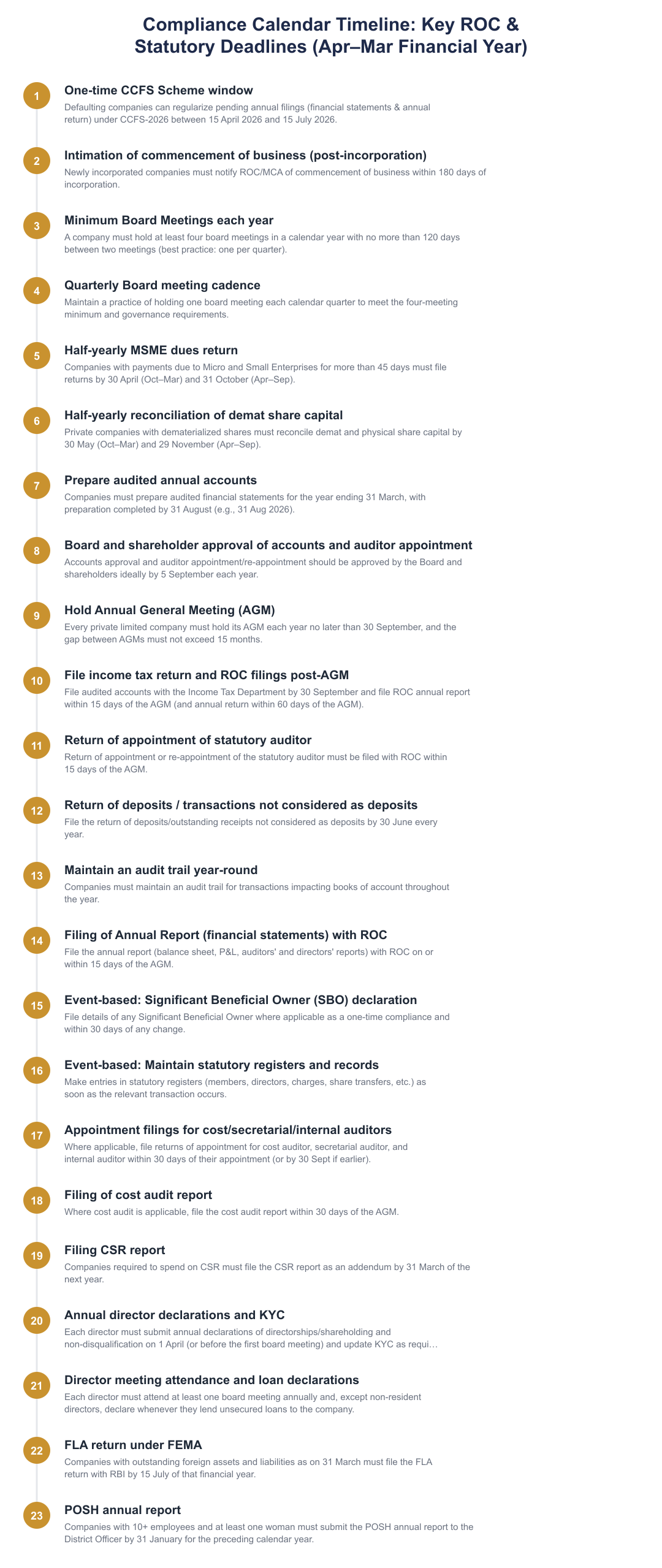
This guide gives private limited company directors and company secretaries a concise, practical checklist of mandatory annual compliance points under corporate law and related statutes. You will learn which board and shareholder meetings are required across the year, what audit and auditor appointment obligations to plan for, how to manage statutory registers, and when workplace‑related reporting under POSH is necessary. Compliance with these requirements is central to good corporate governance, helps avoid procedural defects, and keeps a company in good standing with regulators. The checklist focuses on recurring, annual and event‑driven obligations that apply to most private companies: convening board meetings at required intervals (including virtual meetings where useful), preparing audited financial statements, holding the annual general meeting, appointing auditors for the statutory term, maintaining statutory registers with timely entries, and meeting internal complaints committee reporting obligations where applicable. Each item is explained with practical implications for planning the company’s calendar, assigning responsibilities, and documenting actions so that filings and records reflect what actually happened. Use this checklist to coordinate the company secretary, finance team and board so deadlines are not missed and statutory records remain accurate. The following sections break the year into an actionable timeline, explain the legal requirements and good practices, and list the minimum checks every private limited company should perform before closing its books and convening the AGM.
Corporate governance obligations under the Companies Act, 2013
The Companies Act, 2013 establishes mandatory corporate governance requirements that private limited companies must observe. These requirements capture core governance processes such as board oversight, annual shareholder meetings, statutory audits and maintaining corporate records; together they form the backbone of statutory compliance and corporate accountability.
For directors and company officers this means planning the company’s annual cycle around a small number of fixed obligations so that board decisions, audited accounts and shareholder approvals occur in the correct sequence. Good governance reduces legal risk, preserves accurate records for investors and creditors, and ensures the company can evidence compliance if challenged.
Annual compliance timeline, minimum steps
Ensure at least four board meetings are convened in each calendar year so the company satisfies the statutory minimum and maintains oversight of business and accounts.
Schedule meetings so the time gap between any two board meetings does not exceed 120 days; virtual meetings are permitted where needed to meet this requirement.
At the end of the financial year, the company must prepare its accounts and have them audited by a Chartered Accountant as a compulsory step before shareholder approval.
Convene the AGM each year (by the prescribed date) ensuring the interval between two AGMs is no more than 15 months; the AGM is the forum to approve audited financial statements.
The auditor is appointed for a five‑year term at the AGM; plan the AGM agenda and resolutions accordingly when an audit appointment or reappointment is required.
Update registers (shares, members, directors, charges, etc.) as soon as the relevant transaction occurs so records remain current and verifiable.
If the company has 10 or more employees with at least one woman employee, constitute an Internal Complaints Committee (ICC) and submit its annual report to the District Officer by 31 January for the preceding calendar year.
Board meetings: frequency, gaps and virtual meetings
A private company must hold a minimum of four board meetings in each calendar year. This minimum is intended to ensure regular director engagement with operational and strategic matters, and to provide a series of documented decisions that support the company’s annual reporting and compliance cycle.
The law also requires that the gap between any two board meetings not exceed 120 days. Practically, companies should plan one board meeting approximately each quarter and maintain a rolling calendar so unexpected events do not create a statutory breach. Virtual board meetings are expressly permitted and are a useful tool to meet the frequency and gap requirements when in‑person attendance is difficult.
Statutory audit and auditor appointment
At the end of every financial year, a company must prepare its accounts and have them audited by a Chartered Accountant. The statutory audit is compulsory and forms the basis for shareholder review and approval of the financial statements at the AGM.
The company appoints its statutory auditor at the AGM, and that auditor serves for a five‑year term. Boards should therefore align the audit timetable with AGM scheduling so there is sufficient time for the auditor to complete fieldwork, issue the audit report, and for the board and shareholders to consider the audited accounts when approving them.
Statutory registers and POSH reporting
Private companies must maintain a set of statutory registers, for example registers of shares, members, directors and charges, and entries must be made as soon as the relevant transaction takes place. Prompt entries protect the company and its officers by ensuring records accurately reflect ownership, authority and encumbrances when required by stakeholders or regulators.
Separately, under the POSH Act, companies that have at least 10 employees and at least one woman employee are required to constitute an Internal Complaints Committee (ICC) and submit an annual report to the District Officer in every calendar year. That annual report must be submitted by 31 January for the preceding calendar year. Companies meeting these thresholds should incorporate POSH reporting into their annual compliance checklist so the ICC’s findings and actions are documented and filed on time.
Use this checklist to align the company’s finance, secretarial and board calendars so statutory obligations are met in sequence: convene board meetings on time (allowing virtual participation), complete the statutory audit, hold the AGM to approve accounts and appoint the auditor for the five‑year term, keep statutory registers current with immediate entries, and, where applicable, file the ICC annual report under POSH by 31 January. Regular planning and delegation of responsibilities will keep compliance simple and defensible.
Frequently asked questions
What are the minimum board meeting requirements for a private limited company under the Companies Act?
A private limited company must hold at least four board meetings in each calendar year, with no gap of more than 120 days between two meetings. Virtual board meetings are permitted, and best practice is to hold one meeting each calendar quarter to satisfy the time-gap rule. Directors should plan the schedule at the start of the year and record minutes for compliance and audit trail purposes. Failing to hold the minimum number or maintain minutes can lead to procedural non-compliance during audits or ROC scrutiny.
When must a private limited company hold its Annual General Meeting (AGM)?
A private limited company must hold its AGM every year and not later than 30th September of that year, ensuring the gap between two AGMs is not more than 15 months. The audited financial statements should be approved by the board and shareholders by around 5th September ideally so filings and notices can be completed in time. The company must file its annual report with the ROC within 15 days of the AGM and file the annual return within 60 days of the AGM. Missing AGM timelines can trigger ROC penalties and restrict certain filings until regularized.
What are the timelines for preparing, auditing and filing annual financial statements?
A company must prepare audited annual accounts by 31st August, get them approved by the board and shareholders by about 5th September, file them with the Income Tax Department by 30th September and file the annual report with the ROC within 15 days of the AGM. The statutory audit of accounts by a Chartered Accountant is mandatory at the end of the financial year and the audit trail must be maintained throughout the year. Delayed preparation or filing can attract ROC penalties and may affect tax filings and compliance ratings. Companies should coordinate audit timelines early to meet these cascading deadlines.
What is the CCFS scheme and when does it run for defaulting companies?
CCFS-2026 (Companies Compliance Facilitation Scheme) is a one-time compliance window launched by MCA for defaulting companies to regularize pending statutory annual filings like financial statements and annual returns. The scheme runs from 15th April 2026 and closes on 15th July 2026, providing a limited period for rectification of defaults. It applies only to companies that have lapsed in filings and aims to reduce penalty exposure and enable revival of good standing. Companies should evaluate pending forms and prepare documents promptly to take advantage of the window before it closes.
What annual and half-yearly compliances should companies follow for MSME dues and demat share reconciliation?
Companies must file a half-yearly return of dues to Micro and Small Enterprises by 30th April for October–March and by 31st October for April–September if payments are overdue beyond 45 days. For companies with shares in demat form, a reconciliation of share capital audit report is mandatory: by 30th May for October–March and by 29th November for April–September to ensure dematerialized and physical shares tally with issued capital. These filings are time-bound and non-compliance can attract penalties and creditor disputes, so companies should calendar these dates each year. Maintain accurate supplier and share records to avoid reporting errors.
When and how must directors update KYC and submit declarations to the company?
Each director must submit annual declarations disclosing their ownerships, shareholding and directorships and confirm they are not disqualified, ideally on 1st April or before the first board meeting of the financial year. Director KYC with ROC must be updated routinely, once in every three consecutive financial years by 30th June of the following year, and within 30 days whenever there is a change in particulars. Additionally, every director is expected to attend at least one board meeting per calendar year and must file declarations when lending unsecured loans to the company. Non-compliance in KYC or declarations can lead to disqualification, penalties, or rejection of ROC forms involving the director.
What event-based filings must a company make when there is a corporate change, like a new significant beneficial owner or charge?
For event-based changes, companies must file the relevant ROC forms within specified timelines, for example, declaration of Significant Beneficial Ownership (SBO) is a one-time requirement and must be filed within 30 days when a change occurs. Maintenance of statutory registers such as Register of Members, Register of Directors and Register of Charges must be updated as soon as the relevant transaction occurs. Other event-based filings (appointments of auditors, secretarial/cost/internal auditors, filing cost audit or CSR reports) have specific windows, usually within 30 days of appointment or by prescribed annual dates like 31st March for CSR addendums. Promptly lodging appropriate forms with complete attachments avoids rejections and ROC notices.
What are the key ROC filing deadlines after the AGM for annual report, annual return and auditor appointment?
After the AGM, the company must file its Annual Report (financial statements, directors’ and auditors’ reports) with the ROC within 15 days of the AGM and file the annual return within 60 days of the AGM. The return of appointment or re-appointment of the statutory auditor must be filed within 15 days of the AGM as well, and auditors are generally appointed for a five-year term approved at the AGM. Timely filings ensure statutory compliance and avoid penalties; companies should coordinate board approvals and shareholder sign-offs to meet these post-AGM deadlines. If filings are delayed, companies may need to regularize late through schemes like CCFS or face ROC penalties.
Which other annual statutory filings under different Acts should companies remember (FEMA, POSH, deposits)?
Apart from Companies Act filings, companies with foreign assets/liabilities must file the FLA (Foreign Liabilities and Assets) return with RBI by 15th July for balances as on 31st March, and companies with 10+ employees including one woman must submit the POSH annual report to the District Officer by 31st January for the preceding calendar year. Companies must also file the Return of Deposits or transactions not considered deposits by 30th June each year where applicable. These cross-Act filings have independent deadlines and non-compliance can attract penalties or regulatory actions, so corporates should track them alongside ROC and tax calendars.
Need help staying Compliance compliant?
MoneyGence's AI Finance OS tracks your compliance, wallet share, and finances in one place, built for agencies and growing businesses.
Get started with MoneyGence