Compulsory GST Registration: Rules, Section 24 & Process
This guide explains, in plain language, what compulsory registration under GST means and what a business or individual should expect when the law requires them to obtain registration. You will learn why some persons must obtain GST registration even if they have low turnover, what categories of supplies and business activities commonly trigger mandatory registration, and the practical steps involved in applying for and maintaining a GST registration. The aim is to give a clear, operational overview so you can identify whether your situation might require registration and what documents and preparations typically help the registration process go smoothly. This is a conceptual guide: because GST rules and thresholds can change and may be subject to official notifications, always verify legal particulars against authoritative sources or with a tax professional before taking action.
Section 24 – Compulsory Registration under GST
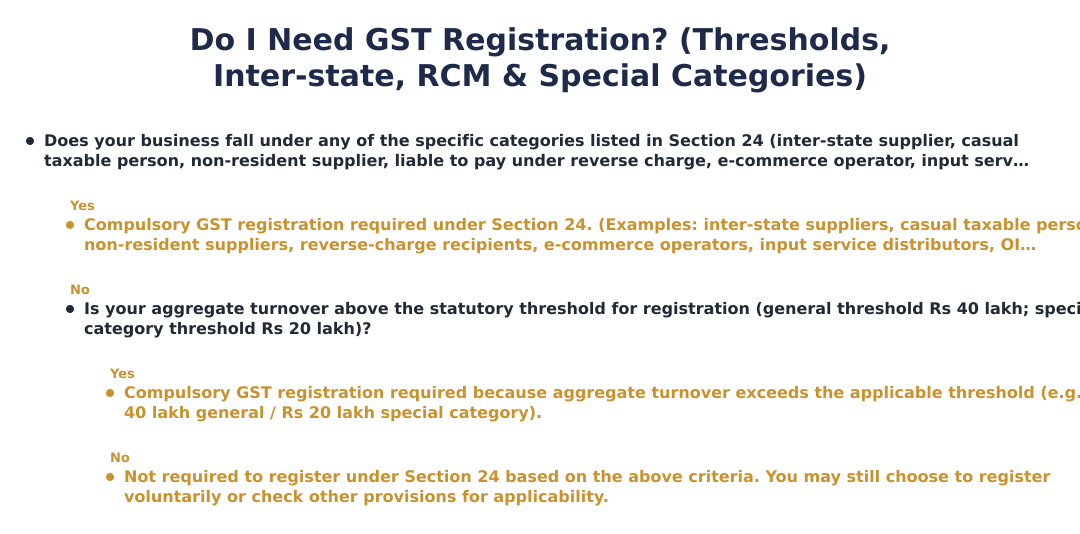
Many jurisdictions within the GST framework include a provision that makes registration compulsory for certain persons or activities. The legal text typically lists categories of taxpayers who must register irrespective of their turnover, for example, those engaged in inter-state supplies, persons required to pay tax under reverse charge, non-resident suppliers, and a few other specified classes.
Understanding the statutory provision is important because compulsory registration carries obligations: filing returns, collecting and remitting tax, issuing proper tax invoices, and complying with record-keeping requirements. Non-compliance with a mandatory registration requirement can lead to late registration consequences and may affect the ability to claim input tax credits.
This section provides a conceptual summary rather than a verbatim reproduction of any law. If you believe your business falls into one of the categories mentioned under the legal provision, check the exact wording and any recent notifications or clarifications issued by the tax authorities to confirm the requirement and effective dates.
Who is Required to Register Compulsorily under GST?
Compulsory registration typically applies to specific types of suppliers or activities rather than to all businesses. Common categories that are often captured include persons making inter-state supplies, non-resident suppliers, entities liable under reverse charge, and businesses operating through certain electronic platforms. The rationale is to ensure tax coverage where collection mechanisms or the place of supply create exposure to leakage.
Beyond the activity-based triggers, there may be additional cases such as persons making taxable supplies to unregistered recipients, businesses facilitating supplies on behalf of others, or entities performing particular roles in the supply chain. The key takeaway is that obligation depends on the nature of supply and the legal classification of the supplier, not exclusively on turnover in all situations.
Because the exact list and definitions can vary and are specified in law and rules, determine your obligation by reviewing the statutory list, any clarifying circulars, and examples supplied by the tax authority. Where doubt persists, seek professional advice to reduce the risk of inadvertent non-compliance.
GST Registration Process
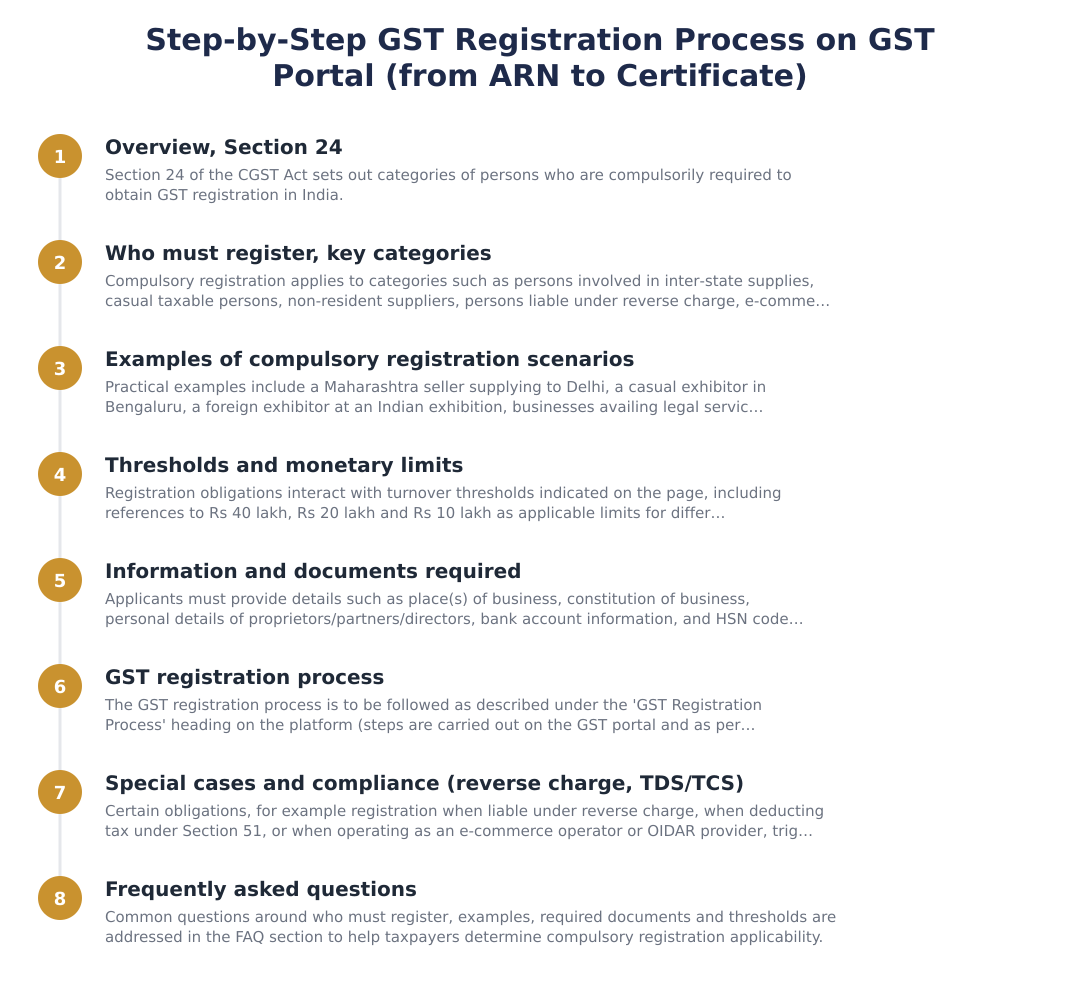
Review the nature of your supplies and the statutory categories that trigger compulsory registration. Consider business structure, place of supply, and whether you fall into any activity-based categories.
Prepare general business details such as place(s) of business, identity documents of owners or directors, bank account information, and descriptions of supplies. Exact document lists are provided by the registration portal or rules.
Fill out the online or prescribed application form with accurate details. Attach required documents and ensure digital signatures or other authentication where required.
The tax authority may seek clarifications or require verification. Respond promptly and provide additional documents if requested to avoid delays.
Once approved, note the registration identifier and the compliance obligations that follow, including return filing, tax payment, invoicing, and record maintenance.
Keep registered details current. Update the registration for changes in business address, constitution, or other prescribed particulars and adhere to periodic filing and payment requirements.
Frequently Asked Questions
Q: What happens if I should have registered but did not? A: Failing to register when required can expose you to compliance consequences, including the obligation to file retrospective returns and potential interest or penalties under applicable rules. The practical consequence is also that purchasers may not be able to claim input tax credit against supplies from an unregistered supplier.
Q: Can electronic platforms or marketplaces be required to register? A: In many GST systems, electronic platforms that facilitate supplies may have specific obligations or be required to obtain registration because they act in a facilitative or collecting capacity. Whether an entity falls into such a category depends on the law's definitions and any relevant notifications.
Q: Do non-resident suppliers need to register? A: Non-resident sellers or service providers who make taxable supplies into the jurisdiction often face separate registration rules. These rules are intended to bring such supplies within the GST net and specify the manner and timing of registration and compliance. Consult the official guidance for precise requirements.
Compulsory GST registration is triggered by the nature of activities and the role a person plays in the supply chain rather than solely by turnover in every case. Use this guide as a conceptual starting point: verify the precise legal criteria, documentation requirements, and timelines with the official tax authority or a qualified tax advisor before proceeding. Proper registration and timely compliance protect your business from downstream liabilities and enable legitimate claims of input tax credit where applicable.
Frequently asked questions
Who must register compulsorily under GST even if their turnover is below the threshold?
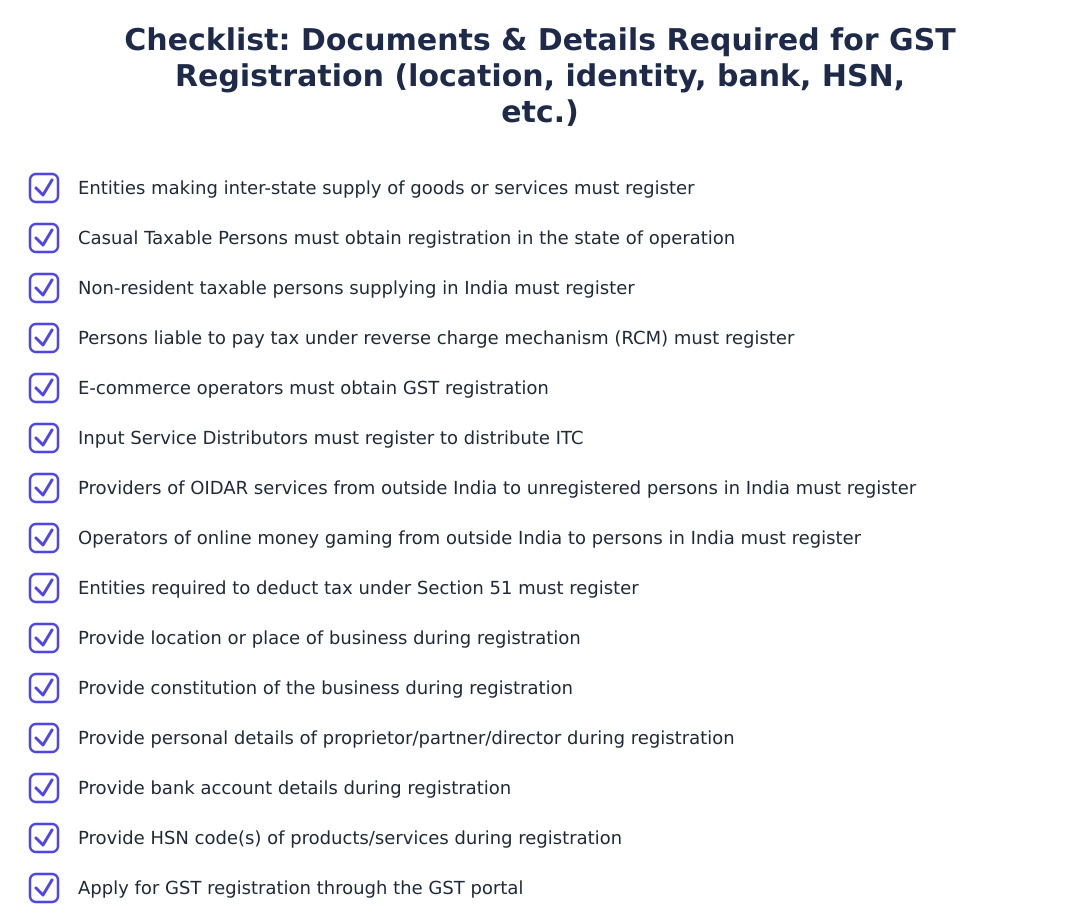
Certain categories of persons must obtain GST registration mandatorily under Section 24 of the CGST Act, even if their turnover is below the threshold. These include persons involved in inter‑state supply of goods or services, casual taxable persons (e.g., a business participating in a trade fair outside its state), non‑resident taxable persons (e.g., a foreign exhibitor selling at an Indian exhibition), persons liable to pay tax under reverse charge, e‑commerce operators, input service distributors, providers of OIDAR services from outside India to unregistered persons in India, entities operating online money gaming from outside India to persons in India, and entities required to deduct tax under Section 51. Each of these categories is specifically listed under Section 24 and triggers registration regardless of annual turnover.
Do casual taxable persons need GST registration and for how long is it valid?
Yes, a casual taxable person must obtain GST registration before making taxable supplies in a state where they do not have a fixed place of business. A casual taxable person (for example, a seller exhibiting at a trade fair in another state) must register even if turnover is below the threshold and typically applies for temporary registration for the period of the event; such registrations are granted for a specified period and may require advance tax deposit and verification as per GST rules. The registration is location‑specific and obligations include filing returns and complying with the tax payment conditions for the registration period.
Is a foreign company providing cloud services to Indian customers required to register under GST?
Yes, a foreign person providing online information and database access or retrieval (OIDAR) services from a place outside India to unregistered persons in India must obtain GST registration. For example, a US‑based cloud services provider supplying services to Indian consumers falls under OIDAR and is required to register under GST irrespective of turnover and comply with invoicing, tax payment and return filing obligations. Such non‑resident suppliers must follow the registration process for non‑resident taxable persons and may need to appoint an authorised representative or comply with additional procedural requirements.
Do e‑commerce operators like Amazon or Meesho need separate GST registration?
Yes, e‑commerce operators are required to register under GST irrespective of turnover because they facilitate supplies through their platforms and may have specific tax liabilities like collecting tax at source. Marketplaces such as Amazon, Meesho or Ola must obtain GST registration and comply with reporting, tax collection, and payment obligations set out in GST law. Additionally, e‑commerce operators often have to maintain special records and comply with provisions related to TCS (tax collected at source) and platform reporting.
What documents and details are needed to apply for GST registration?
To apply for GST registration you must provide details such as place or places of business, constitution of the business, personal details of the proprietor/partners/directors, bank account details, and the HSN code(s) of products or services supplied. These particulars are required on the online application form on the GST portal and typically supported by documents like PAN card, proof of business address, identity and address proofs of key persons, cancelled cheque or bank statement, and authorization documents for the signatory. Accurate submission of these details speeds up processing and helps avoid queries or rejections.
What is the step‑by‑step process to register on the GST portal?
You register for GST online by filling the application on the GST portal, submitting required documents and verification details, and then receiving an ARN and GSTIN after processing. The typical steps are: create a provisional application on the portal with PAN and mobile/email verification, upload documents (business address, identity of proprietors/directors, bank details, HSN codes), submit the application for approval, respond to any departmental queries, and obtain the registration certificate and GSTIN once accepted. For categories like casual or non‑resident taxable persons there are additional requirements such as advance tax deposit and temporary registration periods.
Are persons liable to pay tax under reverse charge required to register for GST?
Yes, persons who are required to pay tax under the reverse charge mechanism (RCM) must obtain GST registration irrespective of turnover. For example, a business that is required to pay GST on legal services received under RCM has to register and account for tax even if its taxable supplies are below the turnover threshold. Registered persons under RCM must file returns and discharge tax on services/goods where RCM applies in accordance with GST rules.
What are Input Service Distributors and do they need GST registration?
Yes, Input Service Distributors (ISDs) must register under GST because they distribute input tax credit of common services to their branches or units. An ISD, such as a corporate head office distributing ITC of centrally procured services to subsidiaries or locations, needs a separate GST registration and must issue ISD invoices and maintain prescribed records for allocation of credit. ISDs are governed by specific rules on distribution of credit, documentation and return filing under GST law.
Do entities required to deduct tax under Section 51 need GST registration?
Yes, entities required to deduct tax at source under Section 51 of the CGST Act must obtain GST registration irrespective of turnover. Examples include government bodies making payments to suppliers where TDS under GST is applicable; such deductors must register, deduct tax at the prescribed rates, deposit it with the government, and issue TDS certificates to suppliers. These deductors also have separate filing and reporting obligations to reconcile deductions and deposits.
Need help staying GST compliant?
MoneyGence's AI Finance OS tracks your compliance, wallet share, and finances in one place, built for agencies and growing businesses.
Get started with MoneyGence