Corporate Law in India: Formation, Governance & Company Types
This guide explains the core principles and main types of companies recognised under Indian company law, and why these distinctions matter for founders, investors and directors. You will learn the legal fundamentals that make a company a distinct entity, the practical meaning of limited liability and perpetual existence, and the statutory categories of companies such as companies limited by shares, public companies, One Person Companies (OPCs), government companies, foreign companies and Section 8 (nonprofit) companies. The guide also summarises basic corporate governance principles that should guide how companies operate. Understanding these concepts is essential when choosing a corporate form, assessing risk exposure, structuring ownership and complying with statutory obligations. Instead of procedural checklists or filing steps, this article focuses on legal character and consequences: what being a separate legal entity implies for liability and continuity, how an OPC is defined under the Companies Act, and how Section 8 companies differ in purpose and profit distribution. Whether you are setting up an enterprise, advising clients, or studying corporate law, the distinctions covered here shape capital-raising ability, stakeholder accountability and the long-term stability of an organisation. The following sections present the fundamental features of a company, compare recognised company types, explain governance principles, and set out practical implications for everyday business decisions.
Fundamental legal characteristics of a company
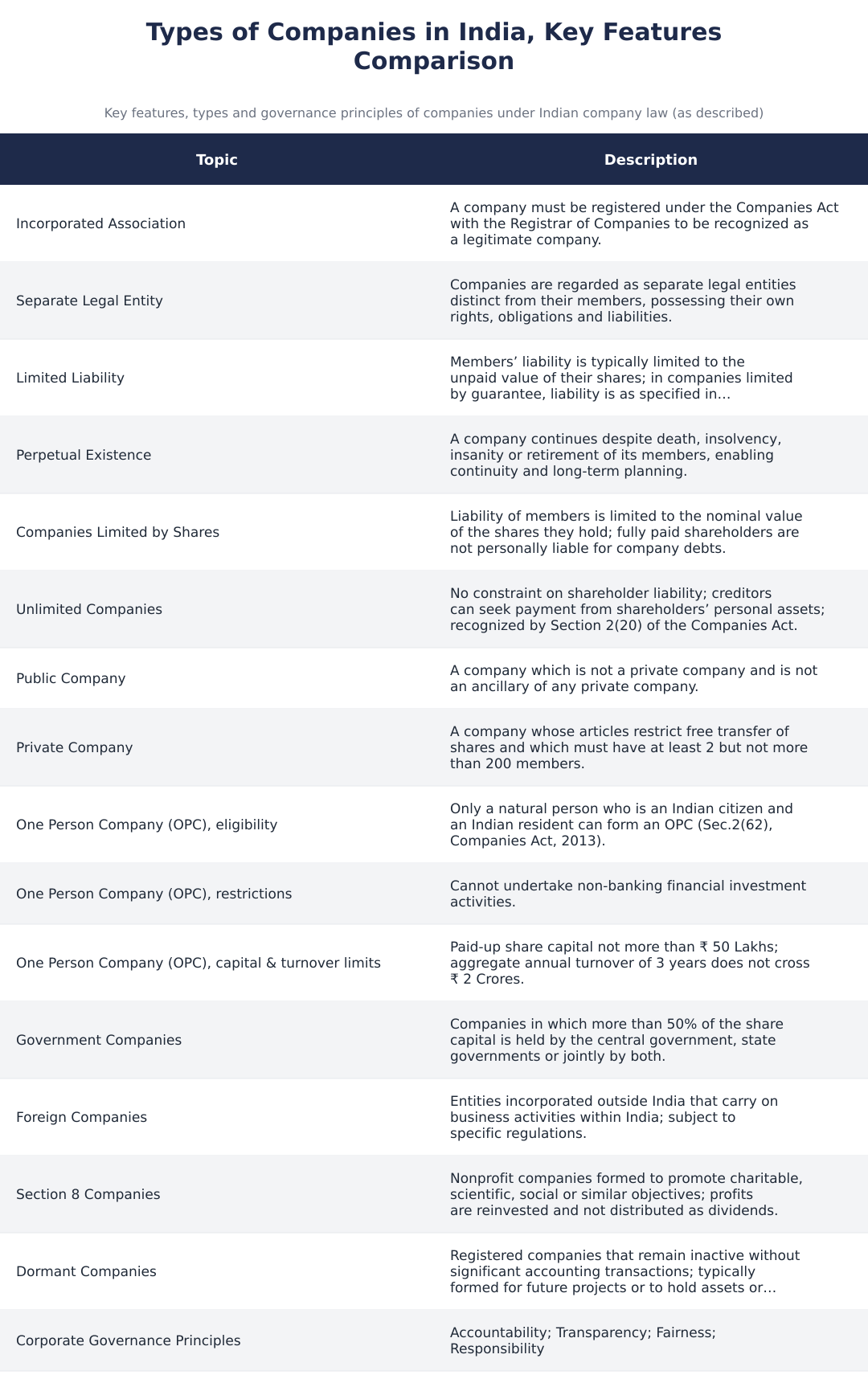
A company only acquires the status of a legitimate company after completing registration under the Companies Act with the Registrar of Companies. This requirement means that mere associations of persons are not treated as companies unless they go through the statutory incorporation process; registration brings legal recognition and opens access to the rights and duties that flow from corporate status.
Once incorporated, a company is treated as a separate legal entity distinct from its members. This separation creates an independent legal personality: the company can own property, enter contracts, sue and be sued in its own name. The practical effect is a clear boundary between the organisation and the individuals who own or manage it.
A central consequence of separate legal personality is limited liability for members. In most companies, members’ financial exposure is typically limited to the unpaid value of the shares they hold. For companies limited by shares, liability of members is limited to the nominal value of their shares, and shareholders who have fully paid for their shares are not personally liable for the company’s debts.
Companies also enjoy perpetual existence: the company continues as a legal entity despite events affecting individual members, such as death, insolvency, insanity or retirement. Perpetuity supports long-term planning and continuity of business operations even as ownership or management changes over time.
Common types of companies and their distinguishing feature
| Company type | Key defining feature |
|---|---|
| Companies limited by shares | Liability of members limited to the nominal value of the shares they hold; fully paid shareholders are not personally liable for company debts. |
| Public company | A company which is not a private company (i.e., not a private company or an ancillary of a private company). |
| One Person Company (OPC) | Defined in Section 2(62) of the Companies Act, 2013 as a company with only one shareholder. |
| Government company | More than 50% of share capital is held by the Central Government, State Government(s), or both. |
| Foreign company | An entity incorporated outside India that carries on business activities within India and is subject to Indian regulations when operating here. |
| Section 8 company | A not-for-profit company formed to promote charitable, scientific, social or similar objectives; it does not distribute dividends and reinvests profits. |
Corporate governance principles: what they mean in practice
Corporate governance sets the framework for how a company is directed and controlled. Four core principles commonly highlighted are accountability, transparency, fairness and responsibility. These principles guide the behaviour of the board, management and stakeholders and shape policies around reporting, decision-making and stakeholder engagement.
Accountability means that decision-makers within the company must accept responsibility for their actions and be answerable to shareholders and other stakeholders for governance outcomes. Transparency requires clear, timely and accurate disclosure of material information so stakeholders can make informed assessments. Fairness pertains to equitable treatment of all stakeholders, preventing preferential treatment that could harm minority interests. Responsibility reflects the company’s duty to consider wider legal and ethical obligations in pursuit of its objectives.
While these principles are stated at a high level, their practical application influences board composition, disclosure practices, conflicts-of-interest policies and the general culture of compliance within the company. Applying these principles consistently helps protect investor confidence and supports sustainable business conduct.
Practical implications for founders, investors and managers
Choosing a company form affects risk allocation, the ability to raise capital and how profits are treated. For example, companies limited by shares shield owners from personal liability beyond their shareholdings, which makes them attractive to investors who wish to limit downside exposure. Section 8 companies, by contrast, cannot distribute profits as dividends and must reinvest any surplus towards their stated objectives, which makes them suitable only for not-for-profit purposes.
An OPC provides a statutory route for a single natural person to incorporate and run a company, which is useful for sole entrepreneurs seeking the benefits of corporate status while retaining single-person ownership. Government companies and foreign companies each bring distinct regulatory contexts, government companies reflect majority public ownership, while foreign companies are subject to Indian regulation when they operate within India.
Across all forms, the company’s separate legal identity and perpetual existence mean that corporate obligations and rights generally attach to the company itself rather than the individuals behind it. That separation supports continuity of business, but it also imposes on founders and managers the need to maintain corporate formalities and governance practices so the company’s distinct status and the protections it affords are preserved.
Understanding the statutory nature of companies, registration, separate legal personality, limited liability and perpetual existence, is the foundation for choosing the right corporate form and practising sound governance. The types of companies under the law serve different purposes: from commercial enterprises limited by shares to not-for-profit Section 8 companies and single-shareholder OPCs. Applying the core governance principles of accountability, transparency, fairness and responsibility helps translate legal form into responsible business conduct.
Frequently asked questions
How do you form a company in India, what are the basic steps to incorporate one?
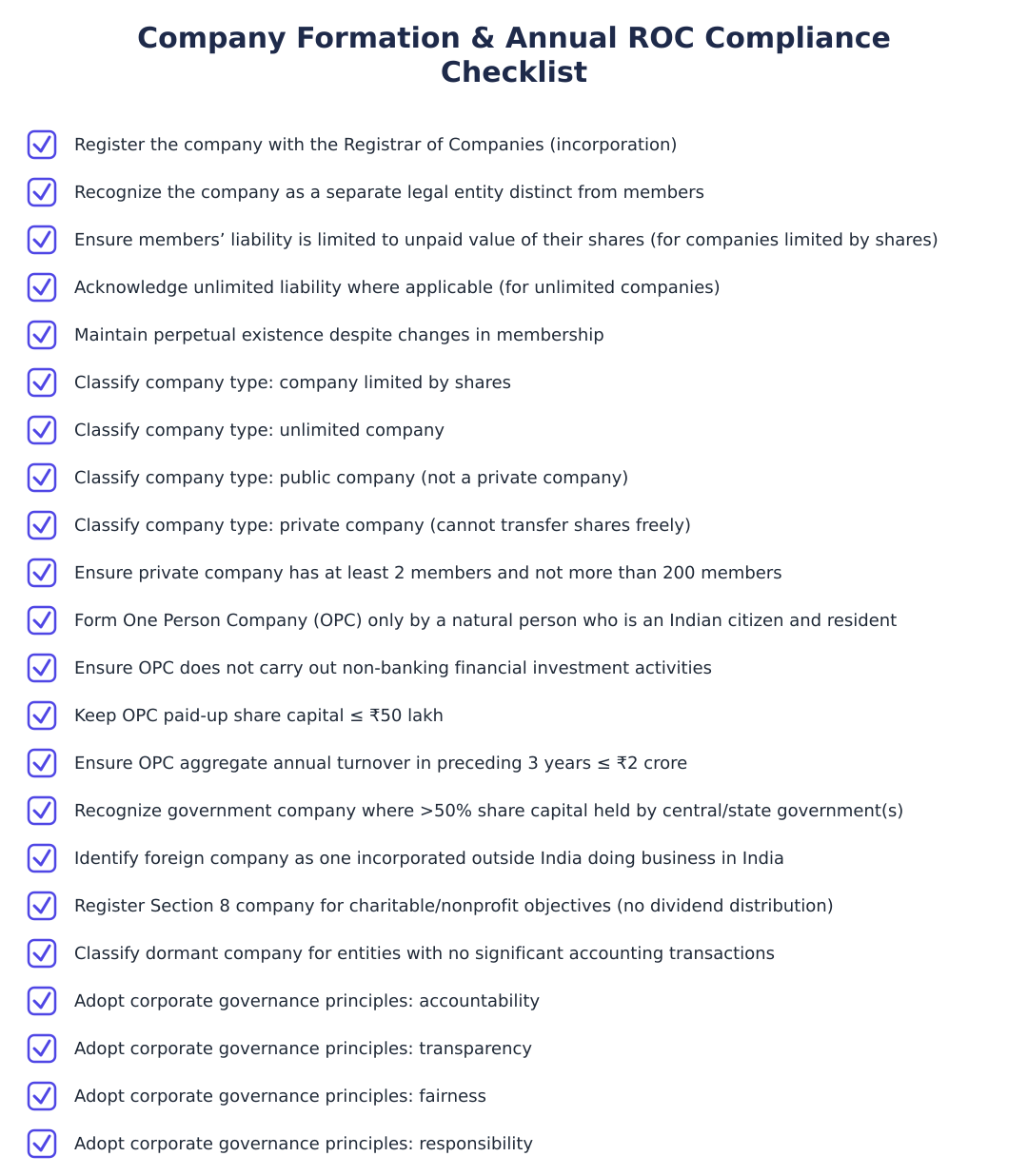
To form a company in India you must register and incorporate the entity with the Registrar of Companies under the Companies Act, following prescribed procedures such as name approval, filing Memorandum and Articles of Association, and submitting incorporation forms. You need at least the minimum number of members (1 for an OPC, 2 for a private company, 7 for a public company) and minimum documents including identity/address proofs, director DIN/DPIN or DSC and the registered office proof; prescribed fees and stamp duties must be paid. After incorporation, the company receives a Certificate of Incorporation which gives it legal existence and a Corporate Identification Number (CIN). Note that industry-specific permissions (for example RBI for NBFCs) or sectoral limits may apply before commencing operations.
What does it mean that a company is a separate legal entity in India?
A company being a separate legal entity means it has its own legal identity distinct from its shareholders and directors, with rights and liabilities in its own name. This allows the company to enter contracts, own property, sue or be sued independently of its members; therefore creditors cannot normally pursue personal assets of shareholders for company debts. This principle underpins limited liability and perpetual succession, the company continues irrespective of changes in membership, death, insolvency or retirement of individual members. Exceptions can arise where courts lift the corporate veil in cases of fraud, sham or statutory contraventions to hold persons behind the company liable.
What is limited liability and how does it protect company members?
Limited liability means a member’s liability is restricted to the unpaid amount on their shares or to the amount they have guaranteed, so they are not personally liable for the company’s obligations beyond that. In companies limited by shares, shareholders only risk the nominal unpaid value of shares; in companies limited by guarantee, liability is limited to the guarantee amount stated in the incorporation documents. This protection does not extend where personal guarantees are given, or where statutory exceptions or piercing of the veil apply; creditors can still claim against company assets but not the personal assets of fully paid shareholders. For example, a shareholder who paid fully for shares normally has no further call on personal funds to meet company debts.
What are the main types of companies under Indian law, private, public and One Person Company (OPC)?
The main company types are private companies, public companies and One Person Companies (OPC), each with distinct membership and control rules. A private company cannot freely transfer shares and must have at least 2 but not more than 200 members, while a public company is not a private company and can invite the public to subscribe to its shares subject to legal compliances. An OPC has a single natural person as shareholder, that person must be an Indian citizen and resident, and is subject to limits such as paid-up capital not exceeding ₹50 lakh and aggregate turnover not exceeding ₹2 crore in the preceding three financial years. Choice of form affects compliance, fundraising, director/shareholder limits and disclosure obligations to the Registrar of Companies.
Who can set up a One Person Company (OPC) and what are the limits for OPCs?
An OPC can only be formed by a single natural person who is an Indian citizen and resident; it cannot be formed by non-resident or foreign nationals. Statutory limits for OPCs include paid-up share capital not exceeding ₹50 lakh and aggregate annual turnover in the preceding three financial years not exceeding ₹2 crore; OPCs are also restricted from carrying out non-banking financial investment activities. OPCs enjoy simplified decision-making and lower compliance compared to larger companies but must convert to a private or public company if they cross the prescribed capital or turnover thresholds. The nominee provision allows one nominee to be appointed who will become the member in case of the sole member’s death or incapacity.
What are Government companies, foreign companies, Section 8 companies and dormant companies?
Government companies are entities where the central or state government holds more than 50% of share capital; they serve public functions under government oversight. Foreign companies are enterprises incorporated outside India that carry on business or have a place of business in India and must comply with specified registration and reporting requirements. Section 8 companies are non-profit entities formed for charitable, scientific or social objectives under Section 8 of the Companies Act and are prohibited from distributing dividends; profits must be applied to the objectives. Dormant companies are incorporated entities that remain inactive with no significant accounting transactions and enjoy relaxed regulatory obligations while holding the option to become active later.
What is the difference between companies limited by shares and unlimited companies?
In a company limited by shares, members’ liability is limited to the unpaid amount on the nominal value of their shares, so fully paid shareholders generally have no personal exposure to company debts. An unlimited company imposes no such cap, if company assets are insufficient, creditors can pursue shareholders’ personal assets to meet liabilities, making shareholder risk unrestricted. Unlimited companies are rare in India but are recognized under Section 2(20) of the Companies Act; they are typically used for special cases where members prefer full liability. Most commercial ventures adopt companies limited by shares to protect investors and encourage capital participation.
What are the core principles of corporate governance in Indian companies?
The core principles of corporate governance in Indian companies are accountability, transparency, fairness and responsibility, which guide how a company is directed and controlled. Accountability requires clear roles and duties for the board and management, transparency mandates timely and accurate disclosure to stakeholders, fairness ensures equitable treatment of all shareholders including minorities, and responsibility involves ethical decision-making and compliance with laws. These principles underpin board composition, audit and disclosure practices, stakeholder engagement and internal controls, and are enforced via statutory provisions, listing regulations and regulator supervision. Strong corporate governance reduces risks, improves investor confidence and helps meet compliance such as annual ROC filings and financial statements.
What is a Section 8 company and can it distribute profits to members?
A Section 8 company is a non-profit entity incorporated under Section 8 of the Companies Act to promote charitable, social, scientific or cultural objectives, and it cannot distribute profits to its members. Any surplus generated by a Section 8 company must be reinvested into advancing its stated objectives rather than paid as dividends, and it enjoys certain regulatory and tax concessions subject to compliance and approval conditions. Such companies must still file statutory returns and maintain records, and they obtain a license from the Registrar at incorporation specifying their non-profit nature and permitted activities. If a Section 8 company contravenes its objects by distributing profits, it risks regulatory action and loss of its status.
Need help staying Company Registration compliant?
MoneyGence's AI Finance OS tracks your compliance, wallet share, and finances in one place, built for agencies and growing businesses.
Get started with MoneyGence