Credit Note in GST: Meaning, Process, Format & Time Limit
This guide explains what a credit note is under the GST framework, why businesses issue them, how the issuing process typically works, what information a credit note should contain, and practical steps to create one. If you run a business that issues invoices, understanding credit notes is essential because they adjust taxable supplies after the original tax invoice has been raised. A well‑prepared credit note corrects the taxable value, tax charged or payable, and provides a clear record for both supplier and recipient. This matters for bookkeeping, filing returns, and reconciling accounts receivable and payable. You will learn the typical commercial situations that give rise to credit notes (for example, returns, discounts, or billing errors), the internal and compliance considerations when issuing them, the usual content and format expectations so the document is useful for accounting and tax records, and a concise set of steps a supplier can follow to prepare and issue a compliant credit note. The guide also covers timing considerations in general terms and answers frequently asked questions that businesses commonly have when they need to adjust an earlier invoice. The aim is to provide a practical, compliance‑minded explanation so you can create credit notes correctly and maintain clear records for audits and reconciliations.
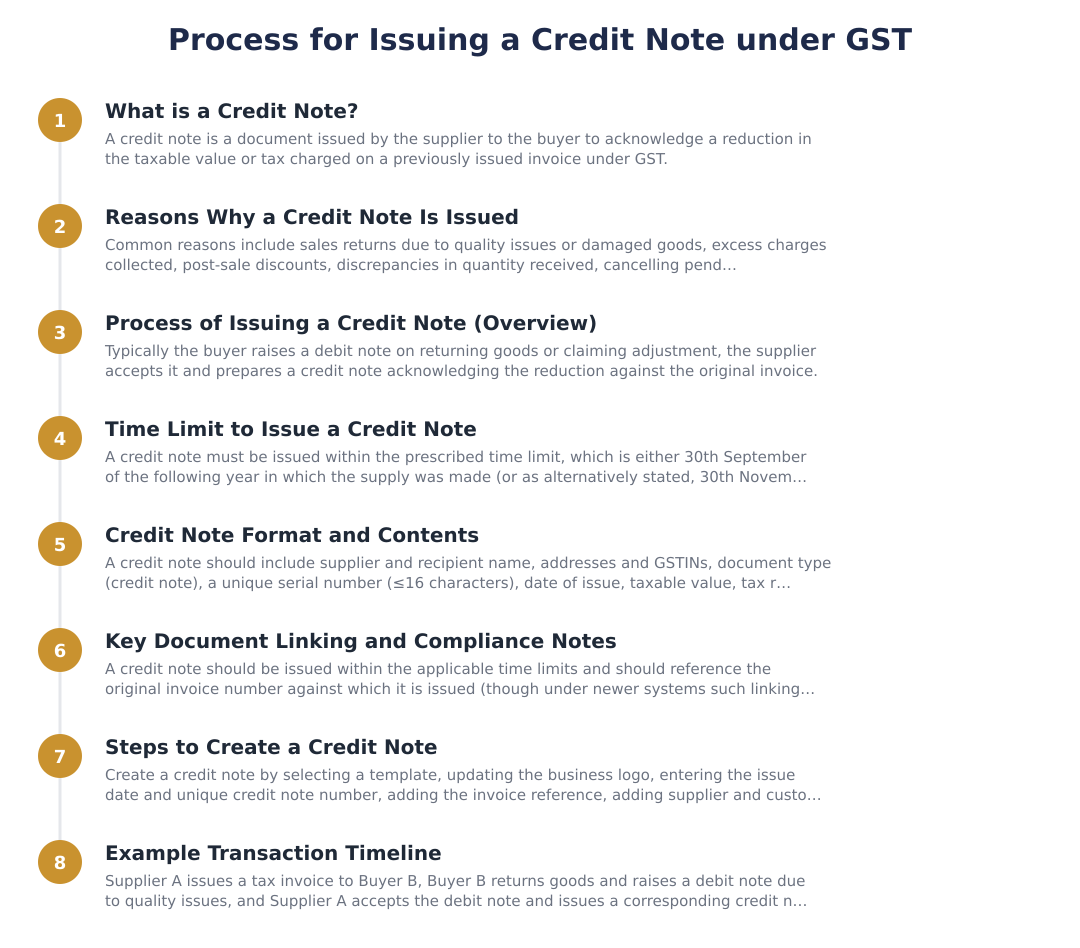
What is a Credit Note?
A credit note is a commercial document issued by a supplier to the recipient to reduce the amount previously invoiced. It acts as an acknowledgement that the supplier owes an adjustment to the buyer, either by way of lowering the taxable value, reducing tax charged, or indicating that a refund or offset is due against the original supply.
In practice, a credit note functions as the counterpart to a debit note issued by the buyer or as a stand‑alone correction initiated by the supplier. It provides an auditable paper trail showing why the original invoice has been modified, which is important both for accounting records and for any tax reporting obligations.
Issuing a credit note does not always mean cash will change hands immediately. Often it is used to offset amounts against future invoices, adjust accounts receivable, or formalise a reduction in price after the supply has occurred. The precise legal effect and treatment for tax reporting depend on the applicable GST rules and the manner in which the credit note is reflected in returns and books.
Reasons Why Credit Note is Issued
Credit notes are issued for a range of commercial and operational reasons. Common situations include returned goods because of defects or incorrect supply, billing errors where the supplier overcharged the buyer, and post‑sale concessions such as discounts or rebates that were agreed after the original invoice.
They are also used when the quantity delivered differs from the quantity invoiced or when a previously charged fee needs cancellation. Generally, any circumstance that requires reducing the taxable value or tax liability on an earlier invoice can be addressed by issuing a credit note.
From a compliance and accounting perspective, using a credit note makes the correction transparent to both parties and provides documentation required for reconciling tax and accounting records. It ensures that the supplier’s sales ledger and the buyer’s purchase ledger both reflect the agreed adjusted amount.
Process of Issuing a Credit Note
Confirm the reason for issuing a credit note, for example, returned goods, pricing correction, or a post‑sale discount, and obtain any supporting documentation such as return advices or buyer communication.
Draft the credit note with a clear reference to the original invoice, a unique serial number, the date, the adjusted amounts, and an explanation for the adjustment so both parties understand the change.
Enter the credit note in your accounting system, adjust accounts receivable or payable as appropriate, and send a copy to the buyer for their records and reconciliation.
Ensure the adjustment is captured in your periodic tax reporting and internal reconciliations in line with the applicable GST requirements and your accounting policies.
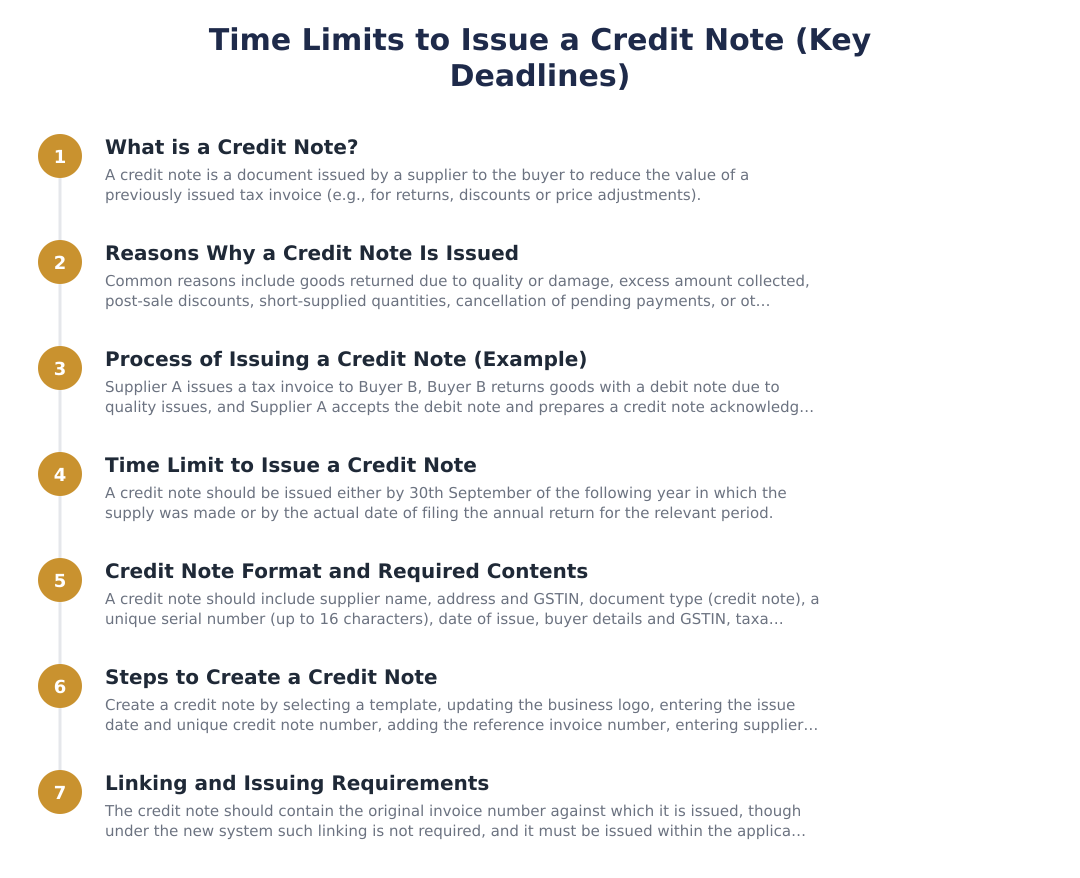
Time Limit to Issue a Credit Note
The GST framework prescribes time limits and conditions for when credit notes can be issued and how they must be reflected in tax returns. These limits are intended to provide certainty to taxpayers and tax authorities about when adjustments can be made for a given tax period.
Because time limits and procedural requirements are specified in law and may vary with circumstances or be updated over time, it is important to refer to the current statutory provisions or consult a tax professional to determine the exact deadline that applies to a particular adjustment.
Practically, a supplier should act promptly when an adjustment is identified, delaying the issuance of a credit note can complicate accounting, reconciliation and compliance with return filing. Good practice is to document the date of the underlying event, the date the adjustment was agreed, and the date the credit note was issued so you can demonstrate timely action if required.
Credit Note Format and Contents
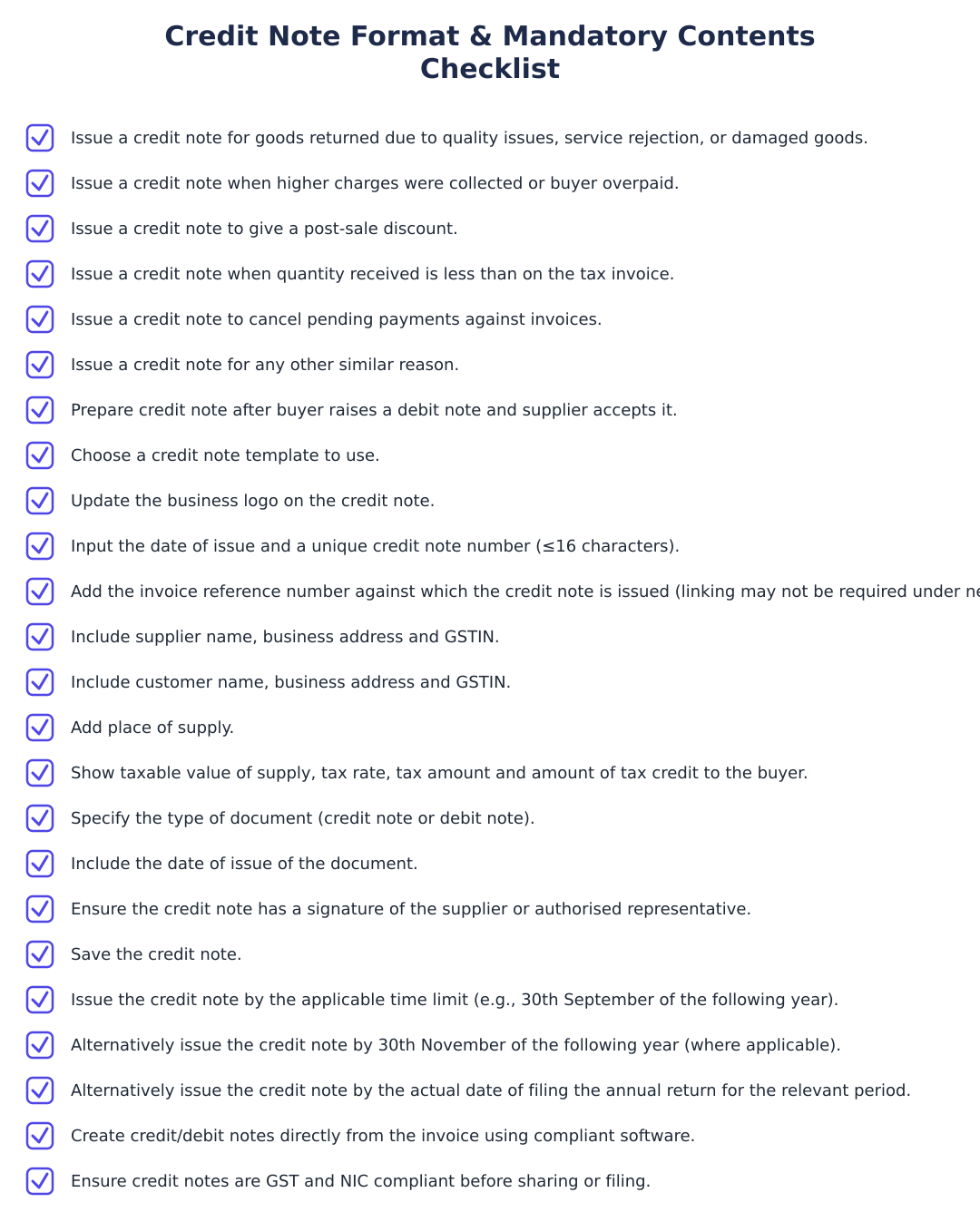
A credit note should contain sufficient details to tie it back to the original invoice and explain the adjustment. Typical elements include the names and addresses of supplier and recipient, a document type label (credit note), a unique serial number, date of issuance, reference to the original invoice number and date, and a clear description of goods or services being adjusted.
It should also show the taxable value being reduced or adjusted, the applicable tax rates and tax amounts affected, and the net amount credited. Where relevant, place of supply and state details may be included so the adjustment can be correctly apportioned for tax purposes.
Finally, the credit note should indicate the reason for issuance and bear an authorised signature or electronic authentication from the supplier. Maintaining consistent formatting and including all required particulars makes the credit note acceptable for accounting entries and tax reconciliations.
Steps to Create a Credit Note
Choose a credit note template that captures all required fields and matches your accounting or billing software setup.
Fill in supplier and recipient details, a unique credit note number, and the issuance date.
Add the original invoice number and date so the adjustment can be traced easily.
List the items or services being adjusted, show taxable values, corresponding tax components, and the total credit amount.
State the reason for the credit note and include an authorised signature or electronic approval before sending it to the buyer.
Save the credit note in your records and reflect the adjustment in ledgers and tax reporting as required.
Frequently Asked Questions
Q: Can a credit note be used in place of a refund? A credit note documents an adjustment in value or tax. Whether it leads to a cash refund or is used to offset future invoices depends on the agreement between supplier and recipient and company policy.
Q: Must a credit note reference the original invoice? A clear reference to the original invoice and an explanation for the adjustment are best practice so both parties can reconcile their accounts and meet compliance requirements.
Q: How should credit notes be stored? Keep credit notes together with the related invoices and other supporting documents in your accounting records. Electronic storage with reliable backups and audit trails simplifies retrieval during reconciliation or audits.
Q: Who authorises a credit note? Authorisation procedures vary by organisation. Typically an authorised representative of the supplier approves the credit note so there is clear accountability for the adjustment.
Credit notes are a routine but important part of commercial and tax compliance when correcting previously invoiced supplies. Issue them promptly with clear references to the original invoice, include all necessary particulars, record them in your accounting system, and ensure they are reflected correctly in tax reporting. When in doubt about time limits or specific procedural requirements under GST, consult the current law or a qualified tax professional to ensure compliance.
Frequently asked questions
What is a credit note under GST?
A credit note under GST is a document issued by a supplier to reduce the taxable value or tax charged on a previously issued invoice. It acknowledges that the supplier has credited the buyer’s account for returned goods, excess charges, discounts, or cancellations and serves as the seller’s response to a buyer’s debit note. It is not exactly a cash refund but can be used by the buyer to adjust future purchases or for accounting purposes. The credit note must contain prescribed particulars such as the original invoice reference, supplier and recipient details, taxable value and tax amounts, and the supplier’s signature.
Why is a credit note issued in GST transactions?
A credit note is issued to correct or reduce the taxable value or tax charged on a previously issued tax invoice. Common reasons include goods returned due to quality or damage, overcharged amounts, post-sale discounts, quantity shortfalls, cancellation of pending payments, or similar adjustments. It acts as an acknowledgement by the supplier that the buyer’s liability has been reduced and enables adjustment of input tax credit by the recipient where applicable. For example, if Buyer B returns damaged goods to Supplier A, Supplier A issues a credit note against the original invoice to reflect the reduced supply value.
How do I prepare a credit note, what is the process?
To prepare a credit note, the supplier chooses a credit note template, inputs a unique serial number and date, links the original invoice reference (linking may not be mandatory under the new system), and adds supplier and recipient GSTIN and place of supply before saving. The process usually starts with the buyer raising a debit note or returning goods; the supplier then accepts the debit note and issues the credit note as an acknowledgement. Ensure the credit note includes taxable value, tax rates and amounts, and the supplier’s signature or authorised signatory. Many businesses use accounting or GST software to automate template selection, numbering (up to 16 characters), and record-keeping.
What is the time limit to issue a credit note under GST?
A credit note must be issued either by 30th September of the following financial year in which the original supply was made or by the actual date of filing the annual return for the relevant period, whichever is earlier. There is also an alternate timeline mentioned as 30th November of the following year in some procedural contexts, but the safe practice is to follow the earlier of the two, 30th September next year or the annual return filing date. Issuing within the time limit is important because the supplier can only reduce output tax liability and the recipient can adjust input tax credit within these prescribed periods. Always check the current GST notifications or your tax advisor for any updates or clarifications on these deadlines.
What information must be included in a GST credit note format?
A GST credit note must include the supplier’s name, address and GSTIN; the document type (credit note); a unique serial number (up to 16 characters, numeric/alphanumeric/special characters allowed); date of issue; recipient’s name, address and GSTIN; taxable value, tax rate and amount; and the supplier’s signature or authorised representative. It should ideally reference the original invoice number against which the credit note is issued, although under newer systems explicit linking may not be mandatory. Including the place of supply and breakup of taxable value and taxes by rate helps ensure correct reporting and input tax credit adjustments by the buyer.
Can I issue a credit note without referencing the original invoice?
Under the older GST practice a credit note should contain the original invoice number against which it is issued, but under the new system explicit linking to the original invoice may not be required. Despite this, best practice is to reference the original invoice number and date to avoid disputes and to make it easier for the buyer to claim input tax credit. If you omit the reference, ensure your records clearly show the relationship between the credit note and the original supply to support tax filings and audits. Using accounting software that stores cross-references automatically helps maintain clear audit trails.
How should I number credit notes, what are the rules for serial numbers?
Credit notes must carry a unique serial number not exceeding 16 characters, which can be numeric, alphabetic, alphanumeric, or include specialised characters. The serial number should be consecutive and unique for the financial year to ensure traceability and compliance with GST record-keeping requirements. Many businesses include a prefix indicating document type or branch and then a numeric sequence (for example CN/DEL/0001) to help internal reconciliation. Ensure your numbering system is consistent and backed up in your accounting or GST software to prevent duplicates.
How do I create a credit note step-by-step in accounting software?
To create a credit note in accounting software, choose the credit note template, update your business logo (optional), enter the date of issue and a unique credit note number, add the original invoice reference, and fill in supplier and customer GSTIN plus place of supply before saving. After saving, verify taxable values, tax rates and totals, and obtain the authorised signature or e-signature if required; then share the document with the customer and record it in your GST returns. Using software automates compliance items like format, mandatory fields, and serial numbering, reducing errors and speeding up issuance. Always review the saved credit note for correct linkage to the corresponding invoice to enable proper adjustment of output tax and the buyer’s input tax credit.
Need help staying Finance Templates compliant?
MoneyGence's AI Finance OS tracks your compliance, wallet share, and finances in one place, built for agencies and growing businesses.
Get started with MoneyGence