Cryptocurrency Tax India 2026: Complete Guide to Crypto Taxes
This guide explains how cryptocurrencies and other virtual digital assets (VDAs) are treated under Indian income tax law as of 2026. You will learn: what counts as a VDA under the Income Tax Act, which kinds of crypto-related activity are taxable, how the law classifies income from different crypto dealings, and practical steps to prepare accurate records for filing. The Indian government clarified its stance on taxation of cryptocurrencies and other VDAs in the 2022 Union Budget, and the statute now contains a legal definition that frames tax treatment. Understanding these rules matters because classification determines whether crypto profits are taxed as capital gains or as business income, and because a wide range of crypto activities, from trading and spending to mining, staking and receiving airdrops or gifts, are expressly within the scope of taxation. While this guide does not give numerical tax rates or computations, it focuses on the legal categories, the typical tax heads that apply to crypto transactions, and why careful bookkeeping is essential for accurate reporting and compliance. Read on to understand how various crypto events are likely to be taxed, what that classification means in practice, and how to organise records so you can compute and report your crypto income correctly when you file returns.
What are Crypto Currencies as per the Income Tax Act?
The Income Tax Act now recognises a legal category called 'Virtual Digital Asset' (VDA). Section 2(47A) was inserted to provide a detailed definition: it covers information, codes, numbers or tokens generated through cryptographic means and expressly excludes Indian or foreign fiat currency. This statutory definition is the foundation for applying income‑tax rules to crypto and similar digital tokens.
Practically, that means many instruments commonly called cryptocurrencies, tokens and certain digital representations of value will be treated as VDAs for tax purposes. The legal definition is technology‑neutral and focuses on the nature of the asset rather than the platform on which it operates, so businesses and individuals must consider whether their holdings fall within this statutory scope.
Is Crypto Taxed in India?
Yes. The government’s position on taxing cryptocurrencies and other VDAs was clarified in the 2022 Union Budget, which brought crypto explicitly within the tax framework. That public clarification created the basis for subsequent tax rules and reporting expectations.
Because VDAs are defined in the tax law and the Budget statement established the intention to tax crypto, most crypto events are treated as taxable under existing income‑tax heads. Whether a particular receipt or disposal is taxed as capital gains or business income depends on how the asset is held and how frequently transactions occur.
How is Cryptocurrency Taxed in India?
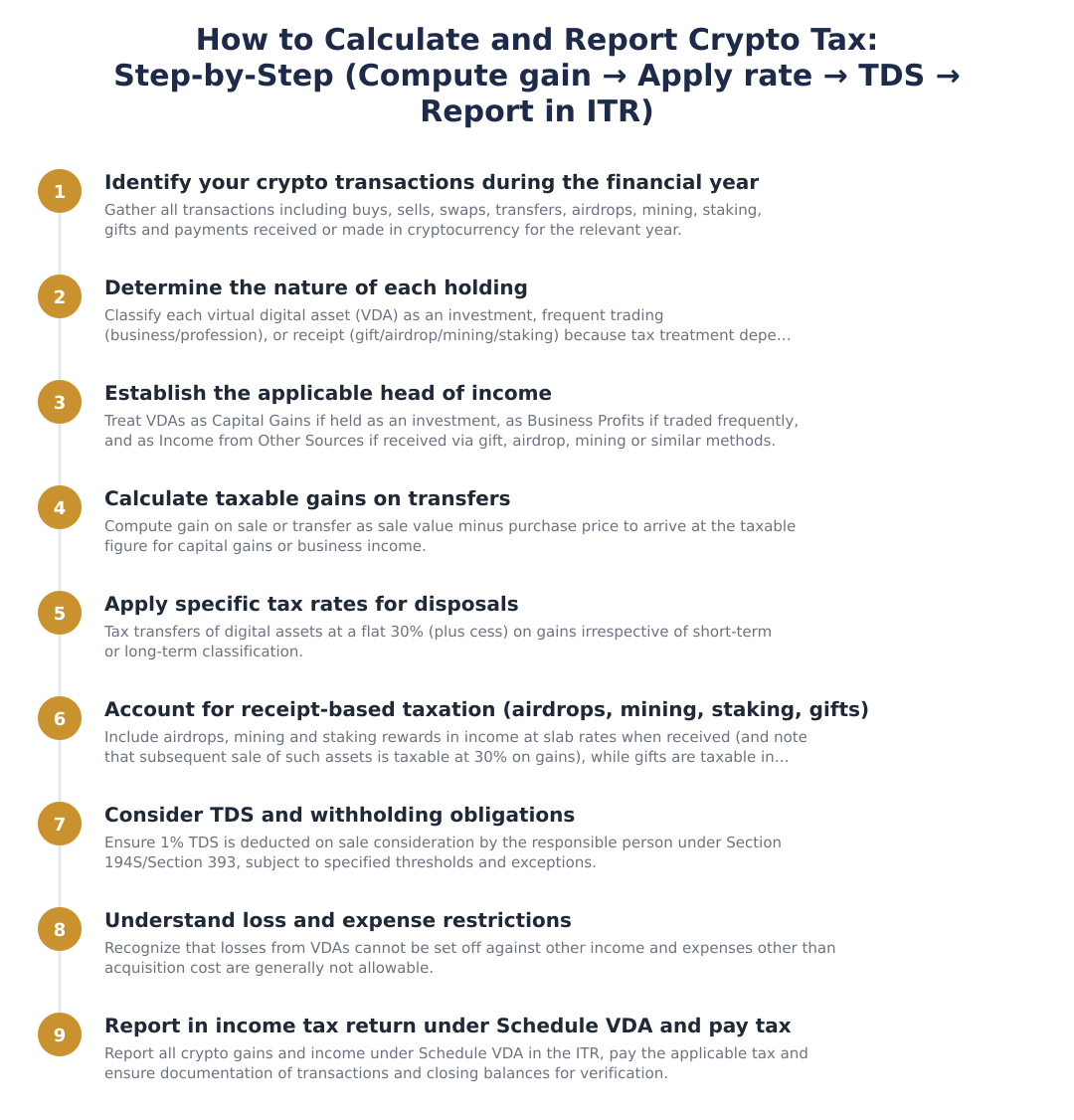
Taxation of cryptocurrency depends on the nature of the activity and the taxpayer’s pattern of dealing. Broadly, three tax heads are relevant: Capital Gains when a VDA is held as an investment; Profits and Gains from Business or Profession when VDAs are traded frequently as part of business activity; and other heads in cases such as gifts or receipts where those specific provisions apply.
This classification matters for taxpayers because it determines which rules and compliance requirements apply when you compute taxable income. For example, an investor who holds a crypto asset for capital appreciation is treated differently from a trader who buys and sells crypto as part of a business operation.
Tax Treatment of Income from Crypto Transactions
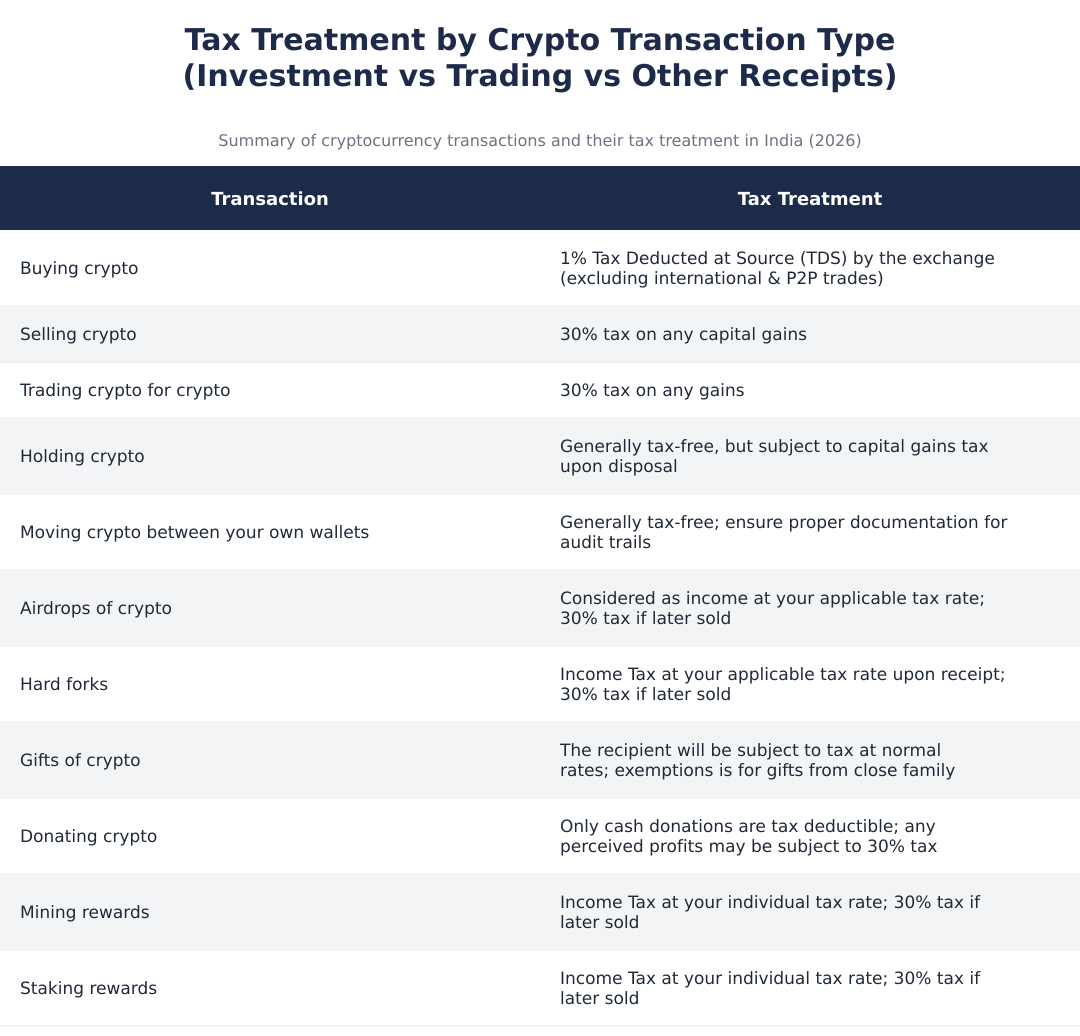
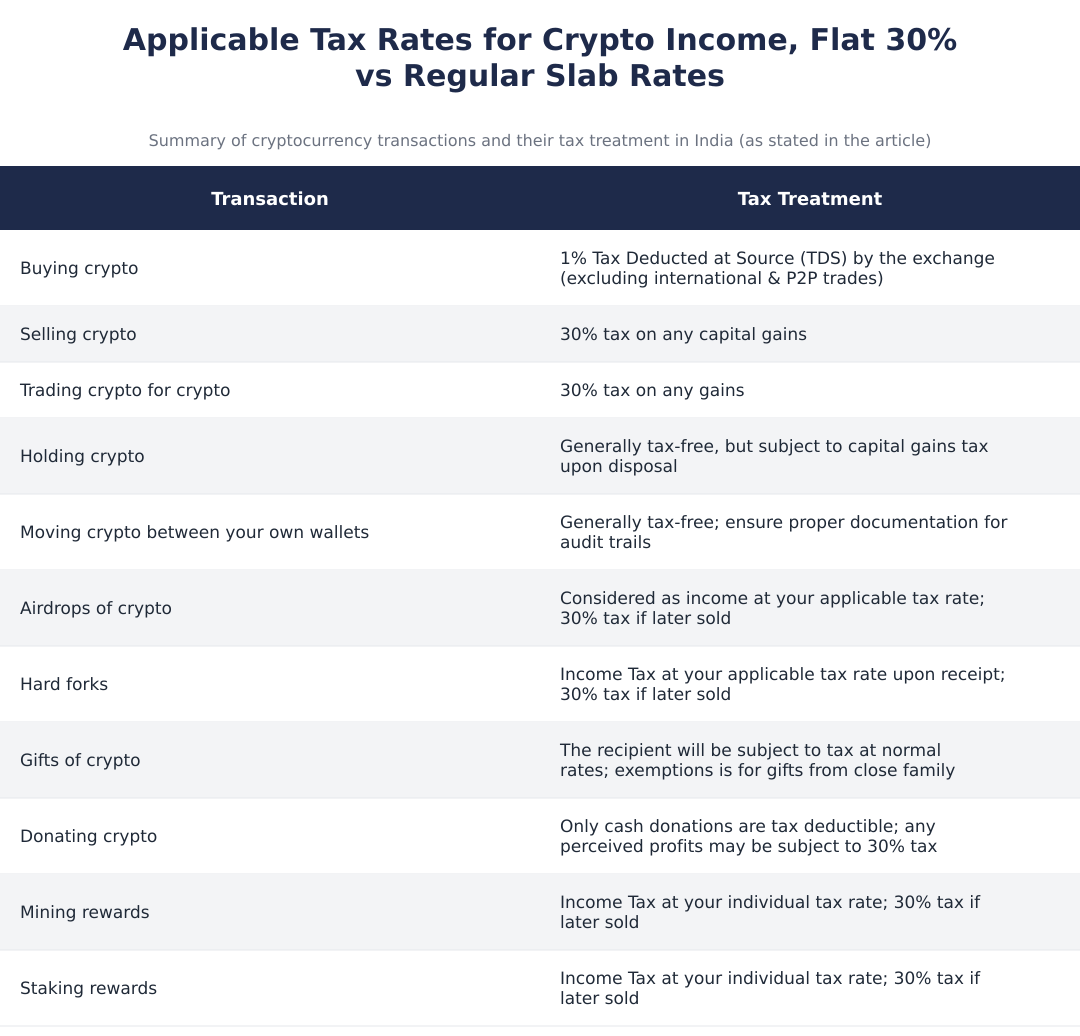
A wide range of crypto activities are recognised as taxable events. Spending, exchanging, trading, receiving crypto as payment, gifting, mining rewards, staking rewards and airdrops are all within the scope of taxation under current rules. That means such events must be examined to determine the appropriate tax head and the time and value of recognition.
Which head applies, capital gains, business income or other, depends on facts and circumstances: frequency of transactions, motive for holding, and the specific nature of the receipt. Taxpayers should map each kind of crypto transaction to the relevant tax head before computing tax so that income is reported correctly in returns.
How to Calculate Tax on Crypto?
Accurate calculation starts with robust bookkeeping and consolidation of transactions from exchanges and wallets. Because crypto activity commonly occurs across multiple platforms and wallets, it is recommended to maintain consolidated records that capture all deposits, withdrawals, trades, transfers between your own wallets, receipts (like airdrops or mining rewards) and disposals.
Good records let you establish acquisition dates, consideration received on disposal, and whether transactions are investment disposals or trading receipts. Even though computation details depend on classification and applicable rates, the practical step every taxpayer must take is to reconcile platform statements with personal ledgers so that taxable events are supported by documentary evidence at the time of filing.
Tax on Airdrops, Mining and Staking, Practical Considerations
Certain modes of acquiring VDAs, airdrops, mining rewards and staking/forging rewards, are explicitly within the scope of taxable events. When you receive tokens through any of these routes, you should treat receipt as an event that may give rise to taxable income and keep contemporaneous records showing the time and circumstances of receipt.
For such receipts it is important to document how the tokens were obtained, the network/event details (for example, which airdrop or which mining/staking activity), and the market value at the time of receipt so you can later determine the correct taxable amount when you dispose of the asset or when the relevant tax rules require recognition.
Losses, Gifts and Recordkeeping
Treatment of losses and gifts involves specific legal rules and may vary depending on whether assets are held as investments or as business stock-in-trade. Gifts in crypto form and losses arising from crypto dealings should be recorded with supporting documents: chain of custody for gifts, evidence of transfer, and valuations where relevant.
Because crypto transactions can span many wallets and exchanges, taxpayers should prioritise a consistent approach to valuation and preserve exchange statements, transfer receipts and any correspondence that supports the purpose of holdings. This documentation will be essential for substantiating the tax position on audits or queries.
The Indian tax framework treats cryptocurrencies and similar digital tokens as virtual digital assets under Section 2(47A), and the 2022 Union Budget confirmed the government’s intent to tax such assets. Which tax head applies depends on how you hold and use VDAs, investment, business trading or other receipts such as gifts, mining or airdrops. The single most important practical step for taxpayers is comprehensive bookkeeping and consolidation of all exchanges and wallets so you can classify transactions correctly and support your computations when filing returns. If your crypto activity is substantial or complex, consider professional advice to map specific events to the correct tax treatment and to ensure compliance.
Frequently asked questions
Are cryptocurrencies taxable in India?
Yes, gains from cryptocurrencies (Virtual Digital Assets or VDAs) are taxable in India. Income from transfer (sale, trade, swap) of VDAs is taxed at a flat 30% plus 4% cess irrespective of whether it is treated as capital gains or business income, and this applies to both short-term and long-term gains. Certain receipts such as airdrops, mining rewards, staking income or gifts received without consideration are taxed differently at your slab rate when received and may attract 30% when later sold. All crypto gains must be reported under Schedule VDA in the ITR and losses from VDAs cannot be set off against other income.
How much tax do I pay if I sell or trade crypto in India?
You pay 30% tax (plus 4% cess) on any gains from sale, trade or swap of crypto in India. The 30% rate applies to all gains irrespective of holding period and whether the income is treated as capital gains or business income. You are allowed to deduct only the actual cost of acquisition (purchase price) as the expense; other expenses are generally not allowed and losses from VDAs cannot be set off against other heads of income. Example: if you bought Bitcoin for ₹60,000 and sold for ₹80,000, the taxable gain is ₹20,000 and tax is 30% of that (₹6,000) plus cess.
Is there TDS on cryptocurrency transactions in India?
Yes, a 1% TDS (Section 194S) applies on payments for transfer of VDAs by the buyer (responsible person) at the time of payment of sale consideration. The TDS is required to be deducted and deposited with the government and applies to exchanges and buyers except for specified exclusions like international and P2P trades; thresholds apply such as no TDS if total sales during the year do not exceed ₹10,000 and special thresholds for certain small taxpayers. Individuals/HUFs with business turnover up to ₹1 crore (₹50 lakh for specified professions) have a higher TDS exemption threshold of ₹50,000 per financial year.
How are airdrops taxed in India?
Airdrops are taxable as income from other sources at the fair market value on the date of receipt and taxed at your applicable slab rates. The value of tokens received via airdrop is determined as per Rule 11UA (fair market value on the date received) and treated as taxable income even if you did not pay for them. If you subsequently sell those tokens, the sale will attract 30% tax on gains with the cost of acquisition considered as the value taxed at receipt (i.e., the FMV on receipt).
How is income from crypto mining taxed?
Income from mining is taxed as income at your applicable slab rate when you receive the mined coins, and later sale of those coins results in 30% tax on gains. The cost of acquisition for mined crypto is considered zero for computing capital gains at the time of sale unless you have treated mining as a business and maintained books showing otherwise; expenses like electricity or infrastructure cannot be added to acquisition cost. Therefore mining rewards are taxed on receipt, and any subsequent profit on sale is taxable at 30% with the receipt value as cost of acquisition for that computation.
Are staking or forging rewards taxable and how are they treated?
Yes, staking and forging rewards are taxed as income at your applicable slab rates when received, and if you later sell the staked/forged tokens any gains on sale are taxed at 30%. The staking rewards you earn (for example, APR-based interest) must be included in income from other sources or business income depending on facts, and on disposal the cost of acquisition will be the value taxed at receipt. So you face slab-rate tax on receipt and 30% capital gains tax on subsequent sale gains with limited deduction allowances.
What is the tax treatment for crypto received as a gift?
Crypto received as a gift is taxable in the hands of the recipient as income from other sources at slab rates if the aggregate value of gifts from non-relatives exceeds ₹50,000 in a financial year. Gifts from specified relatives are tax-exempt, and exemptions also apply for gifts received on marriage, by inheritance, will, or in contemplation of death. If the gifted crypto is later sold, the recipient will face 30% tax on gains with the cost of acquisition being the value taxed when the gift was received.
Can I set off crypto losses against other income or carry them forward?
No, losses from transfer of virtual digital assets cannot be set off against any other income and cannot be carried forward to offset other heads of income. Section 115BBH restricts set-off of losses from VDAs even against other crypto gains, meaning you cannot reduce taxable income from other sources using crypto losses. You are also limited in claiming expenses related to crypto activities other than the actual cost of acquisition when computing gains.
How do I calculate tax on a crypto sale, what's the computation?
Taxable gain on a crypto sale is computed as sale value minus actual purchase price (cost of acquisition); that gain is taxed at 30% plus applicable cess. For example, Sale value ₹XXX less Purchase Price (₹XXX) equals Gain ₹XXX which is taxable; only the purchase cost is deductible and other expenses are generally disallowed. If the crypto was acquired as income (airdrop/mining/gift), that receipt value becomes the cost of acquisition for computing any subsequent capital gain when sold.
Need help staying Income Tax compliant?
MoneyGence's AI Finance OS tracks your compliance, wallet share, and finances in one place, built for agencies and growing businesses.
Get started with MoneyGence