CTC Full Form in Salary: Meaning, Structure & How to Calculate
The CTC full form is Cost to Company - the total yearly cost an employer bears to employ you, not the amount you actually take home. This guide explains CTC in salary, what it means, what employers include in it, how it differs from gross and take-home pay, and how you can calculate it for a given package. Understanding CTC is important for job-seekers negotiating offers and for employees who want clarity on how benefits and contributions affect their take-home salary. You will learn which salary components are typically counted in CTC, which deductions reduce your in-hand pay, a simple formula to compute CTC from gross salary plus employer costs, and an illustrative example to make the calculation concrete. Armed with this knowledge you can compare offers more accurately, ask informed questions about employer contributions such as provident fund and insurance, and plan cash flow and tax provisions more realistically.
What is CTC in Salary?
CTC stands for Cost to Company and represents the total cost an employer incurs to hire and retain a worker for a year. It is a comprehensive figure that bundles direct cash pay with benefits and employer-paid contributions. CTC is an employer-centric number rather than the actual cash an employee receives.
Practically, employers present CTC to show the full value of the employment package, covering salary components, bonuses, and other costs such as contributions to statutory funds and insurance. Because CTC aggregates many items, it is not the same as the monthly take-home salary an employee will receive.
Structure and Key Components of CTC
Employers typically include a mix of fixed salary elements, variable pay, and benefits when calculating CTC. Fixed elements commonly present in most packages include Basic Salary and, where applicable, Dearness Allowance and House Rent Allowance. These form the predictable portion of pay that appears on monthly payslips.
Variable components and performance-linked items such as performance bonuses, commissions, and profit-sharing are also frequently part of CTC. In addition, employer-paid benefits, notably the employer contribution to the Provident Fund, health insurance, medical allowance and other benefits, are counted toward CTC because they represent a cost borne by the employer.
How to Calculate CTC in Salary?
CTC is calculated by adding Gross Salary, Benefits, and Other Costs. In formula form: CTC = Gross Salary + Benefits + Other Costs.
Ensure you add employer contributions such as the employer’s Provident Fund contribution and any employer-paid insurance or other benefits. Also include performance bonuses and other variable pay promised as part of the package.
For example, if Gross Salary is Rs. 5,00,000, PF contribution is Rs. 80,000 and Bonus is Rs. 20,000, the total CTC will be Rs. 6,00,000 (5,00,000 + 80,000 + 20,000).
Deductions that Affect Your In-hand Pay
CTC is not the exact amount an employee takes home because several deductions and contributions are removed from the CTC to arrive at the take-home salary. Common deductions that reduce in-hand pay include statutory and payroll deductions such as Income Tax, Professional Tax, and other contributions like the employee’s share of Provident Fund.
Understanding which parts of the CTC are employer-paid benefits versus amounts that will be deducted from your monthly pay is essential. Employer contributions shown within CTC (for example, the employer’s PF contribution) do not increase your monthly cash receipt but are a cost borne by the employer on your behalf.
CTC vs Gross Salary vs In-Hand Salary
Gross Salary is the employee-facing salary figure before employer-paid benefits and is typically the starting point in the CTC calculation. To arrive at CTC, employers add benefits and other costs on top of Gross Salary. Thus CTC is usually higher than Gross Salary because it includes employer contributions and benefits.
In-hand (take-home) salary is what the employee actually receives after employer and employee deductions are accounted for, most notably Income Tax, Professional Tax, and the employee’s share of any social security contributions. Because these deductions are removed from the gross or basic pay components, the in-hand figure will be lower than both CTC and often Gross Salary.
Knowing how CTC is constructed helps you compare job offers fairly and plan personal finances. Remember that CTC bundles gross pay plus employer-paid benefits and costs, while take-home pay is reduced by taxes and employee contributions. Use the simple formula CTC = Gross Salary + Benefits + Other Costs and verify employer-provided line items such as the employer’s PF contribution and any bonuses to understand the real value of an offer.
Frequently asked questions
What does CTC in salary mean?
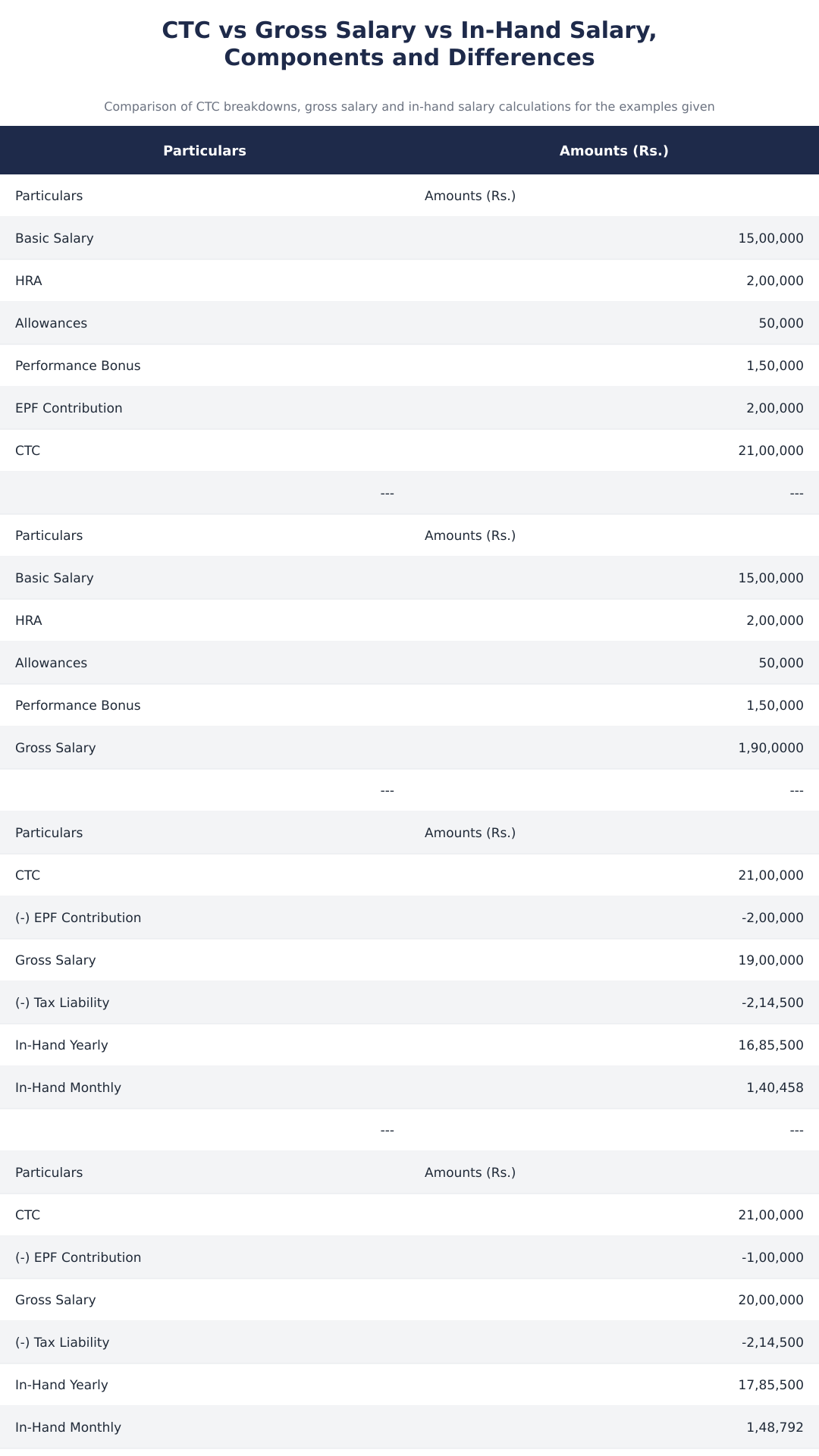
CTC (Cost to Company) is the total amount an employer spends on an employee in a year, including salary, benefits and employer contributions. It includes fixed pay (basic salary, HRA, allowances), variable pay (performance bonus, commissions), and employer-paid benefits such as provident fund contribution and health insurance. For example, a sample CTC of Rs. 21,00,000 can include Basic Rs. 15,00,000, HRA Rs. 2,00,000, allowances Rs. 50,000, performance bonus Rs. 1,50,000 and employer EPF Rs. 2,00,000. Note that CTC is not the take-home pay because deductions like employee PF and income tax reduce the in-hand salary.
What are the main components included in CTC?
The main components of CTC are fixed components (basic salary, dearness allowance, HRA and other allowances), variable/performance-linked pay (bonuses, sales commission, profit sharing) and employer-paid benefits (employer provident fund, health insurance, medical allowances). Fixed components form the guaranteed monthly pay, while variable components like performance bonus are contingent on targets; for example a performance bonus in a sample CTC is Rs. 1,50,000. Employer contributions such as EPF (e.g., Rs. 2,00,000 in the example) are also added to compute the total CTC even though they are not part of take-home pay.
What is basic salary and how much of CTC is it usually?
Basic salary is the core component of salary on which many other pays and statutory contributions are based and it is typically the largest fixed component of CTC. Employers often set basic as a significant portion of CTC, in the example given basic is Rs. 15,00,000 out of a Rs. 21,00,000 CTC. Many allowances (HRA, special allowance) and provident fund calculations are derived from the basic salary, so a higher basic can increase PF and certain taxable components.
Is employer provident fund contribution part of CTC?
Yes, the employer's provident fund (EPF) contribution is included in the CTC. For instance, the sample CTC shows an EPF contribution of Rs. 2,00,000 included in the total Rs. 21,00,000 CTC. Although employer PF adds to CTC, the employer portion is not part of immediate take-home pay, it is deposited into your EPF account and may be shown separately when calculating gross and in-hand salary.
How do I calculate my in-hand salary from CTC?
To calculate in-hand salary from CTC, subtract employer-paid components that are not paid out monthly (like employer EPF) to get gross salary, then subtract employee-side deductions such as employee PF, income tax and professional tax to arrive at in-hand pay. Example: from a Rs. 21,00,000 CTC, removing employer EPF Rs. 2,00,000 gives Gross Rs. 19,00,000; minus tax liability Rs. 2,14,500 results in in-hand yearly Rs. 16,85,500 or monthly Rs. 1,40,458. Note that the in-hand figure varies with how much of PF is borne by employer vs employee and the actual tax calculations and exemptions claimed.
What is the difference between CTC, gross salary and in-hand salary?
CTC is the total annual cost to the employer, gross salary is CTC minus employer-only contributions (like employer PF) and represents the total taxable pay before employee deductions, and in-hand salary is what you actually receive after employee deductions (tax, employee PF, professional tax). For example, a Rs. 21,00,000 CTC with Rs. 2,00,000 employer EPF becomes Gross Rs. 19,00,000, and after tax liability Rs. 2,14,500 the in-hand yearly is Rs. 16,85,500 (monthly Rs. 1,40,458). Each step removes components that either are employer expenses not paid out monthly or statutory/voluntary deductions from the employee's pay.
How do variable components like performance bonus affect my CTC and pay?
Variable components such as performance bonuses, sales commissions and profit-sharing are included in CTC but are paid only when performance conditions are met, so they may not be part of guaranteed monthly in-hand pay. In the example CTC of Rs. 21,00,000, a performance bonus of Rs. 1,50,000 is included, if not paid, your actual gross and in-hand pay will be lower. Employers often show variable pay separately within the CTC to clarify guaranteed versus contingent earnings.
Does health insurance and medical allowance form part of CTC?
Yes, employer-paid health insurance premiums and medical allowances are typically included as part of CTC as employer-incurred benefits. These are non-cash or reimbursable benefits that add to the employer’s cost; the guide lists health insurance and medical allowance under 'Other Benefits' included in CTC. While these increase your CTC, their value may not be received as monthly cash in-hand, for example, insurance is a company-paid premium and medical allowance may be taxable or reimbursable subject to policy rules.
How can I negotiate a better in-hand salary if the employer quotes CTC?
To increase your in-hand salary when an employer quotes CTC, negotiate the composition by asking for higher fixed pay (basic and allowances) and lower non-cash/employer-only contributions (like excessive employer PF or non-cash benefits). For example, reducing employer-only components in a Rs. 21,00,000 CTC in favour of higher gross salary will increase the monthly take-home after statutory deductions; also clarify how much of the CTC is variable (e.g., Rs. 1,50,000 bonus) and whether any reimbursements are taxable. Always request a breakup showing basic, HRA, allowances, employer PF and expected tax to compare true take-home across offers.
Need help staying Payroll compliant?
MoneyGence's AI Finance OS tracks your compliance, wallet share, and finances in one place, built for agencies and growing businesses.
Get started with MoneyGence