Demand Under GST: How Tax Authorities Raise & Recover Tax
This guide explains how tax authorities determine and raise a demand under the Goods and Services Tax (GST) regime, what triggers a demand, and what a taxpayer can expect when a notice arrives. You will learn the broad categories of situations that lead to a demand, how authorities distinguish between inadvertent errors and deliberate wrongdoing, the role of general determination provisions, what a show‑cause notice and adjudication process look like in practice, and practical steps a taxpayer can take when faced with a demand. Understanding these concepts matters because a GST demand can affect cash flow, compliance status and future audits. Knowing the procedural safeguards, your rights to be heard, and the typical elements officers consider when re‑computing tax liability will help you respond promptly and limit additional costs. This guide focuses on explaining the legal and practical framework for demands (how they arise, how they are processed, and how taxpayers can respond) rather than specific numeric limits or penalty amounts. That keeps the emphasis on the actions and decisions that matter most: how tax is re‑determined, when authorities revisit past returns, how allegations of fraud are treated differently from genuine errors, and how the general provisions for tax determination fit into the overall enforcement picture.
When can a Demand Under GST be Raised by the Tax Authorities?
A demand normally arises when tax authorities find that the tax reported and paid by a taxpayer does not match what they consider to be the correct liability. Common triggers include short payment or non‑payment of tax, claims for refunds that are later considered erroneous, or input tax credit that appears to have been wrongly availed or utilised. Demands may follow routine audits, compliance checks, intelligence leads or cross‑verification of returns and invoices.
When authorities suspect an error or discrepancy, the next step is to examine records and identify the grounds for raising a demand. This process typically culminates in an official communication, often a show‑cause notice, asking the taxpayer to explain the differences and provide supporting documents. The notice sets out the preliminary view of the officer and the legal basis for requiring additional tax (and possibly interest and penalty). Responding promptly with complete documentary evidence and reasoned submissions is the first and most effective step to manage any demand.
How Authorities Treat Errors versus Deliberate Misconduct
Tax administrations distinguish between cases that appear to be bona fide mistakes and those that involve deliberate misstatement, suppression of facts or fraud. This distinction matters because it affects the intensity of scrutiny, availability of mitigation options for the taxpayer, and the likely quantum of any punitive consequences. In general, inadvertent errors discovered during compliance checks are ordinarily dealt with under the routine adjudication framework, allowing taxpayers an opportunity to rectify and pay the shortfall along with applicable interest.
By contrast, matters suspected to involve deliberate wrongdoing are investigated more rigorously. Officers will look for patterns, repeated misreporting, forged documents, or clear evidence of intent to evade tax. Where such indicators exist, the proceedings may take a different course with stricter consequences. Taxpayers facing allegations of deliberate misconduct should consider preserving all relevant records, preparing a timeline of events, and, if appropriate, seeking professional representation to present a strong factual and legal defense.
General Provisions for Determination of Tax (Section 75)
Section 75 contains general provisions for determination of tax and provides the broad legal framework officers use to ascertain tax liability. These general provisions operate alongside more specific sections that deal with particular kinds of demands or misconduct. The role of a general determination provision is to ensure there is a consistent methodology for computing tax, interest and any consequential amounts where an officer concludes there has been non‑compliance.
Practically, invoking the general provision means the officer will identify the period and the transactions under scrutiny, compute the additional tax (if any) based on available records, and include any statutory consequences that follow from the established facts. Taxpayers should note that general provisions are meant to be applied after the officer has formed a prima facie view; they do not replace procedural safeguards such as issuance of a show‑cause notice or the taxpayer’s right to be heard during adjudication.
Responding to a Demand: Practical Steps and Rights
When you receive a notice or show‑cause communication, carefully read the facts and legal grounds stated in it. Gather invoices, bank statements, contracts and any other supporting documentation that directly address the officer’s concerns. Prepare a written reply that explains the factual position, points to the documentary evidence, and identifies any legal arguments or precedents that support your case. Timely and organized responses often reduce the scope of disputes.
During adjudication you are entitled to procedural safeguards such as an opportunity for personal hearing. If you require more time to collate evidence, request an adjournment with reasons in writing; officers commonly allow limited adjournments for genuine needs. If the adjudicating authority proposes any adverse finding, consider whether to accept and pay the demand (if viable) or to reserve the right to appeal, documenting the grounds for your position. Professional assistance can be helpful when the issues are technical or when allegations of deliberate evasion are involved.
Interest applicability on GST demand
When a tax authority re‑determines tax liability, interest is typically computed on the unpaid or short‑paid amount for the relevant period. Interest is intended to compensate the exchequer for delayed payment and is treated as a statutory consequence of a tax demand. Even where an order does not specify interest explicitly, liability for interest may be inferred from the overall computation and the legal framework that attaches interest to unpaid tax.
For taxpayers, this means that settling the primary tax shortfall does not necessarily extinguish the obligation to pay interest. When negotiating or considering repayment options, it is important to account for interest along with the principal to understand the total cash outflow and to assess whether any relief mechanisms or mitigations may be available under law or administrative instructions.
Dealing with a GST demand requires prompt attention, careful documentation, and an understanding of the legal framework that guides re‑determination of tax. Use the opportunity provided by the notice to present your records and arguments clearly, and consider professional help where issues are complex or allegations of deliberate wrongdoing arise. Familiarity with the general provisions for tax determination and procedural safeguards will help you manage the process and limit additional exposures.
Frequently asked questions
When can GST authorities raise a demand against me?
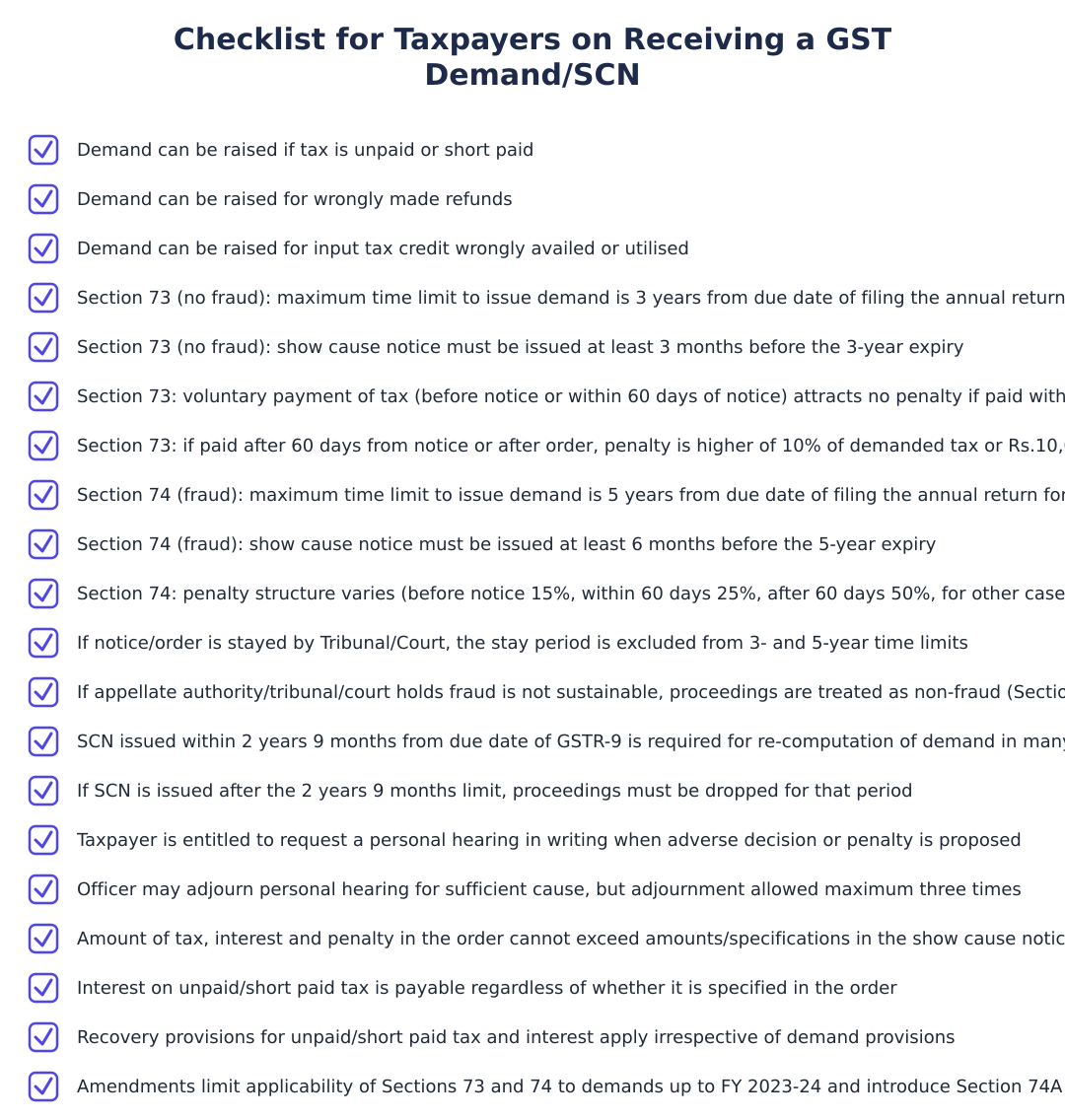
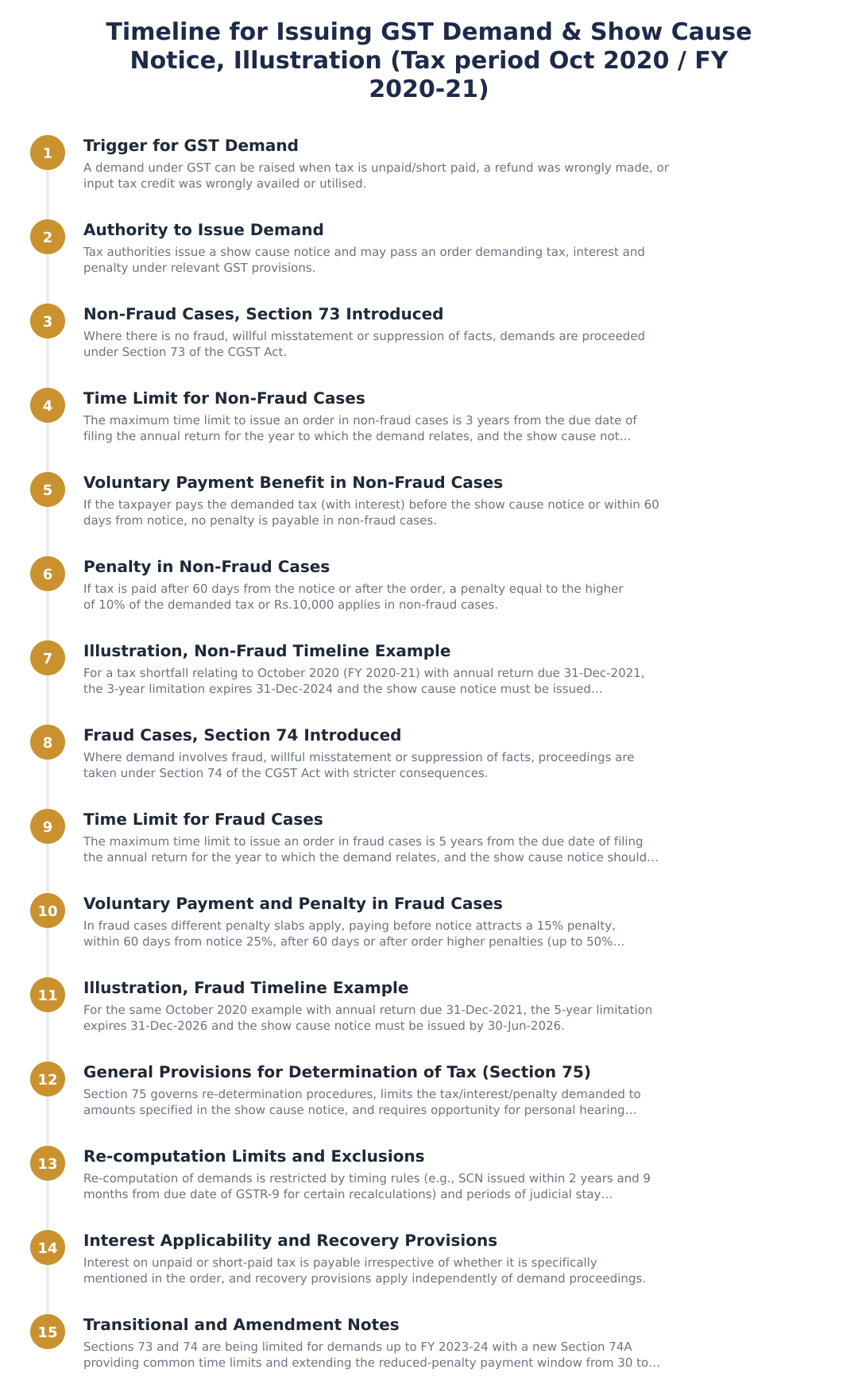
GST authorities can raise a demand if tax is unpaid or short paid, a refund was wrongly made, or input tax credit was wrongly availed or utilised. This applies whether the issue arose from error, omission or deliberate misstatement; the officer will issue a show cause notice and then an order if not satisfactorily replied. Recovery provisions can run even when demand proceedings are time-barred, so unpaid tax, interest and recovery steps may still apply. Time limits and penalty rates differ depending on whether the case is treated as fraud/wilful misstatement or a non-fraud case.
What's the difference between GST demand under Section 73 and Section 74?
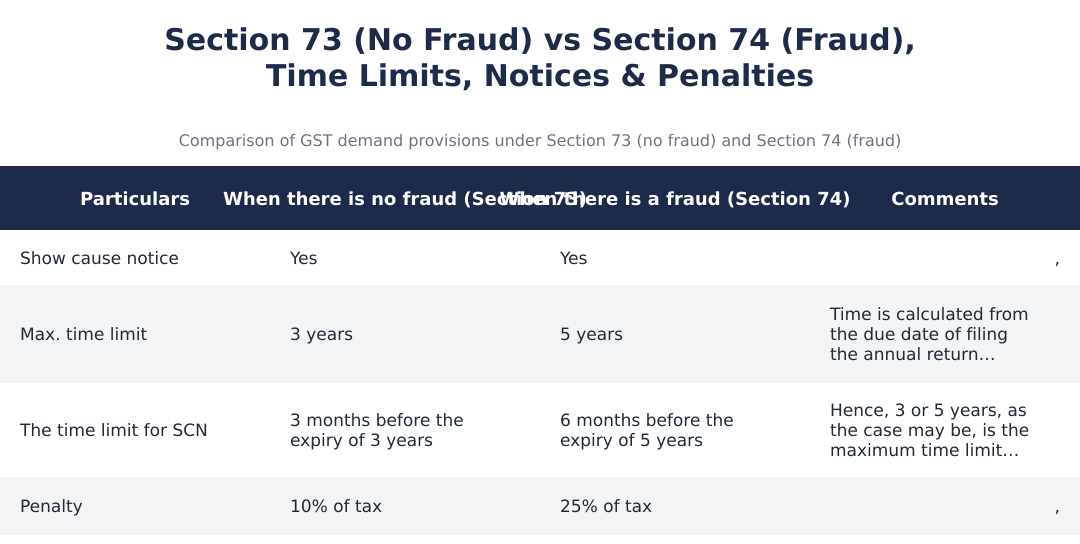
Section 73 covers demands where there is no fraud, wilful misstatement or suppression of facts, while Section 74 applies when the short payment/refund/credit involves fraud, wilful misstatement or suppression of facts. Time limits differ: maximum 3 years (Section 73) versus 5 years (Section 74) measured from the due date of the annual return or date of refund, and penalty rates are generally lower under Section 73 (10% of tax) versus Section 74 (25% of tax) though higher penalties can apply in other situations. The legal process (show cause notice, opportunity of hearing, order) is similar but consequences and time bars vary.
What are the time limits for issuing a GST demand notice or order?
The maximum time limit to issue a demand order is 3 years from the due date of the annual return for the relevant year in non-fraud cases and 5 years in fraud cases, with show cause notices served at least 3 months (non-fraud) or 6 months (fraud) before expiry. Practically that means the tax officer must issue the SCN within 2 years 9 months (for Section 73) or 4 years 6 months (for Section 74) from the due date of filing the annual return so that the order can be passed before the barrier date. If the order is not issued within the applicable period, adjudication proceedings are treated as concluded and cannot be initiated later, subject to limited exceptions like court/tribunal directions or stayed proceedings. Recovery provisions, however, may still apply irrespective of these demand time limits.
How does voluntary payment of tax affect penalty in a demand notice?
If the taxpayer pays the full tax demanded along with interest before issuance of the show cause notice or within 60 days of the notice, no penalty is levied under the reduced penalty provisions; this window is now 60 days (previously 30) for demands up to FY 2023-24. If payment is made after 60 days from the notice or after the order, a penalty of higher of 10% of the demanded tax or Rs.10,000 (non-fraud) applies, and steeper penalty slabs apply in fraud/other cases, including up to 100% in certain Section 122 situations. The availability of reduced penalty depends on timing and on whether the demand pertains to years covered by transitional/amendment provisions, so timely payment is critical to minimise penalty exposure.
What penalties apply if tax demand relates to fraud or wilful suppression?
In cases held to involve fraud, wilful misstatement or suppression of facts (Section 74), the penalty is generally higher, 25% of the tax demanded under Section 74 and even steeper rates under other provisions (15–50% depending on timing, and 100% under Section 122 for specific offences). If the taxpayer pays the demanded tax before notice is issued, a lower penalty may be applied; if payment is within 60 days of notice, a reduced percentage applies compared with payment after 60 days. Exact penalty percentages depend on timing of payment and the statutory provision invoked, so the stage at which the tax is paid (before notice, within 60 days of notice, or after order) materially affects the penalty outcome.
How is interest applied on GST demands?
Interest is chargeable on unpaid or short paid tax from the due date until actual payment, and the amount of unpaid/short-paid tax determined in the order attracts interest irrespective of whether interest is specifically quantified in the order. Interest rates follow CGST provisions and are calculated on the tax amount determined in the demand; the officer will re-compute interest when re-determining tax under Sections 73/74 where permitted by time limits. Some amendments and circulars provide conditional relief in limited circumstances, but generally interest liability cannot be avoided unless relief is specifically granted by statute or notified amnesty schemes.
What happens if a show cause notice is issued after the time limit?
If a show cause notice (SCN) is issued after the statutory time limit (beyond the 3-year or 5-year window measured from due date of the annual return or refund), the proceedings must generally be dropped and no demand/order can be sustained for that period, except where limited re-determination rules or court/tribunal directions apply. Circulars clarify that re-determination is allowed only if the SCN was issued within specified sub-limits (for example within 2 years 9 months from due date in many cases); SCNs beyond those sub-limits will not lead to valid orders. Stays by courts or tribunals and subsequent directions can alter these timelines, stay periods may be excluded and a fresh two-year window to pass an order may open on direction, so litigation history matters for final outcome.
Do amendments like Section 74A affect demand time limits or penalty relief?
Yes, amendments such as the newly inserted Section 74A (and related changes) create a common time limit mechanism for demands, extend the 30-day reduced penalty window to 60 days for certain years, and limit applicability of Sections 73 and 74 to demands up to FY 2023-24 with new rules for later years. Section 128A may provide conditional waivers of interest and penalty for specific older years if full tax liability is paid by notified dates, and changes to Section 17 restrict blocking of input tax credit for demands under Section 74 for periods up to FY 2023-24. These legislative changes are transitional and year-specific, so their benefits and applicability depend on the tax year of the demand and whether notified timelines are met.
Can the tax officer re-compute demand for multiple years in one notice?
The officer can re-determine tax for multiple years only to the extent SCNs for those years were issued within the applicable sub-limits (for example within 2 years 9 months from the due date of the annual return); if SCNs for other years were issued after these sub-limits, those proceedings must be dropped. In fraud cases, if SCN was issued within the sub-limit for a year, the entire demand in that notice may be re-computed; where SCNs span several years but some are time-barred, re-determination is limited to the years where SCN timing was valid. The amount ultimately demanded cannot exceed what was specified in the notice, and the taxpayer has right to personal hearing and appeal rights against the order.
Need help staying GST compliant?
MoneyGence's AI Finance OS tracks your compliance, wallet share, and finances in one place, built for agencies and growing businesses.
Get started with MoneyGence