Difference Between Wages and Salary – Key Comparisons & Examples
This guide explains the practical differences between wages and salary so you can understand how each pay structure affects workers and employers. You will learn how these two common forms of compensation are typically determined, what each implies for work hours, predictability of income, and benefits, and the typical advantages and disadvantages associated with each. Knowing these differences helps job-seekers evaluate offers, helps employers design appropriate pay structures for different roles, and helps HR teams communicate pay terms clearly to staff. The explanations below focus on concepts and workplace implications rather than specific legal thresholds or statutory rates.
What are Wages and Salaries?
At a conceptual level, wages and salaries are two ways employers compensate workers for their work. The core distinction lies in how pay is measured and delivered: one method ties pay to units of time or output, while the other ties pay to a periodic contractual amount.
Beyond the basic measurement, the two forms often carry different expectations about work hours, job continuity, and the relationship between employer and worker. Understanding these differences helps clarify expectations about flexibility, predictability of income, and how work performance is evaluated.
How are Wages Calculated?
Wages are generally calculated based on short time units such as hours or days, or on specific units of work completed. That means changes in hours worked or output typically lead to proportional changes in pay for the worker.
Because pay varies directly with measured time or output, wage arrangements are often used for roles with variable hours, piecework, or temporary assignments. In practice, this can provide earning flexibility when overtime or extra shifts are available, but it also means income can fluctuate from one pay period to the next.
How are Salaries Calculated?
Salaries are typically expressed as a fixed amount paid at regular intervals, independent of the exact number of hours worked in each pay period. This fixed periodic payment reflects a broader employment relationship and expectations about ongoing responsibilities.
A salaried arrangement tends to provide predictable pay and is commonly associated with roles where deliverables, responsibilities, or overall performance are the primary measures rather than hour-by-hour output. Salaried employees may have different expectations regarding work hours, paid leave, and other benefits compared with those on a wage basis.
Pros and Cons, Wages vs Salaries
Wage-based pay can offer flexibility and direct linkage between time worked and pay. For workers who prefer or require variable hours, or who can access overtime, wages can allow for immediate compensation increases. However, the downside can be income variability and a potential lack of employer-provided benefits or paid leave that are more common in salaried roles.
Salary-based pay offers stability and predictability of income, which can help with personal financial planning. Salaried roles are often bundled with other employment benefits and clearer expectations about longer-term responsibilities. On the flip side, salaried workers may have less direct compensation for extra hours and may face performance expectations tied to broader targets rather than hourly output.
Key Practical Differences
In recruitment and job selection, employers may choose wage structures for short-term, task-specific, or variable-hour roles, while salaried structures are often used for ongoing roles that require consistent responsibility and integration with organisational goals. For workers, the choice between wages and salary can influence mobility, financial predictability, and eligibility for certain benefits.
From an administrative standpoint, each pay model affects payroll processing, record-keeping, and how changes such as leave, overtime, or termination are handled. Employers and employees should therefore ensure that the chosen pay arrangement is clearly documented and communicated to avoid misunderstandings about pay calculation and employment expectations.
Frequently Asked Questions
Question: Which is better, wages or salary? Answer: "Better" depends on the individual’s priorities. If you prioritise predictability and bundled benefits, salaried work may suit you. If you prefer flexibility or the ability to increase earnings through additional hours, wage-based roles may be preferable.
Question: Can a job change from wages to salary? Answer: Employment arrangements can be redesigned by the employer and agreed with the worker, but such changes should be documented and communicated clearly to reflect any changes in responsibilities, pay calculation, and leave or benefits.
Choosing between wages and salary affects earnings stability, work flexibility, and the nature of the employment relationship. Assessing your personal priorities and the expectations of the role will help determine which compensation model is most appropriate. For contractual or legal specifics that apply to your situation, consult official employment regulations or a qualified advisor.
Frequently asked questions
What is the difference between wages and salary?
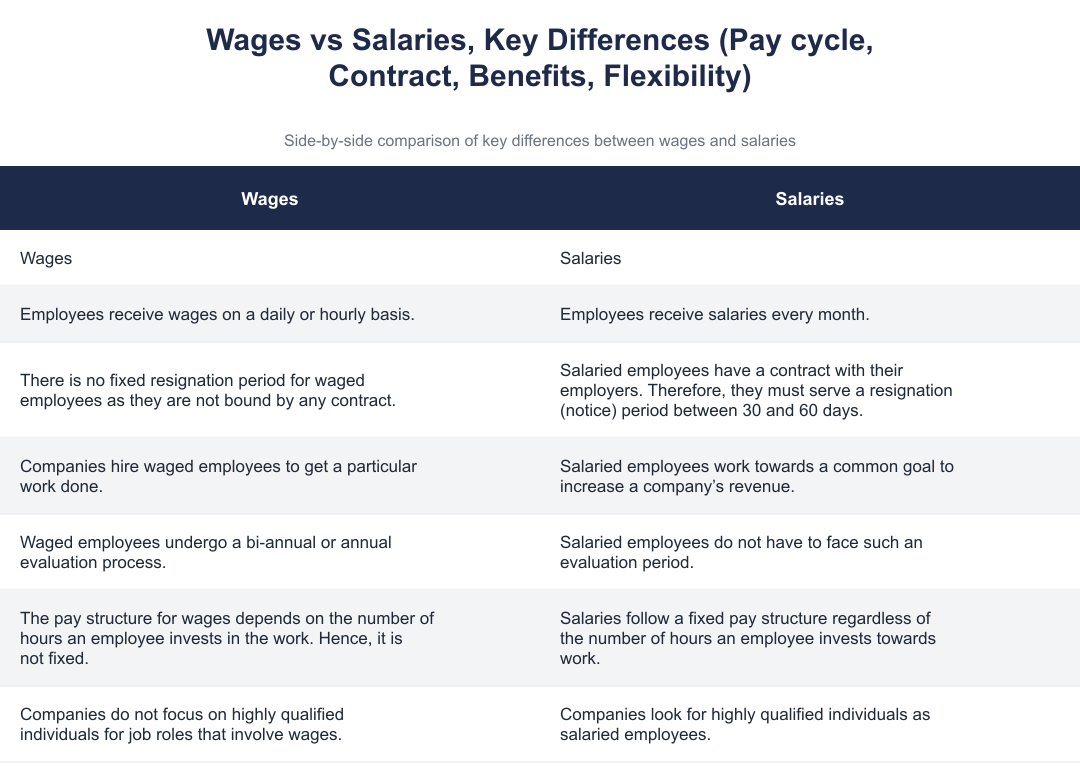
Wages are pay based on hours or days worked while salary is a fixed periodic pay, typically monthly. Wages are calculated on an hourly, daily or weekly basis and vary with time worked; salaried employees receive a set amount irrespective of hours and are usually under an employment contract. Waged workers often have more flexibility and can be paid overtime, but usually do not get add-on benefits like HRA or medical insurance. Salaried employees get stability and benefits (HRA, medical, travel) but typically do not get paid for overtime and may have notice-period obligations.
How are wages calculated?
Wages are calculated by applying an agreed rate to the time worked (hours, days or weeks) and dividing any annual rate by the pay period where needed. Employers often set an annual amount for recruitment clarity and then divide it by the pay period to get hourly or daily rates, for example, to get an hourly wage you divide the total amount allocated by the number of hours worked in the pay period. Waged employees may also earn overtime by working extra hours, and wages fluctuate with actual time put in. This method makes wages less predictable than a fixed salary.
How are salaries calculated?
Salaries are usually a fixed monthly amount agreed between employer and employee and calculated from components such as CTC, gross pay and deductions. A typical relation shown is Gross salary = CTC - EPF - Gratuity, and in-hand salary = Gross salary - Income Tax - EPF - Professional Taxes, so employers break total cost-to-company into fixed and variable components to arrive at monthly pay. Salaries do not depend on hours worked but on role, responsibilities and performance metrics, and may include allowances like HRA and travel reimbursement. Contracts govern salaried pay and often include notice periods and other terms.
What types of wages exist?
Common types of wages include fair wages, living wages and minimum wages, each defined by different policy or legal criteria. Minimum wages are statutory floors set by law, living wages are intended to cover basic living costs, and fair wages aim to ensure equitable pay relative to work. Waged employment is often part-time, flexible and not contract-bound, which affects benefits and job security. Because waged roles are less likely to include allowances or paid leave, workers paid by wages are usually more vulnerable to pay cuts and replacement.
What types of salaries are there?
Salary structures commonly include gross salary, net (in-hand) salary, CTC, and fixed plus variable pay components. Gross salary is the total pre-deduction pay derived from CTC after removing employer contributions like EPF and gratuity; in-hand salary is what remains after income tax, EPF and professional tax deductions. Employers may also split pay into fixed pay (guaranteed monthly) and variable pay (performance-linked). These components determine benefits, tax treatment and take-home pay for salaried employees.
Do waged employees have to serve a notice period when they quit?
No, waged employees are generally not bound by a formal contract and therefore typically do not have a fixed resignation or notice period. Because waged workers are not contractually bound in the same way as salaried staff, they have the freedom to quit immediately if needed without going through the formal resignation process. This flexibility comes at the cost of lower job security and fewer employment benefits compared with salaried roles. Employers also find waged employees easier to replace due to the lack of contractual obligations.
Do salaried employees get paid for overtime?
Typically salaried employees do not get paid separately for overtime because their pay is fixed irrespective of hours worked. Salaried compensation assumes a regular set of responsibilities and a fixed monthly pay, and many salaried roles include clauses that exclude additional overtime payments. However, some organisations may offer compensatory time off or include overtime in variable pay arrangements for certain grades, this depends on the employment contract and company policy. Waged employees, by contrast, are more likely to receive overtime pay because their pay is tied to hours worked.
What are the pros and cons of wages?
Pros of wages include greater flexibility, ability to take on overtime to increase earnings and freedom from long resignation procedures; cons include fewer add-on benefits, lack of paid leave and higher risk of pay cuts or replacement. Waged work is often part-time with fewer responsibilities, which suits workers seeking flexibility but not long-term security. Because employers do not typically offer allowances like HRA, travel reimbursement or insurance for waged staff, overall compensation and social protections are usually lower than for salaried employees. This makes wages attractive for short-term or variable work but less so for stable career paths.
What are the pros and cons of salaries?
Pros of salaries include pay stability, predictable monthly income and additional benefits such as HRA, medical and travel insurance, while cons include no overtime pay and potential withholding of variable compensation if revenue targets are not met. Salaried roles are typically full-time, tied to an employment contract and may require serving a notice period of 30 to 60 days upon resignation. The pay and benefits align with the employee's responsibilities and hierarchy, giving career progression and social security advantages over waged work. However, fixed salaries can reduce flexibility and may penalise employees if performance metrics are missed.
Need help staying Payroll compliant?
MoneyGence's AI Finance OS tracks your compliance, wallet share, and finances in one place, built for agencies and growing businesses.
Get started with MoneyGence