e-Invoicing Under GST: Applicability, Limits, Rules & Process
This guide explains e-invoicing under GST: what the system is, how it works, the technical components that make an e-invoice authentic, practical compliance touchpoints, benefits for businesses and common implementation challenges. You will learn how B2B invoices are authenticated, what the Invoice Reference Number (IRN) and QR code are, when e-invoicing began, and how valid e-invoices interact with GST returns and e-way bills. Understanding these elements matters because e-invoicing changes how businesses create and exchange B2B invoices, it adds a government-authenticated layer to invoices that improves invoice traceability, reduces duplication and streamlines reporting. Whether you are a finance head, tax consultant, ERP implementer or a business owner, this guide will clarify the system-level flow of e-invoices and the core pieces that make authentication and downstream reporting possible. The explanations focus on the features and mechanics that every organisation must accommodate when moving from paper or standalone electronic invoices to the government-authenticated e-invoice system.
What is e-Invoicing under GST?
E-invoicing under GST is a process where business-to-business (B2B) invoices are authenticated electronically by the GST infrastructure for further use on the common GST portal. Rather than invoices remaining solely between supplier and recipient systems, they are validated through a government-backed mechanism which creates an authoritative record.
The e-invoicing system creates standardized, authenticated invoice records which can be consumed by other GST processes. Because invoices are authenticated centrally, downstream activities such as return preparation and movement documentation can be linked to the same validated invoice data, reducing duplication and manual reconciliation.
When was e-Invoicing introduced?
Electronic invoicing for B2B transactions was implemented from 1st January 2020. Since that date, the government-backed process has been available to authenticate invoices through the designated infrastructure.
The implementation created a new interaction point between a supplier’s invoicing system and the GST ecosystem: invoices intended for B2B use are reported and authenticated so they can be relied upon for tax reporting and other GST-related systems.
Key technical components of an authenticated e-invoice
| Component | What it is | Why it matters |
|---|---|---|
| Invoice Reference Number (IRN) | A 64-character unique hash string generated by the Invoice Registration Portal (IRP) for every B2B invoice reported. | Serves as a unique identifier that authenticates the invoice and prevents duplication across the system. |
| Digital Signature by IRP | After IRN generation the IRP digitally signs the invoice. | Provides authentication that the invoice content returned by the IRP is unchanged and officially issued through the e-invoice process. |
| QR Code | A machine-readable code generated by the IRP and embedded with key invoice parameters such as supplier and recipient GSTIN, invoice number, date, invoice value, HSN and IRN details. | Enables offline verification of essential invoice data and quick authentication at the point of acceptance or inspection. |
How the GST e-Invoice system works (high-level flow)
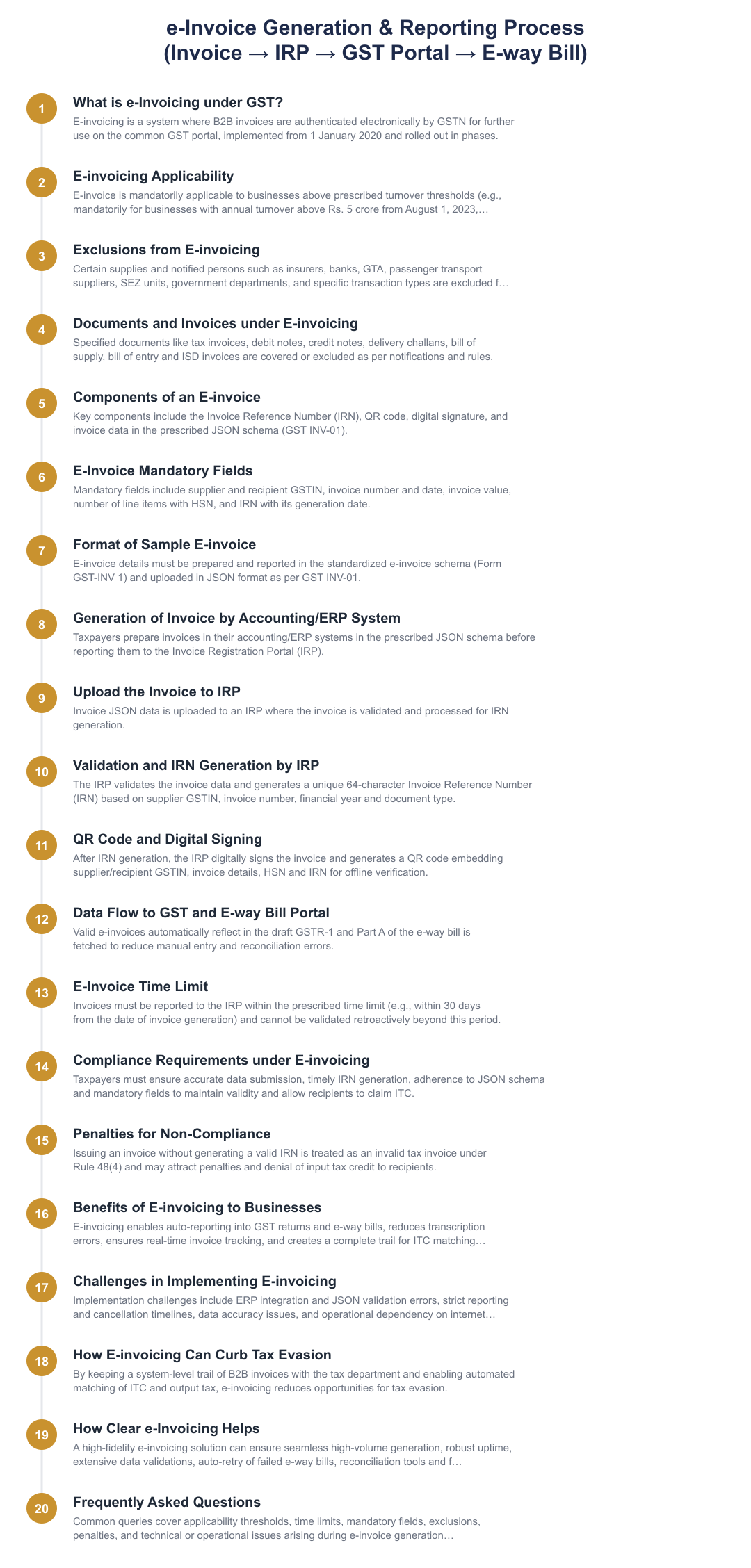
The supplier creates the B2B invoice in its accounting or billing system in the required format to be reported to the Invoice Registration Portal (IRP).
Invoice data is submitted to the IRP where it is validated and a unique Invoice Reference Number (IRN) is generated for that invoice.
After generating the IRN the IRP digitally signs the invoice and generates a QR code containing key invoice parameters; the signed e-invoice is returned to the supplier.
Valid e-invoices reported to the IRP automatically get reflected in the draft GSTR-1 and Part A of the e-way bill is automatically fetched, allowing downstream GST processes to consume the authenticated invoice.
Practical implications for businesses
Once an invoice is authenticated through the IRP, it becomes a trusted source for downstream GST activities. The IRN, digital signature and QR code together form an authoritative set of artefacts that suppliers and recipients can rely on for compliance and verification.
Because valid e-invoices automatically populate draft return data and fetch part of the e-way bill, businesses can reduce manual data entry and reconciliation effort between their internal records and the GST environment. This improves traceability of B2B invoices and supports smoother tax reporting workflows.
Benefits and operational challenges
Benefits include stronger authenticity of B2B invoices through system-generated IRNs and digital signatures, the ability to verify invoices offline via QR codes, and integration with GST return and e-way bill processes which reduces duplicate data entry and reconciliation.
Operational challenges arise because adopting the e-invoicing process requires changes in invoicing systems, timely reporting to the IRP and handling the authenticated outputs (IRN, signed invoice, QR code) correctly. Organisations need to adapt their internal processes to consume and store authenticated invoice records and to ensure seamless downstream use of the returned artefacts.
E-invoicing introduced a government-authenticated layer for B2B invoices that improves invoice authenticity, prevents duplication and enables smoother flow into GST returns and e-way bill processes. The core elements to plan for are IRN generation, the IRP's digital signature and the QR code, together these make an e-invoice a trusted, consumable document for tax and logistics workflows. Businesses should prioritise system readiness so they can generate, report and retain authenticated invoices for downstream compliance and operational efficiency.
Frequently asked questions
What exactly is e-invoicing under GST and who generates the invoice?
E-invoicing under GST is a system where B2B invoices are electronically authenticated by an Invoice Registration Portal (IRP) and the government does not create invoices but validates them; businesses continue to generate the invoice in their ERP and then report it to the IRP. The IRP validates the invoice data, generates a unique Invoice Reference Number (IRN), a 64-character hash, digitally signs the JSON payload and returns a signed invoice with a QR code for offline verification. Once validated, the invoice details are automatically made available to the GST portal (draft GSTR-1) and to the e-way bill system (Part A), reducing manual entry and reconciliation. This process prevents duplicate or fake invoices and helps in real-time matching of ITC claims and output tax.
Who must comply with e-invoicing under GST, what are the turnover limits and dates?
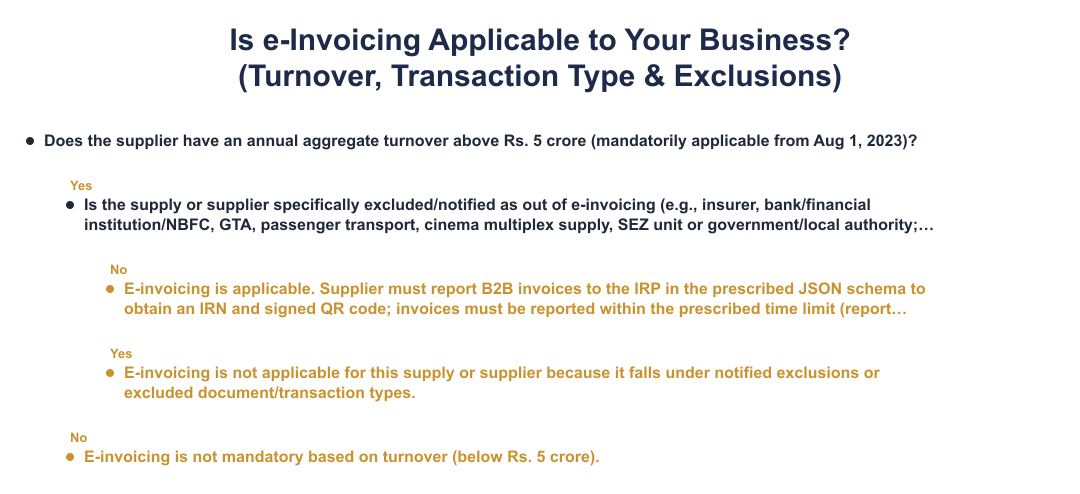
E-invoicing is mandatory for businesses whose aggregate annual turnover exceeds Rs. 5 crore in a financial year, effective from August 1, 2023. Previously higher thresholds applied in phased rollouts, but the current notified limit requires all taxpayers above Rs. 5 crore turnover to report their B2B invoices to an IRP. Note that the rule applies to B2B supplies and specified document types (tax invoices, debit/credit notes) and some notified categories and transactions are excluded. Businesses below the turnover threshold are not mandated but may adopt e-invoicing voluntarily if they wish.
What documents and invoice types are required to be reported in the e-invoice system?
You must report B2B tax invoices, debit notes and credit notes in the prescribed JSON schema (GST INV-01) to the IRP for e-invoicing. The e-invoice schema corresponds to Form GST INV-1 and requires supplier, recipient, item-level, value and tax breakup fields; non-tax invoices like bill of supply, bill of entry, ISD invoices and certain delivery challans are excluded. Specific notified businesses (for example insurers, banks, GTA, passenger transport suppliers, cinema multiplex services, certain SEZs and government departments as exempted) have tailored exclusions via CBIC notifications. Always ensure the invoice is uploaded within the statutory time limit and in the correct JSON format to generate an IRN and signed QR code.
What are the mandatory fields on an e-invoice and what happens if they are wrong?
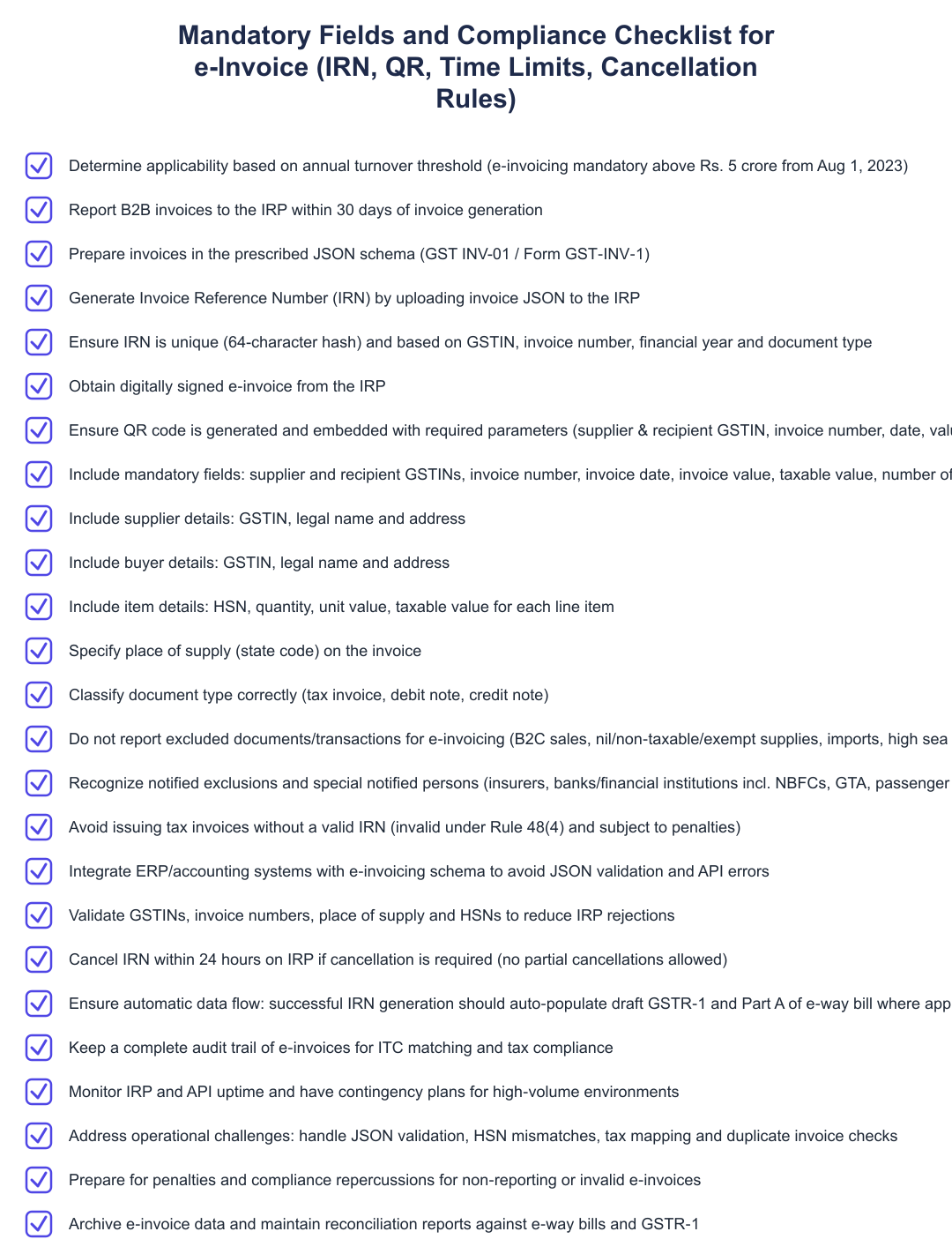
Mandatory e-invoice fields include supplier and recipient GSTIN, invoice number and date, invoice value (taxable and tax), number of line items with HSN, place of supply (state code), and the IRN and its generation date once issued. If any mandatory field is incorrect, for example wrong recipient GSTIN, duplicate invoice number, or incorrect place of supply, the IRP will reject the JSON and you will not receive a valid IRN, making the document an invalid tax invoice under Rule 48(4) and exposing you to penalties and denial of ITC for recipients. Small clerical mismatches commonly cause validation errors, so accurate data entry and ERP-to-IRP validation are critical. Corrections generally require cancelling and reissuing the invoice subject to time and cancellation rules.
How does the e-invoicing process work step-by-step from ERP to IRP to GST portal?
First, the supplier generates the invoice in their accounting/ERP system in the prescribed JSON schema (GST INV-01); next, the invoice JSON is uploaded to the IRP (via API, Excel mode, FTP/SFTP or Tally connector). The IRP validates the data and, upon success, generates a 64-character IRN, digitally signs the invoice, and returns a signed JSON with a QR code; this signed invoice data is simultaneously pushed to the GST portal (draft GSTR-1) and the e-way bill system (Part A) where applicable. The signed IRN and QR code are used for authentication and offline verification by the buyer or tax authorities, and the workflow reduces manual reconciliations and transcription errors. Failed validations must be corrected in the ERP and re-submitted within the allowed timelines.
What are the time limits for reporting and cancelling e-invoices?
An IRN must be generated by uploading the invoice to the IRP within 30 days from the date of invoice generation; invoices not reported within this period cannot be validated later as a backend IRN. If you need to cancel a generated e-invoice, cancellation is permitted on the IRP only within 24 hours of IRN generation and partial cancellations are not allowed. These strict timelines mean businesses must ensure correct invoice details before reporting and have operational processes to handle cancellations quickly when needed. Non-adherence can lead to the invoice being treated as invalid and potential penalties for both supplier and recipient.
What penalties or compliance consequences apply for not generating a valid e-invoice?
If a notified taxpayer issues a B2B invoice without generating a valid IRN from the IRP, that invoice is treated as an invalid tax invoice under Rule 48(4) and may attract penalties and denial of input tax credit to the recipient. Besides Rule 48(4) consequences, inaccuracies or failure to report can invite interest, penalties under GST provisions for incorrect tax invoices, and enforcement actions during audits due to mismatch in system-level records. Recipients relying on such invoices may face blocked or delayed ITC claims, so both supplier and recipient face financial and compliance risks. Maintaining accurate, timely e-invoice reporting and storing signed JSON/QR codes helps demonstrate compliance in assessments.
What are the main benefits and practical challenges of implementing e-invoicing for businesses?
The main benefits of e-invoicing are automated reporting into GST returns and e-way bills, reduced transcription errors, real-time invoice trail for tax authorities which curbs fake ITC claims, and faster reconciliation and tracking of invoices. Practical challenges include ERP integration and JSON validation errors, strict reporting and cancellation timelines (30 days for reporting, 24 hours for cancellation), frequent data validation rejections (wrong GSTIN, duplicate invoice numbers, HSN mismatches), and operational dependency on internet connectivity and IRP/GST portal uptime for high-volume users. Businesses can mitigate these challenges with robust integration, pre-validation checks, and using high-availability middleware or approved IRPs that offer retries, bulk modes and enriched validation features. For large volumes, using an IRP-approved solution with uptime guarantees and auto-retry for e-way bills reduces failures and manual workarounds.
What are the technical components of an e-invoice like IRN, QR code, digital signature and JSON schema?
Key technical components of an e-invoice are the JSON payload in the prescribed GST INV-01 schema, the Invoice Reference Number (IRN), a unique 64-character hash generated by the IRP, a digitally signed JSON returned by the IRP, and a QR code that embeds supplier and recipient GSTIN, invoice number and date, invoice value, HSN, IRN and IRN generation date for offline verification. The digital signature authenticates the sender and ensures the signed invoice content is tamper-proof; the QR code allows quick scanning and verification at the buyer’s end or during verification by authorities. Proper construction and submission of the JSON schema from the ERP is essential to pass IRP validation and receive the signed IRN and QR code back for invoicing records and GST filing automation.
Need help staying GST compliant?
MoneyGence's AI Finance OS tracks your compliance, wallet share, and finances in one place, built for agencies and growing businesses.
Get started with MoneyGence