E-Way Bill Guide: Rules, Applicability, Limit & Generation
This guide explains what an e-Way Bill is, who must generate it, the state-wise threshold limits, required documents, the generation methods (portal, SMS, app, bulk upload, API), validity rules, time limits and common compliance errors. For businesses and transporters moving goods across India, understanding e-Way Bill rules is crucial to avoid penalties, detention or seizure of goods. You will learn when an e-Way Bill is mandatory (including standard interstate thresholds and various intrastate exceptions), which parties are responsible for generation, the documents and details needed to create an e-Way Bill, and practical steps for generation using web, mobile or system integration. The guide also covers important operational constraints: e-Way Bills can only be generated for documents dated within 180 days of the generation date, validity calculation (1 day per 200 km for regular cargo; 1 day per 20 km for Over Dimensional Cargo), the limit on extensions (capped at 360 days from original generation date), and the penalty exposure for transporting goods without a valid e-Way Bill. Lastly, you will find common portal errors and how to resolve them, plus a concise FAQ-ready summary of the key points. This information reflects updates including advisory changes effective from 1 August 2026 and system changes live from 1 July 2025 where relevant, so you can align your processes to current e-Way Bill practice.
What is an E-Way Bill?
An e-Way Bill is an electronic document required for movement of goods when specified conditions are met. It captures details of the consignor, consignee, goods, invoice or challan, and transport so that tax officers can track consignments and guard against evasion. The e-Way Bill system is designed to be used across modes of transport and integrates with GST processes to streamline compliance.
Practically, the e-Way Bill replaces paper documentation for movements exceeding specified monetary thresholds or where state rules require it. It is relevant not only for outward supplies (sales) but also for transfers, returns, job-work movements, imports and exports in specific contexts. Knowing whether a movement requires an e-Way Bill, who must create it, and what details are mandatory helps businesses avoid penalties and logistical delays.
E-Way Bill Applicability
An e-Way Bill is required when either the value of a single consignment (invoice/bill/delivery challan) exceeds Rs. 50,000 or when the aggregate value of all consignments in a vehicle exceeds Rs. 50,000 for interstate movement. In addition to outward supplies, the system applies to movements for reasons other than supply (such as sales return or branch transfer) and to purchases from unregistered persons.
Certain transactions attract e-Way Bill requirements irrespective of value, for example, inter-state movement of goods by a principal to a job-worker and inter-state transport of handicraft goods by a dealer exempted from GST registration. At the same time, a list of exemptions exists (goods moved by non-motorised vehicles, movements under Customs supervision, transit cargo to/from Nepal or Bhutan, empty containers, and other notified categories). Businesses must map their typical movements against these applicability rules to decide when to generate e-Way Bills.
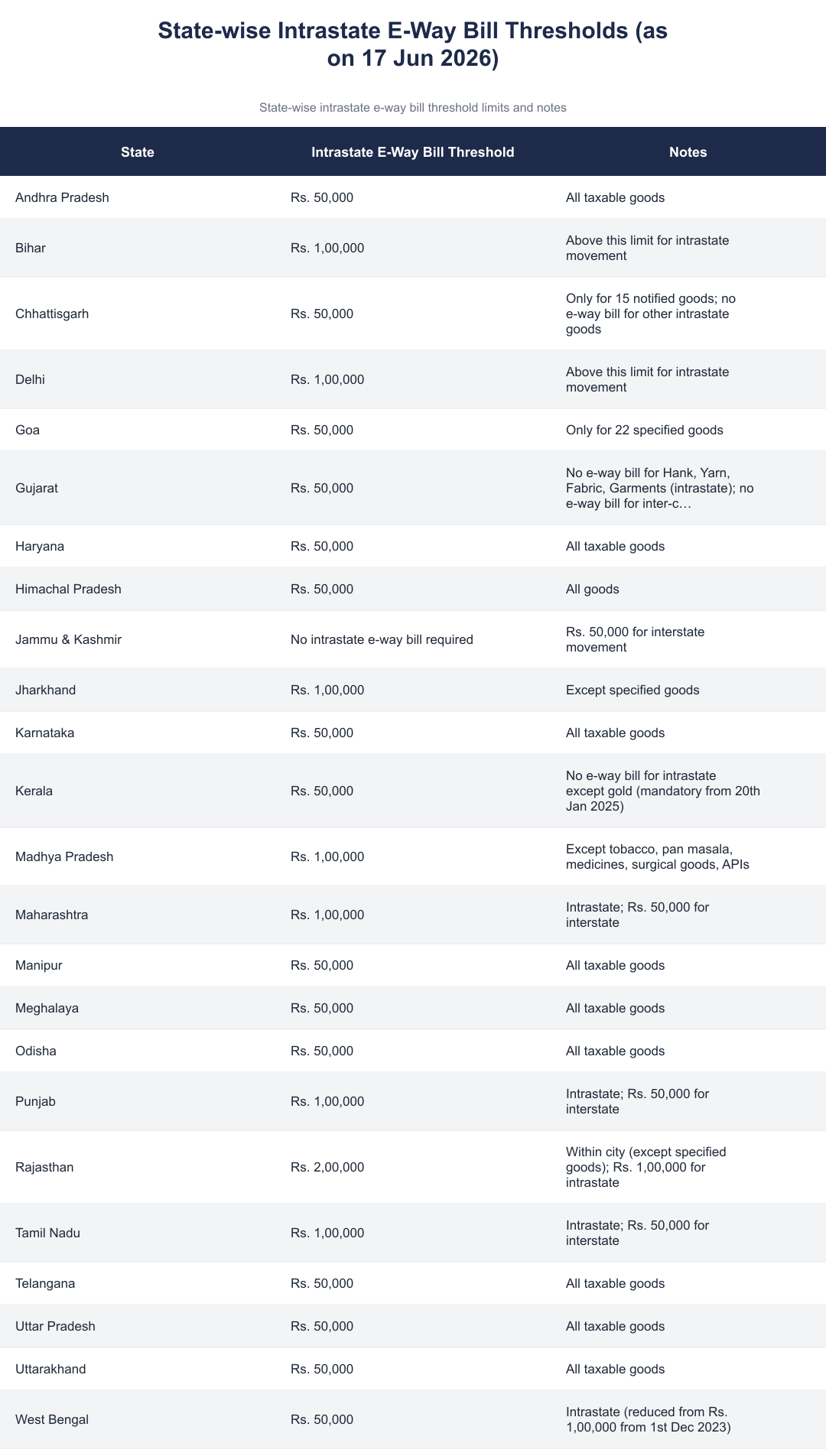
E-Way Bill Limit: State-wise Threshold Limits
| State | Intrastate E-Way Bill Threshold | Notes |
|---|---|---|
| Andhra Pradesh | Rs. 50,000 | All taxable goods |
| Bihar | Rs. 1,00,000 | Above this limit for intrastate movement |
| Chhattisgarh | Rs. 50,000 | Only for 15 notified goods; no e-way bill for other intrastate goods |
| Delhi | Rs. 1,00,000 | Above this limit for intrastate movement |
| Goa | Rs. 50,000 | Only for 22 specified goods |
| Gujarat | Rs. 50,000 | No e-way bill for Hank, Yarn, Fabric, Garments (intrastate); no e-way bill for inter-city movement (from 1st Oct 2018) |
| Haryana | Rs. 50,000 | All taxable goods |
| Himachal Pradesh | Rs. 50,000 | All goods |
| Jammu & Kashmir | No intrastate e-way bill required | Rs. 50,000 for interstate movement |
| Jharkhand | Rs. 1,00,000 | Except specified goods |
| Karnataka | Rs. 50,000 | All taxable goods |
| Kerala | Rs. 50,000 | No e-way bill for intrastate except gold (mandatory from 20th Jan 2025) |
| Madhya Pradesh | Rs. 1,00,000 | Except tobacco, pan masala, medicines, surgical goods, APIs |
| Maharashtra | Rs. 1,00,000 | Intrastate; Rs. 50,000 for interstate |
| Manipur | Rs. 50,000 | All taxable goods |
| Meghalaya | Rs. 50,000 | All taxable goods |
| Odisha | Rs. 50,000 | All taxable goods |
| Punjab | Rs. 1,00,000 | Intrastate; Rs. 50,000 for interstate |
| Rajasthan | Rs. 2,00,000 | Within city (except specified goods); Rs. 1,00,000 for intrastate |
| Tamil Nadu | Rs. 1,00,000 | Intrastate; Rs. 50,000 for interstate |
| Telangana | Rs. 50,000 | All taxable goods |
| Uttar Pradesh | Rs. 50,000 | All taxable goods |
| Uttarakhand | Rs. 50,000 | All taxable goods |
| West Bengal | Rs. 50,000 | Intrastate (reduced from Rs. 1,00,000 from 1st Dec 2023) |
Who Should Generate an E-Way Bill?
| Who | Obligation | Form |
|---|---|---|
| Registered Supplier (Consignor) | Before movement of goods exceeding Rs. 50,000 | Fill Part A of Form GST EWB-01 |
| Registered Recipient (Consignee) | If acting as the transporter (own or hired vehicle) | Fill Part A + Part B of Form GST EWB-01 |
| Transporter (Registered or Enrolled) | If the supplier/recipient has not generated the e-way bill | Generate EWB based on Part A information from the registered person |
| Unregistered Transporter | Must enrol on the e-way bill portal to obtain a Transporter ID (TRANSIN) | Generate EWB on behalf of clients after enrolment |
| Unregistered Supplier → Registered Recipient | The registered recipient is responsible for compliance, as if they were the supplier | Recipient ensures EWB generation |
Documents Required for e-Way Bill Generation
| Mode of Transport | Documents Required |
|---|---|
| All modes | Invoice / Bill of Supply / Delivery Challan related to the consignment |
| Road | Transporter ID (GSTIN or TRANSIN) or Vehicle Registration Number |
| Rail, Air, or Ship | Transporter ID + Transport Document Number + Date of the transport document |
How to Generate an E-Way Bill?
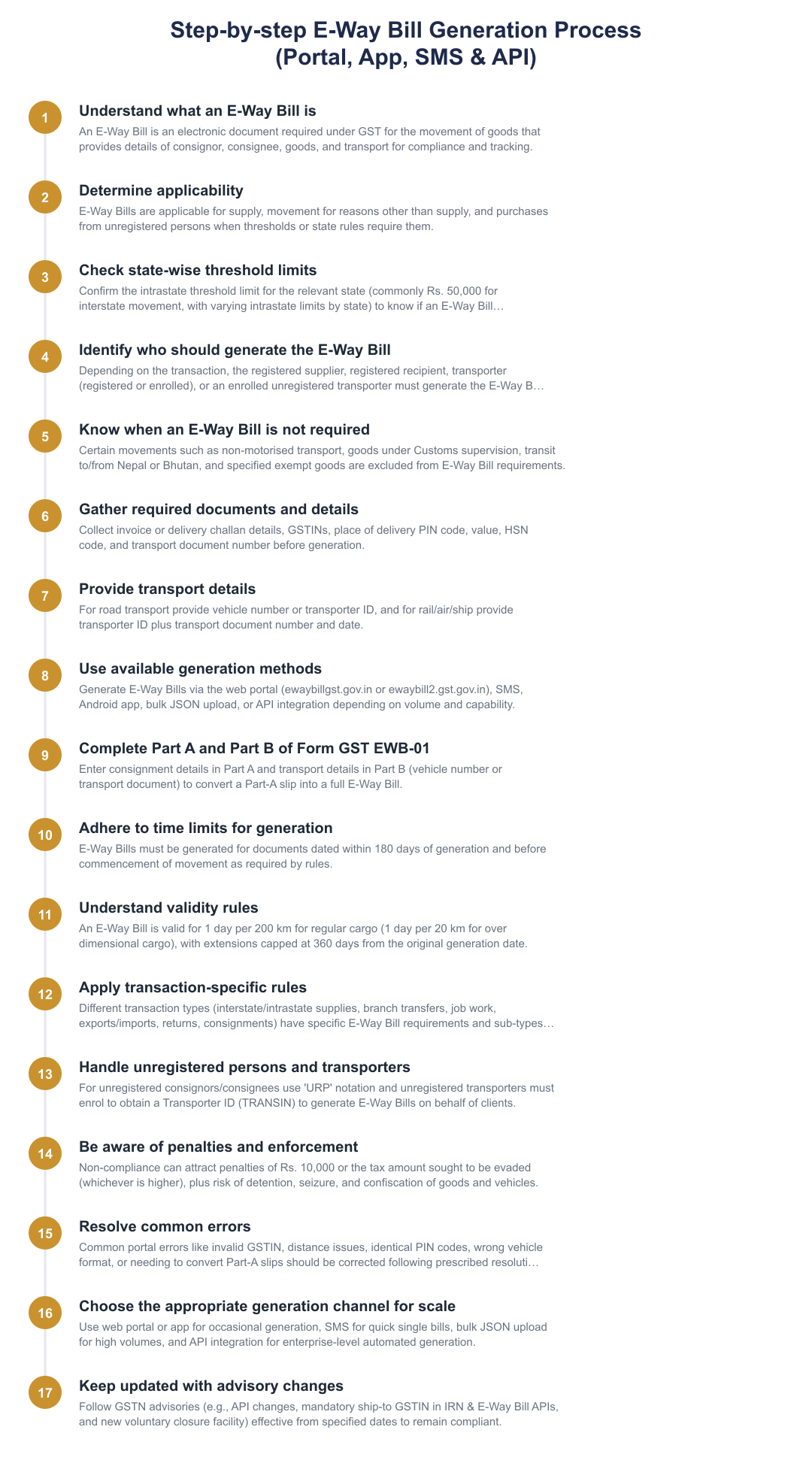
Ensure you have a valid GSTIN, an active GST account, and a registered account on the e-way bill portal; 2FA (Multi-Factor Authentication) has been mandatory for all taxpayers from 1st April 2025.
Generate e-Way Bills via the web portal (ewaybillgst.gov.in) or the newer portal (ewaybill2.gst.gov.in live from 1st July 2025) by entering Part A and Part B details as applicable.
Register your mobile number on the e-way bill portal under Registration > For SMS, then send predefined SMS codes to the GSTN's designated mobile number to create an e-Way Bill.
Use the Android app (registered IMEI-based access) for on-the-go generation, or upload a JSON file for bulk generation if you handle high volumes.
Enterprises with high daily invoice volumes can integrate directly with e-Way Bill APIs for system-to-system generation; note advisory changes effective 1st August 2026 affecting Ship-to GSTIN and related fields.
Time Limit to Generate and Validity of E-Way Bill
E-Way Bills can only be generated for documents dated within 180 days from the date of generation. For example, an e-Way Bill generated on 1st March 2025 can only be raised against documents dated on or after 3rd September 2024. Documents older than 180 days are ineligible for e-Way Bill generation.
Validity of an e-Way Bill depends on distance and type of cargo: the standard rule is 1 day per 200 km for regular cargo and 1 day per 20 km for Over Dimensional Cargo (ODC). The transporter can seek validity extension up to 8 hours before or 8 hours after expiry for specified reasons (natural calamity, law and order issues, trans-shipment delay, vehicle breakdown, etc.). Effective 1st January 2025, extensions are capped at 360 days from the original generation date.
Penalty for Non-Compliance with E-Way Bill Rules
Transporting goods without a valid e-Way Bill attracts a penalty of Rs. 10,000 or the tax amount sought to be evaded, whichever is higher. A transporter who fails to generate an e-Way Bill when required is also liable to the same penalty. Non-compliance can lead to detention and seizure of goods and possible confiscation of the vehicle.
There are additional penalties for display and other violations under CGST rules, non-compliance under CGST Rule 18(1) can attract penalties up to Rs. 25,000. Given the financial and operational risks, businesses should build controls to ensure e-Way Bills are generated timely and accurately.
Common Errors in E-Way Bill Generation
| Error | Cause | Resolution |
|---|---|---|
| Invalid GSTIN | Incorrect GSTIN entered for consignor/consignee | Enter 'URP' for unregistered persons; verify GSTIN via GST Search tool |
| Distance not available | PIN-to-PIN distance not in NIC database | Enter '0'; if NIC has data it will auto-fill; if not, e-Way Bill is generated with '0' distance and user must provide the actual distance |
| Same PIN code error | Source and destination PIN codes are identical | Enter actual distance (must be within 100 km); e-Way Bill cannot be generated with identical PIN codes |
| Invalid vehicle number format | Vehicle number entered in non-standard format | Follow the prescribed format (portal format guide) |
| Part-A Slip generated instead of EWB | Part B details (vehicle number or transport document number) not entered | Enter Part B details to convert the Part-A Slip into a complete e-Way Bill |
| Cannot edit generated e-Way Bill | EWBs cannot be edited once generated | Cancel within 24 hours (if not verified by an officer) and regenerate with correct details |
| Portal login failure after multiple attempts | Account blocked after 5 incorrect login attempts | Wait 5 minutes; use 'Forgot Password' to reset credentials |
E-Way Bill compliance affects almost every business that moves goods. Key takeaways: interstate movements default to a Rs. 50,000 threshold, states may set different intrastate thresholds, e-Way Bills must reference documents not older than 180 days, validity is distance-based with extension limits, and penalties for non-compliance are severe. Implement clear roles (who generates the EWB), use available generation channels (portal, SMS, app, bulk JSON, API) and validate GSTIN, PIN codes and vehicle details to avoid common errors. For high-volume operations, consider API or bulk upload to reduce manual errors and ensure timely generation.
Frequently asked questions
What is an e-way bill and when do I need one?
An e-way bill is an electronically generated document required for movement of goods in India when the value of a consignment (invoice/bill/delivery challan) exceeds Rs. 50,000 or when the aggregate value of consignments in a vehicle exceeds Rs. 50,000. It must be generated before the movement of goods for interstate supplies and for intrastate supplies where the state-specific threshold mandates it; some states set higher intrastate limits up to Rs. 2,00,000. The e-way bill records GSTINs, invoice/challan details, place of delivery (PIN), HSN, transporter details and is generated on the e-way bill portal or via SMS, app, bulk JSON upload or API. Note that e-way bills can only be generated for documents dated within 180 days of generation (applicable from 1 Jan 2025) and Ship-to GSTIN may be mandatory in APIs from 1 Aug 2026 if ship-to information exists.
Who is responsible for generating the e-way bill, supplier, recipient or transporter?
The registered supplier (consignor) is primarily responsible for generating the e-way bill by filling Part A of Form GST EWB-01 before movement when required. If the registered recipient acts as the transporter (using own or hired vehicle), the recipient must fill Part A and Part B; transporters (registered or enrolled) can generate the e-way bill if the supplier/recipient has not done so, using Part A information. Unregistered transporters must enrol on the e-way bill portal to obtain a Transporter ID (TRANSIN) and then can generate EWBs on behalf of clients; if an unregistered supplier sends goods to a registered recipient, the recipient assumes the compliance responsibility.
What are the state-wise intrastate e-way bill limits I should know about?
Intrastate e-way bill thresholds vary by state; while the standard threshold for interstate movement is Rs. 50,000, many states set different intrastate limits ranging from Rs. 50,000 up to Rs. 2,00,000. For example, Andhra Pradesh, Gujarat, Karnataka, Kerala (except gold from 20 Jan 2025), Telangana, Uttar Pradesh and West Bengal (from 1 Dec 2023) have Rs. 50,000 limits; Rajasthan allows Rs. 2,00,000 within city and Rs. 1,00,000 intrastate; Maharashtra and Tamil Nadu set intrastate at Rs. 1,00,000 while interstate remains Rs. 50,000. Several states also have product-specific exceptions (e.g., Goa applies e-way only for 22 specified goods, Chhattisgarh only for 15 notified goods); check the state rules before transit.
When is an e-way bill not required for transporting goods?
An e-way bill is not required for certain movements such as goods transported by non-motorised vehicles, cargo moving under customs supervision/under seal, transit to/from Nepal or Bhutan, goods moved by defence formations, empty containers, and movements from customs port to ICD/CFS for clearance. Additionally, goods specified as exempt under Rule 138(14), items treated as no supply under Schedule III, and other exemptions notified by states are excluded. Small consignments below the applicable threshold (interstate Rs. 50,000 or state-specific intrastate limit) also do not need an e-way bill, and there are procedural exceptions like consignor moving goods to a nearby weighbridge within 20 km accompanied by a delivery challan.
What documents and details do I need to generate an e-way bill?
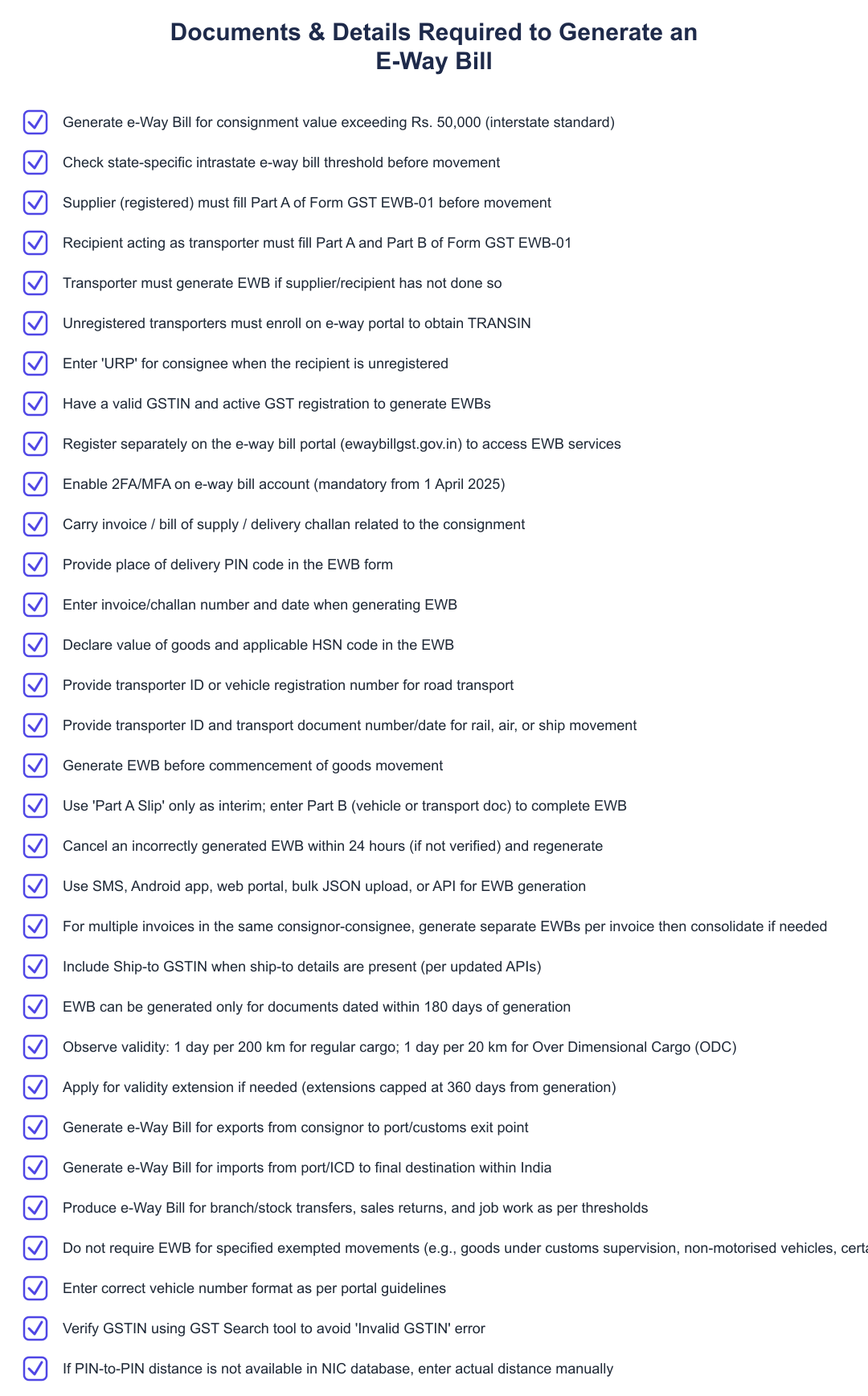
To generate an e-way bill you must have the invoice, bill of supply or delivery challan number and date, value of goods, HSN code, GSTIN of recipient (or 'URP' for unregistered persons), place of delivery PIN code, transport document number for rail/air/ship and transporter details like vehicle number or Transporter ID. For road transport you need the vehicle registration number; for rail/air/ship you need the transporter ID plus the transport document number and date. Also ensure your GSTIN is active and you are registered on the e-way portal with 2FA enabled (mandatory from 1 Apr 2025); bulk JSON or API users need proper authentication and schema-compliant data.
How long is an e-way bill valid and can I extend it?
An e-way bill is valid for 1 day for the first 200 km of travel for regular goods and 1 day for the first 20 km for Over Dimensional Cargo (ODC); you get an additional day for every subsequent 200 km (regular) or 20 km (ODC) or part thereof. Validity extensions are allowed but are capped, extensions cannot push validity beyond 360 days from the original generation date. Also note that EWBs must be generated for documents dated within 180 days of generation (effective from 1 Jan 2025), and a new voluntary e-way bill closure facility was introduced allowing participants to declare delivery completion (optional from 1 Aug 2026 via API changes advisory).
What are the methods available to generate an e-way bill?
You can generate an e-way bill via the official web portal (ewaybillgst.gov.in or ewaybill2.gst.gov.in live from 1 Jul 2025), SMS from a registered mobile number, Android app for registered taxpayers and enrolled transporters, bulk JSON file upload for high-volume users, or system-to-system API integration suitable for enterprises with thousands of invoices daily. Bulk generation via JSON is ideal for businesses with many consignments; API integration requires compliance with GSTN updates (e.g., mandatory Ship-to GSTIN in APIs when applicable from 1 Aug 2026). All methods require an active GSTIN, enrolment on the e-way portal, and 2FA for portal access (mandatory from 1 Apr 2025).
What penalties apply for transporting goods without a valid e-way bill?
Transporting goods without a valid e-way bill attracts a penalty of Rs. 10,000 or the tax amount sought to be evaded, whichever is higher, and the consignment can be detained or seized with possible confiscation of the vehicle. Transporters failing to generate the e-way bill when required are liable to the same monetary penalty, and non-compliance under CGST Rule 18(1) (display violations) can invite penalties up to Rs. 25,000. Because of these significant risks, it is important to generate a valid e-way bill before movement and ensure details match the invoice/transport documents.
What are common errors while generating e-way bills and how do I fix them?
Common errors include entering an invalid GSTIN (enter 'URP' for unregistered persons and verify GSTIN via the GST search tool), PIN-to-PIN distance not found in NIC database (enter '0' to let NIC auto-fill or manually enter actual distance), identical source and destination PIN codes (enter actual distance within 100 km), and incorrect vehicle number format (use the portal-prescribed format like KA01AB1234). Other issues are generating a Part-A slip instead of a full EWB due to missing Part B details, add vehicle or transport document details to complete it, and the fact that EWBs cannot be edited once generated (you must cancel within 24 hours if not verified by an officer and then regenerate). Portal login may be blocked after 5 wrong attempts; wait 5 minutes or use 'Forgot Password' to reset.
Need help staying GST compliant?
MoneyGence's AI Finance OS tracks your compliance, wallet share, and finances in one place, built for agencies and growing businesses.
Get started with MoneyGence