EPF Interest Rate 2026: Calculate EPF Interest & Tax Implications
This guide explains how Employee Provident Fund (EPF) contributions are calculated and split between the employee and employer, what tax benefit you can claim on those contributions, and how to use simple arithmetic to estimate monthly contributions from your basic salary. Knowing how EPF contributions are computed matters because it helps you plan cash flow, understand the composition of your payroll deductions, and maximise allowable tax savings under Section 80C of the Income Tax Act. This article focuses on the mechanics of contribution calculation and employer allocation, the practical, verifiable facts you can apply immediately to your salary slip. You will learn: how to compute the employee share of EPF from basic wages, how the employer’s monthly contribution is apportioned between the Employees’ Pension Scheme (EPS) and the EPF account, and the tax deduction limit available for EPF contributions under Section 80C. Practical examples using a sample basic salary are included so you can verify the math with your own figures. Whether you are a salaried employee reconciling your payslip or an employer preparing payroll entries, this guide gives clear, step-by-step methods and examples to ensure contributions are being calculated correctly and that you are claiming the prescribed deduction under income tax law.
How EPF contributions are split
EPF contributions have a statutory structure with distinct shares for the employee and the employer. The employee’s share is a fixed percentage of basic wages. The employer’s contribution is divided into two parts: a mandated allocation to the Employees’ Pension Scheme (EPS) and the remainder that goes into the EPF account.
Understanding this split is important because the amounts credited to the EPF account and the EPS have different purposes: EPF accumulates retirement savings that earn interest, while EPS is designed to provide a pension benefit. When you look at your payslip or EPF passbook, the credited amounts reflect this employer apportionment.
Example breakdown for a representative basic salary
| Component | Rate / Portion | Amount (for Rs. 15,000 basic) |
|---|---|---|
| Employee contribution to EPF | 12% of basic wages | Rs. 1,800 |
| Employer contribution to EPS | 8.33% of Rs. 15,000 | Rs. 1,250 |
| Employer contribution to EPF (remainder) | 3.67% of Rs. 15,000 | Rs. 550 |
How to calculate your monthly EPF contribution
Locate the basic salary figure on your payslip, EPF contributions are computed on basic wages (and dearness allowance where applicable).
Multiply the basic wages by 12% to get the monthly employee contribution to EPF (for example, 12% of Rs. 15,000 = Rs. 1,800).
From the employer’s total mandated contribution, 8.33% of the basic (example: Rs. 1,250 on Rs. 15,000) is allocated to EPS and the remainder (example: Rs. 550) goes to the EPF account.
Check your payslip and EPF statement to ensure the employee debit and the employer credits match your calculations. The EPF passbook will show the EPF portion credited each month.
Tax benefit under Section 80C
Contributions you make to your EPF are eligible for income tax deduction under Section 80C of the Income Tax Act. There is a statutory cap on the total deduction available under Section 80C, and EPF contributions count towards that limit alongside other eligible investments and payments.
Practically, this means the portion of your salary that you and your employer contribute to EPF can reduce your taxable income up to the permitted Section 80C ceiling. Use this when planning how much to contribute to other 80C instruments so you don't exceed the aggregate limit.
Interpreting EPF account entries and why they matter
Your EPF account records monthly credits from both employee and employer portions. The employee contribution shows as a debit from salary and a credit to your EPF account, while the employer’s contribution is split between EPS and EPF as described above. Regular reconciliation helps you ensure that the correct percentages are being applied to your basic wages.
For employees planning long-term retirement savings, tracking these entries is important because the EPF balance (employee plus employer EPF credits and interest) is the basis for eventual withdrawal or pension calculations. If entries do not match expected amounts, raise the issue with your employer’s payroll or the EPF regional office for correction.
Knowing the exact percentages used for EPF, 12% from the employee, and the employer split of 8.33% to EPS with the remainder to EPF, lets you validate payslips and estimate monthly savings. Remember to factor EPF contributions into your Section 80C planning to maximise tax benefit. If numbers on your payslip differ from these rules, follow up with payroll or the EPF authorities to get them corrected.
Frequently asked questions
What is the EPF interest rate for FY 2025-26?
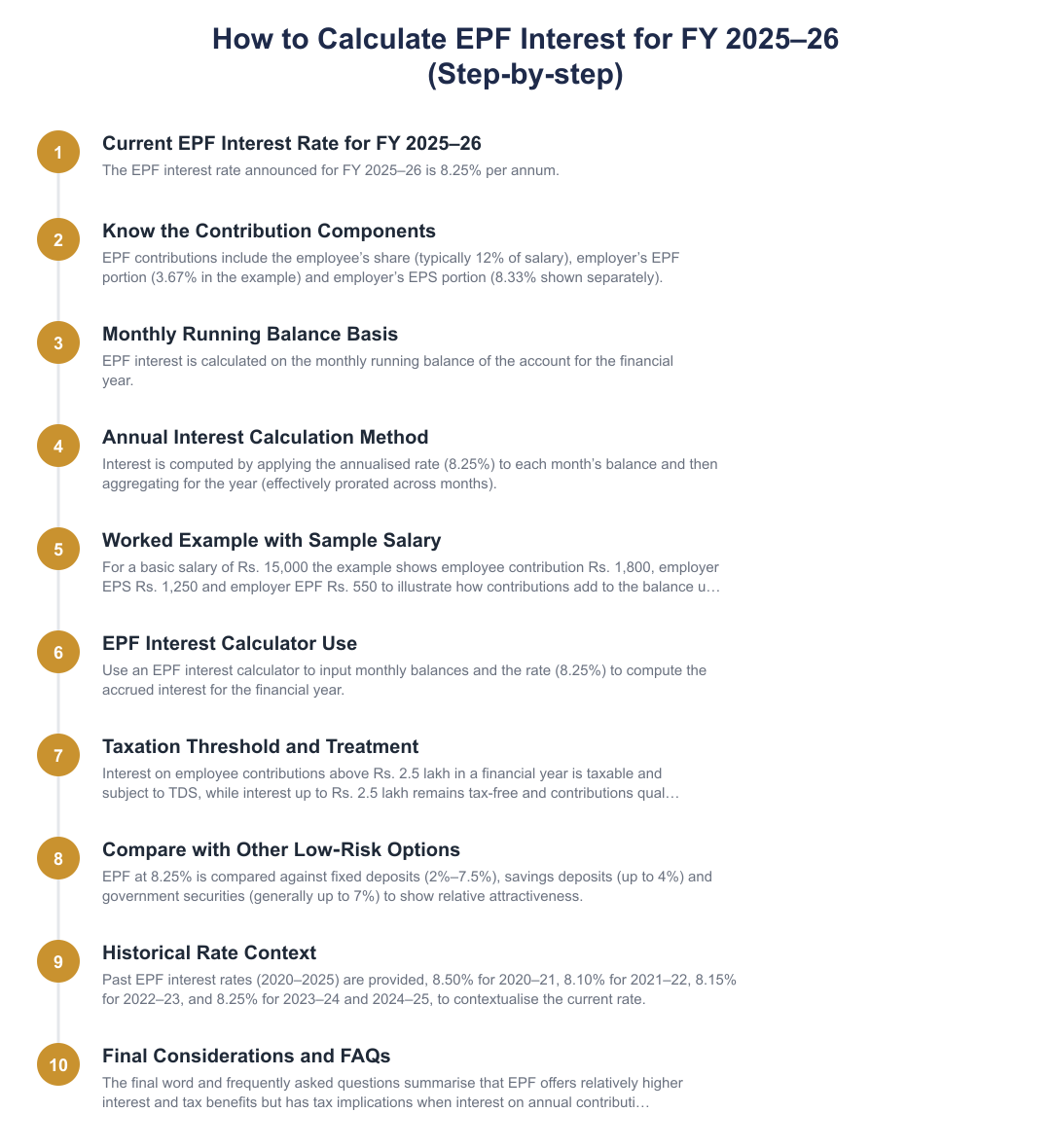
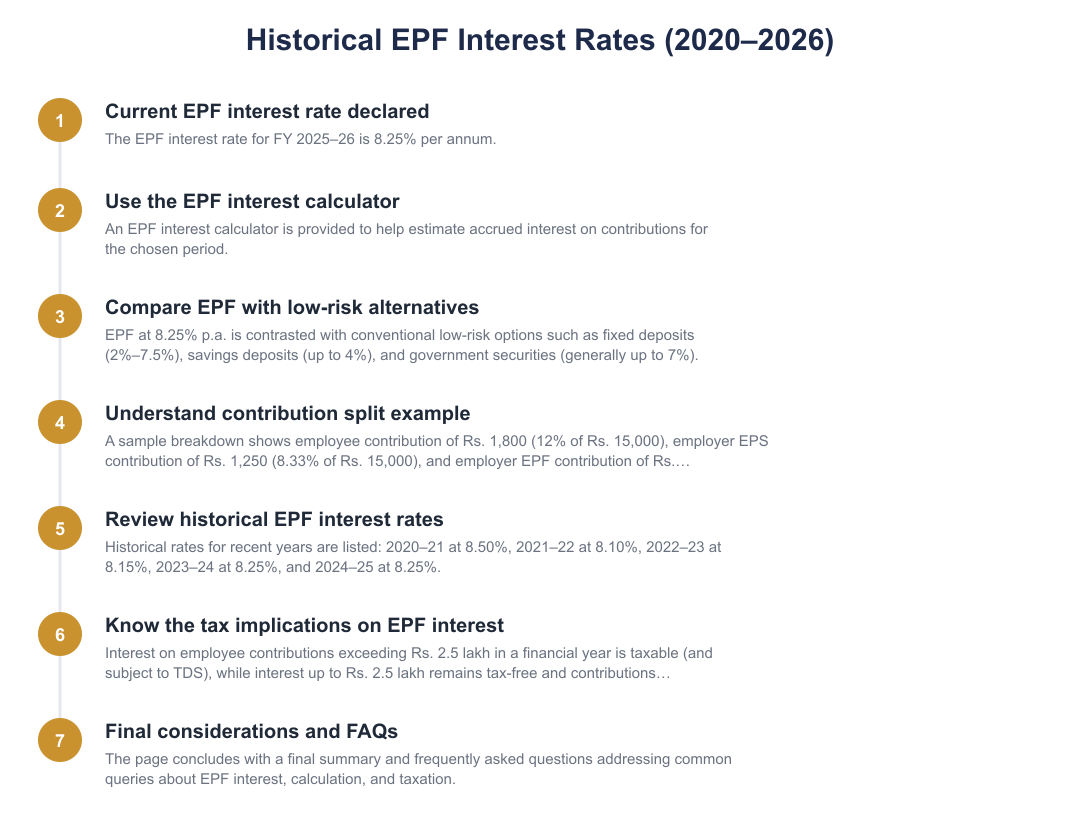
The EPF interest rate for FY 2025-26 is 8.25% per annum. This rate applies to the accumulated balance in the Provident Fund and is the same as the rate declared for FY 2024-25 and 2023-24. EPF interest is declared annually by the government and credited to member accounts at the declared rate. Historical context: rates in recent years have ranged between 8.10% and 8.50% as shown in past notifications.
How is EPF interest calculated for my account in 2026?
EPF interest is calculated on the monthly running balance in your EPF account and credited annually at the declared rate of 8.25% for FY 2025-26. Every month’s closing balance (including contributions and previous interest) is considered, interest for that month is computed at the annual rate divided by 12, and the total for the year is posted to your account at year-end. For example, regular employee contribution of 12% of salary and employer portions increase the monthly balance used in this calculation. This method ensures interest compounds annually based on monthly balances.
Can you show a simple example of EPF interest calculation?
A simple example: if your basic pay is Rs. 15,000 and employee contribution is 12% (Rs. 1,800) each month, those monthly contributions add to the running balance and earn interest at 8.25% p.a., calculated monthly and credited annually. The employer’s contributions (EPS 8.33% and remaining EPF share) also add to the balance used for interest calculation, e.g., employer EPS 8.33% of Rs. 15,000 = Rs. 1,250 and employer EPF 3.67% = Rs. 550. Over 12 months, interest on each month’s balance is summed to give the annual interest credited. Using an EPF calculator (monthly balance method) will give the precise credited interest for the year.
Is EPF interest taxable and when does tax apply?
EPF interest is tax-free for balances and interest up to a threshold, but interest on employee contributions exceeding Rs. 2.5 lakh in a financial year is taxable in the hands of the employee. Interest on the portion of contributions over Rs. 2.5 lakh will be added to income and may be subject to TDS as applicable. However, interest accumulated on EPF contributions within the Rs. 2.5 lakh limit remains tax-free, and principal plus interest typically remain tax-exempt on qualifying withdrawals. Members should track their yearly contributions to determine any taxable interest exposure.
Can I claim tax deductions for EPF contributions?
Yes, employee contributions to EPF are eligible for tax deduction under Section 80C of the Income Tax Act up to Rs. 1.5 lakh in a financial year. This deduction applies to the principal (the actual contribution) made by the employee during the year and helps reduce taxable income. Interest earned on contributions (subject to the Rs. 2.5 lakh rule) and qualifying withdrawals can be tax-free under the law, making EPF a tax-efficient retirement vehicle. Be sure to include EPF contributions along with other 80C investments when computing the Rs. 1.5 lakh limit.
How does EPF compare with fixed deposits and other low-risk options?
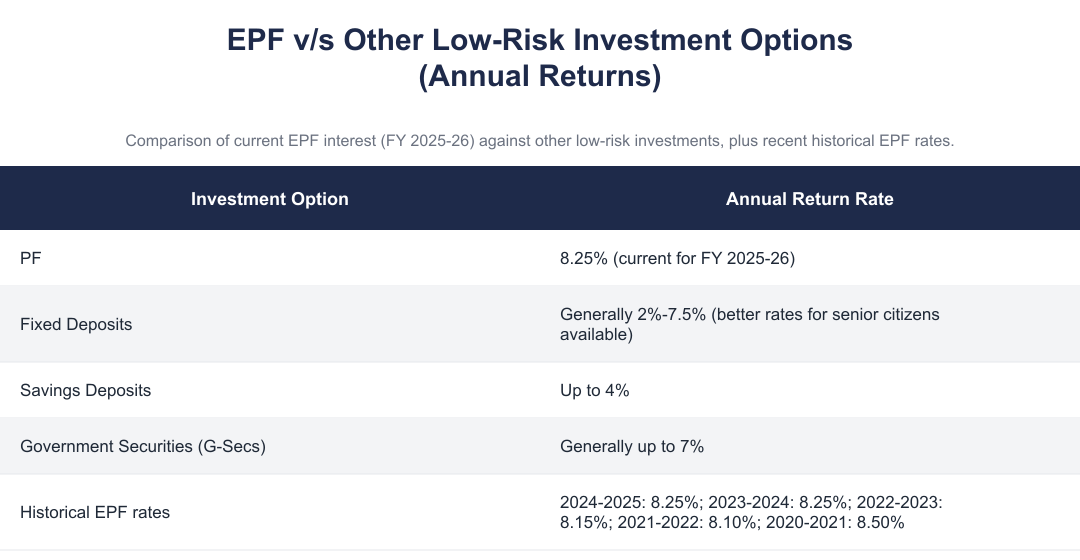
EPF at 8.25% p.a. currently offers a higher return than most conventional low-risk options such as fixed deposits (generally 2%–7.5%), savings deposits (up to 4%), and is competitive with many government securities (generally up to 7%). Besides a relatively higher return, EPF also provides significant tax advantages (deduction under Section 80C and tax-exempt interest within limits) that FDs typically do not. For conservative investors seeking long-term retirement savings, EPF often remains more attractive on a post-tax basis, though senior citizens may find some FDs with special higher rates. Consider liquidity needs, employer matching, and tax treatment when comparing.
What were the recent historical EPF interest rates?
Recent historical EPF interest rates have been: 2020-21, 8.50%, 2021-22, 8.10%, 2022-23, 8.15%, 2023-24, 8.25%, and 2024-25, 8.25%. These rates are declared annually by the government and show modest fluctuation around the 8% mark over the past five years. Knowing past rates helps members estimate likely future returns but does not guarantee future rates, which depend on government decisions and EPFO finances. The FY 2025-26 rate remains at 8.25% as declared for that year.
How does employer contribution get split between EPF and EPS?
Employer contributions are split between EPF and EPS: of the standard employer contribution on a salary of Rs. 15,000, employer EPS is 8.33% (Rs. 1,250) and employer EPF share is the remaining 3.67% (Rs. 550) in the example provided. The employee’s 12% contribution (e.g., Rs. 1,800 on Rs. 15,000) goes fully to the EPF account, which earns the declared interest rate. The EPS portion is directed to the pension scheme and is not part of the EPF interest calculation in the same way; EPF interest is credited only to the EPF portion. This split affects the total balance that earns EPF interest versus pension benefits under EPS.
Where can I calculate my expected EPF balance and interest for 2026?
You can use an EPF interest calculator that applies the monthly running balance method and the declared rate of 8.25% for FY 2025-26 to estimate your expected balance and interest. An EPF calculator asks for your current balance, monthly contributions (employee and employer), basic salary, and the period to compute projected interest and total corpus using monthly compounding credited annually. Many online calculators also allow you to model salary growth and varying contribution amounts to show how the final corpus changes. Using a calculator helps plan retirement goals and tax implications based on actual contribution patterns.
Need help staying Payroll compliant?
MoneyGence's AI Finance OS tracks your compliance, wallet share, and finances in one place, built for agencies and growing businesses.
Get started with MoneyGence