EPF Withdrawal Taxability: Income Tax on EPF Withdrawal
This guide explains how income tax applies to withdrawals from Employees’ Provident Fund (EPF). You will learn which withdrawals are potentially taxable, common reasons for partial and complete withdrawals, how withholding (TDS) and tax liability are determined in broad terms, and practical steps you can take to minimise withholding or correctly report EPF receipts. Understanding these principles matters because EPF is a major part of retirement savings for many salaried taxpayers; treating EPF withdrawals correctly for tax and compliance prevents unexpected tax bills, withholding at source, and filing errors. This article focuses on concepts and practical guidance rather than specific numeric thresholds or rates.
Eligibility for EPF Withdrawal
Eligibility for withdrawing from an EPF account depends on the nature of the withdrawal (partial or final), the reason for withdrawal, and the employment status of the member. Final withdrawal typically occurs on retirement or when a member stops contributing for a prolonged period; partial withdrawals are allowed under specified circumstances such as financial needs or specified life events.
Some withdrawals require proof of the trigger event (for example, termination of employment or certain life-stage expenditures) while others are structured to permit limited advances subject to conditions set by the provident fund rules. Understanding which category your situation falls into determines both the procedural steps and the tax treatment that may follow.
Reasons for Partial Withdrawal of EPF
Partial withdrawals are generally permitted for specific, listed purposes. Typical reasons include medical expenses, education and marriage of dependents, purchase or construction of a home, repayment of a home loan, renovation, and other contingencies specified under the provident fund rules. Each reason has its own documentation and eligibility conditions.
Employers and the provident fund authority set limits on how much can be withdrawn for each purpose and at what stage of service a member becomes eligible. Some purposes allow multiple withdrawals over a career, while others are permitted only under particular circumstances or after a minimum period of contributions.
Tax on EPF Withdrawal
Whether an EPF withdrawal is taxable depends on the nature of the withdrawal and the member’s length of continuous service and other conditions prescribed under the tax law. In general, certain final withdrawals and qualifying transfers are treated differently from premature withdrawals. The tax treatment also distinguishes between the employee’s own contributions, the employer’s contributions, and interest credited to the account.
Separately, withholding at source (often referred to as TDS) may be applied by the provident fund authority or the payer when a withdrawal does not meet specified qualifying conditions. Withholding is a mechanism to collect tax at the time of payment; it does not necessarily determine the final tax liability, which is computed when the recipient files their income-tax return.
TDS, Special Cases and Temporary Employees
Withholding may vary in special situations such as withdrawals from unrecognised provident funds, withdrawals by temporary or short-tenure employees, or withdrawals where employment ended for reasons beyond the employee’s control. The treatment of such cases is determined by statutory provisions and administrative rules that treat qualifying and non-qualifying exits differently.
If an account is with an unrecognised fund, or if a withdrawal occurs before qualifying conditions are met, withholding rules can be different from those applicable to recognised funds and qualifying final withdrawals. Taxpayers in these situations should retain documentation showing the reason for withdrawal and the nature of the fund to support their tax position when filing returns or responding to enquiries.
How to Avoid or Reduce Withholding on EPF Withdrawal
There are legitimate ways to avoid or reduce withholding at source on an EPF withdrawal that depend on satisfying qualifying conditions, providing prescribed declarations or forms to the payer, or transferring accounts instead of withdrawing. One commonly recommended approach is to preserve continuity of service by transferring the EPF balance between employers rather than withdrawing when you change jobs.
Another approach is to ensure you submit any prescribed declarations or proofs to the payer before payment. If you believe a withdrawal is exempt from tax, keep supporting paperwork (such as termination letters, medical certificates, or proof of the qualifying event) to establish the exemption when filing returns or if asked by the tax authorities.
Table on Taxability on Withdrawal of EPF
The taxability of EPF withdrawals can be summarised in a decision-oriented way: determine whether the withdrawal is final or partial; confirm whether the withdrawal meets qualifying conditions prescribed by law or by the provident fund; identify whether the fund is recognised for tax purposes; and check whether applicable declarations or proofs have been furnished to avoid withholding.
Because specific thresholds and rates are set in tax law and administrative instructions and may change over time, consult the latest official guidance or a tax adviser for the current numeric limits and withholding rates that apply to your case.
Procedure: Withdrawing EPF and Handling Tax
Identify whether your need is for a partial advance or a final settlement, and gather any documents that substantiate the reason for withdrawal.
Establish whether your period of service or account status meets qualifying conditions, and whether the fund is recognised for tax purposes, these affect taxability and withholding.
Provide the provident fund office or employer any prescribed forms or evidence before requesting payment to reduce the chance of withholding.
If changing employers, transfer the EPF balance to the new account to preserve continuity and potential tax exemptions on future withdrawals.
Keep all documents related to the withdrawal, and report the receipt correctly in your income-tax return, withholding does not always equal final tax liability.
EPF withdrawals interact with income-tax rules in ways that depend on the type of withdrawal, the member’s service history, and the recognition status of the fund. While this guide outlines the conceptual framework and practical steps, specific numeric thresholds, withholding rates, and statutory provisions can change, consult current official guidance or a qualified tax adviser to apply these principles to your exact circumstances.
Frequently asked questions
When is EPF withdrawal taxable and when is it exempt?
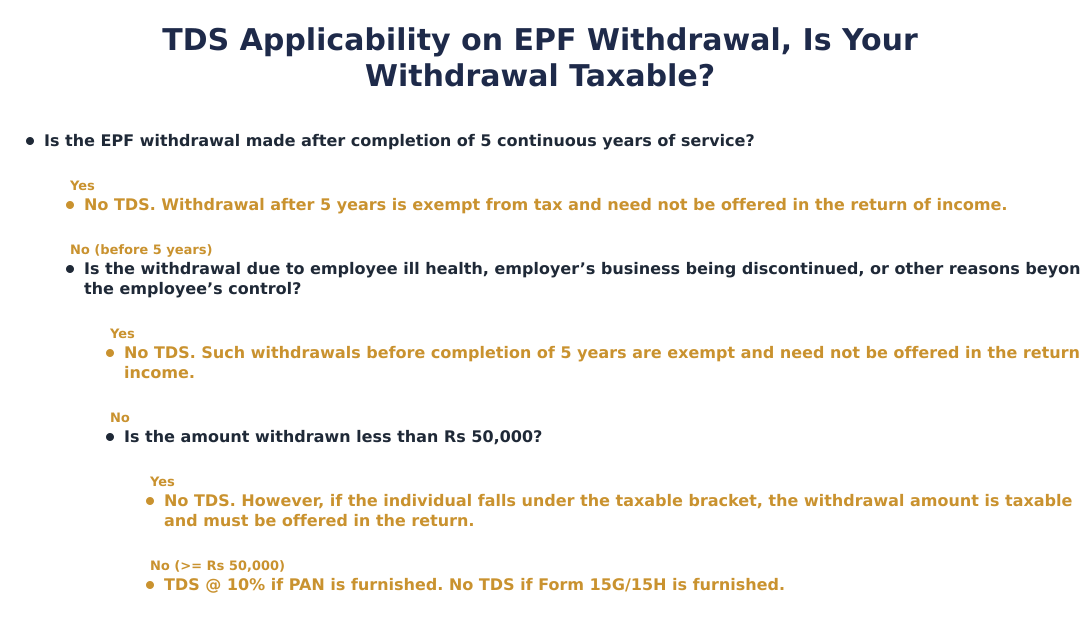
EPF withdrawal is taxable if you withdraw before completing 5 continuous years of service except in specified circumstances, and it is exempt if withdrawn after 5 continuous years of service or under certain permitted reasons. Withdrawals after 5 years are fully exempt and need not be offered in the return of income; withdrawals before 5 years are taxable unless the reason falls under exceptions such as termination due to ill-health, employer’s business being discontinued, or other reasons beyond the employee’s control. Also, transfers of PF on change of job are not taxable. Note that the employee’s total income will determine taxability if an early withdrawal is otherwise exempt from TDS but the person is in a taxable bracket.
Who is eligible to withdraw EPF and what are common reasons for partial withdrawal?
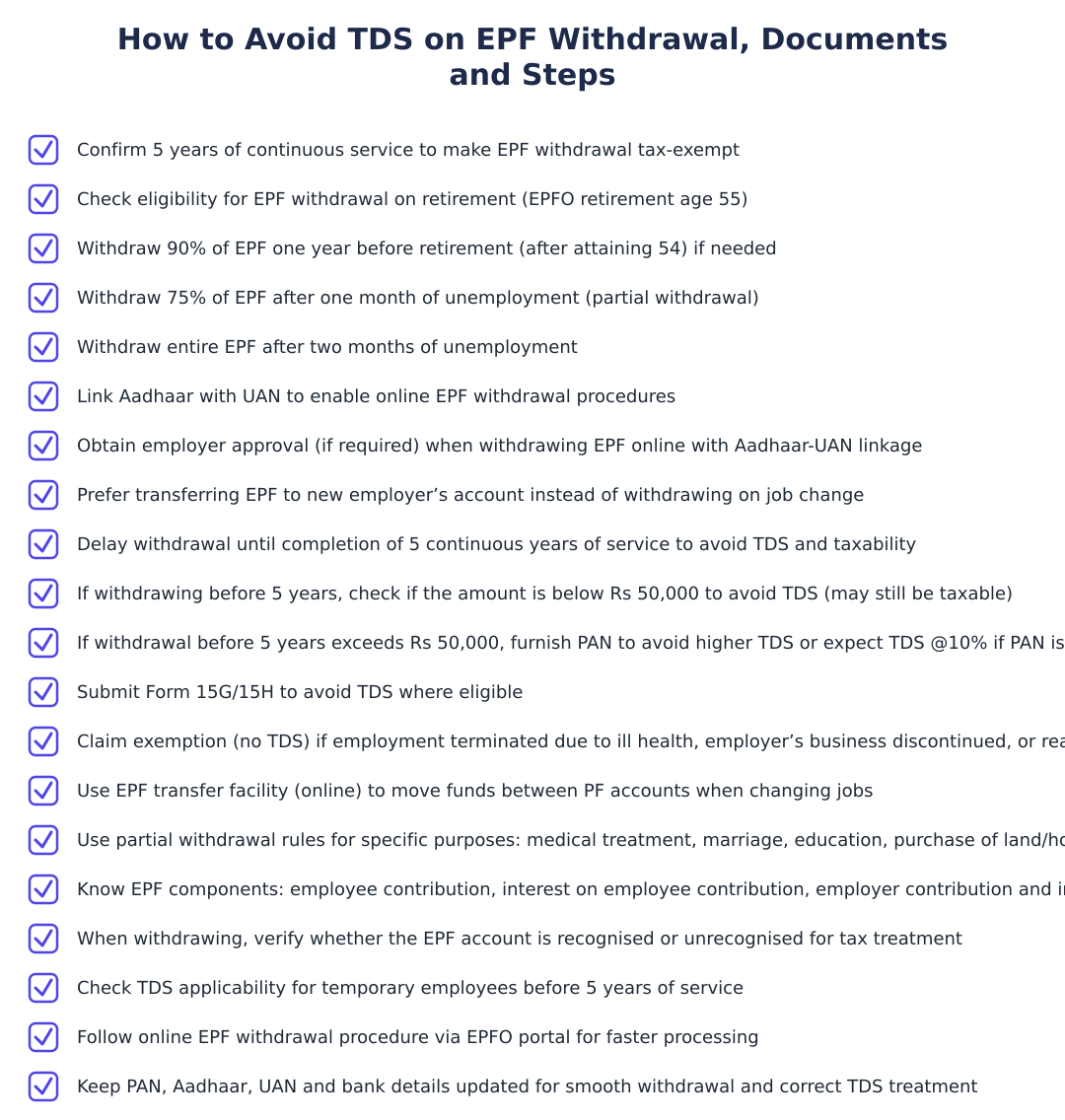
You are eligible to withdraw EPF on retirement (normally at age 55), unemployment, resignation, or for specified personal reasons such as medical treatment, marriage, education, house purchase or construction, home loan repayment and renovation. The EPFO allows specific partial withdrawals: medical purposes, marriage, education, purchase/construction of house or land, home loan repayment, and house renovation among others, with conditions on quantum and timing. Special rules apply for unemployment (e.g., withdraw 75% after one month of unemployment and the balance after two months) and you can withdraw 90% one year before retirement after attaining age 54.
What is TDS on EPF withdrawal if I withdraw before 5 years of continuous service?
If you withdraw EPF before completing 5 continuous years of service, TDS is deducted at 10% if the amount withdrawn exceeds Rs 50,000 and you have furnished PAN, otherwise different rates may apply; no TDS is deducted if the amount is less than Rs 50,000 or if you submit Form 15G/15H. Specifically, amounts > Rs 50,000 before completion of 5 years attract TDS @ 10% when PAN is furnished; if PAN is not furnished the TDS rate can be higher as per income-tax rules, and Form 15G/15H can be used by eligible individuals to avoid TDS. Even if TDS is not deducted, the withdrawal may still be taxable in your hands and must be declared in your income-tax return if you fall in a taxable bracket.
What are the TDS rates applicable on EPF withdrawals?
The table in EPFO guidance states that TDS is generally 10% on EPF withdrawals exceeding Rs 50,000 before completing 5 years of service if PAN is furnished, while no TDS applies on withdrawals below Rs 50,000 or on exempt withdrawals after 5 years. If PAN is not furnished, a higher rate under the Income-tax Act may apply (such as 20% or the applicable surcharge/cess-inclusive rate under provisions for non-furnishing of PAN), and eligible senior citizens can furnish Form 15H/15G to avoid TDS when criteria are met. Note that exact higher rates for non-PAN cases follow the prevailing income-tax rules and EPFO deducts TDS per those provisions.
Is EPF withdrawal by a temporary employee treated differently for tax or TDS?
EPF withdrawal by a temporary employee is taxed the same way as for regular employees, taxation depends on completion of 5 continuous years of service and applicable exceptions, and TDS rules apply similarly. The key criterion is whether the employee has completed five continuous years of service (across employers) or qualifies under exempting conditions; temporary employment status does not by itself change taxability. Therefore, if a temporary employee withdraws before five years and the amount is > Rs 50,000, TDS at 10% (with PAN furnished) may be deducted; withdrawals after five years are exempt.
How is EPF withdrawal from an unrecognised EPF taxed?
Withdrawal from an unrecognised provident fund (one not recognised under Section 2(37) of the Income-tax Act) is taxable under the head 'Income from other sources' with the employer’s contribution and interest forming part of taxable income, subject to specific provisions. In an unrecognised fund, the tax exemption available for recognised EPF on employer contribution and interest after five years does not apply, so both employee and employer contributions and interest may be taxable on withdrawal; also, different TDS rules and computations as per the Income-tax Act apply. You should compute taxable amount as per rules for unrecognised funds and report it in the return of income to avoid assessment issues.
What happens tax-wise if I withdraw EPF after completing 5 continuous years of service?
If you withdraw EPF after completing five continuous years of service, the withdrawal is fully exempt from tax and no TDS is deducted, and you do not need to include it in your income-tax return. This exemption covers both your own contributions and the employer’s contributions with interest, provided the five-year continuity condition is satisfied; transfers between EPF accounts on changing jobs also preserve continuity. There are exceptions if the employer’s PF is unrecognised or specific conditions are not met, so ensure your service is continuous and the fund is recognised to claim the exemption.
How can I avoid TDS on EPF withdrawal legally?
You can avoid TDS on EPF withdrawal by either deferring the withdrawal until you complete five continuous years of service, transferring your PF when changing jobs instead of withdrawing, or ensuring the withdrawal amount is under Rs 50,000 (no TDS for amounts < Rs 50,000); eligible individuals can also submit Form 15G/15H to claim non-deduction. Specifically, transfers between PF accounts on job change preserve continuity and help reach the five-year threshold to get an exempt withdrawal; where immediate withdrawal is necessary and amount is > Rs 50,000, furnishing Form 15G/15H or having PAN on record can prevent or reduce TDS. Note that avoiding TDS does not automatically make the withdrawal non-taxable, if you are in a taxable income slab, early withdrawals (before five years) may still be taxable and must be declared in your return.
If EPF withdrawal attracts no TDS, does that mean it is tax-free?
No, absence of TDS on EPF withdrawal does not automatically mean the withdrawal is tax-free; taxability depends on whether you meet the exemption conditions (such as five continuous years of service) or specific exempt reasons. For example, withdrawals under Rs 50,000 before five years attract no TDS but are still taxable in your hands if you do not meet exemption criteria, so you must include such amounts in your income-tax return if your total income is taxable. Conversely, withdrawals after five years or under specified exempt circumstances are both free of TDS and exempt from tax, and need not be reported as income.
Need help staying Payroll compliant?
MoneyGence's AI Finance OS tracks your compliance, wallet share, and finances in one place, built for agencies and growing businesses.
Get started with MoneyGence