EPFO 3.0 PF Withdrawal via UPI & ATM 2026, Limits & Rules
EPFO 3.0 is being discussed as the next-generation digital upgrade to employee provident fund services. This guide explains, in plain language, what EPFO 3.0 aims to do for withdrawal convenience (including ATM and UPI-style access), what preparatory steps members must take to access digital services, how existing tax and compliance rules continue to apply, and the operational and security considerations every salaried employee should know before using faster withdrawal channels. You will learn which digital credentials and KYC links are essential, what the historical process looked like and why faster digital claims matter, how tax treatment of provident fund withdrawals remains determined by tenure, and the main fraud risks to watch for when using card- or UPI-based withdrawal methods. The guide avoids citing any unverified circular or notification numbers and instead focuses on practical compliance steps and risk mitigation so you can be ready if and when new features roll out for your EPF account.
What is EPFO 3.0?
EPFO 3.0 refers to a modernization effort around the Employees' Provident Fund Organisation’s services aimed at making member interactions quicker and more digital. The programme is commonly described as delivering faster claim settlement and more direct access to EPF balances through digital channels. The broader objective is to reduce dependency on manual processes and employer interventions, and to give members more immediate control over routine account operations.
While many reports describe new features such as ATM-like access and UPI-based disbursements, this guide focuses on universally applicable compliance and preparation measures rather than quoting specific circulars or numeric limits, because no official notification or section numbers are cited in available sources. Members should therefore prepare for digital access while monitoring formal EPFO communications for finalized rules.
Eligibility Criteria for Members
The core eligibility for accessing digital PF services rests less on employment tenure and more on having the required digital credentials in place. Activating your UAN and ensuring it is linked with key KYC elements (Aadhaar, PAN, and bank account details including IFSC) and an active mobile number are fundamental prerequisites for any digital or self-service interactions with EPFO.
Because EPFO 3.0 aims to automate many routine claims, members should ensure their PAN is linked to avoid higher TDS deductions when a withdrawal becomes taxable. Keep an eye on official EPFO updates for any additional eligibility criteria or enrollment steps tied to new features.
How to Withdraw PF through ATM and UPI?
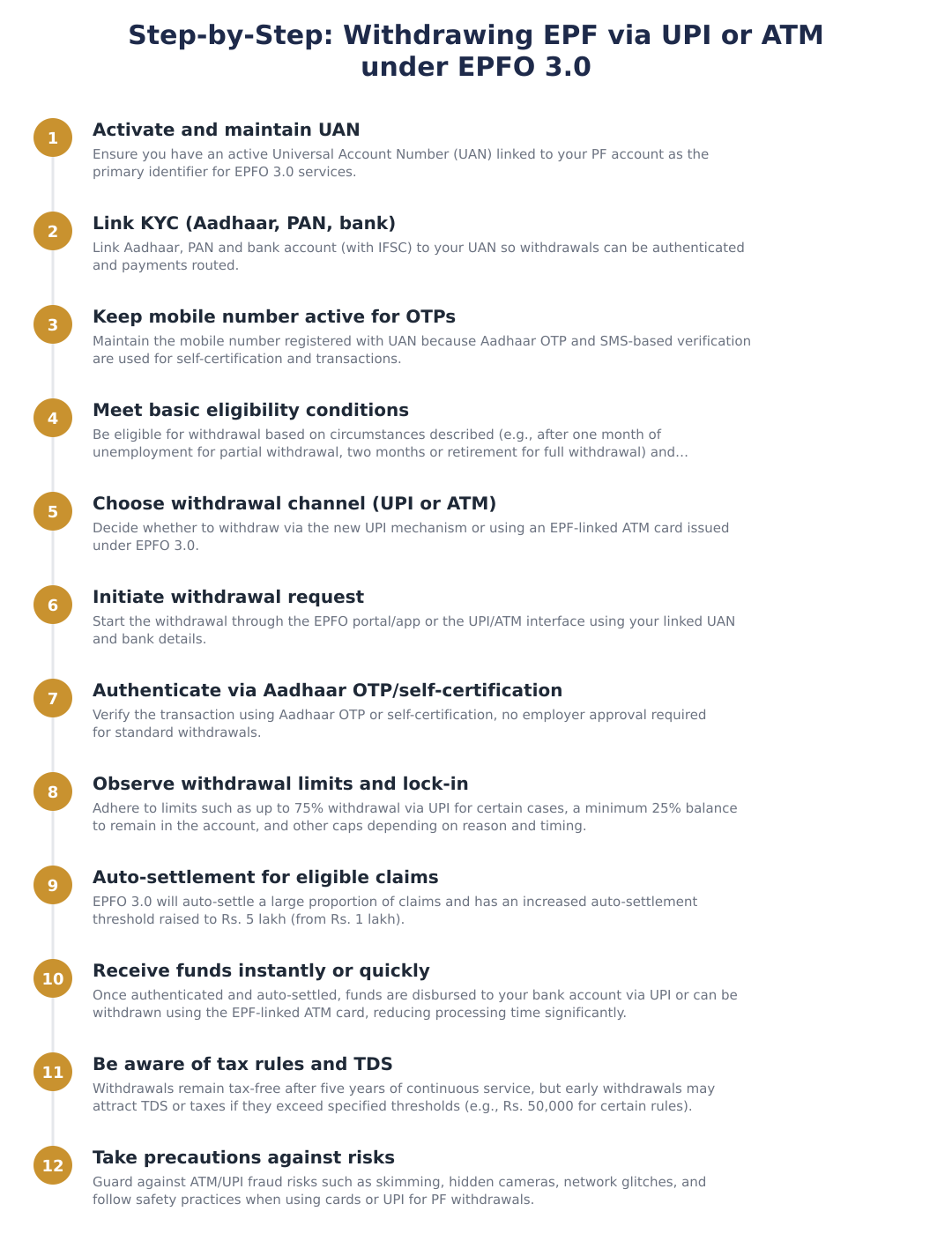
The concept of withdrawing PF via ATM or UPI is to provide immediate access to funds in a manner similar to other digital payment and card systems. Practically, that means once digital credentials and bank links are verified, a member could initiate a withdrawal and receive funds through familiar channels instead of submitting paper forms.
Historically, traditional PF withdrawals required employer attestation and took longer to process, examples of earlier processing times ranged up to several days or weeks. The shift to digital channels under EPFO 3.0 is intended to reduce that dependence on employer attestation and speed up settlement, though members should watch for formal process descriptions from EPFO that detail the exact steps, authentication and limits.
Who can use UPI and ATM withdrawal?
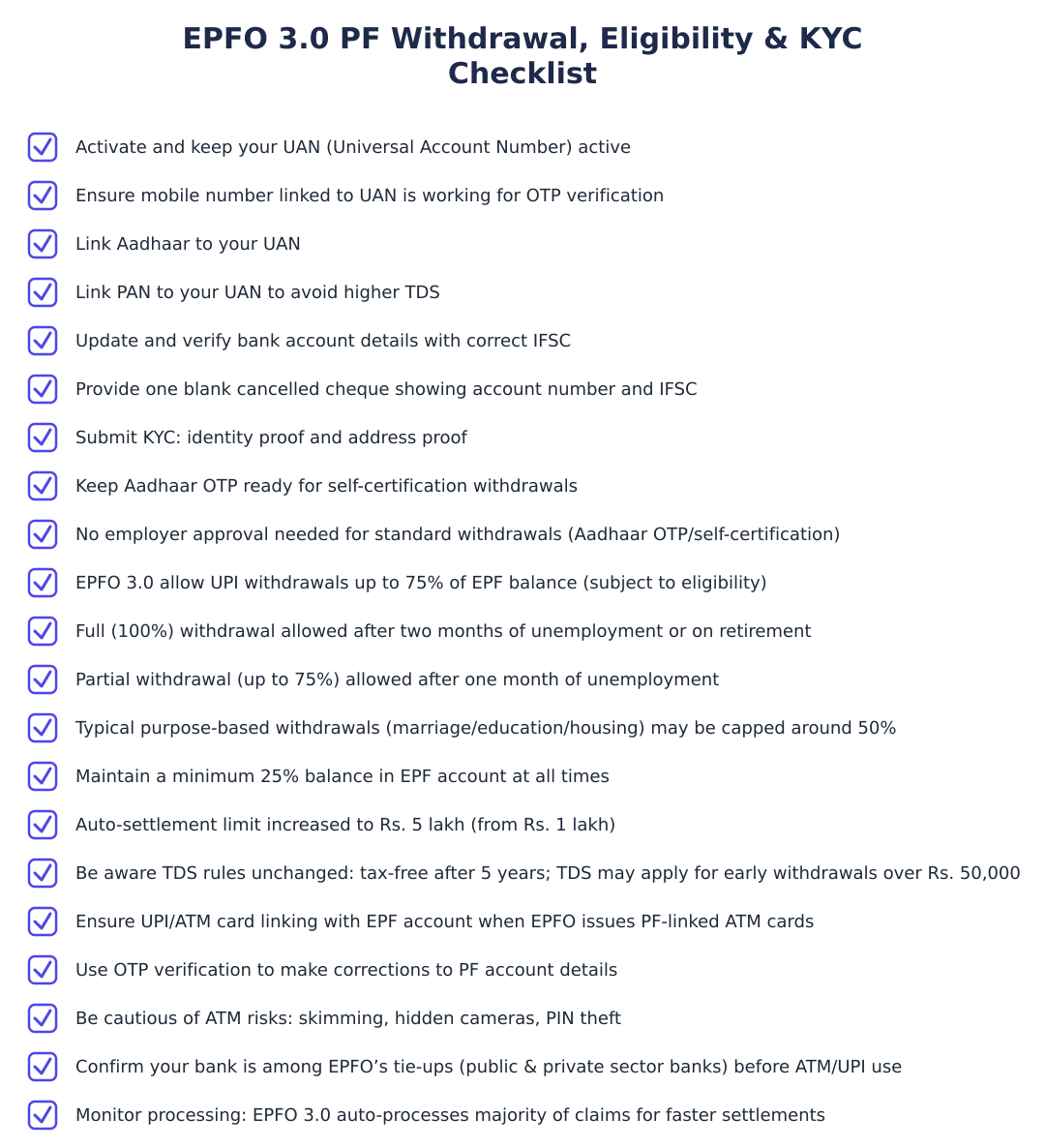
Any EPF member who has completed the requisite digital preconditions should be positioned to use new digital withdrawal channels when they become available. The essentials are activation of the UAN, linking Aadhaar and PAN to the UAN, providing bank account details with IFSC, and maintaining an active mobile number. These elements enable identity verification and electronic settlement.
Before attempting any ATM- or UPI-based withdrawal, ensure your account KYC is up to date. Linking PAN is particularly important from a tax perspective because it helps avoid higher TDS deductions on withdrawals that may be taxable.
How Much PF Can You Withdraw?
Specific numeric withdrawal limits and cap details for ATM or UPI transactions under EPFO 3.0 are not reproduced here because no official notification or circular numbers are cited in the verified material used for this guide. Members should therefore consult EPFO’s official announcements for exact amounts or percentage limits applicable under the new service mode.
What is clear from tax rules that continue to apply is that withdrawals are eligible for tax-free treatment based on tenure: withdrawals remain tax-free after five years of service. For withdrawals that are taken earlier and may be taxable, linking PAN to your UAN helps avoid higher TDS deductions.
Security Considerations and Potential Risks
Faster access also raises familiar operational risks. Notable potential fraud risks include ATM skimming devices that capture card details, hidden cameras or covert methods used to capture PINs, and network or system glitches that could cause transaction failures or duplicate charges. Members should be vigilant about physical ATM safety and monitor electronic transaction alerts closely.
To reduce exposure to these risks, keep your mobile number and KYC details updated so alerts reach you immediately, use only secure and known ATMs, and report any suspicious activity to your bank and EPFO promptly. Because EPFO has not published specific circular numbers in the material referenced here, always cross-check any operational changes or security advisories with official EPFO channels.
EPFO 3.0 promises more immediate and digital access to provident fund balances, but members should prioritise getting their UAN and KYC links in order, especially Aadhaar, PAN and bank details, and keep an active mobile number for alerts and OTPs. Remember that tenure-based tax rules remain in force, withdrawals generally become tax-free after five years, and linking PAN can prevent higher TDS on taxable withdrawals. Watch EPFO’s official communications for finalised procedures, limits and security guidance before using any new ATM- or UPI-based withdrawal option.
Frequently asked questions
What is EPFO 3.0 and what new withdrawal features does it bring?
EPFO 3.0 is an upgraded, IT-driven EPF platform that enables instant and self-service features such as PF withdrawals via UPI and ATM, auto-claim settlement and digital corrections. The upgrade allows members to withdraw up to 75% of their EPF balance through UPI and provides EPF-linked ATM cards for cash access, while also automating about 95% of claims to cut processing time significantly. It supports Aadhaar OTP and self-certification for standard claims (removing the need for employer attestation), ties up with 32 public and private banks, and increases the auto-settlement limit to Rs. 5 lakh from the existing Rs. 1 lakh. Members can also update KYC and bank details online, making corrections via OTP verification instead of lengthy physical processes.
Who will be eligible to use UPI and ATM withdrawals under EPFO 3.0?
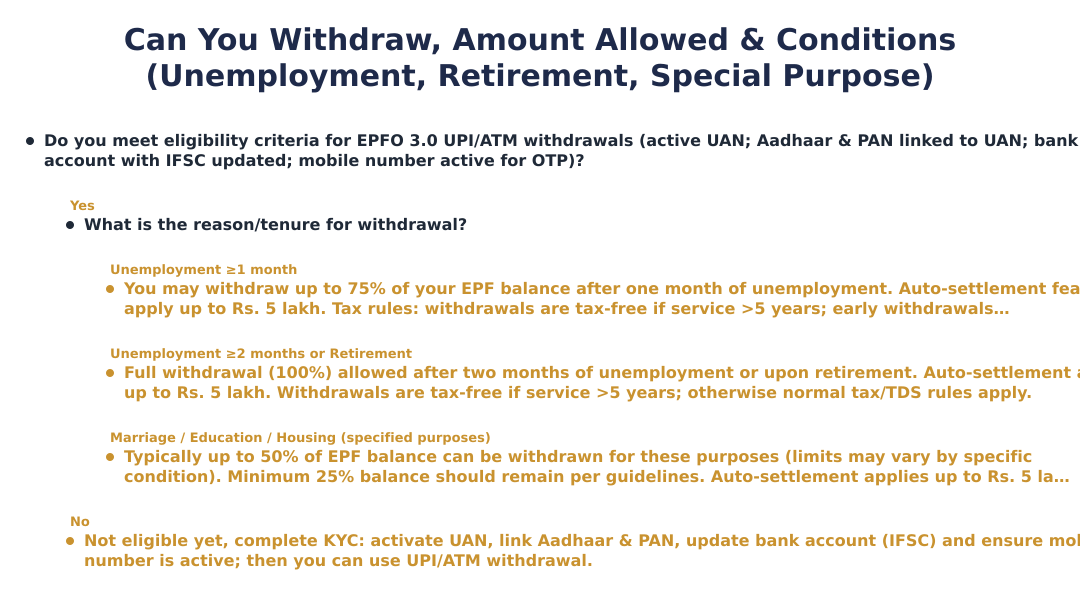
You are eligible to use UPI and ATM withdrawals under EPFO 3.0 if you have an active UAN linked to your Aadhaar, PAN and bank account with correct IFSC, and your mobile number is active for OTP verification. Members must complete KYC linking (Aadhaar, PAN and bank details) and ensure UAN activation so the system can authenticate withdrawals via Aadhaar OTP or UPI. Linking PAN is important to avoid higher TDS on withdrawals and having correct IFSC/bank account details ensures funds and refunds are routed properly. In practice, EPFO has tied up with multiple banks, so account-holders must ensure their bank is supported for ATM/UPI operations.
What documents and details do I need before attempting a PF withdrawal through EPFO 3.0?
You must have your UAN activated and linked KYC documents, Aadhaar, PAN, and your bank account with IFSC, plus an active mobile number for OTP verification before withdrawing PF through EPFO 3.0. EPFO may also require a blank cancelled cheque showing account number and IFSC for bank verification and basic identity/address proof for some claims. Having PAN linked helps avoid higher TDS rates on premature withdrawals, and Aadhaar linkage enables instant authentication via OTP so employer attestation is not required for standard claims. Keep these details updated in your EPF profile to ensure smooth UPI/ATM or auto-settlement transactions.
How do UPI withdrawals from EPF accounts work under EPFO 3.0?
UPI withdrawals under EPFO 3.0 let members transfer up to 75% of their EPF balance to their bank account instantly using UPI authentication and Aadhaar OTP without employer approval. The member initiates the withdrawal from the EPFO portal or app, authenticates via Aadhaar/UPI OTP, and the funds are pushed to the linked bank account, subject to KYC and UAN linkage. This facility is designed for speed and convenience, but a minimum 25% of the balance must remain locked in the EPF account at all times to preserve retirement savings. For early withdrawals before five years of continuous service, tax/TDS rules still apply as per existing law.
How will EPF-linked ATM withdrawals work and what limits apply?
EPFO 3.0 plans to issue EPF-linked ATM cards that allow members to withdraw cash linked to their PF account at ATMs, subject to withdrawal caps and standard ATM network limits. The ATM card will be linked to the member’s EPF balance and may enforce limits such as a 50% cap on withdrawals in some scenarios to preserve emergency funds, while UPI allows up to 75% for certain conditions like one month of unemployment. Members still must complete KYC (Aadhaar, PAN, bank IFSC) and have an active UAN/mobile for OTP; security risks like skimming and PIN theft apply similarly to bank cards, so members should exercise usual ATM precautions. Specific per-transaction ATM limits will depend on EPFO’s bank tie-ups and network rules.
How much of my PF balance can I withdraw under EPFO 3.0 for unemployment or emergencies?
Under EPFO 3.0 you can withdraw up to 75% of your EPF balance after one month of unemployment, while full withdrawal (100%) is allowed after two months of unemployment or on retirement. For specific purposes like marriage, education, or housing, members can typically withdraw up to 50% of the PF balance subject to eligibility conditions, though exact caps may vary by purpose. Additionally, EPFO enforces a 25% lock-in rule to ensure a minimum balance remains for retirement savings under most circumstances. Note that premature withdrawals before five years of continuous service may attract TDS or tax as per existing Income Tax rules.
What is the increased auto-settlement limit and how does it affect me?
The auto-settlement limit under EPFO 3.0 has been increased to Rs. 5 lakh from the earlier Rs. 1 lakh, meaning claims up to Rs. 5 lakh can be settled automatically without manual intervention. This expansion allows a far greater number of claims to be processed instantly or within hours for eligible members, reducing paperwork and manual verification steps. Auto-settlement still requires proper KYC linkage (Aadhaar, PAN, bank details) and OTP authentication, and larger claims above this limit may undergo additional checks. Faster auto-settlements benefit members needing quick access to funds while retaining safeguards for bigger disbursements.
Have the tax rules on PF withdrawals changed under EPFO 3.0?
No, EPFO 3.0 does not change the tax rules: EPF withdrawals remain tax-free if made after five years of continuous service, while premature withdrawals continue to be taxable and may attract TDS above specified thresholds. If a withdrawal is made before five years of continuous service and exceeds Rs. 50,000 (subject to prevailing thresholds), TDS rules may apply unless you provide PAN details; linking PAN in your UAN avoids higher TDS rates. Members should therefore ensure PAN is updated in EPF records and consult a tax advisor for their specific situation, as operational ease under EPFO 3.0 does not alter statutory taxability.
What are the main risks or downsides of withdrawing PF through ATM or UPI?
The main risks of ATM/UPI PF withdrawals include fraud (ATM skimming, hidden cameras capturing PINs), transaction failures due to network glitches, and the danger of depleting retirement savings because of easier access to funds. EPFO 3.0 mitigates some risks via Aadhaar OTP and KYC checks, but members must remain cautious with ATM security, safeguard OTPs, and avoid unnecessary early withdrawals because the 25% lock-in is meant to preserve retirement corpus. Additionally, premature withdrawals can trigger tax/TDS consequences, and technical failures might delay or duplicate transactions, so members should verify balances and keep transaction receipts.
How is traditional PF withdrawal different from withdrawals under EPFO 3.0?
Traditional PF withdrawal required employer attestation, manual forms and took several days to weeks, whereas EPFO 3.0 enables self-service digital corrections, Aadhaar OTP authentication, and instant or near-instant settlements for about 95% of claims. Under EPFO 3.0 members can use UPI or EPF-linked ATM cards to access funds faster, update KYC online without physical visits, and benefit from an increased auto-settlement cap of Rs. 5 lakh. However, core limits and tax rules (such as five-year tax-free status and TDS on premature withdrawals) remain unchanged, and some caps, like a 25% balance lock-in, are enforced to protect retirement savings. Overall, EPFO 3.0 prioritizes speed and convenience while retaining statutory safeguards.
Need help staying Payroll compliant?
MoneyGence's AI Finance OS tracks your compliance, wallet share, and finances in one place, built for agencies and growing businesses.
Get started with MoneyGence