ESIC Act 1948 Applicability: Contributions, Compliance & Penalties
This guide explains the Employees' State Insurance Corporation framework as set out in the ESIC Act 1948 and what businesses and employees should understand about its applicability, contributions and compliance. You will learn how the Act functions at a high level, which kinds of establishments it is intended to cover, the broad responsibilities expected of employers and employees, and why compliance matters for both workplace social security and organisational risk management. Though this article does not list statutory rates, thresholds or specific penalty amounts, it focuses on practical interpretation: how employers typically assess whether the law applies to their workforce, the administrative tasks involved in staying compliant, and the operational consequences of non-compliance. The aim is to give business owners, HR professionals and payroll teams a clear conceptual roadmap so they can identify when to seek detailed, up-to-date statutory information from official sources or a qualified adviser. Understanding these concepts helps organisations prepare for statutory obligations, integrate payroll and human-resources processes with social insurance requirements, and reduce the risk of disputes or enforcement action arising from misunderstandings about coverage or duties under the ESIC Act 1948.
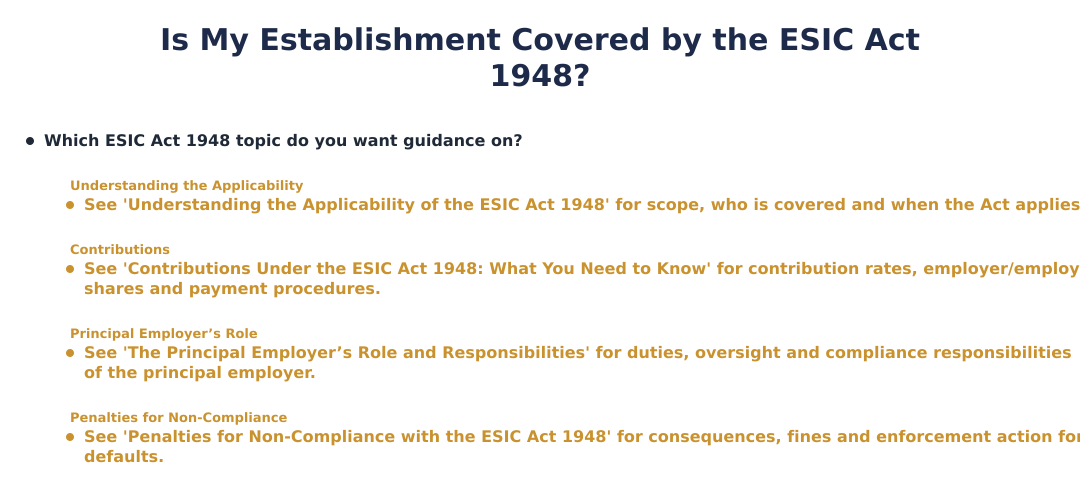
Understanding the Applicability of the ESIC Act 1948
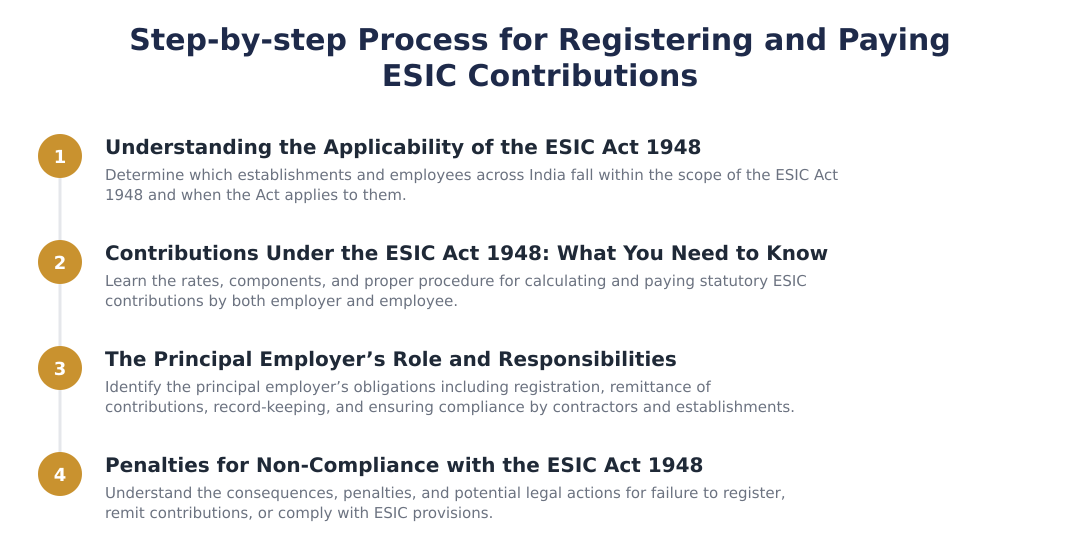
The ESIC Act 1948 is the primary statute that governs Employees' State Insurance in India. The law establishes the framework for social insurance for employees by defining when and how employers and employees participate in the scheme. Applicability depends on the nature of the establishment and the workforce engaged, and determining whether the Act applies is typically an early compliance step for any employer.
Practically, employers assess applicability by reviewing the business activities and the composition of their workforce against the criteria laid down under the Act and associated rules. This assessment informs whether they must register under the statutory scheme, make contributions, and extend insured benefits to eligible workers. Because the Act creates statutory entitlements for employees, getting this assessment right is important for both employee welfare and organisational legal exposure.
Contributions Under the ESIC Act 1948: What You Need to Know
The ESIC Act 1948 requires a contribution mechanism so that insured employees can receive prescribed benefits. Contributions are intended to finance the benefits framework established by the Act, and typically involve both employer and employee participation. The exact method for calculating, collecting and remitting contributions is set out in the statute and subordinate rules.
From an operational standpoint, employers should ensure payroll systems can identify insured employees, compute contributions as required by law, and maintain records of deductions and remittances. Even where an organisation believes the Act may not apply, documenting the rationale for that determination and periodically reviewing the position helps manage compliance risk as the workforce or business operations change.
The Principal Employer’s Role and Responsibilities
Under the ESIC Act 1948, the principal employer (or the employer recognised by the statute) carries primary administrative responsibilities relating to the scheme. This typically includes registering the establishment where required, maintaining employee records, making prescribed contributions, and facilitating employees' access to statutory benefits. Employers are also the primary point of contact for communication with statutory authorities administering the Act.
In practice, fulfilling these responsibilities requires coordination across HR, payroll and finance functions. Employers should implement processes for timely recordkeeping, secure handling of employee data, and prompt remittance of any dues. Clear internal ownership and documented procedures reduce administrative errors and the likelihood of disputes with employees or enforcement authorities.
Penalties for Non-Compliance with the ESIC Act 1948
The ESIC Act 1948 provides for consequences where obligations under the law are not met. Penalties and enforcement measures are part of the legal framework to encourage compliance and to protect employee entitlements. Enforcement can arise from late or non-payment of contributions, failure to register where applicable, or inadequate recordkeeping and reporting.
Because the Act is statutory, non-compliance can create financial exposure and reputational risk for employers, as well as adverse consequences for employees who may lose access to benefits. Organisations should therefore treat compliance as a business-critical activity, periodically review their practices against the statutory requirements, and consult official sources or legal advisers for specific penalty provisions and remedial steps when questions arise.
Practical Steps for Staying Compliant
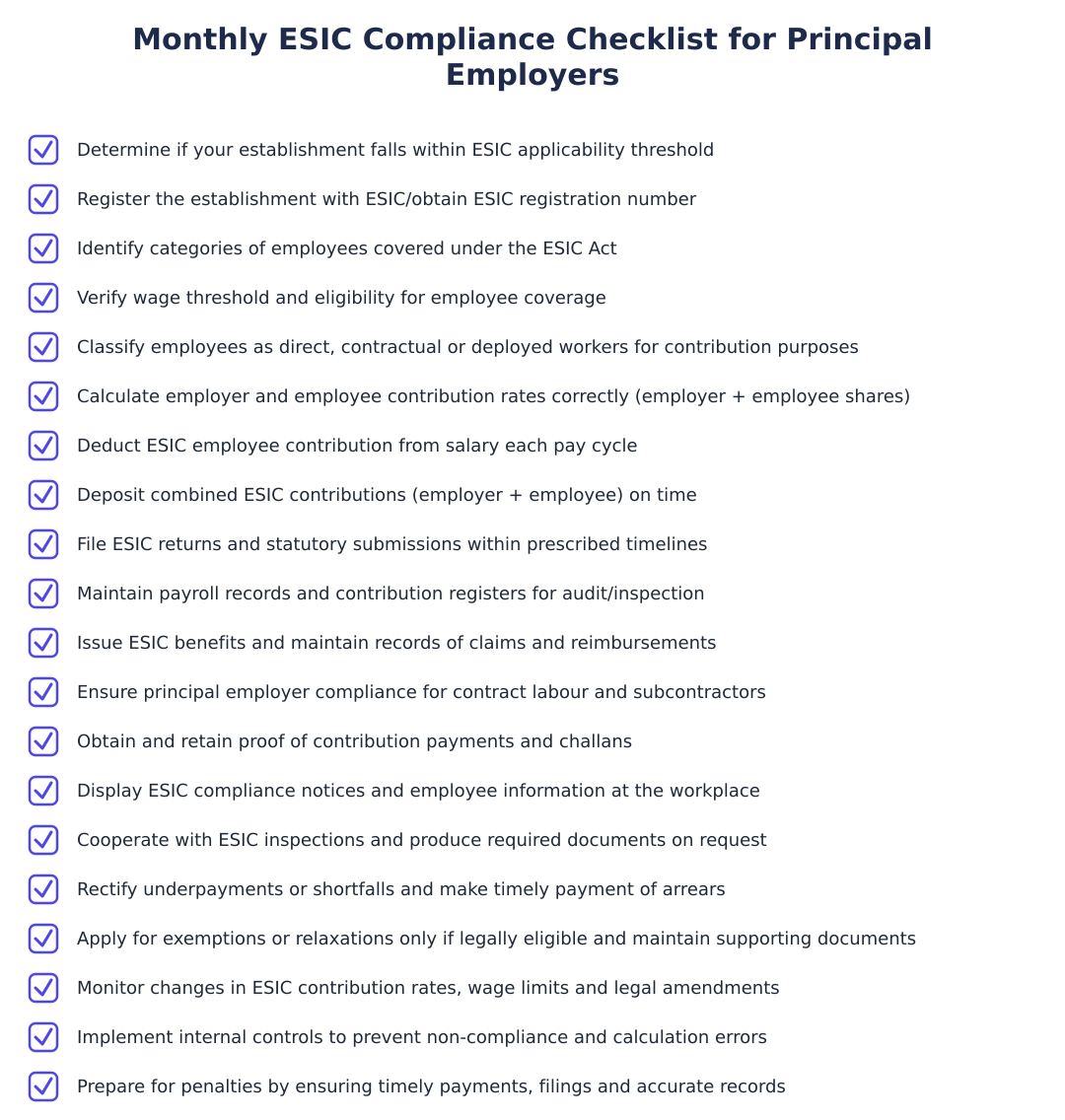
To manage compliance effectively, employers should develop a simple checklist: determine applicability for each establishment, maintain accurate payroll and employee records, integrate statutory contribution workflows into payroll cycles, and document decisions about coverage. Regular internal audits or periodic reviews by an external adviser help detect gaps early and correct them before regulators intervene.
When in doubt about statutory details, such as eligibility thresholds, contribution rates, registration procedures or penalties, employers must refer to the Act, official government notifications and rules, or seek professional advice. Treating compliance as ongoing rather than a one-time exercise keeps the organisation prepared for workforce changes, expansions or regulatory updates.
The ESIC Act 1948 provides the statutory foundation for Employees' State Insurance in India. While this guide outlines the conceptual framework, applicability, contributions, employer responsibilities and the importance of compliance, organisations should consult the Act, official rules and qualified advisers for current, specific legal and numerical details. Proactive processes and accurate recordkeeping are the best practical measures to protect employee entitlements and reduce legal risk.
Frequently asked questions
Who must register under the ESIC Act 1948, when does an employer become liable to ESIC?
An employer must register under the ESIC Act 1948 once they employ 10 or more persons in an establishment covered by the Act; the Central Government can notify a higher threshold for specified states or sectors. The Act typically covers factories, shops, hotels, restaurants, cinemas, road transport undertakings and other establishments notified by the Government, and the 10-employee threshold is counted on any day of the preceding 12 months. Casual, part-time or apprentice workers are also counted for the threshold unless specifically exempted by notification, and registration must be done online with the Employees’ State Insurance Corporation (ESIC) as soon as the threshold is reached. Failure to register timely can cause recovery of past contributions with interest and penal consequences under the Act.
What are the current contribution rates under the ESIC Act, how much do employer and employee pay?
Under the ESIC Act, contributions are shared between the employer and the employee: the employee contributes 0.75% of wages and the employer contributes 3.25% of the employee’s wages (total 4.0% of wages). These rates apply to insurable employees whose gross monthly wages do not exceed the wage ceiling (see next question) and are calculated on wages paid or payable for the month. Contributions are statutory liabilities of the employer, the employer must deduct the employee share from wages and deposit the combined amount with ESIC on time; non-payment attracts interest and penalties. Some special schemes or historical variations may have different rates, but the 0.75%/3.25% split is the standard in force for most covered employees.
What is the wage ceiling for ESIC coverage, who is an insurable person?
An insurable person under the ESIC Act is an employee whose gross monthly wages do not exceed the prescribed wage ceiling, which is Rs 21,000 per month for most categories (Rs 25,000 per month for certain specified categories such as persons with disability or as notified by the Government). Wages include basic pay and all allowances but exclude certain statutory deductions and reimbursements; if an employee’s average monthly wages exceed the ceiling, they are not covered. The wage ceiling is periodically revised by the Government, so employers must monitor notifications to determine who qualifies as an insurable employee and remit contributions accordingly. Even where an employee temporarily exceeds the ceiling in a month, many employers continue contributions until a formal exclusion is required by ESIC rules or notification.
When and how must ESIC contributions be paid, what are the filing and payment deadlines?
ESIC contributions must be paid monthly, and the employer is required to deposit the combined employer and employee share with ESIC by the statutory due date (usually by the 15th of the following month) using the online payment portal or other prescribed challan mechanism. Employers must also file periodic returns and documents online (for example, monthly contribution statements and employee data) in the format and timelines prescribed by ESIC; late filing or payment attracts interest and penal charges. Employers should reconcile payroll and contribution records each month to avoid mismatches; any arrears should be deposited immediately to prevent cumulative interest and legal action. Specific due dates and formats can change by notification, so employers should follow ESIC circulars and the ESIC portal instructions.
What are the Principal Employer’s responsibilities when using contractors or outsourcing staff?
The Principal Employer remains responsible for ensuring ESIC compliance for all employees engaged through contractors where the Principal Employer exercises control and supervision; they must ensure the contractor registers, deducts employee shares and deposits contributions on time. Where law or contract requires, the Principal Employer may be held jointly liable for payment of contributions, inspection records and compliance defaults of the contractor, and ESIC authorities can recover dues from the Principal Employer. In practice, a Principal Employer should verify contractor enrolment, obtain monthly contribution proofs, maintain records and include indemnity clauses in contracts to mitigate risk. If employees are supplied through a contractor but are actually in the Principal Employer’s control, ESIC authorities may treat them as employees of the Principal Employer for contribution purposes.
What records and registers must an employer maintain for ESIC compliance?
Employers must maintain employee-wise records such as insured person registers, contribution payment records, wage registers, attendance registers and copies of challans/receipts for contributions deposited with ESIC, and produce them on inspection. These records should show wages paid, deductions made, contributions deposited, registration numbers and employee documents (ID, proof of wage) and must generally be kept for specified statutory periods (commonly several years) as required by ESIC rules. Proper recordkeeping helps in audits, claim settlement and dispute resolution, and failure to maintain or produce records can lead to penalties or adverse presumptions by inspectors. Employers should also ensure their online ESIC account data (employee master, wage details) is reconciled with payroll and bank payment records monthly.
What penalties and consequences apply for non-compliance with the ESIC Act?
Non-compliance with the ESIC Act can attract recovery of unpaid contributions with interest, monetary penalties and in serious cases prosecution which may include fines and imprisonment as provided under the Act. The ESIC can issue demand notices, attach employer property or bank accounts and prosecute wilful defaulters; repeated or deliberate evasion often leads to higher fines and criminal proceedings. In addition to statutory penalties, employers may face disciplinary liabilities such as denial of employee benefits, reputational damage and liability to employees for medical or disability claims. Prompt regularization, registering, depositing arrears with interest and cooperating during inspections, usually reduces litigation risk and may help in negotiating penalties.
How do employees claim benefits under ESIC and what role does the employer play?
Employees covered under ESIC can claim medical, sickness, maternity, disability and dependent benefits by producing their ESIC identity card and prescribed documents at ESI dispensaries/hospitals or through cashless network hospitals; the employer’s role is to ensure the employee is registered with ESIC and that contributions have been correctly remitted. For certain benefits (like maternity or sickness cash benefits), the employee may need contribution history or a certificate of insurability, which the employer must help furnish by maintaining accurate wage and contribution records. Employers must also cooperate in furnishing employment and contribution records to ESIC during claim adjudication; failure to do so can delay or jeopardise an employee’s claim. Employers should inform employees about ESIC facilities, issue identity slips/cards and maintain timely contribution filings to keep benefit claims smooth.
Can an employer appeal ESIC orders or demand notices, what is the dispute resolution process?
Yes, an employer can appeal ESIC orders or demand notices, the ESIC Act and rules provide statutory appeal routes starting with filing objections before the appropriate officer, followed by appeals to the Appellate Authority and further judicial remedies in courts. Appeals typically require submission of supporting payroll, attendance, registration and payment records, and the time limits for filing appeals are specified in the Act and rules, so prompt action is important to preserve rights. Alternative dispute resolution like settlement through compromise or rectification of records and deposit of admitted dues with interest often resolves many disputes without protracted litigation. Employers should carefully follow procedural timelines, attach documentary evidence and, where necessary, seek legal advice to prepare effective appeals against ESIC demands or penalty orders.
Need help staying Payroll compliant?
MoneyGence's AI Finance OS tracks your compliance, wallet share, and finances in one place, built for agencies and growing businesses.
Get started with MoneyGence