ESOP Taxation India: How ESOPs are Taxed in Salary Packages
Employee Stock Option Plans (ESOPs) are a popular tool companies use to align employee incentives with shareholder value by giving employees a right to acquire company equity. This guide explains, in clear terms, how ESOPs are treated for Indian income‑tax purposes: what the key dates and terms mean, how taxation happens at exercise and at a later sale, and what tax records and outcomes you should expect. You will learn which moment triggers salary taxation, how the fair market value (FMV) at exercise affects your future capital‑gains computation, and the practical implications for payroll reporting and your income tax return. The guide focuses on the tax events you, as an employee, will face, exercise (treated as a perquisite recorded in Form 16), and disposal of shares (treated as capital gains where FMV at exercise is your cost of acquisition). It also outlines how losses from a sale can be handled in subsequent returns. By the end you will understand the flow of tax reporting from employer withholding to how the transaction fits into your return, so you can plan paperwork and conversations with payroll, tax advisers, or your employer’s HR/compensation team.
Terms on ESOPs
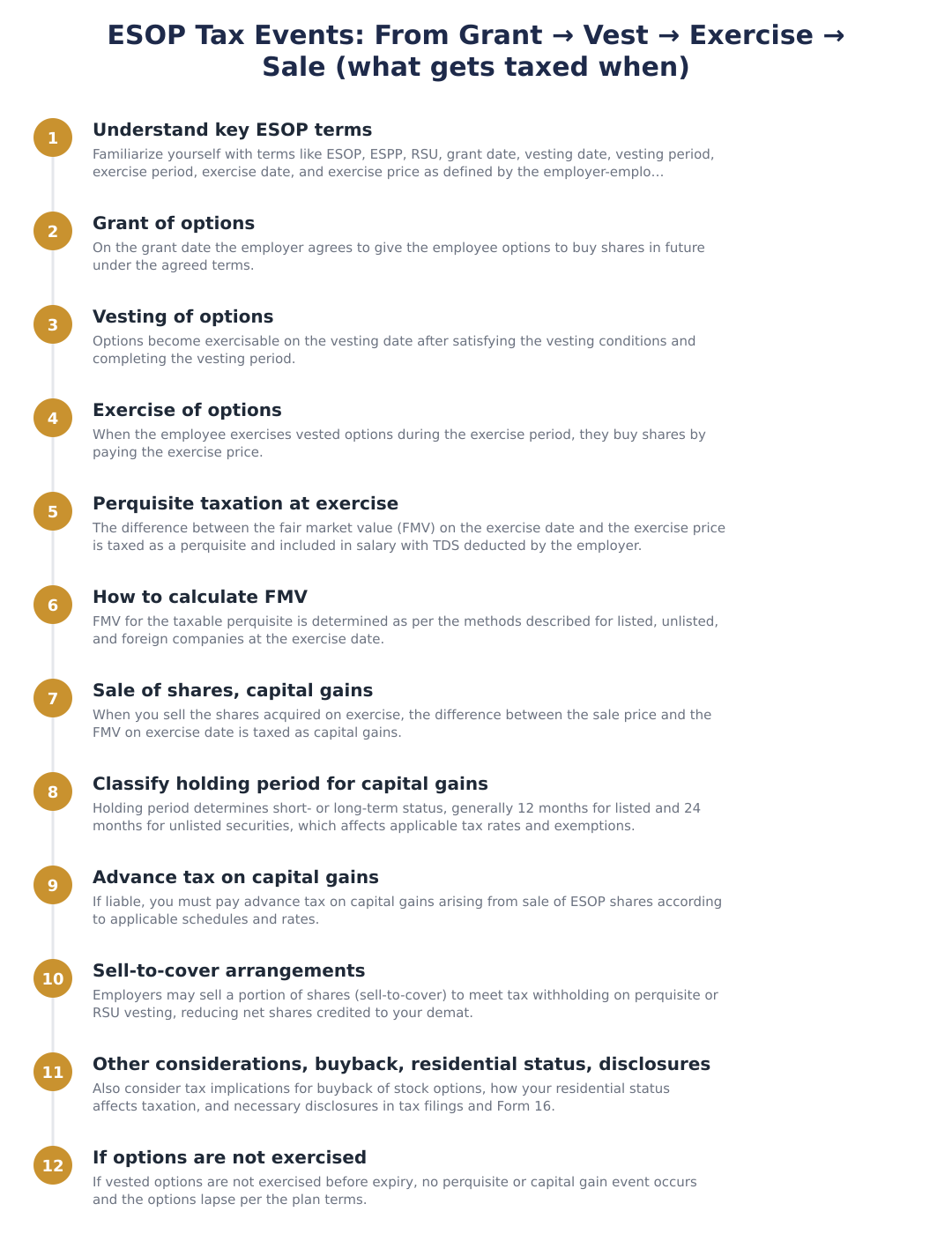
ESOP, Employee Stock Option Plan, allows an employee to own equity shares of the employer company over a certain period under terms agreed between employer and employee. Understanding the timeline and labels used in an ESOP is important because specific dates determine when tax events arise.
Grant Date is the date when the employer and employee agree to give the option to own shares at a future date. The Vesting Date is when the employee becomes entitled to buy the shares after the agreed conditions are satisfied; the interval between grant and vesting is the Vesting Period. After vesting, the employee has rights only, the Exercise Period is the span of time during which the employee may choose to buy the shares, and the Exercise Date is the actual date the employee exercises the option.
Exercise Price is the price at which the employee buys the shares on exercise; it is typically lower than the prevailing fair market value (FMV) on the exercise date. These basic definitions are the foundation for how and when tax applies, because tax rules reference the FMV at exercise and compare it with the exercise price.
Calculating Taxes
There are two distinct tax events to keep in mind. First, at the time of exercise: the difference between the FMV on the exercise date and the exercise price is treated as a perquisite and taxed as part of salary income. Because this is a perquisite, the employer is responsible for deducting tax at source (TDS) on that amount and reporting it in payroll.
Second, at the time you sell the shares acquired on exercise: the difference between the sale price and the FMV on the exercise date is treated as a capital gain. For capital‑gains computation, the FMV on the exercise date is considered your cost of acquisition. These two separate tax treatments mean the same economic benefit is taxed twice in different heads, once as salary (perquisite) on exercise and again as capital gain on sale, with the FMV at exercise forming the acquisition cost for the latter.
How to Calculate FMV?
FMV (fair market value) at the time of exercise is a critical number because it determines the taxable perquisite on exercise and later serves as the cost of acquisition for capital‑gains calculation. Employers typically determine and document the FMV at exercise; that valuation is then used for payroll reporting and in the employee’s Form 16.
From a practical standpoint, keep a record of the employer’s communicated FMV on the exercise date and any valuation certificates or payroll statements that show how the perquisite was computed. These documents are the primary evidence you will use when computing capital gains on a later sale and when reconciling amounts reported in Form 16 with sale proceeds.
Advance Tax on Capital Gains
When you dispose of shares you acquired on exercise, the difference between the sale price and the FMV on the exercise date is taxable as capital gains. That tax treatment makes it important to include the transaction in your tax planning for the year of sale so the correct tax liability is met when filing returns.
Maintain a clear trail: sale contract notes, brokerage statements, and the record of FMV at exercise are essential to compute the capital gain correctly. If a sale results in a loss, that loss can be carried forward under the capital‑gains rules and adjusted against future gains as allowed by tax provisions.
Other Considerations
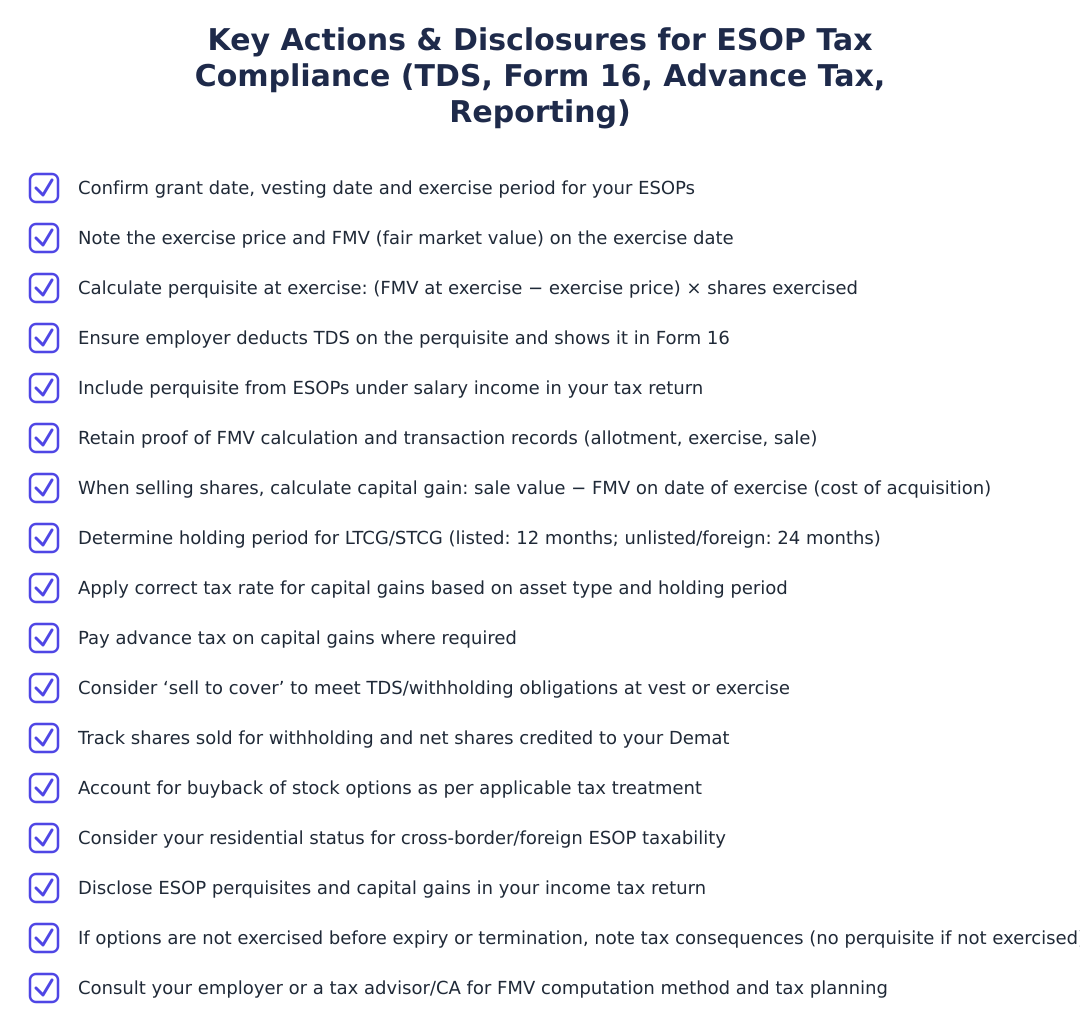
TDS and reporting: because the perquisite at exercise is treated as part of salary, the employer deducts TDS and shows the amount in Form 16. Verify that the taxable perquisite reported by your employer matches the FMV and exercise price used to calculate it.
Capital‑gains documentation and losses: when you sell shares, keep all sale documentation and reconcile sale proceeds with the FMV at exercise (which is your cost of acquisition for capital gains). If the sale results in a short‑term loss, you are permitted to carry forward that loss in your tax return and set it off against future gains, subject to the general carry‑forward and set‑off rules.
Frequently Asked Questions
Q: When is the ESOP benefit taxed? A: The benefit is taxed at two points: as a perquisite at exercise (difference between FMV on exercise date and exercise price) and as capital gain on sale (difference between sale price and FMV on exercise date).
Q: Who withholds tax on the perquisite? A: The employer deducts TDS on the perquisite and reports it in Form 16, which is included as part of salary income in your tax return.
Q: What serves as the cost of acquisition for capital gains? A: The FMV at the time of exercise is treated as the cost of acquisition for capital‑gains purposes.
Q: Can I set off a loss from selling these shares? A: If you incur a capital loss on sale, short‑term capital losses can be carried forward in your return and adjusted against gains in future years as per the capital‑gains provisions.
ESOPs create two distinct tax touchpoints: exercise (taxed as a perquisite and reported in Form 16) and sale (taxed as capital gains with the FMV at exercise as cost of acquisition). Keep accurate records of grant, vesting, exercise dates, the employer’s FMV at exercise, payroll computations, and sale documents. These records will help you verify employer withholding, compute capital gains correctly on sale, and claim carry‑forward of losses where applicable.
Frequently asked questions
What is an ESOP and how does it work as part of my salary package?
An ESOP (Employee Stock Option Plan) is a benefit that lets employees buy equity of their employer at a pre-agreed price, usually as part of compensation. Companies grant options on a grant date, the options vest after a vesting period (when conditions are met), and the employee can buy shares during the exercise period at the exercise price. ESOPs are different from ESPPs (purchase plans with payroll deductions) and RSUs (restricted stock units paid on milestones) and the specific vesting, exercise price and timelines are set out in your agreement. Tax consequences arise at exercise (as a perquisite) and when you later sell the shares (as capital gains).
How is ESOP taxed when I exercise the options?
When you exercise ESOPs the difference between the fair market value (FMV) on the exercise date and the exercise price is taxed as a perquisite and added to your salary income. Your employer is required to deduct TDS on this perquisite and the amount is reported in Form 16, so it flows into your total taxable salary for the year. The taxable perquisite equals (FMV per share on exercise − exercise price) × number of shares exercised; keep records of the FMV used because it becomes your cost of acquisition for capital gains later. If options are exercised in a foreign-listed company or in some RSU cases, withholding methods like “sell to cover” may be used to meet tax withholding immediately.
How are capital gains on ESOP shares taxed when I sell the shares?
Capital gains tax applies on the difference between the sale price and the FMV on the exercise date (which is your cost of acquisition). If you sell listed company shares after holding them for more than 12 months they qualify for long-term capital gains (LTCG) taxed at 12.5% on gains exceeding Rs 1.25 lakh, while sale within 12 months is short-term and taxed at 20% for listed shares. For unlisted or most foreign shares the long-term holding period is 24 months, short-term gains are taxed at your slab rate and long-term gains are taxed at 12.5% (without indexation in the table), and you can carry forward short-term capital losses to set off future gains by following I-T filing rules.
How do I calculate the Fair Market Value (FMV) for ESOP taxation?
FMV for ESOP taxation is the market value of the stock on the date of exercise and this value is treated as your cost of acquisition for later capital gains calculations. For listed stocks FMV is generally the market price on the exercise date; for unlisted companies FMV may be determined by valuation rules or company-provided valuation on the exercise/allotment date. The FMV difference over the exercise price is taxed as a perquisite at exercise and then later used to compute capital gains when you sell: Capital Gain = Sale Value − FMV on Exercise Date. Keep employer-issued valuation/transaction records to substantiate the FMV used.
Do I need to pay advance tax on capital gains from ESOP sales?
Yes, you may need to pay advance tax on capital gains arising from sale of ESOP shares if the tax liability exceeds the advance tax threshold, and normal advance tax schedules apply. If you realize significant gains (for example, a large sale after exercise) you should estimate the tax and pay advance tax installments to avoid interest, especially because employer TDS at exercise may not cover capital gains tax due on sale. Advance tax rules apply to the net tax liability after accounting for TDS and other credits, so track perquisite TDS at exercise and expected capital gains at sale and pay required instalments.
What is 'sell to cover' and how does it affect my ESOP shares and taxes?
Sell to cover is when the company or broker sells a portion of your vested shares immediately to raise cash to pay the withholding tax on the perquisite at vest or exercise. For example, if 100 RSUs vest at market value $60 and withholding is 31.2% (tax + cess), roughly 33 shares may be sold to meet $1,872 of withholding and the remaining 67 shares are deposited to your demat. Sell-to-cover reduces your net shares received but ensures withholding obligations are met at vesting/exercise without you paying cash upfront.
How are buybacks of ESOP shares treated for tax purposes?
Buyback of ESOP shares by the company can trigger capital gains or other tax implications depending on whether you sell back vested shares to the employer; the difference between buyback price and your cost of acquisition (FMV at exercise) is treated as capital gain. Tax rates follow the holding-period rules, listed shares follow 12-month holding for LTCG treatment and unlisted typically 24 months, and the taxability (short-term slab rates or long-term 12.5%) depends on that classification. Also check whether the buyback includes special withholding or reporting by the company and whether any perquisite element arises at the time of buyback if structured differently.
What happens taxwise if my ESOPs expire or I leave the company before exercising?
If options are not exercised and they expire or you forfeit them on termination, there is typically no perquisite or capital gains tax because no exercise/allotment occurred and you never acquired shares. Tax events arise only on exercise (perquisite) and on subsequent sale (capital gains); therefore, unexercised options that lapse usually have no immediate tax consequence. However, examine your grant and employment terms, certain terminations may accelerate vesting or create other taxable events, and the expiry/forfeiture date (including five-year expiry windows or termination-triggered dates) should be checked for specifics.
What employer disclosures and employee reporting are required for ESOP taxation?
Employers must report the taxable perquisite (FMV − exercise price) and deduct TDS, showing the amount in the employee’s Form 16; employees must include that perquisite in salary income and report any capital gains on sale in their ITR. Maintain records of grant, vesting, exercise dates, FMV used at exercise, sale proceeds, and brokerage/transaction costs because these are required to compute cost of acquisition and capital gains correctly. Also note residential status can change taxability (resident vs non-resident) and cross-border RSUs/foreign listings may require extra disclosures or different withholding methods.
Need help staying Income Tax compliant?
MoneyGence's AI Finance OS tracks your compliance, wallet share, and finances in one place, built for agencies and growing businesses.
Get started with MoneyGence