Exports Under GST: Deemed Exports & Refund Forms
This guide explains how exports are treated under the Goods and Services Tax (GST) framework and what exporters need to know about refunds. You will learn the basic legal perspective on import and export of goods and services, the practical distinction between exports and deemed exports, the two broad ways exports are effected under GST (under bond or letter of undertaking, and on payment of integrated tax), and how refund claims arise in each route. Understanding these points matters because they determine cash-flow outcomes for exporters: whether they can carry forward or claim a refund of input tax credits, or obtain a refund of tax paid at the time of export. The guide also summarises the procedural reality that refunds of IGST on exports and refunds of unutilised input tax credit for zero-rated supplies are governed by prescribed rules, procedures, and safeguards. That means businesses must follow statutory processes to convert tax credits into cash. This article is aimed at exporters, tax heads, and advisers who need a clear conceptual map of export treatment under GST so they can plan compliance, manage working capital, and prepare documentation for refund processes. It does not provide form numbers or timelines but sets out the options, the practical implications, and the relationship between export routes and refund entitlement.
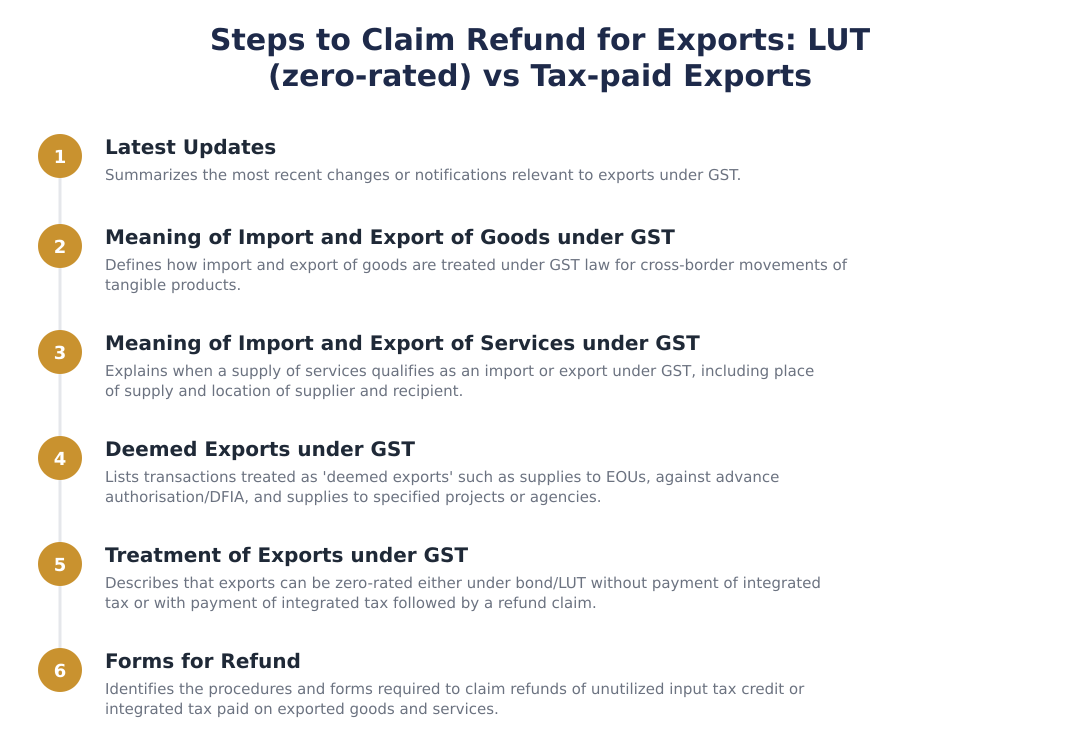
Latest Updates:
At the highest level, the GST treatment of exports continues to distinguish between zero-rated supplies and taxable supplies that attract integrated tax. This distinction determines whether an exporter uses a bond or letter of undertaking to ship without paying tax, or pays IGST and seeks a refund later.
Refunds connected with exports, whether a refund of IGST paid at export or a refund of unutilised input tax credit arising from zero-rated supplies, remain subject to specified rules, procedures and safeguards. Businesses should expect that statutory processes will govern how and when refunds are sanctioned.
Meaning of Import and Export of Goods under GST
When considering exports under GST, it is essential to understand the legal framework applicable to the movement of goods across borders. The laws applicable to import and export of goods set out how cross-border transactions are characterised for tax purposes, which in turn determines compliance obligations and refund entitlements.
Practically, this means that an exporter must classify a transaction as an export or a domestic supply under the statute to determine whether the transaction is zero-rated or taxable. That classification affects whether the exporter can use a bond or letter of undertaking to avoid paying IGST at the time of export, or whether the exporter will pay IGST and later seek a refund of that tax.
Meaning of Import and Export of Services under GST
The legal approach to import and export of services mirrors that for goods: the applicable laws define when a supply of services is treated as an export, which impacts tax treatment and refund rights. Service exports can therefore be routed either as zero-rated supplies or as taxable supplies depending on how the transaction meets statutory criteria.
For service providers, this distinction is important because it determines whether input tax credits tied to the exported service can be utilised or claimed as a refund. The broader point is that both goods and services exports are governed by the same conceptual framework under GST, and exporters of services must consider that framework when deciding how to structure cross-border contracts and receipts.
Deemed Exports under GST
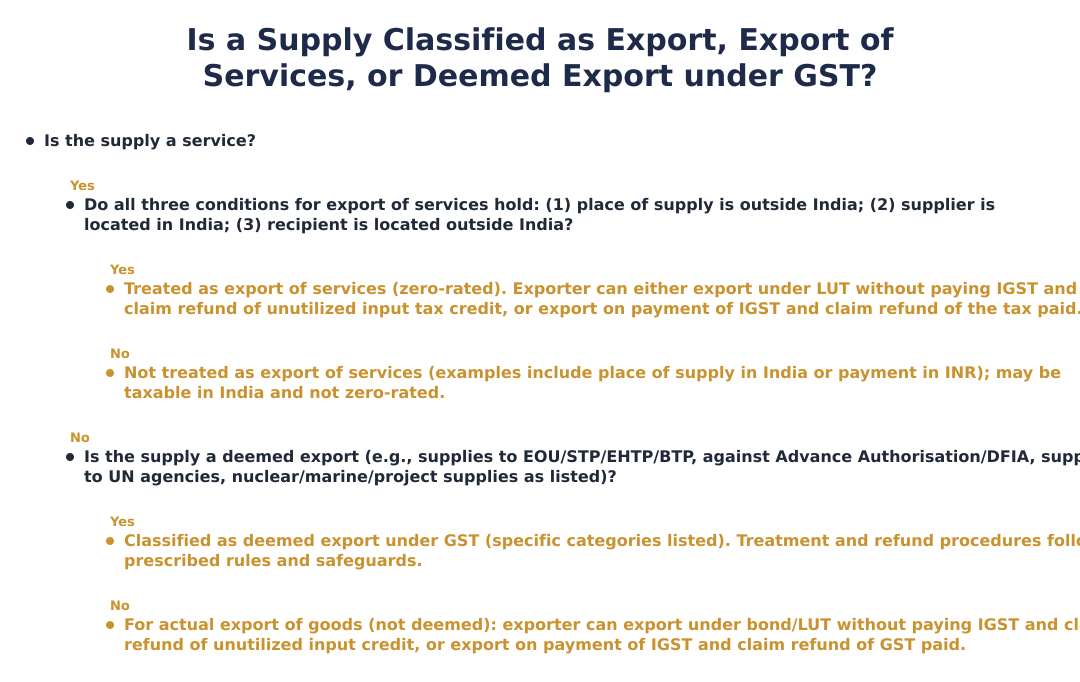
Deemed exports are a special category under GST where the supply is treated as an export for certain purposes even though the goods do not physically leave the country. The concept exists to grant export-like benefits in situations the law recognises as equivalent to exports.
From a practical standpoint, businesses dealing in transactions that qualify as deemed exports should be aware that such supplies may attract treatment similar to exports, affecting their entitlement to input tax credit reversal, refunds, or other export-related reliefs. As with standard exports, the precise consequences depend on statutory provisions and the implementing rules.
Treatment of Exports under GST
There are two broad treatments for exports under GST. First, exporters may ship goods or services under a bond or a letter of undertaking (LUT) without paying integrated tax; in this route the exporter can claim a refund of unutilised input tax credit. Second, exporters may choose to export on payment of integrated tax and subsequently claim a refund of the IGST paid on such exported goods or services.
Both routes are intended to ensure that exports are zero-rated in economic effect, taxes borne on inputs are either refunded or not levied at the point of export, but they operate differently in compliance and cashflow terms. Choosing between the routes is a business decision influenced by working capital considerations, compliance readiness, and the exporter’s ability to pursue refunds through the prescribed procedures.
Forms for Refund
Exporters may supply goods or services under a bond or letter of undertaking and not pay integrated tax at export; they can claim a refund of unutilised input tax credit arising from these zero-rated supplies.
Exporters may alternatively export after paying IGST on the supplies and then claim a refund of the IGST paid on such exported goods or services.
Refunds of IGST paid on exports or refunds of unutilised input tax credit for zero-rated supplies are subject to rules, procedures, and safeguards prescribed by the law, so exporters must comply with those procedural requirements to obtain refunds.
In summary, exports under GST are structured to be zero-rated economically, either by exporting under a bond/LUT and claiming unutilised input tax credit, or by exporting on payment of IGST and claiming a refund of tax paid. Both options involve statutory compliance and are governed by prescribed rules and safeguards. Exporters should align their operational and compliance practices to the chosen route so they can secure refunds and manage cash flows effectively.
Frequently asked questions
What counts as export of goods under GST?
Export of goods under GST is when goods are shipped from India to a place outside India and the supplier fulfils prescribed documentation and customs procedures. Specifically, the transaction must involve actual movement of goods out of India and export through approved ports or airports, with export bills of entry and shipping bills filed; otherwise it may not qualify. Exports of goods are generally treated as zero-rated supplies, meaning IGST can be exported under bond/LUT without payment or exported with payment of IGST and claim refund later. Note that supplies classified as 'deemed exports' (see below) are treated differently even though goods do not leave India.
What counts as export of services under GST?
Export of services under GST is when the supplier of services is located in India, the recipient is located outside India, the place of supply is outside India, and the payment is received in convertible foreign exchange or in Indian rupees from a person located outside India. All four conditions must be satisfied for a service to qualify as an export of services; if any condition fails the supply may not be zero-rated. Export of services is also treated as zero-rated, so the supplier can export under LUT/bond without paying IGST or pay IGST and claim a refund of tax paid. Note that transactions involving foreign branches or certain rupee receipts can be excluded depending on whether the consideration is from a person located outside India and in convertible currency.
What are deemed exports under GST and how are they different from normal exports?
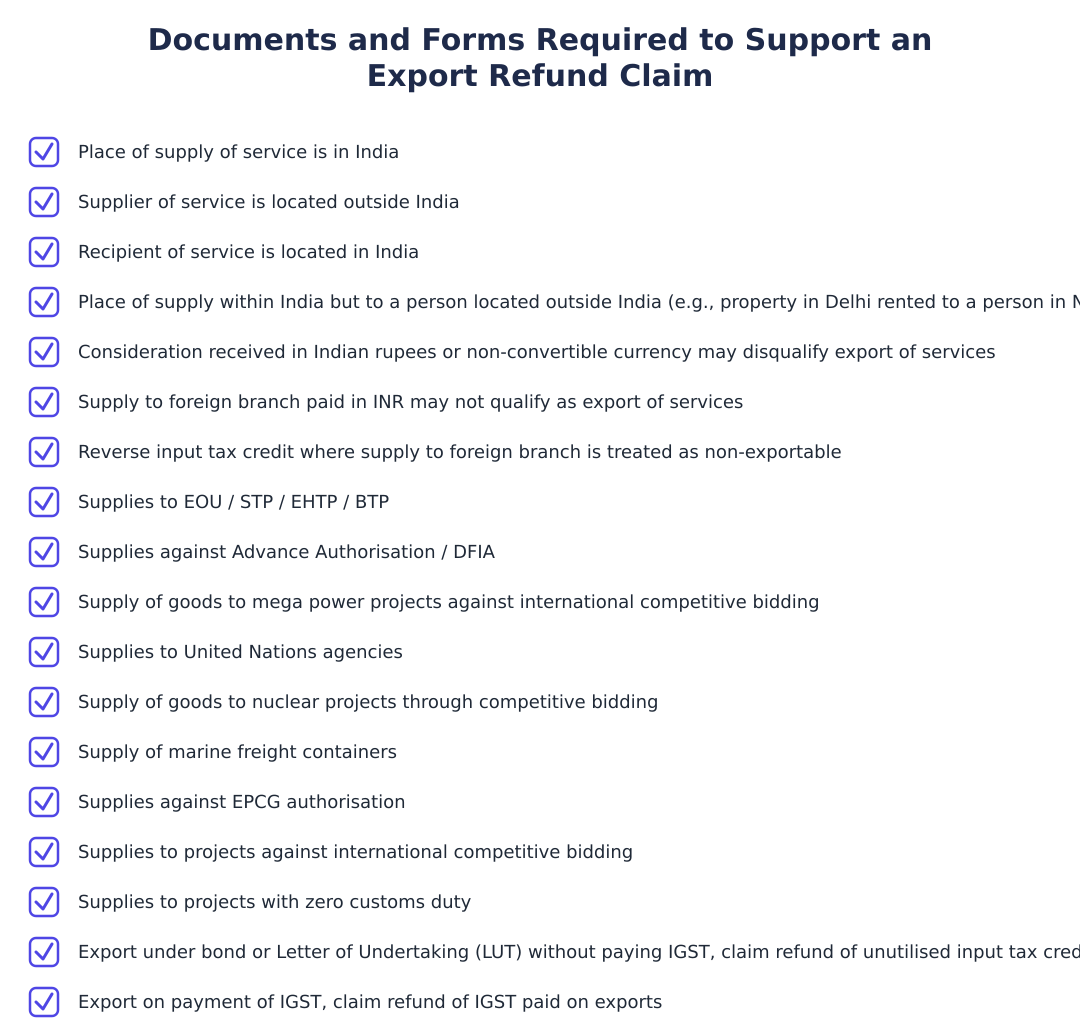
Deemed exports under GST are particular domestic supplies of goods specified by statute that are treated as exports even though the goods do not leave India. Examples include supplies to Export Oriented Units (EOU), Special Economic Zones (SEZ) in certain situations, supplies against Advance Authorisation/DFIA, supplies to UN agencies, and supplies to projects awarded through international competitive bidding; these are listed under the GST law and notifications. Unlike normal exports, deemed exports do not involve physical cross-border movement, and suppliers may be eligible for refund or other benefits under notified procedures rather than the usual zero-rating mechanisms. Suppliers should check the specific notification conditions and documentation required to treat such supplies as deemed exports and claim any refunds or concessions.
Can I export goods or services without paying IGST under GST?
Yes, you can export goods or services under a Letter of Undertaking (LUT) or bond without paying IGST, provided you meet eligibility and procedural requirements. Exporters who furnish a valid LUT or security bond can supply zero-rated exports without payment of integrated tax and later claim refunds of unutilized input tax credit, while those who do not furnish LUT can pay IGST at the time of export and claim refund of the tax paid. Furnishing an LUT typically requires meeting compliance conditions and is subject to safeguards prescribed by the tax authorities; exporters should retain proof such as shipping bills and invoices to support zero-rating claims.
What refunds are available for exporters under GST?
Exporters can claim either a refund of unutilised input tax credit (ITC) when exports are made under LUT/bond without payment of IGST, or a refund of IGST paid on exports if tax was paid at the time of export. The refund claims are subject to prescribed forms, documentary evidence (such as shipping bills, export invoices, and bank realization certificates for services), and verification by tax authorities under the GST refund rules. Timelines and procedural safeguards apply, for instance, the refund claim must be filed within the statutory period and can be denied or adjusted if exports are found to be ineligible or documentation is incomplete.
What forms do I need to use for GST refunds on exports?
For GST refunds on exports you must follow the prescribed refund application formats and submit supporting documents like shipping bills, commercial invoices, and LUT/bond or proof of IGST payment; the refund application is filed electronically on the GST portal using Form RFD-01. The RFD-01 is the standard refund application form where exporters attach evidence such as the shipping bill, export invoice, bank realization certificate for services, and LUT or proof of IGST payment, and the portal validates and processes the claim. Additional supporting forms or certificates may be required depending on whether the claim is for refund of unutilized ITC (exports under LUT) or refund of IGST paid (exports with payment), and tax officers may ask for further documents during scrutiny.
When are exports treated as zero-rated supplies under GST?
Exports are treated as zero-rated supplies under GST when goods or services are exported from India and the supplier either furnishes an LUT/bond and does not pay IGST, or pays IGST and claims a refund of the tax paid. Zero-rating means the outward supply is taxed at zero percent, allowing exporters to claim refund of unutilised input tax credit or refund of IGST paid, subject to compliance with documentation and procedural rules. This treatment applies to both exports of goods and exports of services that meet the statutory conditions (place of supply, supplier and recipient locations, and convertible foreign exchange payment where applicable).
What conditions must be met for a service to qualify as export of service?
A service qualifies as an export of service only if the supplier is located in India, the recipient is located outside India, the place of supply is outside India, and the payment is received in convertible foreign exchange or in Indian rupees from a person located outside India. All four conditions are cumulative, failure of any one (for example, if the recipient is located in India or payment is from an Indian entity in non-convertible terms) will disqualify the supply as an export of service. If the service does not meet these conditions it will not be zero-rated and input tax credit apportionment or reversal rules may apply instead. Examples include consultancy services to a foreign client paid in foreign currency and whose place of supply falls outside India.
Are supplies to EOUs, SEZs and UN agencies treated specially under GST?
Yes, supplies to specified entities such as EOUs, SEZs, United Nations agencies, and other notified projects are treated as deemed exports or are eligible for special export-related benefits under GST if they meet notification conditions. These supplies may attract zero-rating or allow suppliers to claim refunds or concessions under specific schemes (for example supplies to EOUs or supplies against Advance Authorisation/DFIA are listed as deemed exports). The exact treatment, whether treated as deemed export, zero-rated, or eligible for refund, depends on the nature of the supply and the applicable notifications and documentation requirements; suppliers must follow the prescribed procedure to claim benefits.
Need help staying GST compliant?
MoneyGence's AI Finance OS tracks your compliance, wallet share, and finances in one place, built for agencies and growing businesses.
Get started with MoneyGence