Form 15G & Form 15H FY 2025-26 | Save TDS on Interest Income
This guide explains how Forms 15G and 15H can prevent TDS being deducted on interest and other specified incomes during Financial Year 2025-26, who may use them, how they differ, and what’s changing under the Income Tax (2025) amendments. You will learn the eligibility rules for each form, the practical steps for filling the declarations, the types of income and TDS sections where these declarations can be used, and common mistakes that lead to rejection or penalties. The guide also summarises the new Form 121 introduced by the 2025 amendments and how it will replace current declarations from 1 April 2026. Understanding when to submit Form 15G or 15H matters because these declarations stop a deductor (bank, post office, insurer, employer, tenant, etc.) from withholding tax at source when your estimated tax liability for the year is nil. Using the correct form and submitting it to each deductor where you earn interest or other liable income preserves your liquidity and avoids the need to claim refunds later through your income tax return. Conversely, an incorrect or false declaration can invalidate the relief and attract legal consequences. This guide uses only verified statutory points and practical filing details so you can confidently decide which declaration applies to you, how to fill it, and where and when to submit it during FY 2025-26.
What is Form 15G?
Form 15G is a self-declaration used by certain resident taxpayers to request non-deduction of TDS on specified incomes during a financial year when their total estimated tax liability is nil. It is typically used by resident individuals below 60 years of age, Hindu Undivided Families (HUFs), and other eligible assessees who expect their tax liability for the year to be zero.
Practically, submitting Form 15G to each bank, post office, insurer or other deductor where you receive interest or similar payments prevents them from deducting tax at source on those eligible receipts. The declaration must be submitted separately to every deductor because one submission does not cover income from multiple sources or branches.
What is Form 15H?
Form 15H is the equivalent declaration for senior citizens (age 60 years and above) to seek non-deduction of TDS where their total estimated tax liability is nil. It is specifically designed to accommodate the senior citizen category and has more liberal applicability compared with Form 15G.
Like Form 15G, Form 15H must be submitted separately to each bank, post office, or deductible source from which the senior citizen receives interest or other payments covered by TDS provisions. A valid PAN is mandatory for Form 15H and a senior citizen must ensure the declaration is accurate to avoid future disputes.
Income Tax Act 2025 Updates - Form 121
The Income Tax amendments of 2025 introduce Form 121 as a unified declaration mechanism that will replace Forms 15G and 15H. Form 121 is effective from 1 April 2026 and is intended as a consolidated declaration for eligible resident taxpayers.
Under the 2025 framework, Form 121 is governed by Sections 393(6) and 393(7) of the Income Tax Act, 2025. It will be submitted to each deductor from whom eligible income is received, similar to the current requirement to submit Forms 15G/15H to each paying entity.
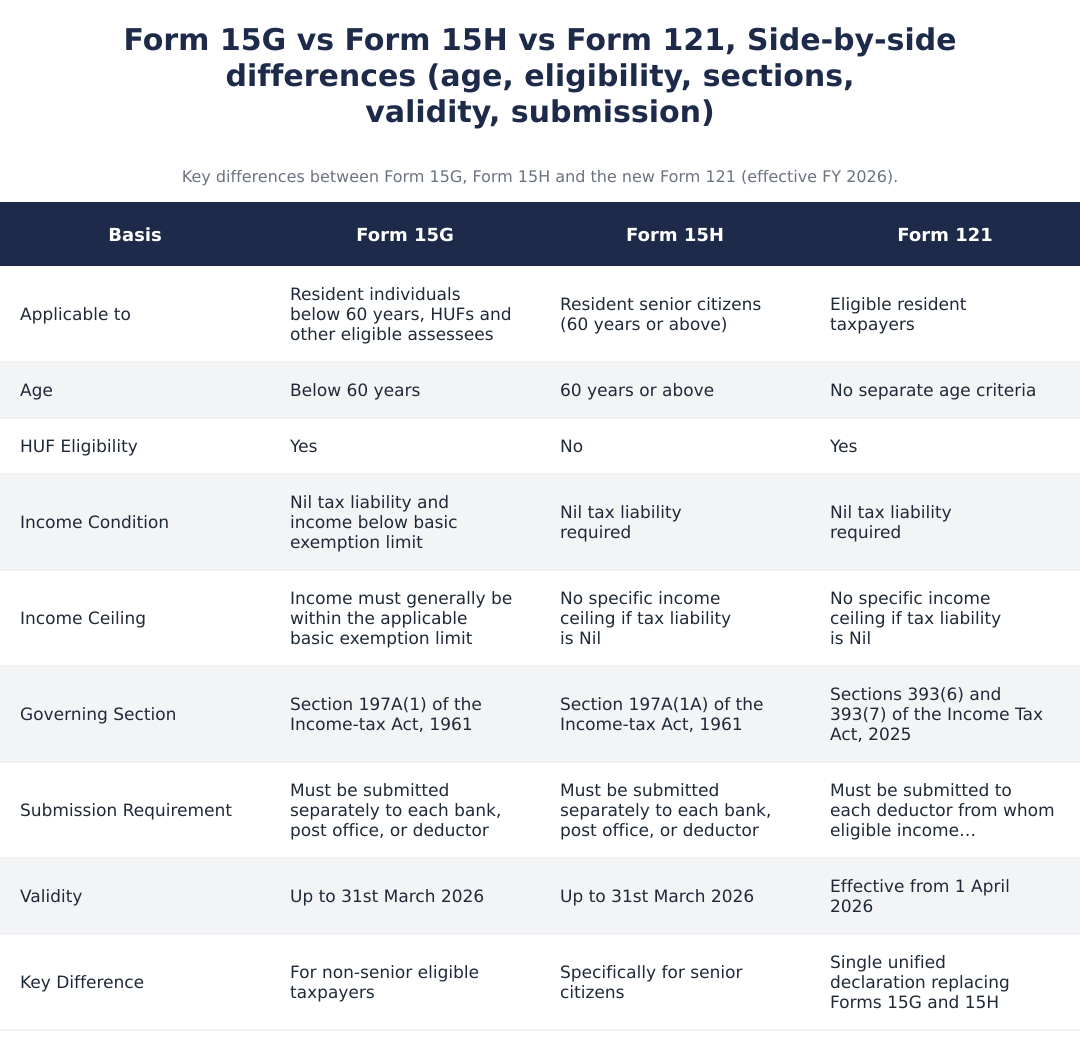
Form 15G vs Form 15H vs Form 121 - Key Differences
| Basis | Form 15G | Form 15H | Form 121 |
|---|---|---|---|
| Applicable to | Resident individuals below 60 years, HUFs and other eligible assessees | Resident senior citizens (60 years or above) | Eligible resident taxpayers |
| Age | Below 60 years | 60 years or above | No separate age criteria |
| HUF Eligibility | Yes | No | Yes |
| Income Condition | Nil tax liability and income below basic exemption limit | Nil tax liability required | Nil tax liability required |
| Income Ceiling | Income must generally be within the applicable basic exemption limit | No specific income ceiling if tax liability is Nil | No specific income ceiling if tax liability is Nil |
| Governing Section | Section 197A(1) of the Income-tax Act, 1961 | Section 197A(1A) of the Income-tax Act, 1961 | Sections 393(6) and 393(7) of the Income Tax Act, 2025 |
| Submission Requirement | Must be submitted separately to each bank, post office, or deductor | Must be submitted separately to each bank, post office, or deductor | Must be submitted to each deductor from whom eligible income is received |
| Validity | Up to 31st March 2026 | Up to 31st March 2026 | Effective from 1 April 2026 |
| Key Difference | For non-senior eligible taxpayers | Specifically for senior citizens | Single unified declaration replacing Forms 15G and 15H |
Field-by-field guide: What to fill in Form 15G and Form 15H
| Field No. | Particulars | What to Fill |
|---|---|---|
| 1 | Name of Assessee (Declarant) | Enter your full name exactly as per PAN records. |
| 2 | PAN of the Assessee | Mention your valid PAN. Incorrect or missing PAN invalidates the declaration. |
| 3 | Status / Previous Year (P.Y.) | Select your status (Individual, HUF, etc.) and enter the relevant financial year. |
| 4 | Residential Status / Address | Tick Resident and provide complete residential address including city, state and PIN code. |
| 5 | Contact details | Provide a valid email ID and telephone/mobile number. |
| 6 | Whether Assessed to Tax Earlier / Latest Assessment Year | Select Yes if you filed ITR in prior years and mention the latest assessment year; otherwise select No. |
| 7 | Estimated Income for Which Declaration is Made | Mention the income on which TDS may be deducted (e.g., FD interest, EPF withdrawal). |
| 8 | Estimated Total Income of the Previous Year | Enter your total estimated income from all sources during the financial year (include all income heads). |
| 9 | Details of Form 15G/15H Filed During the Year, if Any | Mention the number of declarations already submitted in the year and the aggregate income covered by them. |
| 10 | Details of Income for Which Declaration Is Filed | Provide investment/account number, nature of income, section under which tax is deductible, and the amount. |
TDS sections and threshold limits where Form 15G/15H can be used
| Section | Nature of Payment | Threshold Limit (In Financial Year) | Eligible for 15G | Eligible for 15H |
|---|---|---|---|---|
| 192A | Premature withdrawal of EPF | Rs.50,000 | Yes | Yes |
| 193 | Interest on securities such debenture, govt. bonds, etc. | Rs.5,000 or Rs.10,000 | Yes | Yes |
| 194 | Dividend | Rs.10,000 | Yes | Yes |
| 194A | Interest from Bank, FD, RD, etc. | Rs.50,000(Rs.1,00,000 for senior citizen) | Yes | Yes |
| 194EE | National Saving Scheme Withdrawal (NSS) | Rs.2,500 | Yes | Yes |
| 194D | Insurance Commission | Rs.15,000 | Yes | Yes |
| 194DA | Maturity proceeds of life insurance | Rs.1,00,000 | Yes | Yes |
| 194-I | Rent from land, building plant and machinery | Rs. 50,000 per month or Rs.6 lakhs per annum. | Yes | Yes |
| 194K | Income from mutual funds units | Rs.10,000 | Yes | Yes |
Forms 15G and 15H are practical tools to avoid unnecessary TDS when your estimated tax liability for the financial year is nil. Use Form 15G if you are a resident taxpayer below 60 (or an HUF where applicable), and Form 15H if you are a senior citizen 60 years or older. From 1 April 2026, Form 121 will replace these declarations as the unified mechanism for eligible resident taxpayers. Always submit a separate declaration to each deductor, complete all required fields accurately (especially PAN and estimated total income), and resubmit declarations each financial year to maintain non-deduction of TDS.
Frequently asked questions
What are Form 15G and Form 15H and why are they used?
Form 15G and Form 15H are self-declaration forms submitted to a bank or other deductor to request non-deduction of TDS on certain interest and other incomes when your tax liability is nil. Form 15G is for resident individuals (and HUFs) below 60 years and requires that your estimated total income for the financial year results in zero tax, while Form 15H is for resident senior citizens (60 years or above) who can declare nil tax liability without the same strict income ceiling. Both forms are valid for one financial year (e.g., valid up to 31 March 2026 for FY 2025-26) and must be submitted separately to each bank, post office, or deductor where you earn income. From 1 April 2026, a new unified Form 121 under the Income Tax Act 2025 will take effect replacing 15G/15H for eligible taxpayers, so check applicability for the next year.
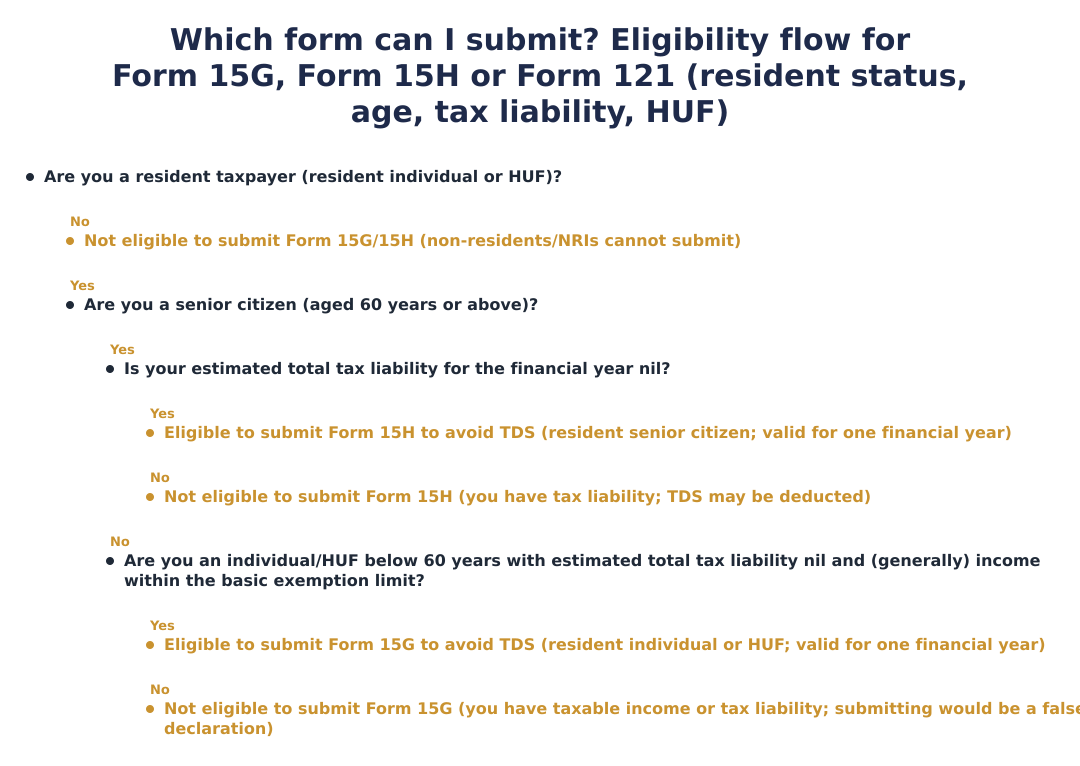
Who can file Form 15G for FY 2025-26?
You can file Form 15G in FY 2025-26 if you are a resident individual, HUF or other eligible assessee below 60 years and your estimated total tax liability for the financial year is nil. Your total estimated income must generally be within the basic exemption limit so that no tax is payable; submitting the form when tax is actually payable makes the declaration false and punishable. Form 15G must be submitted separately to each bank, branch or deductor and is valid only for that financial year (valid up to 31 March 2026 for FY 2025-26). Ensure your PAN is correct on the form, missing or wrong PAN invalidates the declaration and may attract higher TDS rates.
Who can file Form 15H for FY 2025-26?
Form 15H can be filed by resident senior citizens (age 60 years or above) in FY 2025-26 who estimate that their total tax liability for the year will be nil. Unlike Form 15G, there is no strict income ceiling, the key condition is that tax liability must be zero, and the form must include your PAN and estimated income on which TDS may be deducted (for example FD interest). Form 15H must also be submitted separately to each deductor and is valid for one financial year (up to 31 March 2026 for FY 2025-26); incorrect or missing PAN will render it invalid. If your total income would attract tax even by Re.1, you are not eligible and should not file Form 15H.
What are the key differences between Form 15G, Form 15H and Form 121?
The key differences are age, applicability and the transition to Form 121: Form 15G applies to resident individuals and HUFs below 60 years with income within the basic exemption limit, Form 15H applies to resident senior citizens (60+) with nil tax liability and no strict income ceiling, while Form 121 (effective 1 April 2026) is a unified declaration for eligible resident taxpayers replacing 15G/15H. Forms 15G and 15H are governed by sections 197A(1) and 197A(1A) of the Income-tax Act, 1961 and are valid up to 31 March 2026 for FY 2025-26; Form 121 is under sections 393(6) and 393(7) of the Income Tax Act, 2025 and becomes effective from FY 2026-27. All declarations must be submitted separately to each deductor and are valid only for the financial year for which they are filed. HUFs can file Form 15G but cannot file Form 15H; Form 121 has no separate age criteria but replaces the older forms.
How do I fill the important fields in Form 15G (Part I and II)?
When filling Form 15G, you must enter your full name as per PAN, a valid PAN, select the correct status (Individual, HUF, etc.), and specify the previous year (financial year) for which the declaration is made. Provide your complete residential address, email, telephone number and tick "Resident" (non-residents cannot submit), state whether you were assessed to tax in the last six assessment years and give the latest assessment year if applicable; importantly include estimated income for which the declaration is made and estimated total income for the previous year (all sources). Also declare details of any earlier Form 15G(s) filed during the year (number and aggregate income) and provide specific details of the income for which declaration is filed (account or investment number, nature of income, section under which tax is deductible and amount). Errors like wrong PAN, underestimating total income or not declaring other 15G submissions will invalidate the form and can lead to TDS being deducted.
How do I fill Form 15H, which fields are most important?
To fill Form 15H correctly, enter your full name exactly as per PAN, provide your valid PAN (mandatory), indicate the previous year and tick "Resident" as non-residents cannot submit the form. Provide your complete address, email and telephone number, state whether you were assessed to tax previously and mention the latest assessment year if yes, then give the estimated income on which declaration is made and the estimated total income from all sources for the financial year. Also list any Form 15H submitted earlier during the year (aggregate income and number of declarations) and include details of the income for which the declaration is filed (account number, nature of income, applicable section and amount); missing or incorrect PAN will make the declaration invalid and lead to TDS.
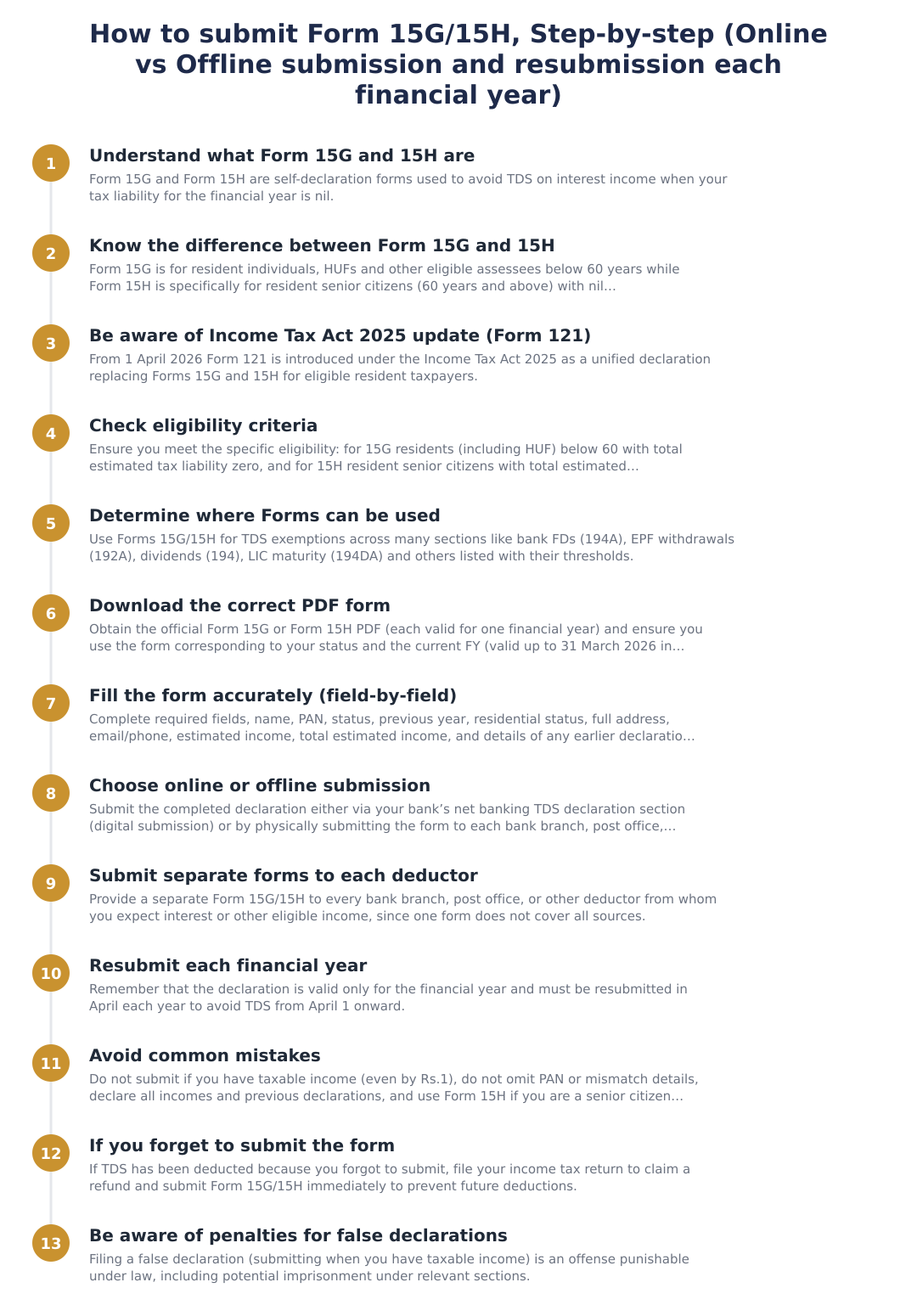
How and where can I submit Form 15G/15H, online and offline options?
You can submit Form 15G/15H both online (via your bank's netbanking TDS declarations section or the deductor's online portal) and offline (physically at the bank branch, post office or deductor office). For online submission, login to netbanking, go to TDS declaration/Form 15G/15H, fill PAN, estimated income and other details and submit digitally; this avoids branch visits and is immediate. For offline submission, sign and hand over the completed physical form to each branch or deductor where you earn income, remember you must submit a separate form to every bank branch or deductor and resubmit each April as forms expire on 31 March. Keep proof of submission (stamped receipt or acknowledgement) and ensure PAN and estimated income fields are accurate to avoid invalidation and TDS.
What should I do if I forgot to submit Form 15G or 15H and TDS was deducted?
If you forgot to submit Form 15G/15H and TDS was deducted, file your Income Tax Return (ITR) for the financial year to claim a refund of the excess TDS and also submit the declaration to the deductor immediately to prevent future deductions. The ITR will allow you to claim the TDS credit and any refund due after reconciliation; keep Form 26AS and TDS certificates handy to support the claim. If you still qualify for non-deduction going forward, submit fresh Form 15G/15H to each deductor and ensure you resubmit annually in April, since submissions do not cover future financial years automatically.
What are common mistakes to avoid and penalties for false declarations?
Common mistakes include submitting a declaration without checking eligibility (if total income is taxable even by Re.1 you are not eligible), failing to submit to every bank/branch where income is earned, not resubmitting every April, missing or wrong PAN, underestimating total income, senior citizens using Form 15G instead of Form 15H, and not declaring other 15G/15H submissions made during the year. Submitting a false declaration is an offence under Section 277 (and related provisions) and can attract prosecution and penalties including imprisonment; therefore ensure accuracy and that your estimated total tax liability is genuinely nil before filing. To avoid problems, keep accurate records, declare all incomes across sources in field 17, and obtain acknowledgement from each deductor when you submit the form.
Need help staying TDS compliant?
MoneyGence's AI Finance OS tracks your compliance, wallet share, and finances in one place, built for agencies and growing businesses.
Get started with MoneyGence