Form 16 Download Guide: How to Download, Parts A & B, Due Date
This guide explains what Form 16 is, who must receive it, what information it contains and how it relates to other tax documents such as Form 16A and Form 26AS. For salaried employees, Form 16 is the primary TDS certificate issued by an employer when tax has been deducted from salary and deposited with the government. Knowing when and why you should collect Form 16, what to verify on the certificate, and how it differs from other records is essential for accurate income-tax return filing, loan applications and ensuring that TDS credits are correctly reflected against your PAN. This article covers the structure of Form 16 (Part A and Part B), the eligibility for receiving it, the employer’s obligation when corrections are needed, and practical points to check on the certificate. You will also get clear comparisons between Form 16, Form 16A (for non-salary TDS) and Form 26AS (the consolidated statement issued by the Income Tax Department). The guide is designed to help salaried taxpayers organize their documents, avoid common mismatches between employer and department records, and understand the employer’s responsibilities under the law.
What is Form 16?
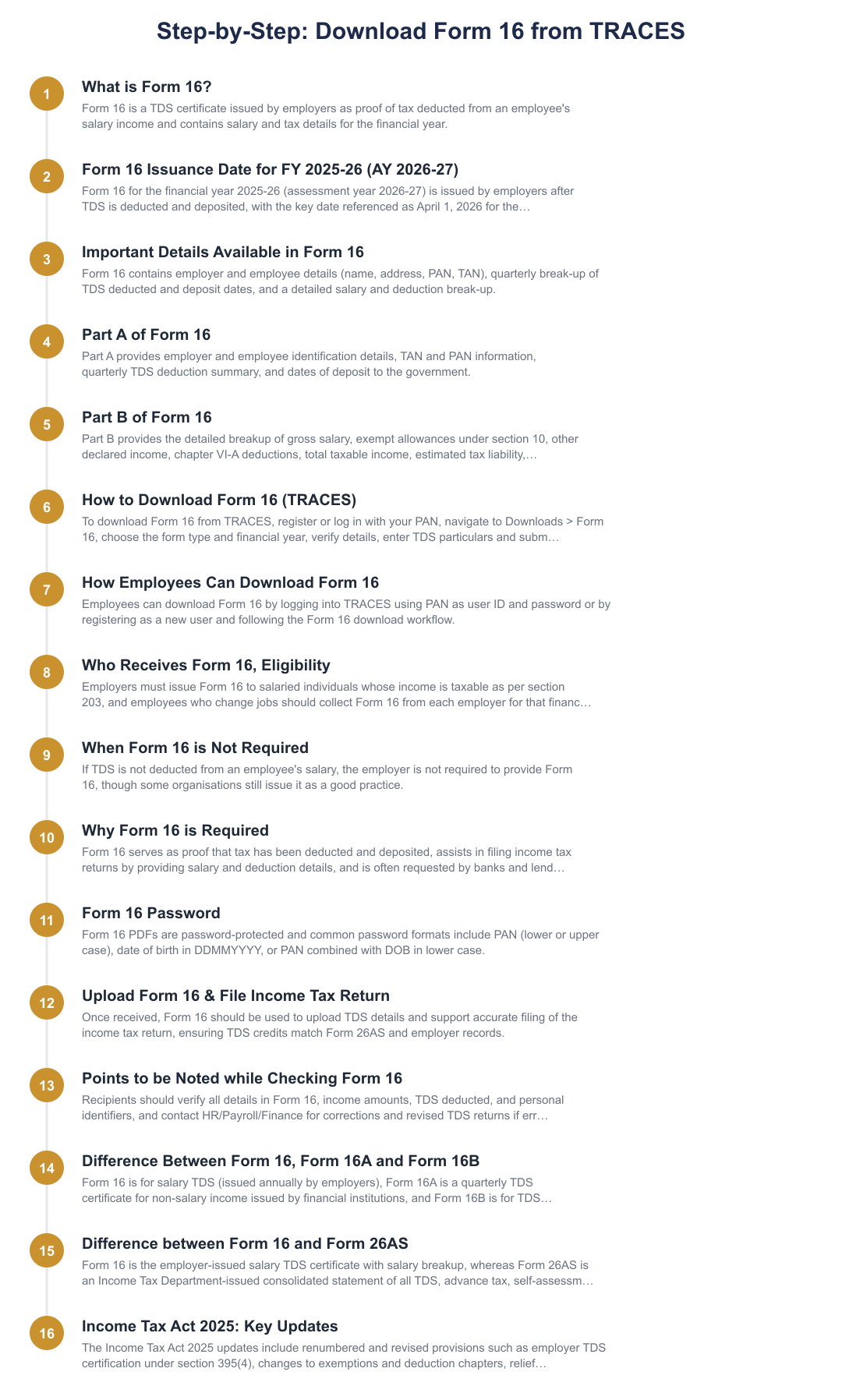
Form 16 is a TDS certificate issued by employers for salary income. It serves as official proof that tax on a taxpayer’s salary has been deducted at source and (implicitly) deposited with the government by the employer.
Form 16 is issued under section 203 of the Income Tax Act, 1961. For a salaried person, it is a key document used while preparing and filing an income tax return, and it is often requested by banks and financial institutions to verify salary credentials during loan or credit applications.
Important Details Available in Form 16
Form 16 is divided into two parts, Part A and Part B, each serving distinct purposes. Part A contains a summary of TDS deductions and identifies both the deductor and deductee. It includes details such as the employer’s TAN and PAN, the employee’s PAN, and a quarterly break-up of TDS deducted along with dates of deposit of monthly TDS.
Part B contains the detailed break-up of salary and the computation of taxable salary. Typical entries in Part B include gross salary (with allowances and perquisites), exempt allowances under section 10, income other than salary declared for TDS purposes, deductions claimed under Chapter VI-A, total taxable income offered for TDS deduction, estimated tax liability and any relief under section 89.
Part A
Part A is the TDS summary section of Form 16 and contains essential identification and TDS deposit details. It records the employer’s name and address, the TAN of the employer, and the PAN of both employer and employee, making it the authoritative record for TDS credits against the employee’s PAN.
It also provides the quarterly break-up of the amount of TDS deducted and the dates on which monthly TDS deductions were deposited. These entries are crucial for reconciling TDS amounts with Form 26AS and ensuring the tax credit appears correctly in the government’s consolidated statement.
Part B
Part B provides a detailed salary computation and the basis on which TDS was calculated. It lists gross salary components, exemptions claimed under section 10, other declared income that was considered for TDS purposes, and deductions under Chapter VI-A such as investments or eligible expenses.
Part B also shows the total taxable income as considered by the employer for TDS, the estimated tax liability (including tax, surcharge and cess as applicable) and any relief claimed under section 89. This breakdown helps employees verify that the correct components were included or excluded while computing TDS on salary.
Who Receives Form 16?
Form 16 is issued when the employee’s income has exceeded the basic exemption limit, in other words, when the employer is required to deduct TDS on salary. Employees should collect Form 16 from every employer they worked for during the financial year if they changed jobs, so that all TDS credits are available for their tax return.
If TDS is not deducted for an employee, the employer is not required to provide Form 16. Some organisations nevertheless provide a certificate as a best practice, but there is no legal obligation to issue Form 16 when no TDS has been deducted.
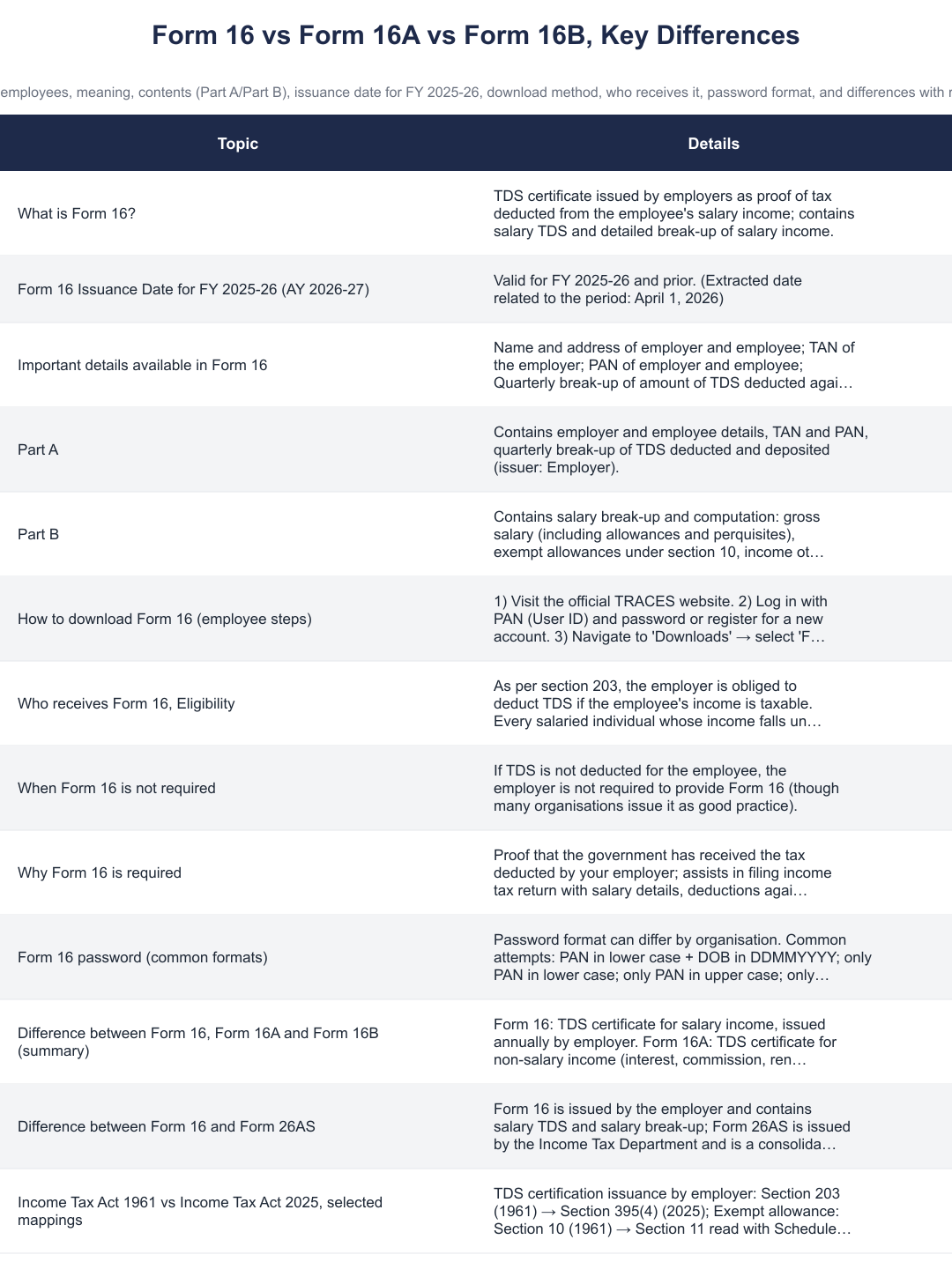
Difference Between Form 16, Form 16A and Form 16B
| Particulars | Form 16 | Form 16A | Form 16B |
|---|---|---|---|
| Description | TDS certificate issued as proof of tax deducted from the employee's salary income. | TDS certificate issued for income other than salary, such as interest income, insurance commission, or rent receipts. | TDS certificate for property purchase under section 194-IA of the Income Tax Act. |
| Who Issues It | Employer | Financial institutions or other deductors | Buyer of property |
| Income Covered | Salary income | Other income (non-salary) where TDS is applicable | Sale of immovable property - land or building |
| Frequency | Issued annually | Issued quarterly | Issued each time the transaction takes place |
Difference between Form 16 and Form 26AS
| Grounds of Difference | Form 16 | Form 26AS |
|---|---|---|
| Meaning | Form 16 is a TDS certificate containing salary TDS and a detailed break-up of salary income. | Form 26AS is a consolidated document issued by the Income Tax Department containing all TDS deducted, advance tax, self assessment tax payments and certain high value transactions. |
| Issuer | Form 16 is issued by the employer | Form 26AS is issued by the Income Tax Department. |
| Importance | Form 16 is a handy document for tax filing and salary verification, though not the only record required for filing returns. | Form 26AS consolidates TDS credits and other tax payments in one place and is used to reconcile whether TDS claimed via Form 16 has been reflected against the PAN. |
| Discrepancies | In case of errors in Form 16, contact your employer to get the certificate corrected; the employer must file a revised TDS return and then issue an updated Form 16. | For discrepancies in Form 26AS, the corrective action typically involves the relevant deductor correcting their TDS return so the department updates the consolidated statement. |
Points to be Noted while Checking Form 16
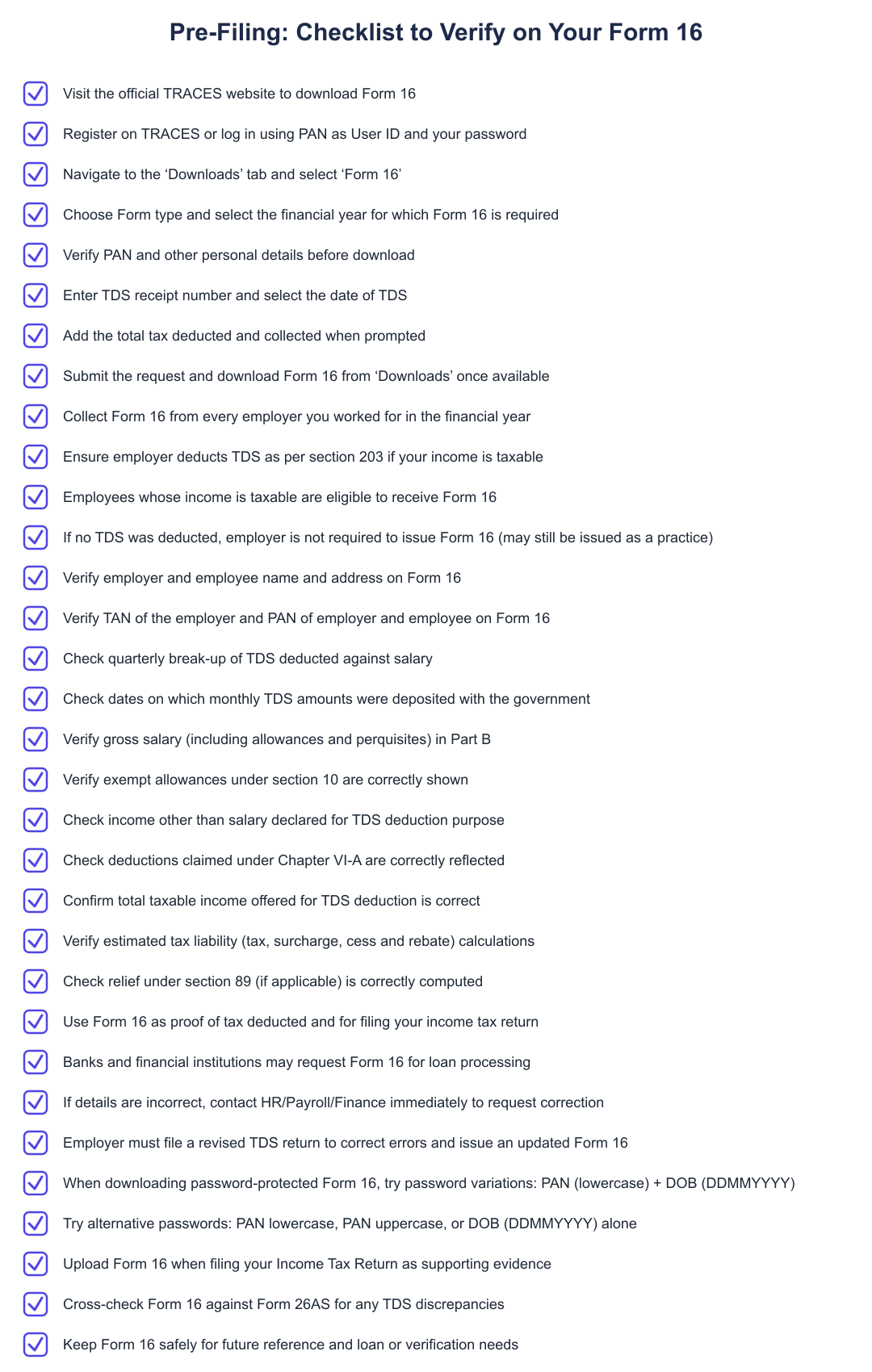
When you receive Form 16, verify key identification data such as employer and employee name and PANs, along with the employer’s TAN. Cross-check the quarterly break-up of TDS deducted and the dates of deposit to ensure amounts align with your records and with Form 26AS when available.
If any detail is incorrect on Form 16, approach your employer’s HR or payroll team to get it corrected. The employer must file a revised TDS return to credit TDS against the correct PAN; once the revised return is processed by the department, the employer will issue an updated Form 16.
Form 16 is the employer-issued TDS certificate for salary income and a key document for salaried taxpayers. Ensure you collect Form 16 from every employer you worked for during the financial year, verify the details against your records and Form 26AS, and request corrections from the employer if any discrepancies are found. Maintaining accurate Form 16s helps in correct tax filing and smooth interactions with banks and other institutions.
Frequently asked questions
What is Form 16 and why do I get it from my employer?
Form 16 is a TDS certificate issued by your employer that shows tax deducted at source from your salary and provides a detailed breakup of your salary and deductions. It is issued under section 203 of the Income Tax Act and is split into Part A (TDS summary with employer/employee PAN and TAN, quarterly TDS deposits) and Part B (detailed salary components, exemptions under section 10, Chapter VI‑A deductions, taxable income and tax computation). You use Form 16 as proof that tax has been deducted and deposited, and it is a key document when filing your income tax return or applying for loans. If you changed jobs during the year, collect Form 16 from each employer you worked for in that financial year.
When should my employer give me Form 16 for FY 2025-26?
Employers normally issue Form 16 after filing the annual TDS return, and most organisations provide it in the months immediately after the financial year ends (typically between May and July following the year). For FY 2025‑26 (assessment year 2026‑27) employees should therefore expect Form 16 sometime in mid‑2026, though exact timing depends on the employer completing and reconciling their TDS returns. If you have not received Form 16 within a reasonable time, contact your HR or payroll team as they must issue it if TDS was deducted. Note that if no TDS was deducted for a given employee, the employer is not legally required to issue Form 16, though many do so as a best practice.
What exactly is included in Part A of Form 16?
Part A of Form 16 contains the TDS summary and identification details: employer and employee name and addresses, TAN of the employer, PAN of employer and employee, period of employment, and quarterly breakup of TDS deducted and dates of deposit. It also includes challan details or the TDS receipt particulars used to deposit the tax with the government. Part A is digitally signed by the employer (or the authorised person) and serves as the official certificate of tax deducted at source on salary.
What information does Part B of Form 16 show?
Part B of Form 16 provides a detailed breakup of your salary income and the tax computation used to arrive at taxable salary: gross salary (all allowances and perquisites), exemptions claimed under section 10, declared income other than salary for TDS purposes, Chapter VI‑A deductions, total taxable income, and the calculated tax liability including surcharge and cess. It also shows relief under section 89 (if any) and the net tax payable or refundable after accounting for TDS. Part B helps you reconcile your salary components with what you report in your income tax return.
How can I download Form 16 if my employer issues it electronically?
If your employer issues Form 16 electronically they typically make it available on TRACES or their payroll portal; employers log in to the TRACES portal (using PAN as user ID) to generate and download Form 16 Part A & B and then provide the file to employees. The TRACES download flow requires selecting form type and financial year, verifying PAN and TDS details, entering challan/TDS receipt information and submitting the request; once processed the certificate appears under Downloads. If you are an employee, you should receive the issued Form 16 from your employer, employees cannot generally download another employer’s Form 16 directly from TRACES without employer credentials.
Who is eligible to receive Form 16 and when is it not required?
Any salaried individual whose income is taxable and on whose salary tax has been deducted at source is eligible to receive Form 16 from the employer, and when you change jobs during the financial year you should collect Form 16 from every employer you worked for. Form 16 is not required where no TDS was deducted by the employer; in such cases employers are not legally bound to issue Form 16, though many still provide a certificate as a courtesy. Also, non‑salary TDS (for example interest, rent) is covered by Form 16A, not Form 16, so you will not get those entries in your salary Form 16.
How do I open a password‑protected Form 16 PDF and what are the common passwords?
Most Form 16 PDFs are password‑protected and can be opened using simple combinations such as your PAN (in upper or lower case), your date of birth in DDMMYYYY format, or PAN (lowercase) concatenated with DOB (DDMMYYYY). Try variants in this order: PAN (lowercase) + DOB, PAN (lowercase), PAN (uppercase), or DOB alone; employers may follow slightly different conventions so check with HR if none work. If the password still fails, ask your employer/payroll for the correct password or an unencrypted copy, since they issued the certificate and can provide access.
Can I upload Form 16 when filing my income tax return and how do I reconcile it?
Yes, you should use the details from Form 16 to prefill and reconcile your income tax return: enter salary breakup, exemptions, Chapter VI‑A deductions and the TDS shown in Form 16 so your ITR matches the TDS deposited on your PAN. Also cross‑verify Form 16 figures with Form 26AS (which shows consolidated TDS, advance tax and self assessment tax payments) to ensure all deducted taxes are correctly credited to your PAN. If you find discrepancies (mismatch in TDS or PAN), contact the employer to get a revised TDS return and updated Form 16 before filing your ITR to avoid tax demand notices.
What key things should I check on my Form 16 for accuracy?
Check that your name, PAN, employer name and TAN, period of employment, gross salary details, exemptions under section 10, Chapter VI‑A deductions, and TDS amounts match your payslips and Form 26AS. Verify quarterly breakup and challan/receipt dates for TDS deposits; if any figures are incorrect (for example wrong PAN or missed TDS credit), immediately inform your employer/HR so they can file a revised TDS return and issue a corrected Form 16. Keep copies of payslips and bank statements as supporting evidence in case you need to resolve discrepancies with the deductor or with the Income Tax Department.
How is Form 16 different from Form 16A and Form 16B, and how does it differ from Form 26AS?
Form 16 is the TDS certificate for salary income issued annually by the employer, whereas Form 16A covers TDS on non‑salary income (like interest or commission) issued quarterly by other deductors, and Form 16B is the TDS certificate issued to the seller when TDS is deducted on immovable property under section 194‑IA. Form 26AS is a consolidated tax statement issued by the Income Tax Department that lists all TDS, advance tax, self assessment tax payments, and high‑value transactions for your PAN, it is not a substitute for Form 16 but should reconcile with it. If discrepancies arise, contact the relevant deductor (employer for Form 16, bank/tenant for Form 16A, buyer for Form 16B) to correct returns so Form 26AS reflects the right credits.
Need help staying Income Tax compliant?
MoneyGence's AI Finance OS tracks your compliance, wallet share, and finances in one place, built for agencies and growing businesses.
Get started with MoneyGence