Form AOC 4 Filing - Due Date, Fees & Penalties Explained
This guide explains the key compliance timelines and filing requirements for Form AOC 4, the e‑form used to file a company’s financial statements and accompanying documents with the Registrar of Companies. You will learn when the financial statements must be filed, which statutory provisions govern timelines and CSR reporting, the minimum certifying information required from auditors, and the segment‑wise details that must be included in the filing. Understanding these points matters because timely and correctly certified filing of financial statements is a primary statutory obligation for companies; missing or incomplete filings can trigger additional fees, late filing consequences and penalties under the Companies Act and Registrar of Companies’ rules. This article focuses on the verified statutory deadlines and filing content requirements that you must follow, highlights special timing for one‑person companies, clarifies how CSR reporting ties into AOC 4 filings, and outlines what auditor information must accompany the form. Where the Companies Act or rules prescribe fees, late fees or penalties, this guide points out those areas and recommends where to confirm specific amounts with the Ministry of Corporate Affairs or a professional adviser.
Who has to file AOC 4?
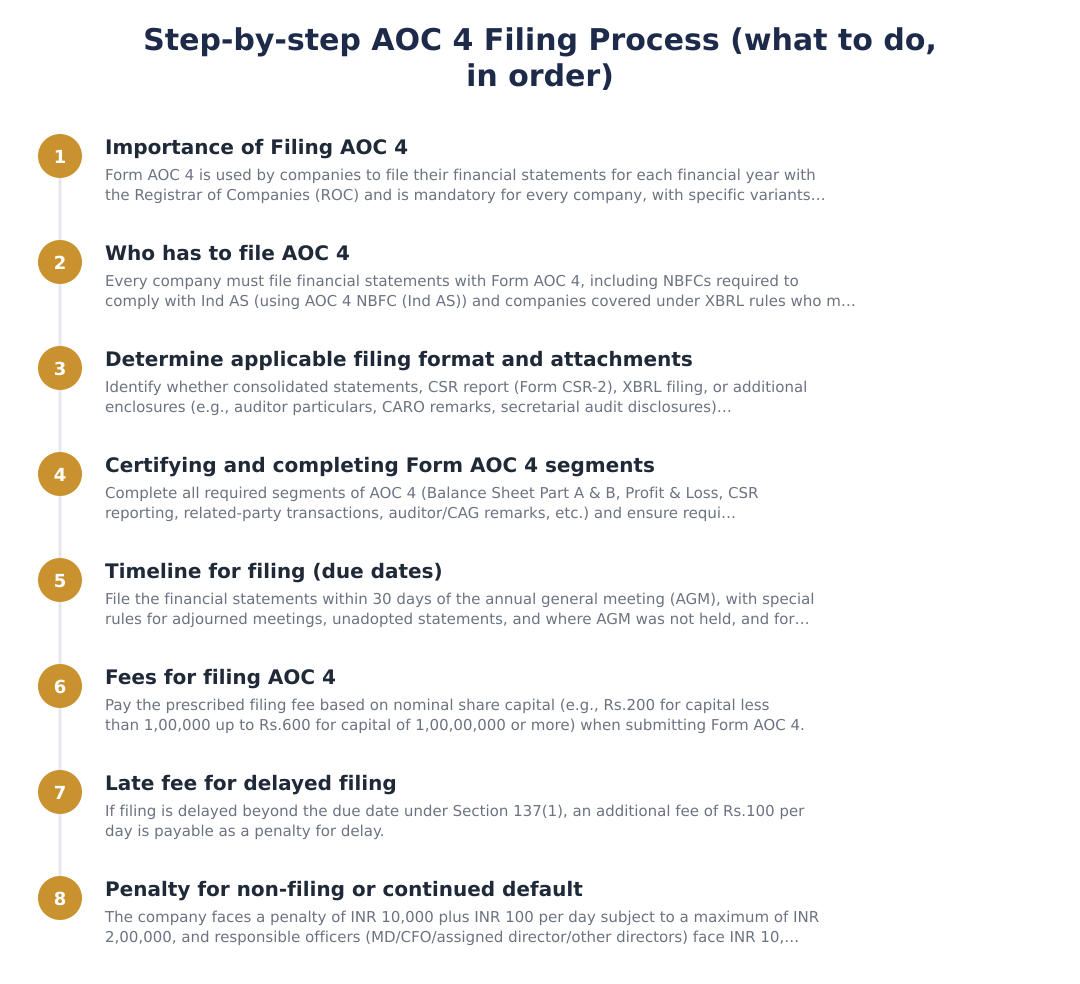
Form AOC 4 is the mechanism for filing a company’s financial statements and the documents attached to those statements with the Registrar. The statutory framework sets out when financial statements must be filed after they are adopted at the annual general meeting.
The legal timelines and obligations for filing are laid out under the Companies Act and associated rules; Section 137(1) specifically provides the due dates for filing AOC 4 (within thirty days of the date of the annual general meeting). Companies should plan board and AGM schedules with this filing timeline in mind to ensure timely submission.
Importance of Filing AOC 4
Filing AOC 4 carries legal significance because it publicly records a company’s financial position and performance for the financial year. The Registrar’s records of filed financial statements are used by regulators, lenders, investors and other stakeholders to assess compliance and financial health.
Timely filing also ensures that statutory disclosures, such as those related to corporate social responsibility and consolidated financial statements where applicable, are formally available in the public domain. Because the Companies Act and its rules prescribe filing timelines, adherence avoids escalation to late fees or penalties administered under the Act and rules.
Points to remember while filing AOC 4
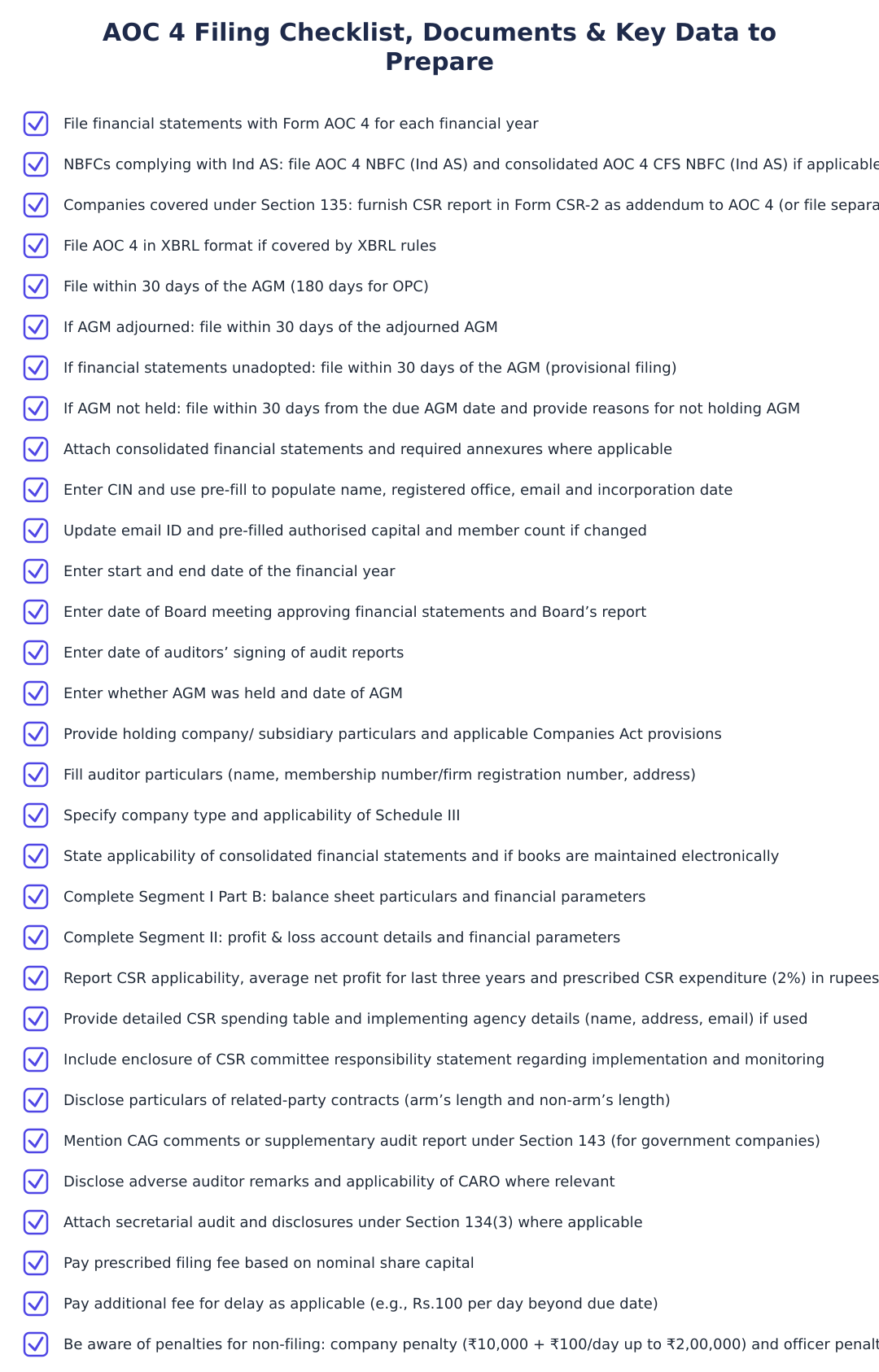
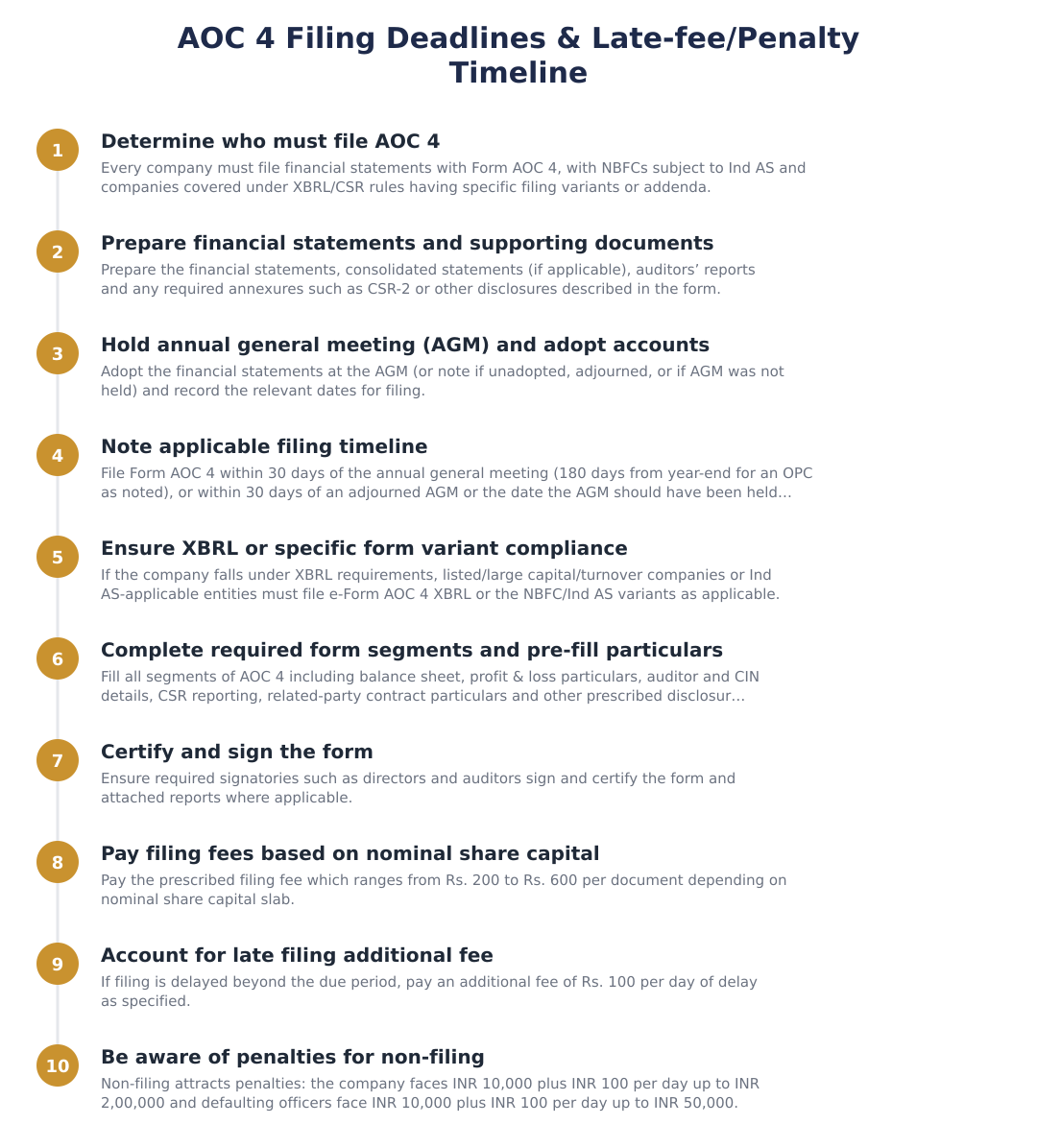
Timing: Financial statements adopted at the AGM, together with any consolidated financial statements and attachments, must be filed within 30 days of the annual general meeting. For one‑person companies (OPCs) a different compliance timing applies: the period shall be taken as 180 days from the closure of the financial year.
CSR reporting and applicability: Companies governed by Section 135 of the Companies Act, 2013 must furnish CSR particulars. The prescribed CSR expenditure is 2% of the average net profit of the company for the last three financial years; CSR disclosures form part of the filings that accompany the financial statements.
Content and segments: AOC 4 requires segment‑wise inputs covering balance sheet particulars (Part A and Part B), profit & loss details, CSR reporting, particulars of related party contracts, and other statutory disclosures. Prepare these sections carefully so that the form captures complete and consistent information.
XBRL and consolidated filings: Where companies fall under XBRL requirements or must prepare consolidated financial statements, ensure the appropriate variant of AOC 4 is used and that consolidated statements and schedules are attached as required.
Certifying Form AOC 4
Certain certifying particulars from the statutory auditor are mandatory in connection with the financial statements filed through AOC 4. The form requires auditor particulars such as the auditor’s name, membership number or the audit firm’s registration number, and the auditor’s address.
The dates of signing of the audit report(s) must also be entered in the filing. Ensuring correct auditor details and signing dates is important because these entries link the financial statements to the statutory audit opinion and are essential for the Registrar’s records.
Fees for filing AOC 4
Filing fees and any additional fees for delayed filing are prescribed under the Companies Act and the Registrar’s rules. The specific fee schedule depends on prescribed limits and classifications set out by the Registrar and should be checked with the Ministry of Corporate Affairs or a professional adviser at the time of filing.
Because fee rules can be updated, always verify the current fee amounts and the applicable fee slab before submission so you include the correct fee in the e‑form and avoid transactional delays.
Late fees on form AOC 4 and Penalty for non-filing
Section 137(1) establishes the due date for filing AOC 4 (within thirty days of the AGM), and the Act and rules provide for additional fees or late filing consequences where filings are delayed beyond the prescribed period. The exact additional fee per day or other late fee mechanics are prescribed under the Registrar’s rules.
In cases of continued non‑filing, the Companies Act provides for penalties and enforcement mechanisms. Because the Act and rules define the nature and quantum of penalties, consult the Ministry of Corporate Affairs, the ROC’s guidance or a qualified professional for the precise penalty provisions that would apply to a specific non‑filing scenario.
Timely and accurate filing of AOC 4 is a core statutory responsibility. Key points to keep in mind are the due date under Section 137(1), the extended timeline applicable to OPCs, the CSR reporting linkage under Section 135 with the 2% prescribed expenditure metric, the auditor certifying particulars that must be entered, and the segment‑wise information that AOC 4 captures. For current fee amounts, late fee rates and penalty figures consult the Ministry of Corporate Affairs portal or your professional adviser before filing.
Frequently asked questions
Who is required to file Form AOC 4 with the Registrar of Companies (ROC)?
Every company must file financial statements with Form AOC 4 with the ROC; specific variants apply to certain entities (for example, NBFCs complying with Ind AS must use AOC 4 NBFC (Ind AS) and consolidated statements use AOC 4 CFS NBFC (Ind AS)). Companies covered under Section 135(1) (CSR) must attach Form CSR-2 as an addendum to AOC 4 (or file CSR-2 separately for FY 2021–22 by 31 March 2023 after filing AOC 4). Companies required to file in XBRL must use AOC 4 XBRL where applicable (see XBRL applicability).
What is the due date for filing Form AOC 4 after the Annual General Meeting (AGM)?
Form AOC 4 must be filed within 30 days of the annual general meeting (AGM) along with the prescribed fees and any additional fees. For One Person Companies (OPCs), the time period is treated as 180 days from the close of the financial year instead of the usual 30 days. If the AGM is adjourned, AOC 4 should be filed within 30 days of the adjourned AGM; if the AGM was not held, the statements must be filed within 30 days from the date the AGM should have been held with reasons for not holding the AGM.
How much is the ROC filing fee for Form AOC 4 based on nominal share capital?
The ROC filing fee for AOC 4 varies by nominal share capital: less than Rs 1,00,000 – Rs 200 per document; Rs 1,00,000–4,99,999 – Rs 300; Rs 5,00,000–24,99,999 – Rs 400; Rs 25,00,000–99,99,999 – Rs 500; and Rs 1,00,00,000 or more – Rs 600 per document. These are the standard fees applicable at the time of filing and must be paid along with the form. Additional fees for late filing (if applicable) are payable separately as prescribed.
What is the additional late fee if Form AOC 4 is filed after the due date?
If Form AOC 4 is filed after the period provided under Section 137(1) (i.e., beyond 30 days of the AGM), an additional fee of Rs 100 per day is payable for the delay. The daily additional fee accrues from the date after the due date until filing, so the total additional fee equals Rs 100 times the number of delayed days. This additional fee is separate from any penalties that may be imposed for non-filing under the Companies Act.
What penalties apply if a company defaults in filing Form AOC 4?
For a defaulting company, the penalty is Rs 10,000 for continuing failure plus Rs 100 for each day of default subject to a maximum of Rs 2,00,000. For responsible officers (Managing Director/CFO or another director assigned by the board, or if none, all directors), the penalty is Rs 10,000 plus Rs 100 for each day of default subject to a maximum of Rs 50,000. Penalties begin from the date of default and continue until compliance, so timely filing is important to avoid cumulative fines.
Which companies must file AOC 4 in XBRL format?
Companies required to file financial statements in XBRL include: all companies listed with any Indian stock exchange and their Indian subsidiaries; companies with a capital of Rs 5 crore or above; companies with a turnover of Rs 100 crore or more; and companies required to prepare financial statements under the Companies (Indian Accounting Standards) Rules, 2015. These companies must upload their financial statements and related documents in the AOC 4 XBRL format when filing with the ROC. Non-applicability to a company means it can file the standard AOC 4 or other applicable variant.
What key details and documents should I prepare before filing AOC 4?
Before filing AOC 4 you should have: the company’s CIN, start and end dates of the financial year, date of board approval of financial statements, date of auditors’ signing of audit report, AGM details, auditor particulars (name, membership/firm registration number, address), and particulars of holding/subsidiary companies where applicable. You must also attach the audited financial statements, board’s report, consolidated statements (if applicable), and CSR report (Form CSR-2) where required; companies covered by XBRL rules must prepare the XBRL instance documents. Correctly indicate applicability of Schedule III, CARO remarks, secretarial audit applicability and provide disclosures on related-party contracts and CSR expenditure details.
Who needs to certify and sign the information in Form AOC 4?
Form AOC 4 requires disclosure of the board meeting date approving the financial statements and the date of signing of the auditors’ report, and the financial statements must be signed as required under the Companies Act; auditor details and their signing date must be entered in the form. The statutory auditors sign the audit report attached to AOC 4, and directors (and the company secretary where applicable) sign the financial statements and board’s report before filing. Accurate dates and signatory details are essential because the form pre-fills certain data (CIN, registered office, incorporation date) and any change in email or other particulars should be updated before submission.
Need help staying Compliance compliant?
MoneyGence's AI Finance OS tracks your compliance, wallet share, and finances in one place, built for agencies and growing businesses.
Get started with MoneyGence