Form MSME-1 V3: New Compliance Triggers & Filing Guide
This guide explains the practical compliance risks that arise with the new MSME-1 (V3) reporting environment and shows how buyers and sellers can avoid surprise exposures. You will learn to recognise the common “hidden” triggers that convert routine supplier payments into regulatory filings, how internal systems should be adjusted to detect these triggers early, and pragmatic steps teams can take before and after filing to preserve commercial and legal positions. While the technical form and filing mechanism may evolve, the compliance landscape increasingly emphasises supplier-level transparency, vendor classification, and timely ageing of payables. That means even a single qualifying delayed payment can generate reporting obligations or stakeholder scrutiny. This piece is aimed at finance leaders, compliance owners, company secretaries, and accounting teams in businesses that deal with micro, small and medium suppliers. It focuses on controls, workflows and documentation practices you can implement immediately, without waiting for external advisories, to reduce reporting surprises, maintain good vendor relationships, and limit escalation risk. Read on for a clear breakdown of where processes commonly break down, a stepwise implementation checklist for accounting and ERP teams, and a practical vendor-reconciliation routine you can adopt at half-year close.
Why MSME-related reporting creates hidden triggers
Regulatory reporting that targets buyer–supplier payment relationships shifts attention from aggregate liabilities to discrete supplier-level records. In practice, that means your vendor ledger entries, ageing buckets and master data become the primary source documents for compliance. Processes that were previously internal bookkeeping matters can therefore become reportable events when they meet the criteria defined by the regulator.
Hidden triggers often arise from routine operational gaps: an unrecognised vendor classification, an incorrectly recorded invoice date, or a missed adjustment in the ageing schedule. Such small data errors can convert an otherwise immaterial delay into a reportable one. For this reason, the way you capture and maintain vendor metadata, like status, identifiers and contract terms, is as important as the payment itself.
Beyond data quality, organisational handoffs are often the weakest link. Purchase, accounts payable and treasury teams may each hold part of the story for a payment; if workflows don’t reconcile these views, reporting obligations get overlooked until the half‑year or year‑end. Ensuring single-source truth and clearly assigned ownership helps prevent surprises.
Finally, transparency in vendor communications mitigates reputational and commercial risks. When suppliers are aware of classification checks and reporting timelines, disputes over ageing or payment status can be resolved before they become compliance incidents.
Common operational scenarios that trigger a filing
A frequent scenario is a reconciliation gap between purchase records and accounting entries. For example, goods received notes or service completion confirmations may not be matched to supplier invoices promptly; this delay propagates into ageing reports and can create a trigger at reporting time. Routine monthly matching and exception clearing reduce this exposure.
Another scenario is vendor master data discrepancies. Missing or inaccurate supplier identifiers or certificates can cause a supplier to be treated differently in reports than intended. Keeping a centralised and validated master database prevents misclassification and the need for corrective filings.
Intercompany arrangements and third‑party payments are also a source of complexity. When payment responsibility or contract ownership is ambiguous, recordkeeping sometimes fails to reflect the true contractual counterparty. Clear allocation of obligations and documentation of intercompany cross‑charges avoids confusion during report preparation.
Finally, one-off settlements, credit notes or disputed invoices that are not reflected correctly in ageing tables can create false positives in compliance checks. A robust process for applying adjustments and notifying counterparties preserves an accurate compliance record.
Stepwise checklist to prevent surprise filings
Create a single validated repository for supplier identifiers and classification so all teams reference the same source of truth.
Use your finance system to auto‑match invoices to POs and receipt records, and maintain real‑time ageing that flags exceptions for review.
Ensure disputes, credit notes and settlements are applied to the ledger promptly and documented, with timelines for resolution.
Run reconciliations with critical suppliers at regular intervals to confirm outstanding balances and prevent surprises at reporting time.
Designate accountable roles for vendor onboarding, data changes, and final sign‑off on half‑year reports to ensure accountability.
Maintain copies of purchase orders, delivery proofs, payment authorisations and correspondence to support reported figures if queried.
Vendor reconciliation routine to adopt at period close
A concise vendor reconciliation routine reduces the effort needed for period‑end reporting and ensures reliable disclosures. Begin by generating a supplier‑wise ageing report from your ledger and cross‑check it against purchase and GRN records for the same period. Resolve mismatches by tracing to source documents rather than adjusting ageing without support.
Next, confirm vendor identifiers and classification with each supplier, and request any outstanding certificates or registration numbers. Where a supplier disputes a balance, document the position and the steps being taken to resolve it so that the report reflects the disputed nature rather than an unqualified outstanding amount.
If automated systems feed your report, validate the mappings that translate ledger fields into report fields. Simple mapping errors, such as using payment date instead of invoice date, can distort ageing and create avoidable compliance events.
Finally, before finalising the period report, conduct an internal sign‑off where the responsible finance officer certifies the reconciliation and a senior officer reviews for completeness. This sign‑off trail strengthens the company’s position in case of follow‑up queries.
Responding to filings and managing post‑report risk
If a filing is required or has been made, proactive communication with the affected suppliers helps manage commercial fallout. Sharing reconciliations and evidence of payments or disputes reduces the chance of escalations and preserves supplier relationships.
Maintain a remediation log for any issues identified during report preparation, detailing root cause, corrective action, owner and timeline. This demonstrates a systematic approach to regulators or counterparties and helps prevent recurrence.
Where reporting exposes potential contractual non‑compliance or interest claims, engage commercial and legal teams early to evaluate options. Timely remedial payments, negotiated settlements or documented dispute positions are preferable to defensive stances that prolong uncertainty.
Finally, treat each reporting cycle as an opportunity to refine controls. Use the findings from reconciliations and remediation to update process documentation, training materials and system validations so future cycles require less firefighting.
Modern supplier‑level reporting emphasises data accuracy, process ownership and timely reconciliation. By centralising vendor data, automating matching and ageing, documenting disputes, and enforcing an internal sign‑off routine, organisations can avoid most hidden compliance triggers and reduce post‑filing risk. Implement the checklist above ahead of your next reporting cycle to convert compliance from a reactive burden into a predictable process.
Frequently asked questions
What exactly triggers the requirement to file Form MSME-1 (V3)?
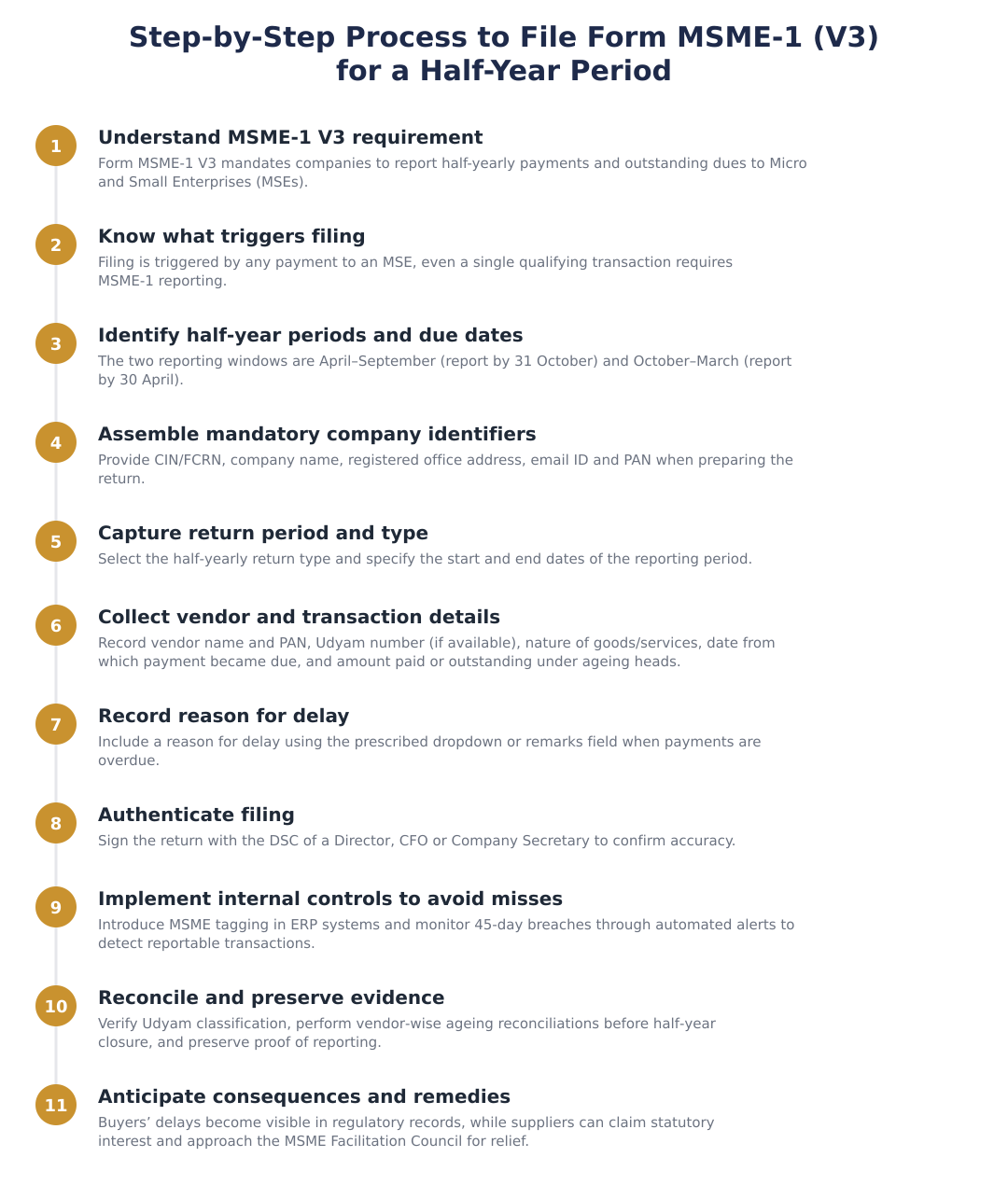
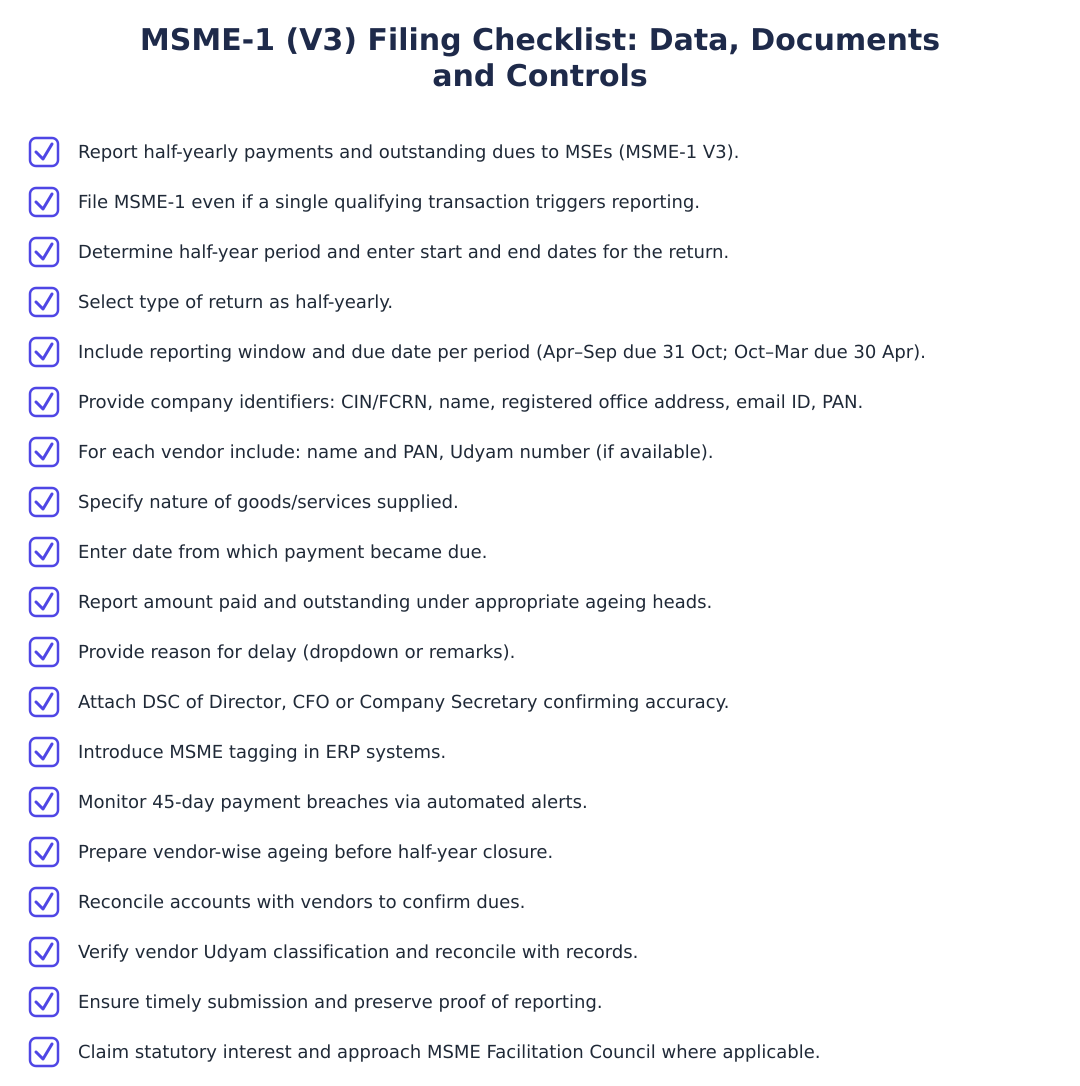
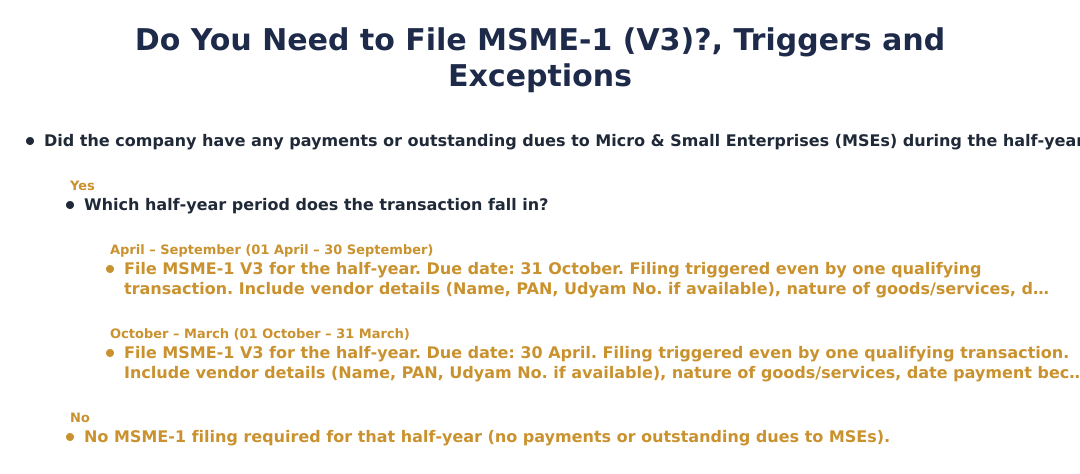
Any payment or outstanding dues to a Micro or Small Enterprise (MSE) during the half-year triggers the requirement to file Form MSME-1 (V3). The filing is mandatory even if there is a single qualifying transaction in the reporting period and covers amounts paid and amounts outstanding as on the reporting cut-off date. This means buyers must track supplier payments and ageing and report vendor-wise details such as PAN, Udyam number (if available), nature of goods/services, date from which payment became due, and amounts under appropriate ageing heads. Non-reporting can make delays visible to authorities and to suppliers, and may lead to enforcement actions under the MSMED Act and MCA reporting directions.
Who within the company must sign and submit Form MSME-1 (V3)?
Form MSME-1 (V3) must be certified and submitted with the digital signature (DSC) of a Director, CFO or Company Secretary. The DSC confirms the accuracy of the information such as CIN/FCRN, PAN, vendor details, amounts paid and outstanding, and the reason for delay where applicable. Companies should ensure the authorized signatory has access to the registered account on the MCA portal and that vendor-wise reconciliations are completed before affixing the DSC. Small lapses in authorization or missing DSC can render the filing invalid and expose the company to follow-up queries or notices.
What is the reporting period and due date for MSME-1 (V3) filings?
MSME-1 (V3) is a half-yearly return with two reporting windows: April–September (reporting window 01 April – 30 September) due by 31 October, and October–March (01 October – 31 March) due by 30 April. Companies must report all qualifying payments and outstanding amounts that pertain to the relevant half-year ending date. Late filings can be scrutinized and make defaults visible to regulatory and dispute-resolution bodies, so companies should calendar these due dates and reconcile vendor balances well before the cut-off. Practical steps include preparing vendor-wise ageing and collecting Udyam certificates ahead of the reporting deadline.
What vendor-level details must be included in Form MSME-1 (V3)?
Form MSME-1 (V3) requires vendor-level details including vendor name and PAN, Udyam registration number (if available), nature of goods or services supplied, date from which payment became due, amount paid during the period, and outstanding amount under prescribed ageing heads. The form also captures a reason for delay via a dropdown or remarks field and requires accurate classification of amounts into the correct ageing buckets. Accurate vendor-wise data is essential because even one misreported supplier can trigger follow-up inquiries and may affect statutory interest claims under the MSMED Act for the supplier. Companies should reconcile with supplier statements and ERP data before filing to avoid errors.
Does reporting in Form MSME-1 (V3) mean the buyer automatically owes interest to the MSME?
Reporting in MSME-1 (V3) does not itself create or negate the buyer's liability to pay interest; statutory interest under Sections 15–23 of the MSMED Act arises when payment exceeds the 45-day timeline and is governed by law and judicial precedents. Courts (e.g., Shanti Conductors, Gujarat State Civil Supplies, Rashtriya Ispat) have held that interest is automatic, mandatory, and cannot be contractually excluded, so reporting simply makes delayed payments visible and can support the supplier's claim. Buyers should therefore reconcile dues promptly and, where delays exist, be prepared for possible claims for interest and approaches to MSME Facilitation Councils. If there is a bona fide dispute about quality or quantity, such invoices should be clearly documented and reconciled as part of the MSME-1 filing to reduce exposure.
Are there any exceptions to filing MSME-1 for companies with no outstanding dues?
If a company has no payments or outstanding dues to MSE suppliers during the half-year, it is not required to file MSME-1 for that period. The filing obligation is triggered only by the existence of payments or outstanding amounts to Micro or Small Enterprises in the reporting half-year. However, companies should still maintain internal records and vendor reconciliations to demonstrate that no qualifying transactions occurred, because even a single qualifying transaction missed from internal checks would require filing. Conservative practice is to run an ERP/Master Vendor check before the reporting window closes to confirm nil report status.
How can companies prevent unexpected MSME-1 triggers using ERP and processes?
Companies can prevent unexpected MSME-1 triggers by tagging MSME suppliers in ERP, enabling automated alerts for payments breaching the 45-day statutory timeline, and maintaining vendor-wise ageing reports that feed into half-year reporting. Practical controls include annual collection of Udyam certificates, periodic reconciliation with supplier statements, and a workflow that flags disputed invoices separately so they are reported correctly. Even one qualifying transaction triggers MSME-1, so automation and periodic reviews reduce the risk of last-minute compliance surprises and potential interest exposure. Implementing these measures also helps in preparing accurate vendor-level disclosures required in the form.
What penalties or regulatory consequences follow non-compliance with MSME-1 (V3)?
Non-compliance with MSME-1 (V3) can lead to regulatory scrutiny, visibility of defaults to authorities, and may strengthen a supplier’s claim for statutory interest and enforcement through MSME Facilitation Councils or courts. While the MCA order mandates reporting and the MSMED Act prescribes interest remedies, failure to report may attract follow-up notices and reputational harm rather than a fixed monetary penalty under the filing mandate itself; however, related statutory consequences like interest claims under MSMED can still be enforced against the buyer. Companies should treat non-filing as a compliance risk, retain supporting documentation, and rectify omissions promptly to limit exposure to legal proceedings or administrative action. Regular internal audits and timely filings mitigate these risks.
How should a company report invoices that are under genuine dispute in MSME-1 (V3)?
Invoices under genuine dispute should still be included in MSME-1 (V3) with appropriate classification and a clear reason for delay entered in the remarks or dropdown, distinguishing them from simple payment delays. The form allows the reporting of the reason for delay, so companies must document the dispute, the nature of disagreement, and any supporting correspondence to substantiate the entry. Including disputed invoices avoids under-reporting and demonstrates the buyer’s position; suppliers can still pursue statutory remedies, but documented disputes can be material in adjudication. Best practice is to reconcile disputed items with suppliers before filing and maintain evidence of the dispute resolution process.
Need help staying MSME compliant?
MoneyGence's AI Finance OS tracks your compliance, wallet share, and finances in one place, built for agencies and growing businesses.
Get started with MoneyGence