FSSAI Perpetual License Validity: Renewal System Abolished (2026)
This guide explains the recent FSSAI shift from a fixed-term licence renewal model to a perpetual-validity framework and what it means for food business operators (FBOs). You will learn how perpetual validity changes the administrative rhythm of compliance, which routine obligations remain unchanged despite the removal of renewal applications, and practical steps businesses should take to stay compliant and avoid unintended suspension. The article also outlines how this regulatory change affects multi-location operations, the role of annual fees and compliance reporting, and how risk-based inspections and third-party audits fit into the new landscape. Whether you run a small food outlet, a multi-state manufacturer, an importer, or a food e-commerce platform, understanding the operational and documentary consequences of perpetual licence validity is essential. This guide avoids technical jargon and focuses on what proprietors, compliance teams and accountants need to do differently, and what remains the same. It also highlights common misconceptions and answers frequently asked practical questions so you can update your internal compliance checklists, advise clients accurately, and prepare for inspections or audit requests under the new regime.
What perpetual licence validity means in practice
Perpetual licence validity means that once issued, a licence does not expire on a fixed term in the way renewals traditionally worked. Practically, this removes the repeated administrative step of submitting a renewal application at fixed intervals, and reduces the risk of missing renewal windows that previously could lead to non-compliance notifications.
However, perpetual validity does not eliminate oversight. Regulatory frameworks that move to a perpetual model generally retain mechanisms to suspend, cancel or require surrender of licences where compliance failures or risks are identified. Business operators should therefore treat perpetual validity as a reduction in paperwork burden, not as an end to regulatory accountability.
What obligations remain annual or ongoing
Even without a renewal application, many of the day-to-day compliance obligations continue to be annual or ongoing. These typically include periodic fee payments, submission of compliance reports, and maintaining records that inspectors or auditors may review. Missing these recurring obligations can trigger administrative actions under most regulatory systems.
Organisations should incorporate these continuing obligations into their calendar and accounting processes so that fee payments and reports are not overlooked simply because the formal renewal form has been removed. Treating the licence as perpetual means internal controls must still ensure that all recurring filings and payments are completed on time.
Multi-location operations and licence coverage
A perpetual licence does not change the fundamental rule that each distinct premises or regulated activity typically requires its own registration or licence. Businesses expanding into new locations should continue to secure the appropriate permission for each new premise rather than relying on an existing licence to cover additional sites.
Compliance teams should map licences to physical sites and activities in their asset register, and ensure any new outlets, factory units, warehouses or separate points of sale are correctly recorded and licensed under the applicable process for new registrations.
Risk-based inspections and third-party audits
Regulatory authorities often move towards risk-based inspection regimes alongside changes in licensing to focus resources where the public health risk is greatest. Under such an approach, inspection frequency and intensity are determined by factors like the nature of the food product, compliance history and audit outcomes, rather than by licence renewal dates.
Authorities may also direct businesses to undergo third-party audits in selected circumstances. FBOs should be prepared to facilitate such audits, maintain transparent records and be ready to act on corrective action plans emerging from audit findings.
Practical steps for businesses after the change
Update internal compliance calendars to track recurring obligations such as periodic fee payments and mandatory reports. Ensure your accounting and operations teams have clear responsibilities and reminders so that absence of a renewal form does not lead to missed compliance actions.
Review licensing coverage for each premise and activity, prepare for risk-based inspections by improving documentation and traceability, and be ready to engage independent auditors if directed. Communicate the changes to staff and service providers so everyone understands that perpetual validity reduces paperwork but not regulatory risk.
Perpetual licence validity is an administrative simplification that reduces the need for repeat renewal applications, but it does not remove recurring obligations or the possibility of enforcement action. Businesses should treat the change as an opportunity to streamline processes while strengthening calendar controls, documentation and readiness for inspections or audits. Taking a proactive approach will ensure you benefit from reduced paperwork without increasing regulatory risk.
Frequently asked questions
What does 'perpetual license validity' under FSSAI mean for food businesses?
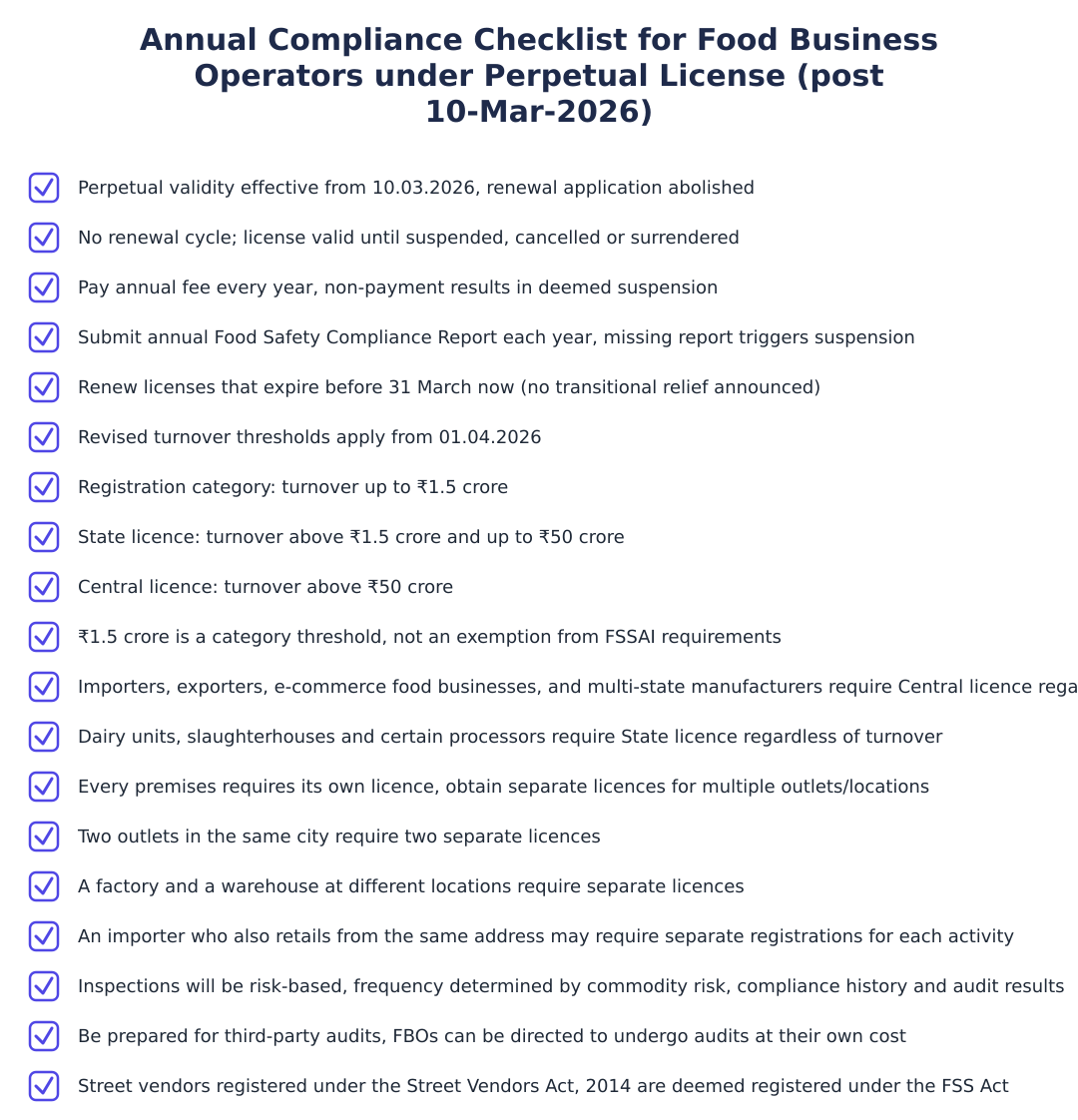
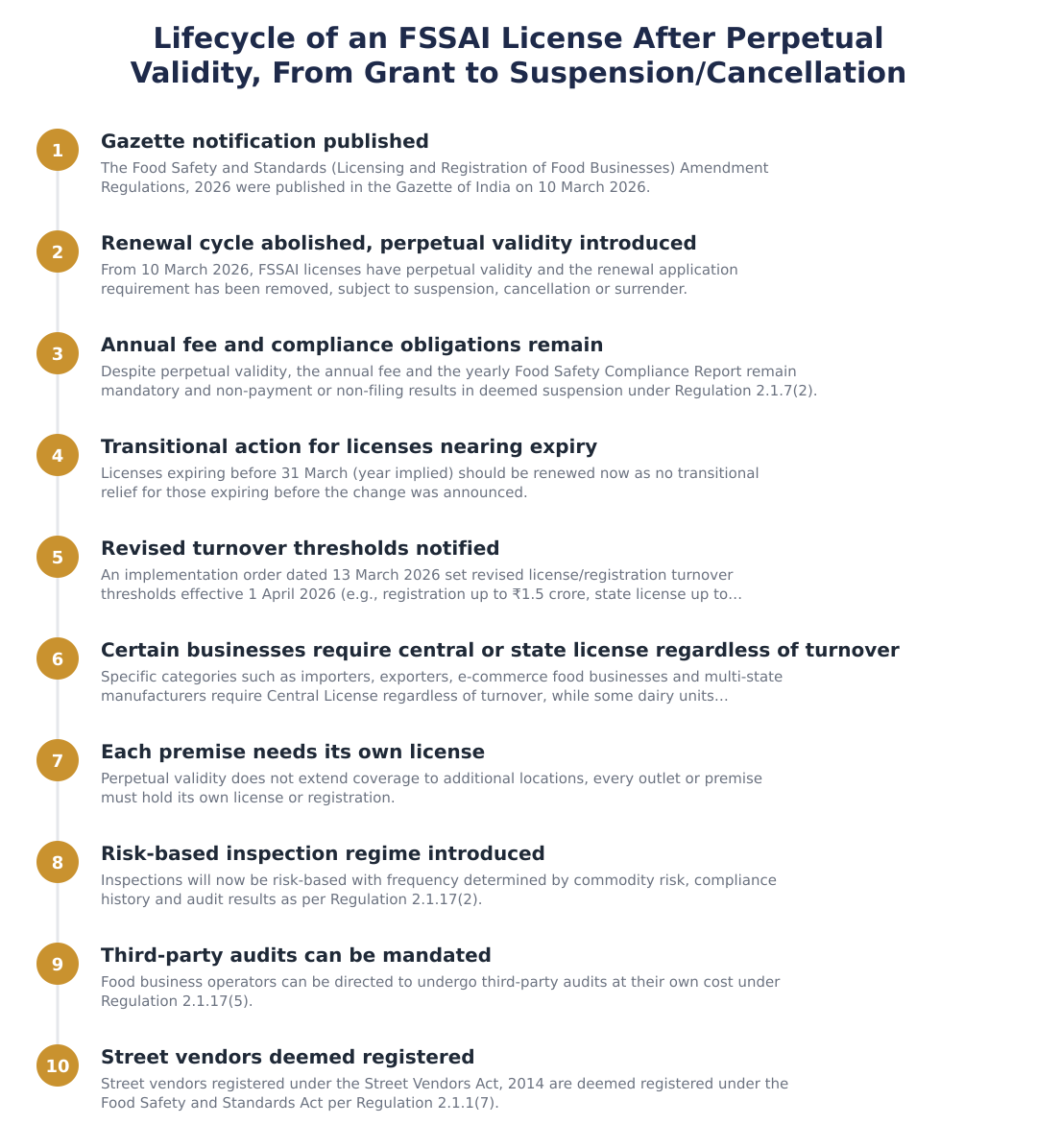
Perpetual license validity means FSSAI licences no longer require periodic renewal and remain valid indefinitely until they are suspended, cancelled or surrendered. The change came into force on 10 March 2026 under the Food Safety and Standards (Licensing and Registration of Food Businesses) Amendment Regulations, 2026, so businesses do not need to file a renewal application anymore. However, perpetual validity only removes the renewal application cycle, annual compliance obligations such as payment of the annual licence fee and filing of the Food Safety Compliance Report remain mandatory and failure to comply leads to automatic suspension. Also, a licence still applies only to the premises and business activities declared; it does not automatically cover new locations or additional activities.
Do I still have to pay the annual fee after perpetual validity was introduced?
Yes, annual fee payment remains mandatory even after perpetual validity was introduced, and non-payment of the annual fee results in the licence being deemed suspended. Regulation 2.1.7(2) explicitly treats non-payment as suspension, so businesses must continue to pay on the scheduled due date to maintain active status. The perpetual regime removed the renewal application but preserved the annual fee and the annual Food Safety Compliance Report obligations, so missing either triggers automatic suspension until rectified. In practice the yearly deadlines and compliance checks therefore still matter even though you no longer file a renewal application.
If my FSSAI licence is suspended for non-payment, how do I restore it?
A licence suspended for non-payment of the annual fee must be restored by paying the outstanding fee and complying with any conditions imposed by the licensing authority; suspension under Regulation 2.1.7(2) is automatic but restoration requires rectification. The regulations retain administrative powers for the authority to demand compliance steps or impose penalties before reinstatement, so contact the issuing authority promptly to learn any additional formalities. Note that suspension differs from cancellation, cancellation may require a fresh application or appeals, while suspension is normally lifted once statutory defaults are cured and any stipulated penalties are paid. Keep records of payment and compliance filings (like the Food Safety Compliance Report) to avoid repeated suspension cycles.
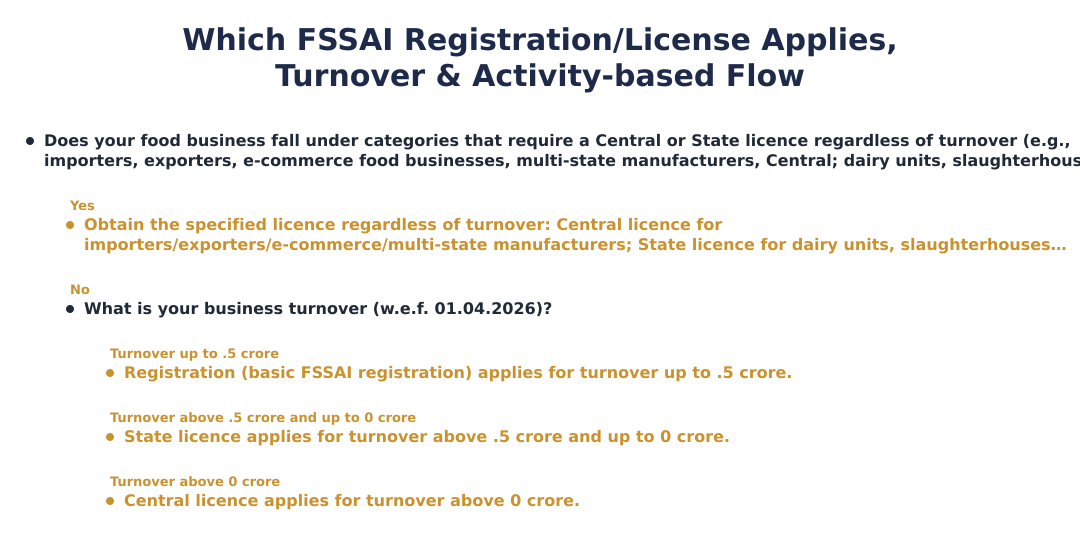
Have turnover thresholds for registration and licences changed from April 2026?
Yes, revised turnover thresholds came into effect from 1 April 2026: Registration category is for turnover up to ₹1.5 crore, State Licence for turnover above ₹1.5 crore and up to ₹50 crore, and Central Licence for turnover above ₹50 crore. This implementation order was issued on 13 March 2026 and adjusts which category of licence a food business operator (FBO) must obtain based on aggregate turnover. Certain categories remain irrespective of turnover, for example, importers, exporters, e‑commerce food businesses and multi‑state manufacturers require a Central Licence regardless of turnover, and some entities like dairy units or slaughterhouses are state-licence mandated regardless of turnover. Always apply the threshold to aggregate turnover as defined in the regulations when deciding licence type.
Does perpetual validity cover multiple outlets or new business locations automatically?
No, perpetual validity does not extend coverage to additional outlets or new locations; every premises requires its own licence or registration. The regulation and guidance clarify that each separate premise or distinct business activity needs individual licensing, so opening a second outlet or warehouse will trigger a separate licence requirement. Examples provided include two outlets in the same city needing two licences and a factory and warehouse in different cities requiring separate licences. You must apply for the appropriate licence type for each new location even though existing licences remain perpetually valid for the declared premises.
What transitional steps should I take if my licence was due to expire before 31 March 2026?
If your licence was expiring before 31 March 2026 you should proactively complete the renewal now because no transitional relief was announced when perpetual validity was introduced. Although perpetual validity came into force on 10 March 2026, the amendment did not create explicit relief for licences already nearing expiry, so renewals completed before expiry avoid unintended suspension. If you miss the renewal deadline and your licence lapses, you'll be subject to the ordinary suspension/cancellation rules and must coordinate with the licensing authority to restore compliance. Keep evidence of submissions and payments in case of administrative queries arising from the regulatory transition.
How have inspections and audits changed under the new FSSAI rules?
Inspections have moved to a risk‑based regime where frequency is driven by commodity risk, compliance history and audit results rather than calendar renewals. Regulation 2.1.17(2) prescribes inspection frequency based on the risk profile of the food and the operator’s past compliance, so high‑risk commodities and poor compliance histories get more frequent checks. The amended rules also allow licensing authorities to direct third‑party audits at the FBO’s cost under Regulation 2.1.17(5), which can be ordered based on inspection findings or as a condition of licence status. Maintain robust compliance records and respond promptly to inspection notices to avoid escalations like suspension or mandatory third‑party audits.
Are street vendors affected by the new perpetual validity rule under FSSAI?
Street vendors registered under the Street Vendors (Protection of Livelihood and Regulation of Street Vending) Act, 2014 are deemed registered under the Food Safety and Standards Act and benefit from the continuity provided by perpetual validity. Regulation 2.1.1(7) confirms deemed registration for street vendors, so they do not need a separate FSSAI registration process and their status continues subject to compliance obligations. However, they must still adhere to annual compliance requirements (where applicable) and local FSSAI monitoring, deemed registration does not exempt them from safety standards or enforcement actions like suspension for non-compliance. Local municipal or licensing conditions may also apply in addition to FSSAI rules.
Can FSSAI order third-party audits and who bears the cost?
Yes, under the amended regulations FSSAI can direct food business operators to undergo third-party audits and the cost of such audits is payable by the FBO. Regulation 2.1.17(5) allows licensing authorities to order independent audits based on risk indicators, inspection findings or compliance history to verify food safety systems and records. The audit results may influence enforcement actions, licence conditions, or frequency of future inspections, so cooperation and timely remediation are important. FBOs should budget for potential audit costs as part of their compliance expenditure, particularly if they operate in higher-risk segments or have prior compliance issues.
Need help staying Compliance compliant?
MoneyGence's AI Finance OS tracks your compliance, wallet share, and finances in one place, built for agencies and growing businesses.
Get started with MoneyGence