Future Value Calculator, Calculate Investment Future Value Online
A future value calculator helps you estimate what an investment made today (or in regular instalments) could become at a chosen point in the future. This guide explains the concept of future value, how online calculators arrive at their results, practical guidance on using these tools, and the benefits they offer for planning savings and investment goals. You will learn what inputs matter, how compounding changes outcomes over time, and how to interpret the results to make better financial decisions. Whether you are saving for a specific goal, comparing instruments, or simply trying to understand the power of time and returns, understanding future value is central to sound planning. This page focuses on the conceptual side of future value calculators and how to use them effectively so you can apply the output to real-world choices about saving, investing, and goal-setting.
What is Future Value?
Future value is the estimated amount an investment will grow to at a specified time in the future, assuming a particular rate of return and a pattern of contributions. It captures the combined effect of the original capital, any additional periodic contributions, and the earnings those amounts generate over time. The idea demonstrates how money has the potential to grow when left invested rather than consumed.
Thinking in terms of future value helps compare different saving and investing strategies on a like-for-like basis. Instead of focusing solely on short-term returns, future value emphasises the cumulative outcome over the chosen horizon, which is useful for retirement planning, goal-based savings, and long-term wealth building.
Two broad components influence future value: the amount invested (either as a lump sum or periodic payments) and the growth rate applied to those amounts. The frequency of compounding, how often the earned return is added to the investment, also affects the final outcome because it determines how frequently returns themselves begin to earn returns.
How do Future Value Calculators Work?
A future value calculator applies the chosen growth assumptions to the cash flows you provide (initial investment and any periodic contributions) and projects the accumulated amount at the end of the horizon. Behind the scenes the calculator models how each contribution grows for the remaining time until the target date, then sums those grown amounts to produce the forecast.
Key modelling choices include the assumed rate of return, whether contributions are made at the start or end of each period, and the compounding frequency. These choices change how much each contribution earns. Calculators typically let you vary these inputs interactively so you can see how different scenarios affect the projected outcome.
The output of a calculator is a projection, not a guarantee. It reflects the inputs and assumptions you made; changing the rate, frequency, or timing of contributions will change the projected future value. Good use of the tool involves testing a range of reasonable scenarios so you can understand potential variability and plan conservatively.
How to use the Future Value Calculators?
Start by specifying what you are calculating for: a single lump-sum investment or a series of periodic contributions. Indicate the time horizon you have in mind and whether contributions occur at regular intervals. Clarifying the objective first makes it easier to choose the correct input format in the calculator.
Next, enter your assumed rate of return and select the compounding frequency the calculator supports. If you are unsure about the exact rate, run multiple scenarios with conservative, moderate, and optimistic assumptions to see a range of possible outcomes. Also make a clear choice about contribution timing, whether deposits occur at the beginning or end of each period, because that affects the accumulation.
Finally, review the projected result and use it to inform decisions: assess whether the projected final sum meets your goal, determine if you need to increase the contribution amount, or evaluate how extending the time horizon changes the outcome. Treat the calculator as an exploratory tool that helps you understand relationships between time, contributions, and returns.
Benefits of Using the Future Value Calculator Online
Using an online future value calculator makes it quick to compare different saving and investment scenarios without manual calculations. With a few input changes you can see how altering contributions, rates, or timelines impacts the eventual outcome, which supports informed decision-making and goal setting.
Calculators also help illustrate the power of compounding visually and numerically, making abstract principles easier to grasp. This can motivate consistent saving and help prioritise which parameters (amount saved, frequency, or time horizon) have the largest effect on reaching a financial target.
Finally, an online tool promotes discipline by enabling regular revisits and updates. As your circumstances or assumptions change, you can rerun scenarios to keep plans aligned with current goals and to decide whether you need to adjust contributions or investment choices.
Frequently Asked Questions
Are the results guaranteed? The calculator’s output is a projection based on the assumptions you enter; it does not guarantee future returns. Actual investment performance will depend on market outcomes and other uncertainties.
How can I make the projection more realistic? Use conservative assumptions, test multiple scenarios, and factor in other elements such as fees, taxes, or changing contribution capacity when interpreting results. Treat the calculator as a planning aid rather than a definitive forecast.
When should I update my inputs? Update the calculator whenever your expected return, contribution pattern, or time horizon changes, or when you want to re-evaluate progress toward a goal. Regular reviews help ensure your plan remains appropriate as circumstances evolve.
A future value calculator is a simple but powerful tool to explore how your savings and investments might grow over time. By experimenting with different inputs and scenarios you gain clarity about what it will take to reach your goals and which levers, contribution amount, time horizon, or expected returns, have the greatest impact. Use the tool regularly as part of disciplined financial planning, and combine its insights with professional advice when making major investment decisions.
Frequently asked questions
What is future value of an investment?
Future value is the value an investment will grow to at a specific date in the future based on a given interest rate and compounding. It shows how much a current asset or series of deposits would be worth after a set number of periods and helps investors plan for goals like buying a house or funding education. Future value accounts for compounding, so the longer the time and the higher the compounding frequency (monthly, quarterly, etc.), the larger the accumulated amount. Knowing future value also helps ensure your returns exceed inflation over the long term.
How does the future value calculator work?
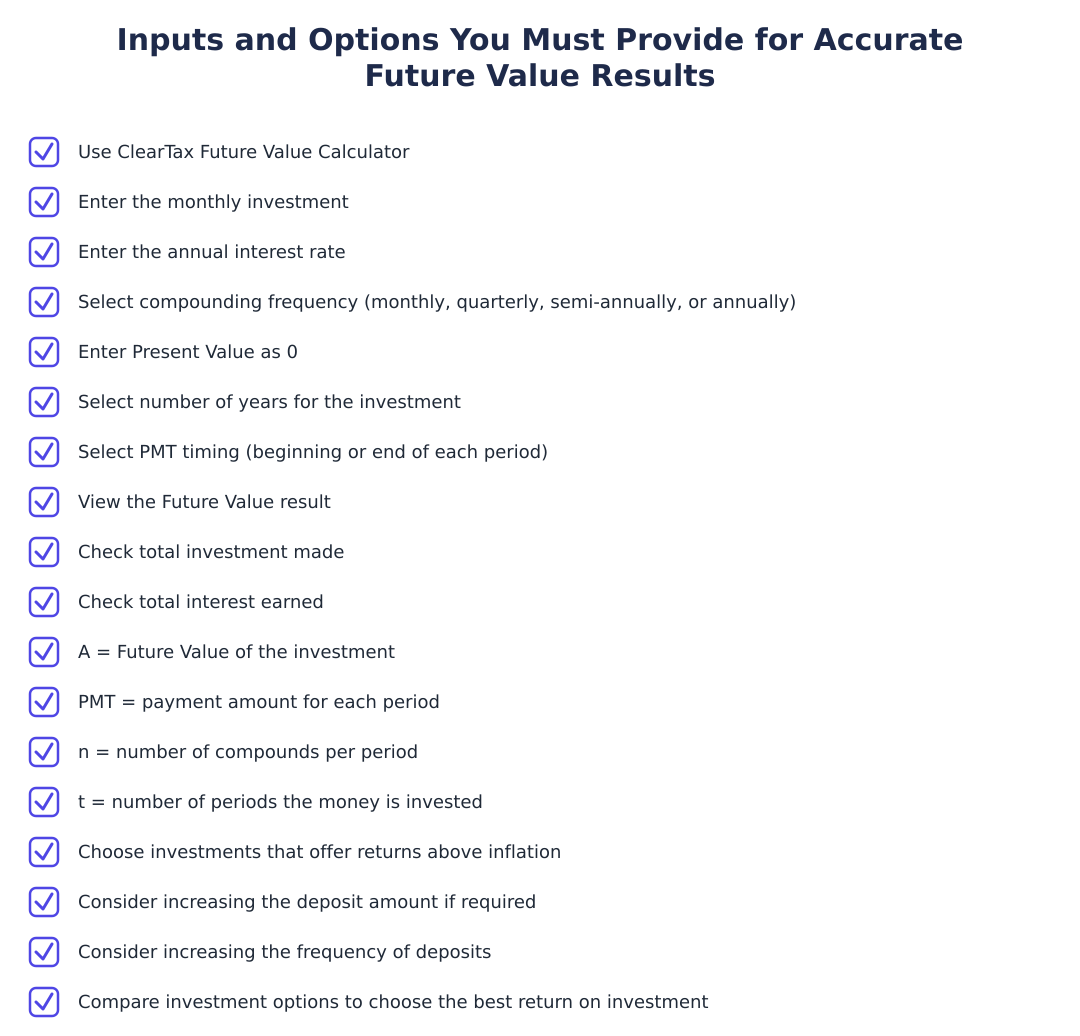
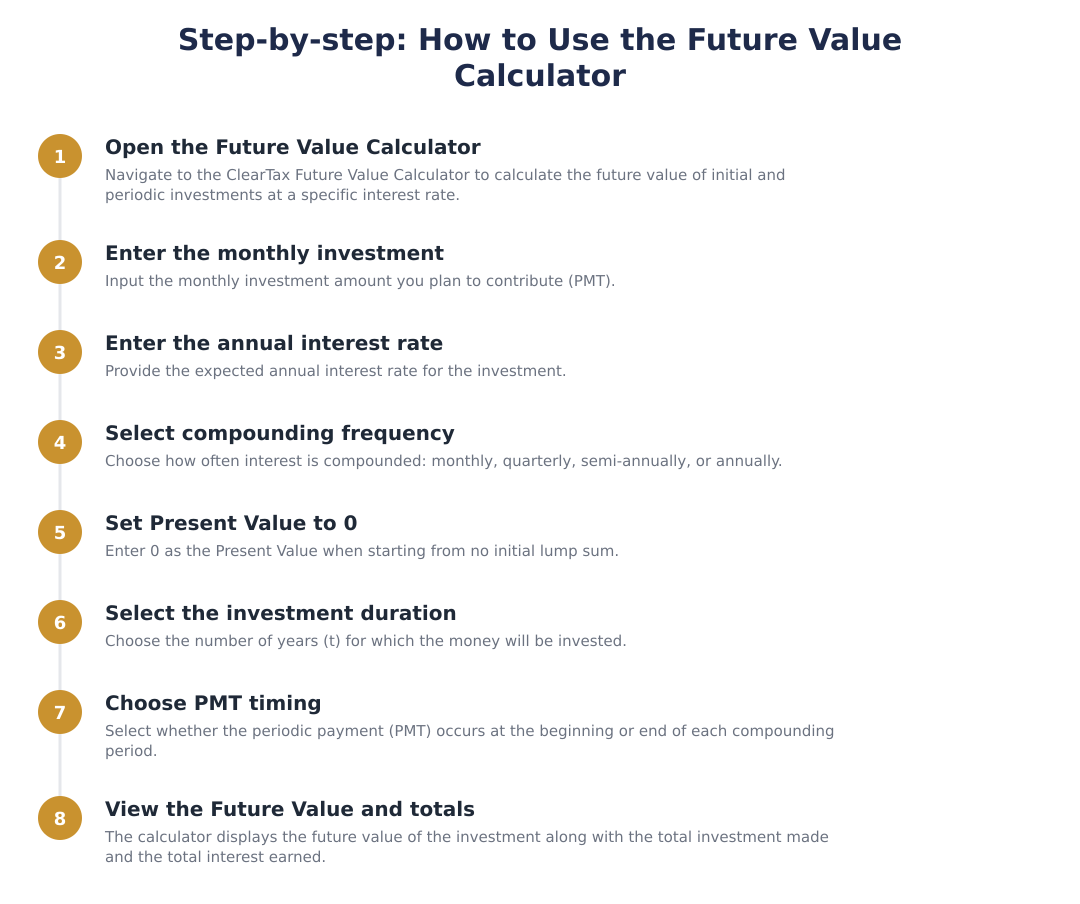
The future value calculator computes the accumulated value of periodic deposits and/or a lump sum using the compound interest formula based on your inputs of periodic payment (PMT), interest rate, compounding frequency, and time. For end-of-period deposits it uses A = PMT * ((1 + r/n)^(n*t) - 1) / (r/n), where r is annual rate, n is compounds per year and t is years; for beginning-of-period deposits it adjusts the formula accordingly. To use the tool you enter the monthly investment, annual interest, select compounding frequency (monthly, quarterly, semi‑annual, or annual), set Present Value to 0 (if only periodic deposits), choose number of years, and specify whether PMT is at period start or end. The calculator then shows the future value, total investment made, and total interest earned.
Can you give a quick example of calculating future value?
Yes, for example, if you deposit Rs 10,000 per month at 8% annual interest compounded monthly for 10 years (PMT at period end), the future value works out to about Rs 18,29,460. In this example PMT = Rs 10,000, n = 12 (monthly compounding), t = 10 years and r = 0.08; applying the end-of-period formula gives the accumulated amount. The calculator will also display the total amount you invested (Rs 12,00,000 in this example) and the interest earned (difference between FV and total investment).
What does PMT at beginning vs end of period mean and how does it affect future value?
PMT at the beginning means each deposit is made at the start of the compounding period and increases future value slightly compared with end-of-period deposits because each payment earns an extra period of interest. The calculator lets you select PMT as beginning or end; the beginning-of-period formula multiplies the end-of-period result by (1 + r/n) to account for that extra compounding. For long horizons or high frequencies the difference can be meaningful, so choose the correct option to reflect when you actually deposit money.
How do I choose compounding frequency in the future value calculator?
Choose the compounding frequency that matches how interest is credited by your investment, monthly, quarterly, semi‑annually, or annually, because more frequent compounding (e.g., monthly vs annual) yields a higher future value for the same nominal rate. In the calculator you select the frequency and it uses n (compounds per year) in the formula; for example monthly = 12, quarterly = 4, semi‑annual = 2, annual = 1. If you don't know the exact frequency, use the frequency closest to how interest is applied to your deposit to get an accurate result.
What outputs does the future value calculator give me?
The future value calculator displays the future value of the investment, the total amount you invested (sum of all periodic deposits and any lump sum), and the total interest earned (future value minus total investment). It also shows intermediate details like the compounding frequency used and whether payments are at the beginning or end of periods. These outputs help you compare investment options and decide whether to increase deposits, change frequency, or pick a higher‑return vehicle to meet your goals.
Does the future value calculator consider inflation or taxes?
No, the standard future value calculator computes nominal future value based on the input interest rate and compounding frequency and does not automatically adjust for inflation or taxes. To understand real purchasing power you must adjust the nominal rate for expected inflation (real rate ≈ nominal rate − inflation) or separately discount the future value by an inflation projection. Similarly, taxes on interest or capital gains should be estimated and deducted outside the calculator to evaluate after‑tax returns.
What are the benefits of using the future value calculator online?
Using an online future value calculator quickly shows how much your periodic and lump‑sum investments will accumulate to, helps you compare different interest rates and compounding frequencies, and lets you decide if you need to increase deposits to meet goals. It also provides clarity on total investment versus interest earned so you can evaluate the efficiency of an investment option. Online calculators save time, avoid manual computation errors, and let you run multiple scenarios (different rates, durations, or PMT timings) for better financial planning.
Can I use the future value calculator for systematic investment plans (SIPs)?
Yes, the future value calculator is suitable for SIPs because it handles regular periodic deposits (PMT) and allows you to set compounding frequency and the investment horizon to estimate the SIP corpus. Enter your monthly SIP amount as PMT, annual expected return as the interest rate, choose monthly compounding (n = 12) if returns compound monthly, set Present Value = 0 if no lump sum, and select the number of years to get the projected corpus. Remember to indicate whether SIP payments are treated as beginning or end of period to match the actual debit timing.
What are limitations of the future value calculator I should be aware of?
Limitations include assuming a constant interest rate and fixed periodic deposits, not accounting for market volatility, taxes, inflation, fees, or changes in deposit amounts over time. The calculator’s projections are deterministic, real investments like mutual funds may have variable returns, so results should be treated as illustrative rather than guaranteed. To get a realistic plan, run multiple scenarios with different rates, include tax and inflation adjustments externally, and update inputs periodically as circumstances change.
Need help staying Calculators compliant?
MoneyGence's AI Finance OS tracks your compliance, wallet share, and finances in one place, built for agencies and growing businesses.
Get started with MoneyGence