Goods Transport Agency GST: Guide on RCM, Registration & Rates
This guide explains the Goods Transport Agency (GTA) under GST and focuses on what constitutes a GTA, the practical importance of documents such as the consignment note, the scope of services covered, invoicing and compliance obligations, and the penalties a GTA or its clients may face for non-compliance. You will learn how the issuance of a consignment note changes the legal position of a transporter, which activities are treated as part of a GTA service, why correct invoicing and timely filing matter, and what common compliance risks to watch for. This matters because transporters and their customers must understand when a movement of goods is treated as a GTA service (rather than a different kind of supply), what paperwork creates that classification, and how failures in documentation or filing can lead to penalties. The guide is practical: it highlights what a transporter should include in their processes to establish responsibility for goods, the ancillary activities that are ordinarily bundled with road transport services, and the high-level compliance areas where mistakes commonly occur. Whether you are a transporter, a consignor, a consignee, or a tax practitioner advising them, this article will give you the factual foundation to manage GTA transactions correctly and reduce the risk of disputes and penalties under GST.
What is a GTA?
A Goods Transport Agency (GTA) is a service provider that carries goods by road and issues a consignment note for that carriage. The issuance of a consignment note is a defining feature: it signals that the transporter has taken over responsibility for the goods and marks a transfer of lien, making the transporter accountable for safe delivery until the goods reach their destination.
The legal and commercial effect of being classified as a GTA flows from this consignment note. When a transporter issues such a document, their role is not merely the physical movement of goods but also includes the custody and accountability implied by the consignment note. This distinction matters for how the transaction is treated under GST and for the allocation of responsibility between consignor, consignee and transporter.
What services are covered by a GTA?
A GTA’s service covers carriage of goods by road and typically includes certain ancillary activities when they are not provided as independent services. These ancillary activities commonly accepted as part of a GTA service are loading and unloading, packing and unpacking, trans-shipment, and temporary warehousing that arises as part of the transport operation.
In practice this means that when a transporter issues a consignment note and performs those ancillary tasks in connection with the carriage, the combined activity is treated as the GTA service. If those ancillary activities are provided separately and independently (for example, separate contractual warehousing services unrelated to a particular carriage), they may be treated differently for tax and contractual purposes.
Importance of the consignment note
Issuance of a consignment note is central to whether a transport activity falls within the ambit of a GTA. If a transporter does not issue a consignment note, the service provider will not be regarded as a goods transport agency. The document therefore acts as a legal marker that brings the GTA classification into effect.
Beyond classification, the consignment note signifies transfer of lien, the transporter assumes responsibility for the goods listed until safe delivery. For transporters, consignors and consignees, maintaining clear consignment notes reduces ambiguity about who holds custody and who bears risks during transit, which in turn helps in resolving disputes and in meeting statutory obligations.
Invoicing and compliance responsibilities
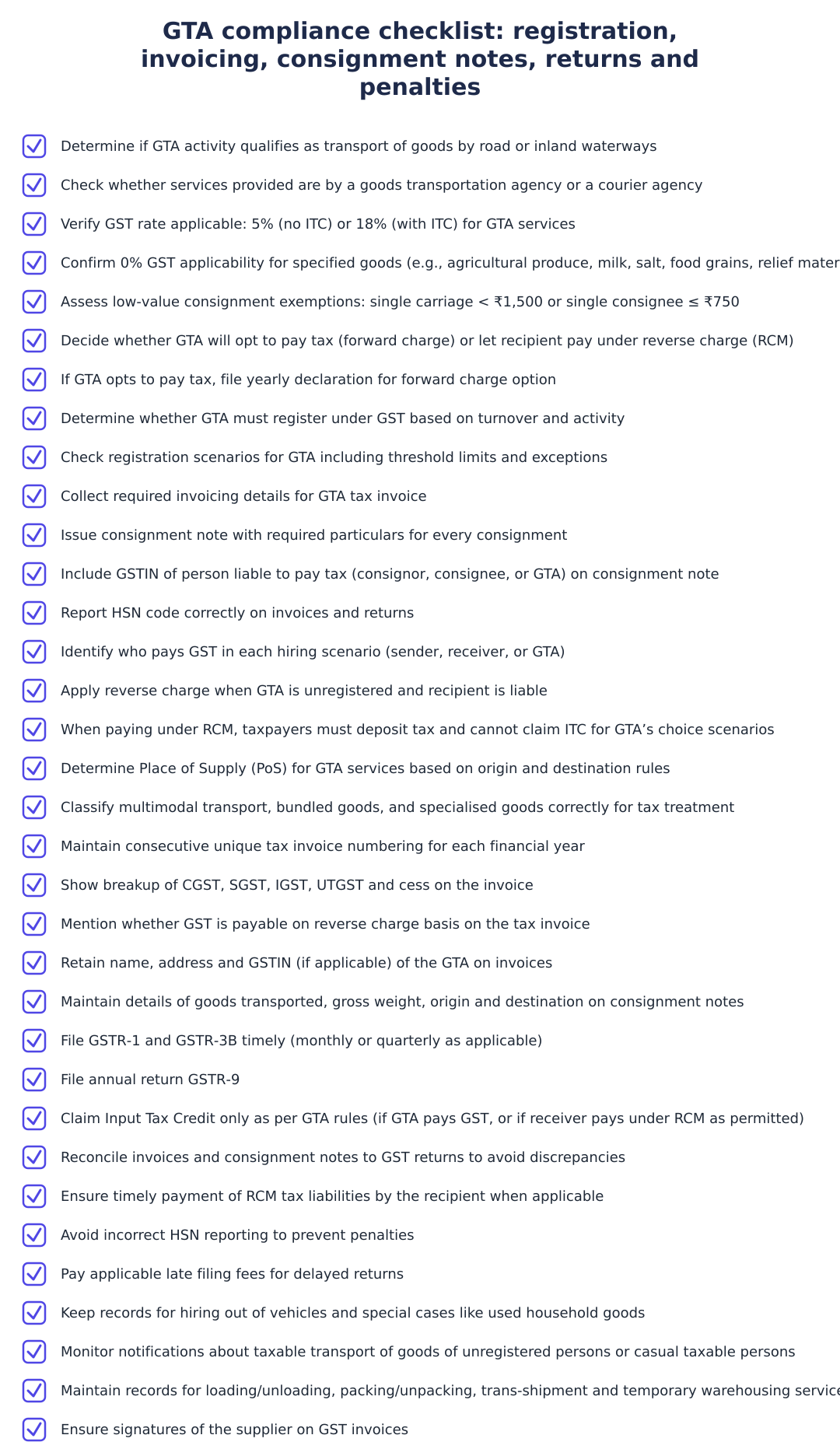
Proper GST-compliant invoicing is a vital compliance requirement for GTA services. Invoices and related transport documents should accurately reflect the nature of the service, the parties involved and any particulars that establish the GTA relationship (for example, the consignment note). Accurate documentation forms the basis for correct tax treatment and reporting.
Timely return filing and accurate reporting, including correct classification (such as HSN where applicable), are equally important. These compliance actions ensure that the tax treatment of GTA transactions is transparent and that both suppliers and recipients can substantiate their positions in case of scrutiny. Attention to invoicing and returns reduces the likelihood of assessments or disputes.
Penalties and risk areas for GTAs and their clients
There are specific compliance risks to monitor in GTA operations. Key areas where non-compliance can lead to penalties include late filing of returns, incorrect HSN reporting, and failure to discharge reverse charge (RCM) liabilities when applicable. Each of these can trigger assessments, interest and penalty consequences under the law.
Operationally, controlling these risks requires reliable processes: ensure invoices and consignment notes are issued correctly, maintain timely and accurate return filings, and have clear internal checks to determine whether tax is payable by the transporter or the recipient under any applicable reverse charge rules. Proactive record-keeping and internal controls go a long way toward avoiding penalties and disputes.
A Goods Transport Agency classification hinges on issuance of a consignment note and the carriage-by-road activity together with customary ancillary services. For transporters and their customers, the practical priorities are clear: ensure consignment notes and GST-compliant invoices are issued, keep records that support the GTA relationship, file returns on time and report classifications accurately. Doing so reduces the risk of penalties related to late filing, incorrect HSN reporting or non-payment of reverse charge liabilities.
Frequently asked questions
What exactly is a Goods Transport Agency (GTA) under GST?
A Goods Transport Agency (GTA) is any person who provides service in relation to transport of goods by road and issues a consignment note; it does not include local delivery services provided by or through an e-commerce operator. The GTA service covers not only carriage but also ancillary activities such as loading, unloading, packing, unpacking, trans-shipment and temporary warehousing where these are part of the same service. The defining feature for GST purposes is issuance of a consignment note (by whatever name), because without it the transporter will not be treated as a GTA. This definition was reinforced by notifications updating the scope to focus on road transport with a consignment note as proof of GTA service.
What GST rates apply to GTA services?
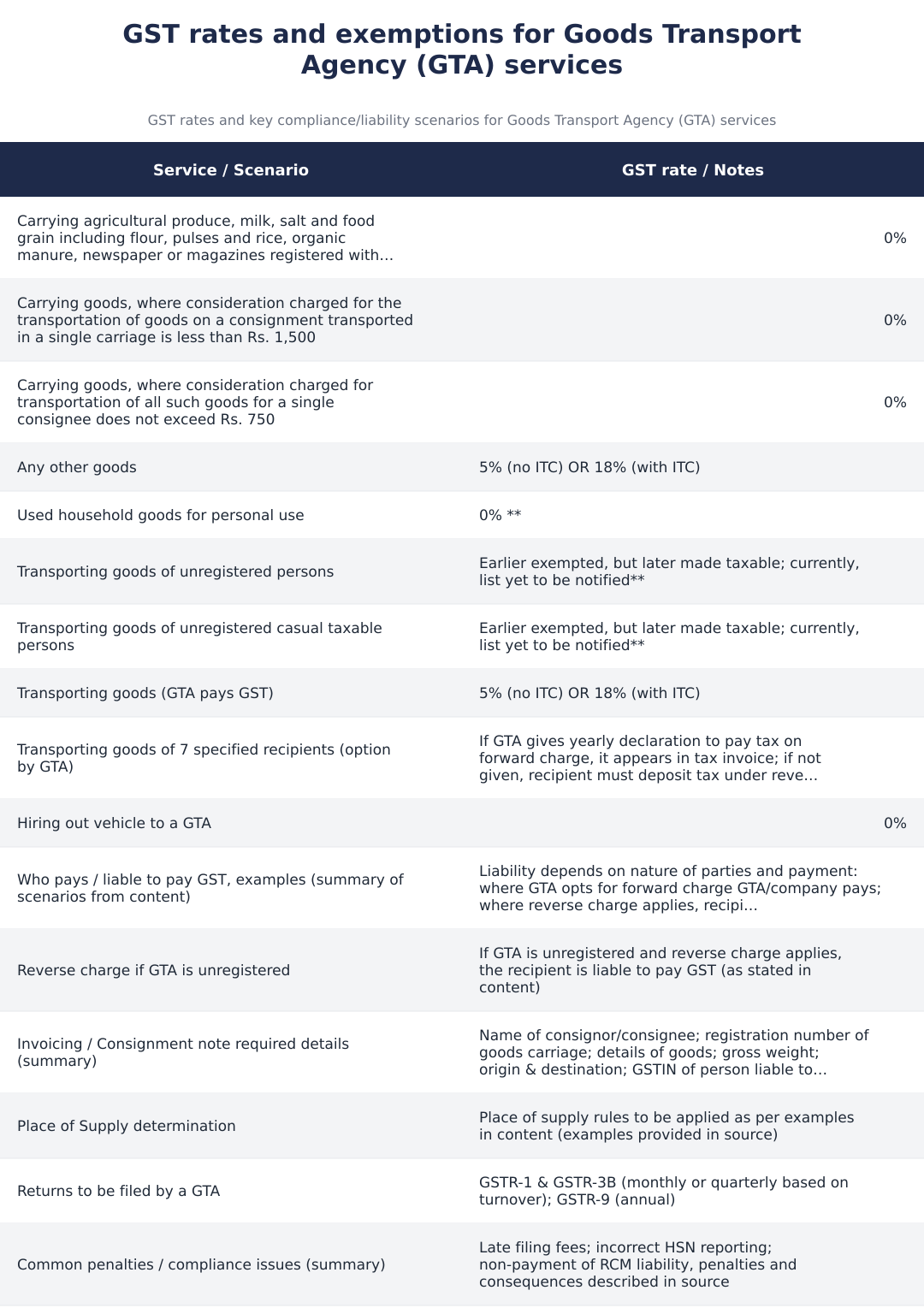
GTA services attract 0%, 5% (no ITC) or 18% (with ITC) depending on the nature and value of the consignment and the GTA's choice to pay tax. Zero rate (0%) applies to carriage of specified items like agricultural produce, milk, salt, food grains, newspapers, relief material and defence equipment, and to consignments where the freight for a single carriage is less than ₹1,500 or where total freight for a single consignee does not exceed ₹750. For ‘any other goods’ the GTA can either pay 18% and claim input tax credit or opt to pay 5% without claiming ITC; if the GTA does not give an annual declaration to pay tax on forward charge, the supply may fall under reverse charge on the recipient.
Who is liable to pay GST when I hire a GTA, the GTA or the recipient?
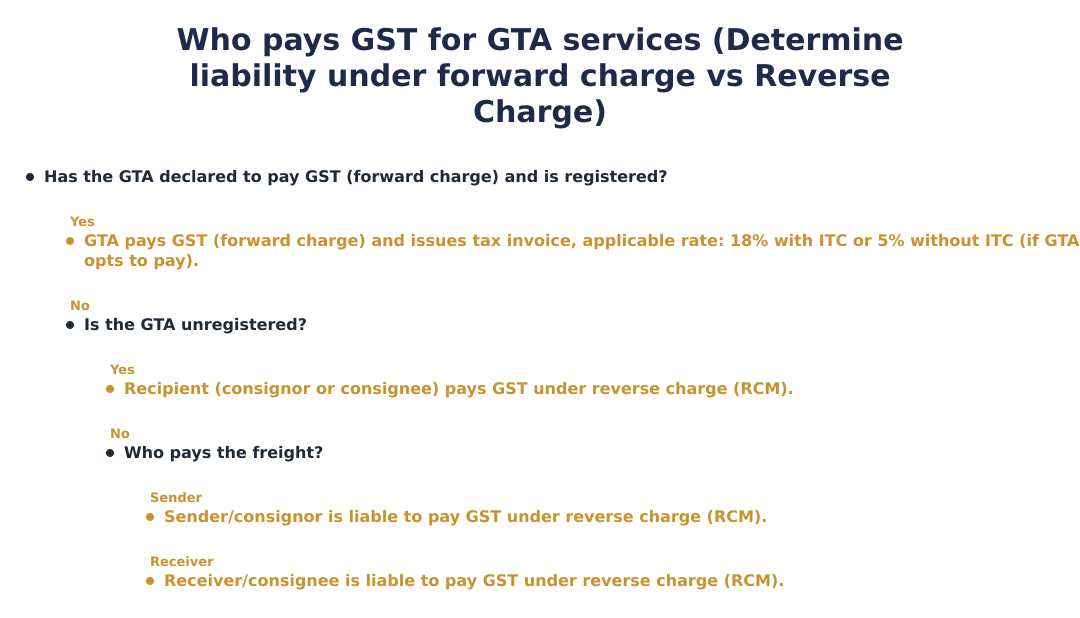
Liability to pay GST on GTA services can be on the GTA (forward charge) or on the recipient under reverse charge mechanism (RCM), depending on circumstances and declarations. If the GTA elects to pay GST himself (and issues a tax invoice), he pays tax at either 18% (with ITC) or 5% (without ITC); if he does not elect and the service falls under RCM, the recipient (consignor or consignee or the person paying freight depending on who is liable) must pay the tax. Specific classes of recipients (e.g., factories, societies, co‑operative societies, bodies corporate, partnership firms, GST-registered persons and casual taxable persons) are required to pay under RCM when the GTA does not charge tax.
Which businesses must pay GST under reverse charge for GTA services?
Businesses such as factories registered under the Factories Act, societies registered under the Societies Registration Act, co‑operative societies, GST-registered persons, bodies corporate, partnership firms (including AOPs) and casual taxable persons are required to pay GST under reverse charge for GTA services when RCM applies. This list identifies recipients who cannot insist on the GTA to pay tax and must discharge the tax liability themselves where notified rules place the GTA supply under RCM. The person liable to pay is also treated as the ‘receiver of service’ under Notification No.13/2017‑CT if they pay or are liable to pay the freight for transportation by road within the taxable territory.
What must a GTA include in its invoice and what is a consignment note?
A GTA’s tax invoice or consignment note must contain consignor and consignee names, vehicle registration number, details and gross weight of goods, place of origin and destination, name/address/GSTIN of the GTA, tax invoice number and date, taxable value, applicable GST rates and tax amounts, and a clear statement whether GST is payable on reverse charge basis. A consignment note is the document issued by the GTA upon receipt of goods for transport that establishes the transporter’s lien and responsibility until delivery; issuance of a consignment note is the cornerstone that classifies a service as GTA. The consignment note should also state the person liable to pay GST (consignor, consignee or GTA) and is necessary for correct tax treatment and compliance.
How do you determine the Place of Supply (PoS) for GTA services?
The Place of Supply for GTA services is generally where the consignment commences and where the goods are handed over for transportation, determined by the locations of origin and destination noted in the consignment note and invoicing rules. If the service is interstate transport, IGST is applicable; if the transport occurs within one state, CGST and SGST (or UTGST) apply. Practical examples rely on the points of commencement and termination shown on the consignment note to decide whether the supply is intra‑state or inter‑state, which in turn dictates the tax heads to be charged.
Can a GTA claim Input Tax Credit (ITC) and when can a recipient claim ITC on GTA services?
A GTA can claim Input Tax Credit only when it pays tax on forward charge at 18% (in which case ITC on inward supplies is allowed); if the GTA opts to pay 5% without ITC, it cannot claim input tax credit. A recipient who pays tax under reverse charge can claim ITC subject to general ITC eligibility rules, provided the service is used for furtherance of business and the recipient holds a valid tax payment and invoice/consignment note showing RCM was applied. Note that if the GTA has charged 5% with no ITC, the recipient cannot claim ITC since tax was not paid by recipient under RCM in that scenario.
Which GST returns must a GTA file and how often?
A GTA must file GSTR-1 and GSTR-3B (monthly or quarterly depending on turnover and opted scheme) to report outward supplies and tax liabilities, and GSTR-9 annually for reconciliation if turnover exceeds the threshold requiring annual return filing. Monthly filing (GSTR-1/GSTR-3B) applies in most regular cases, while small taxpayers may be eligible for quarterly filing of GSTR-1 under specific provisions; GSTR-9 is the annual return that consolidates transactions for the fiscal year. Accurate reporting of HSN, consignment details and RCM transactions in these returns is essential to avoid notices and penalties.
What penalties apply for non-compliance in GTA services under GST?
Penalties for non-compliance by GTAs include late filing fees for delayed returns, penalties for incorrect HSN reporting, and consequences for non‑payment of RCM liability which can include interest plus tax demand and penalties under GST law. Late filing typically attracts statutory late fees per day of delay and interest on unpaid tax; incorrect HSN or invoice deficiencies can lead to scrutiny and penal notices, and failure to deposit RCM tax shifts liability to the recipient with interest and potential penalties. Maintaining timely, accurate invoices/consignment notes, declaring whether tax is on RCM, and correct HSN reporting reduces the risk of these penalties.
Need help staying GST compliant?
MoneyGence's AI Finance OS tracks your compliance, wallet share, and finances in one place, built for agencies and growing businesses.
Get started with MoneyGence