GST Amnesty Scheme: Eligibility, Benefits & Latest Updates
This guide explains the concept of a GST amnesty scheme, who it generally aims to help, the typical benefits it offers, and practical challenges taxpayers and advisors commonly face. You will learn what an amnesty scheme usually means in the context of indirect tax compliance, why governments introduce such measures, and how businesses can assess whether taking part makes sense for their situation. The aim is to provide a clear, practical overview so that business owners, tax professionals, and compliance teams can better understand the implications of regularising past non-compliance under an amnesty framework. The guide highlights typical features of amnesty initiatives, relief from certain enforcement costs, simplified pathways to clear outstanding obligations, and incentives to reintegrate non-compliant taxpayers into the formal compliance system. It also discusses common operational and legal challenges that arise when taxpayers try to use amnesty provisions, and suggests general approaches that help manage those hurdles. This is intended as a conceptual, practical resource rather than a source of specific legal advice; readers should consult their tax advisor or official notifications for authoritative, case-specific guidance before taking action.
What is Meant by the GST Amnesty Scheme?
An amnesty scheme in the indirect tax context is typically a temporary administrative measure designed to encourage taxpayers to resolve past non-compliance without facing the full force of enforcement. Such schemes often focus on simplifying procedures to file pending returns, pay outstanding tax dues, and obtain relief from certain monetary consequences that would otherwise apply. The objective is to bring taxpayers back into the compliance fold in a way that balances revenue protection with administrative efficiency.
From a practical perspective, amnesty measures reduce the immediate financial burden or procedural hurdles that deter some taxpayers from regularising their affairs. They are usually accompanied by specific instructions on how to apply, what liabilities must be settled, and which consequences may be reduced or waived. Participation is generally voluntary, and taxpayers considering it should weigh the short-term cost of compliance against the long-term benefits of restored legal standing and reduced dispute exposure.
The new GST Amnesty Scheme 2024
When tax administrations introduce updated amnesty provisions, the changes typically clarify eligible periods, categories of taxpayers who may apply, and the exact nature of relief being offered. Newer schemes often aim to address litigation backlogs or systemic non-compliance observed in earlier years, and they may include instructions on coordination between field officers and appellate authorities to implement the relief effectively.
For taxpayers, a newly announced scheme requires a careful read of the eligibility criteria and application mechanics. Key practical considerations include confirming whether previously paid amounts are eligible for refund, whether relief applies to interest or penalties, and how outstanding tax liabilities must be paid. Taxpayers should work with their advisors to map outstanding issues against the scheme rules to decide whether applying is beneficial.
All about GST Amnesty Scheme 2023
Earlier amnesty initiatives generally focused on specific categories of returns or particular types of non-compliance, often with a defined filing window. Such frameworks usually set out concessions like capped late fees or partial waivers of statutory penalties to incentivise compliance. Communication from the administration frequently included detailed instructions on how taxpayers should submit pendency-regularising applications and how field offices should process them.
For businesses that missed certain filings or faced procedural cancellation of registration, these earlier measures provided an opportunity to restore compliance without protracted litigation. However, they also required taxpayers to act within prescribed timelines and to ensure that any outstanding tax and interest liabilities were addressed according to the scheme’s terms.
Validity of the GST Amnesty Scheme 2021
Amnesty measures are typically time-bound, with a clear start and end date for when applications will be accepted. The validity period determines the window during which eligible taxpayers must complete the prescribed actions to avail of the relief. Missing the validity window usually means losing access to the concessions provided under the scheme.
Because these schemes are finite, businesses should assess their outstanding compliance issues promptly and prioritise actions that will preserve eligibility. Where timelines are tight, coordination with tax professionals and arranging timely payments or documentation can be critical to successfully availing the benefits.
Benefits of the GST Amnesty Scheme
Amnesty schemes typically offer relief that reduces the financial and procedural barriers to coming back into compliance. Common benefits include lowering or waiving late fees, limiting penalties, and providing a clear discharge mechanism for outstanding liabilities. By easing the immediate cost of compliance, such measures incentivise taxpayers to regularise affairs that might otherwise remain unresolved.
Beyond direct monetary relief, participating in an amnesty can restore a business’s compliance history, reduce the risk of enforcement actions such as cancellation of registration, and decrease ongoing litigation exposure. For many taxpayers, the reputational and operational stability gained by resolving past issues is as valuable as the monetary concessions offered.
What is the Late Fee Reduction Under the GST Amnesty Scheme 2021?
One of the most visible elements of many amnesty frameworks is a concession on late fees for delayed returns. These concessions can take the form of capped fees, partial waivers, or conditions under which nil returns attract no fee. The exact design determines how much immediate relief a taxpayer will receive and which returns or periods are covered.
Taxpayers should carefully review the scheme’s rules to understand how late fee relief is calculated and whether any additional conditions, such as filing all pending returns or paying outstanding tax, must be met to qualify. Compliance teams should also verify if relief applies differently to various classes of returns (for example, regular returns versus final or annual returns).
Resolution for issue while filing GST Amnesty application
Operational issues can arise when taxpayers try to submit applications under an amnesty, for instance, difficulties in navigating online portals, uploading supporting documents, or providing required payment references. Administrations sometimes publish clarifications and user instructions to resolve such problems, and taxpayers should monitor official channels for these updates.
When technical or procedural obstacles persist, taxpayers should document the issue, seek assistance through helpdesks or grievance mechanisms, and retain evidence of attempts to comply. Maintaining clear records of communications and submissions can be important if a dispute arises about whether an application was filed within the scheme period.
Challenges and Issues Under the GST Amnesty Scheme
Amnesty schemes, while useful, also create challenges. Common issues include ambiguity about eligibility, disputes over whether certain liabilities are covered, and confusion when taxpayers have already made partial payments or are subject to concurrent proceedings. These uncertainties can deter taxpayers from availing themselves of the relief or lead to inconsistent outcomes.
Another challenge is administrative implementation: field offices and appellate authorities must align on processing applications, and taxpayers may face delays or differing interpretations. Additionally, ensuring equitable treatment across large numbers of taxpayers while preventing misuse of concessions requires robust safeguards and clear guidelines.
Solutions for the Issues
Practical solutions include seeking formal clarifications from the tax administration when eligibility or scope is unclear, and documenting any technical problems encountered during filing. Taxpayers should also consult professional advisors to map outstanding liabilities against scheme provisions and to structure payments and filings in a way that secures the intended relief.
From an administrative perspective, clear training for officials, timely issuance of FAQs, and a responsive grievance mechanism improve uptake and uniformity. For taxpayers, proactive planning, prioritising critical filings and ensuring timely payment arrangements, reduces the risk of missing a scheme’s window or encountering procedural rejections.
Frequently Asked Questions
Typical FAQs around amnesty schemes relate to who is eligible, what relief is available, whether previously paid amounts will be refunded, how to apply, and the consequences of missing the application window. Because answers depend heavily on the specific terms of a given scheme, taxpayers should consult the official scheme text or a qualified advisor for definitive guidance.
A general rule of thumb is to act promptly: gather records of outstanding filings and payments, consult with advisors to assess the net cost and benefit of participation, and follow official instructions closely to preserve eligibility. Clear documentation of every step is useful if any later dispute arises about entitlement to relief.
GST amnesty schemes can offer a pragmatic route to resolve past non-compliance, reduce litigation, and restore business continuity. Because the precise terms and implications vary by scheme, taxpayers should review official notifications and seek professional advice before acting. Prompt, well-documented action and coordination with advisors will usually yield the best outcome when considering participation in an amnesty.
Frequently asked questions
What is the GST Amnesty Scheme?
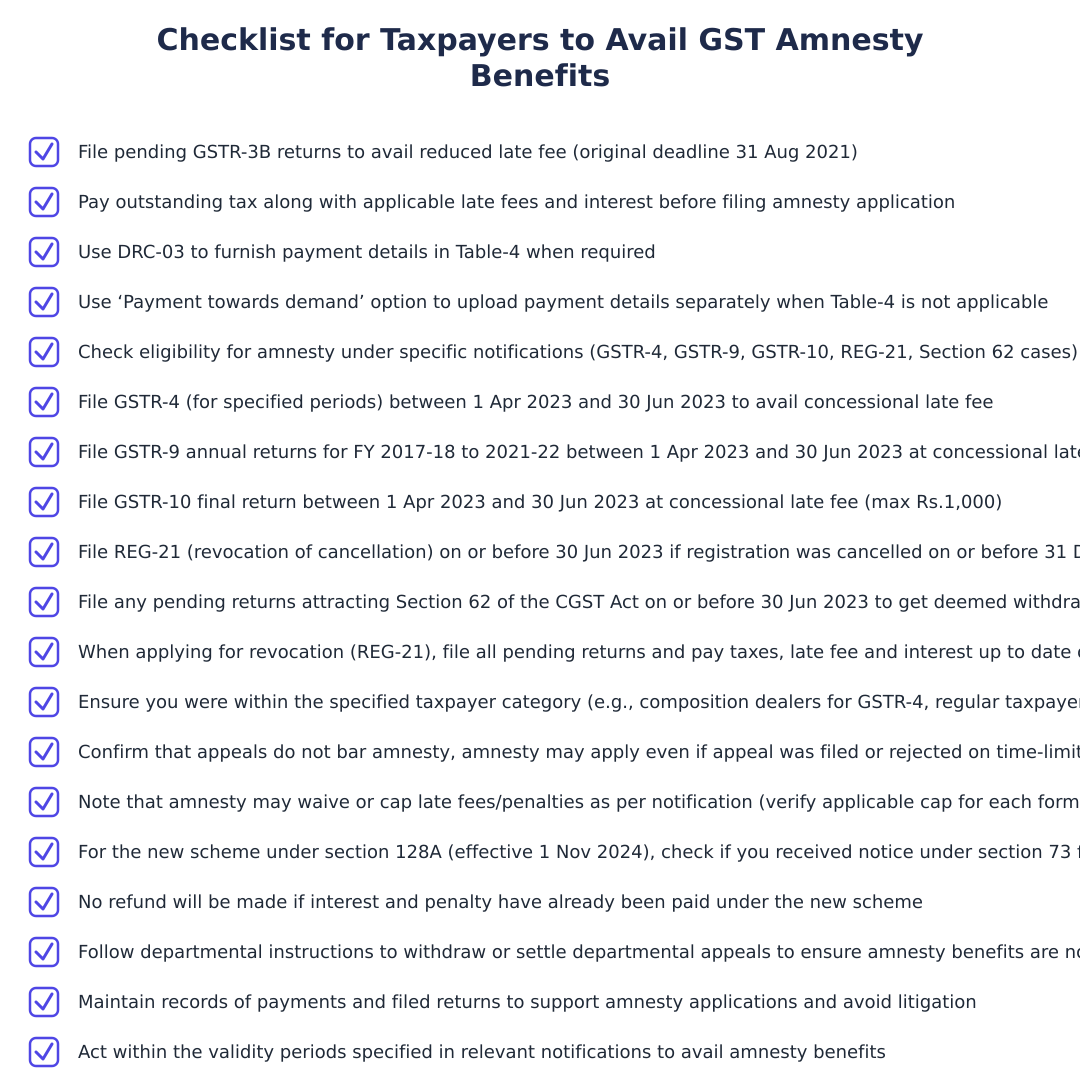
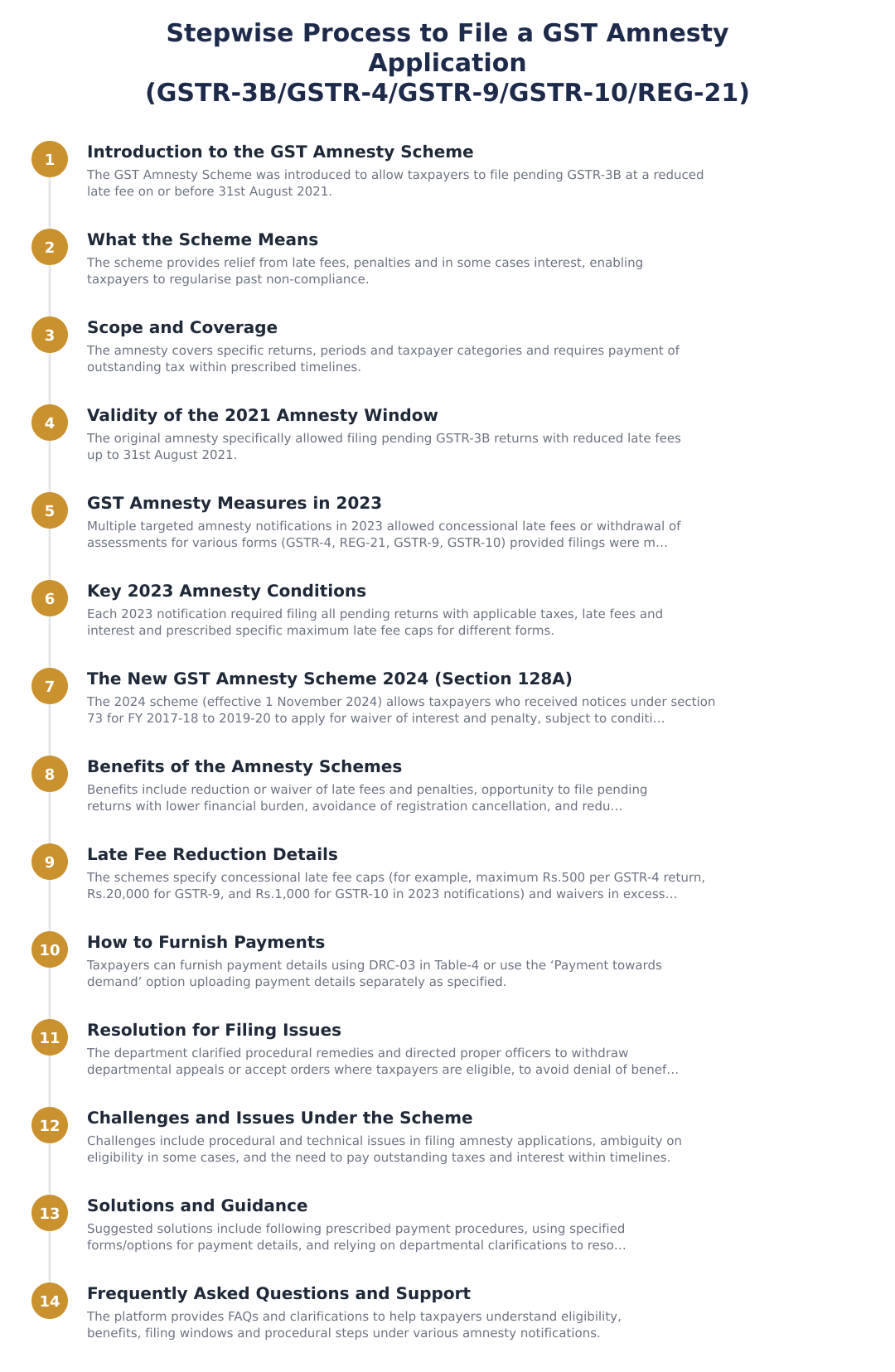
The GST Amnesty Scheme is a time‑bound government relief that lets taxpayers regularise past GST non‑compliance by filing pending returns or settling demands at reduced late fees, penalties, or interest. It covers specific returns and periods (for example GSTR‑3B, GSTR‑4, GSTR‑9, GSTR‑10 and certain cases under Section 62/73) and has been rolled out through multiple notifications with defined filing windows. The scheme aims to reduce litigation and restore compliance but generally requires payment of outstanding tax and any specified reduced charges within the prescribed timelines. Recent expansions include a new provision under Section 128A (effective 1 Nov 2024) that allows conditional waiver of interest and penalty for certain assessment years if tax dues are cleared.
Who was eligible for the GST Amnesty Scheme for GSTR-3B late fees?
Taxpayers who had not filed GSTR‑3B returns for specified periods and had outstanding late fees were eligible to file those pending GSTR‑3B returns under the amnesty and pay a capped late fee. The capped late fee was a maximum of Rs.1,000 per return where there was tax liability (Rs.500 CGST + Rs.500 SGST) and Rs.500 for nil returns (Rs.250 + Rs.250). Eligibility required filing on or before the notified cut‑off date for that round of amnesty (for example the original window for some rounds closed 31 Aug 2021 or subsequent notified windows in 2023), and payment of any outstanding tax and interest as applicable.
What late fee reductions did the GST Amnesty Scheme 2021 offer?
Under the GST Amnesty Scheme 2021, the late fee for delayed GSTR‑3B was capped at a maximum of Rs.1,000 per return for returns with tax liability and Rs.500 for nil returns, instead of the cumulative per‑day late fee under the Act. Practically, the reduced fee was the lower of the amount computed under the Act (per day) and the capped maximum (Rs.1,000 or Rs.500). For example, a return that would otherwise attract Rs.8,150 in late fees could be filed by paying only Rs.1,000 under the scheme if within the applicable window.
Which specific returns and timeframes were covered by later amnesty notifications in 2023?
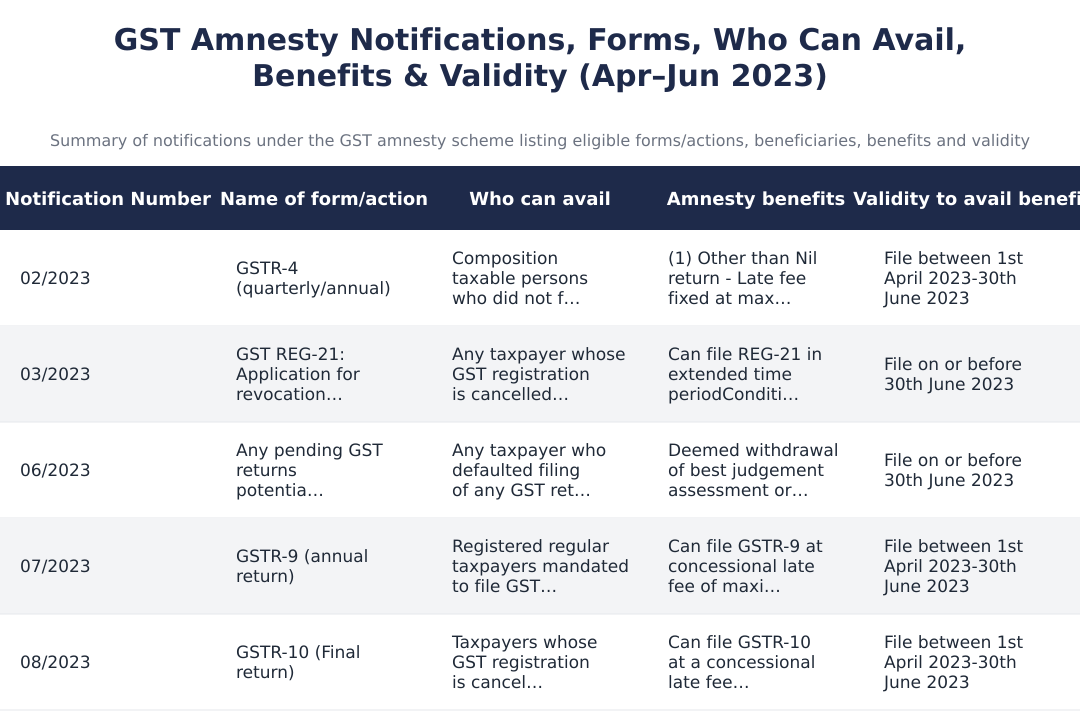
Several targeted amnesty windows were notified in 2023 covering different return types and situations, each with its own benefit and deadline (generally 1 April 2023 to 30 June 2023). For example, Notification 02/2023 allowed composition taxpayers to file overdue GSTR‑4 (July 2017–March 2019 and FY 2019‑20 to 2021‑22) with a late fee capped at Rs.500 for non‑nil returns and nil returns attracting no late fee; Notification 07/2023 permitted filing GSTR‑9 (FY 2017‑18 to 2021‑22) at a concessional late fee capped at Rs.20,000; Notification 03/2023 extended time to file REG‑21 (revocation of cancellation) subject to payment of pending dues; and other notifications covered Section 62 related matters and GSTR‑10 final returns with their respective caps and conditions.
What is the new GST Amnesty provision under Section 128A (effective Nov 1, 2024)?
Section 128A, effective 1 November 2024, allows eligible taxpayers who received notices under Section 73 for assessment years 2017‑18, 2018‑19 and 2019‑20 to apply for conditional waiver of interest and penalty provided they pay the full tax demand within the prescribed timeline. The provision does not allow refunds where interest and penalty have already been paid, and authorities were directed not to deny benefits on technical grounds and to withdraw departmental appeals where appropriate. The aim of Section 128A is to reduce litigation by enabling settlement of disputed demands in return for clearing tax dues.
How do I file and pay when availing the GST Amnesty Scheme (forms and payment methods)?
To avail amnesty benefits you must file the specified pending return or application (for instance GSTR‑3B, GSTR‑4, GSTR‑9, GSTR‑10 or REG‑21) within the notified window and pay outstanding tax, interest and the concessional late fee using prescribed challans or form DRC‑03 as directed. Payments towards demand can be furnished in DRC‑03 Table‑4 with payment details, or if using the 'Payment towards demand' option separately, taxpayers may need to upload payment details as instructed because some payment types cannot be entered into Table‑4. Always follow the specific notification’s instructions about which form to use and ensure payment head (tax/interest/late fee/penalty) is correctly selected to get the amnesty benefit credited.
What are the main benefits of using the GST Amnesty Scheme?
The main benefits are reduction or waiver of late fees and penalties, the ability to file pending returns without unaffordable charges, avoidance of cancellation of registration, and reduced litigation by withdrawing or settling past departmental demands. The scheme helps businesses regularise compliance, improves their GST record, and supports continuity especially after economic disruptions, while generally requiring payment of outstanding tax (and in many cases interest) within the stipulated period. Specific monetary caps (for example Rs.1,000 for GSTR‑3B non‑nil, Rs.20,000 for GSTR‑9, Rs.500 for certain GSTR‑4 returns) make the financial relief concrete.
What common challenges did taxpayers face under the GST Amnesty Scheme?
Common challenges included portal issues while submitting amnesty applications or payments, ambiguity over payment heads and reconciliation of payments against demands, technical rejections (for example while uploading payment proofs), and confusion over eligibility cut‑off dates or applicability to appeals already filed. Additionally, some taxpayers faced difficulty when assessing whether interest or penalty was waived under a particular notification, and revenue officers had differing interpretations in some cases. These issues sometimes delayed recognition of concessional fees or necessitated grievance resolution with the tax department.
What practical solutions were suggested to resolve GST Amnesty filing issues?
Practical solutions included following the exact notification instructions (forms and payment heads), using DRC‑03 correctly with complete payment details or uploading payment confirmations where Table‑4 cannot be used, approaching the GST helpdesk for portal errors, and filing rectification or grievance requests with the proper officer when credits are not reflected. For disputes over eligibility or departmental appeal status, taxpayers were advised to seek administrative relief where the department was directed to withdraw appeals or accept orders if appropriate, and to maintain proof of payments and filings to support claims. Engaging a tax professional to ensure correct form selection and compliance timelines was commonly recommended to avoid technical rejections.
Need help staying GST compliant?
MoneyGence's AI Finance OS tracks your compliance, wallet share, and finances in one place, built for agencies and growing businesses.
Get started with MoneyGence