GST Changes 1 April 2026: New Rules, Compliance & Key Updates
From 1st April 2026 the compliance landscape for exporters under GST includes at least one clear, mandatory action that businesses must follow to avoid transactional disruptions: file a Letter of Undertaking (LUT) for the financial year 2026–27 before generating any export invoice. This guide explains what that single verified requirement means in practice, why it matters for exporters’ cash flow and compliance, and how businesses should prepare operationally so export billing is not delayed when the new financial year begins. You will learn the practical implications for your billing and reconciliation cycles, critical timing considerations to prevent blocked exports or tax leakage, and a simple checklist to get export invoicing ready for 1st April 2026. Although many stakeholders may discuss multiple GST and allied tax changes around this date, this article focuses on the confirmed obligation, the LUT filing timing, and helps you translate that into clear internal steps, communication points with buyers and vendors, and reconciliation controls. Whether you operate a small exporter unit or manage export compliance for a larger group, adopting these precautions will reduce last‑minute operational friction, help maintain trust with overseas customers who expect timely invoices, and support accurate tax reporting as the new financial year opens.
Major GST change you must act on
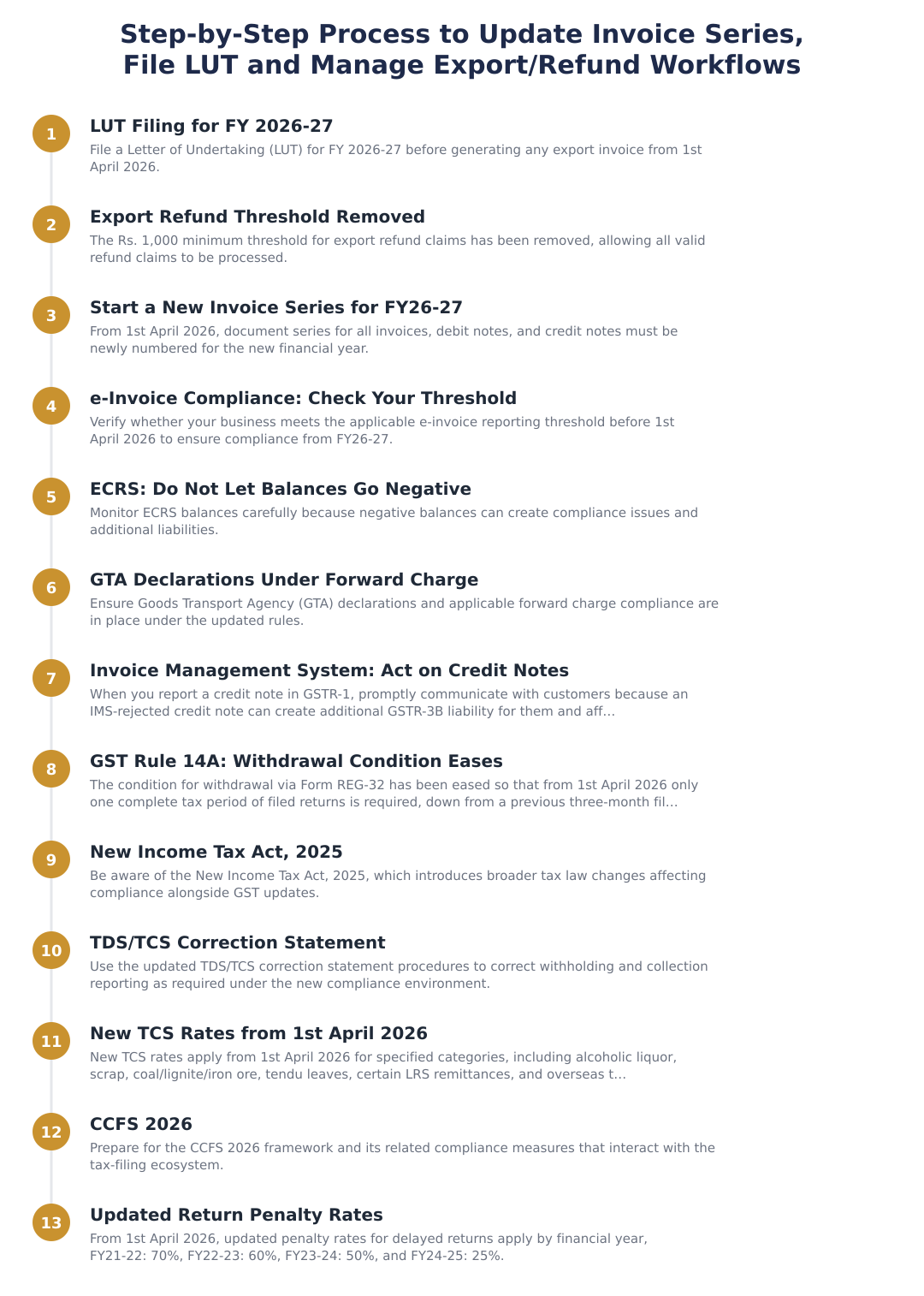
The single verified change that exporters must treat as mandatory for the new financial year is the requirement to file a Letter of Undertaking (LUT) for FY 2026–27 before issuing any export invoice from 1st April 2026. Practically, this means that preparing and completing your LUT filing should be treated as a prerequisite step in your month‑end and year‑end transition checklist so that export billing can continue uninterrupted once the new financial year starts.
Treating LUT filing as a hard deadline helps avoid operational issues such as delayed invoicing or disputes with overseas buyers. Export transactions often trigger downstream activities, shipping, customs clearance, foreign exchange collection, all of which depend on timely invoice issuance. Ensuring the LUT requirement is met before April 1 will preserve smooth commercial flows and reduce administrative rework.
Quick steps to make LUT readiness an operational habit
Assign a person or team (compliance, finance or export operations) who will ensure the LUT for FY 2026–27 is filed before any export invoices are generated from 1st April 2026.
Plan and complete the LUT filing as part of your year‑end transition tasks so the filing is in place ahead of the April 1 start date.
Do not generate export invoices for the new financial year until the LUT filing is confirmed; this prevents non‑compliant export billing.
Practical implications for billing and cash flow
Exporters should factor the LUT filing timing into their invoicing calendars. If the LUT is not filed before generating export invoices for FY 2026–27, those invoices may not meet the statutory precondition implied by the verified requirement. That can create administrative friction: invoices may need correction, or receipts and collections could be delayed while compliance is resolved.
Advance planning also helps treasury teams forecast cash flows more reliably. Many export collections and customs clearances hinge on properly issued invoices; a prevented or delayed invoice can cascade into delayed export realisation and increased working capital needs. Making LUT filing a routine step in the transition to each financial year reduces such operational risk.
Communication and internal controls to avoid last‑minute problems
Communicate the LUT requirement and timeline to sales, export operations, finance and external stakeholders (like freight forwarders and buyers) so everyone understands why invoices may be held briefly at the start of the financial year. Clear internal sign‑offs, for instance, a final check that LUT is filed before invoice series for the new year is opened, will prevent ad hoc invoicing that could be non‑compliant.
Maintain a simple checklist and a single point of truth (a tracker or shared calendar) that confirms the LUT filing status. This reduces the chance of duplicated effort or missed steps, especially in organisations where multiple units process export orders.
A short compliance checklist for exporters
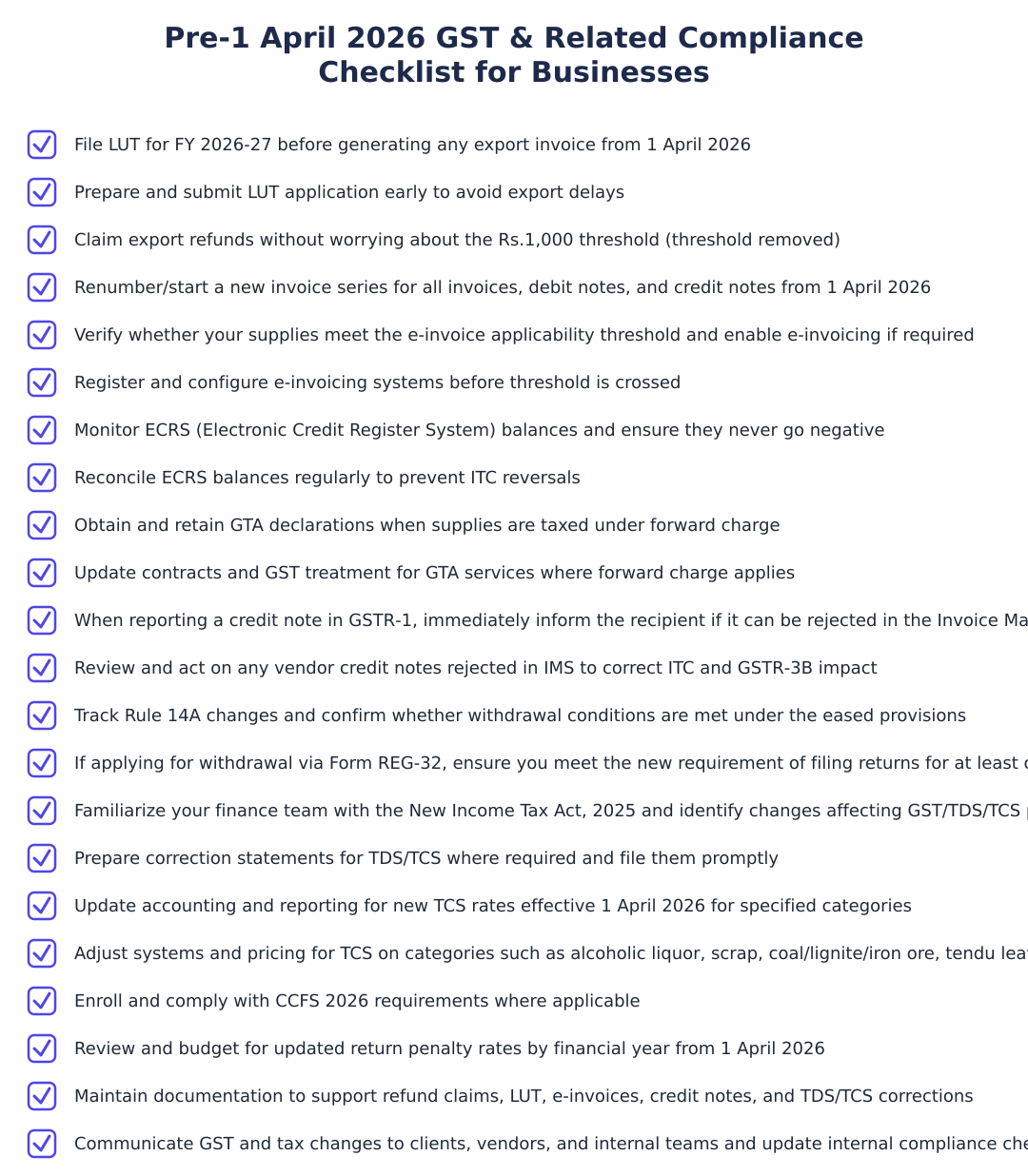
Make LUT filing for FY 2026–27 the first compliance item you tick off before generating any export invoice from 1st April 2026. Consider this a gating control: no LUT, no export invoice for the new financial year.
Complement the LUT gate with internal reconciliations (ensure export orders due around year‑end are either billed in the outgoing financial year or held until LUT is in place), and train teams to escalate any uncertainties early so that filing and invoicing are completed smoothly.
The confirmed and actionable GST change for the start of FY 2026–27 is straightforward: file your LUT before issuing any export invoice from 1st April 2026. Treat this as a non‑negotiable gating control in your year‑end checklist, communicate it across teams, and use simple trackers and sign‑offs to avoid last‑minute delays. Doing so will keep export invoicing, shipping and collections running smoothly as you enter the new financial year.
Frequently asked questions
Do I need to file a new LUT for exports for FY 2026-27 before April 1, 2026?
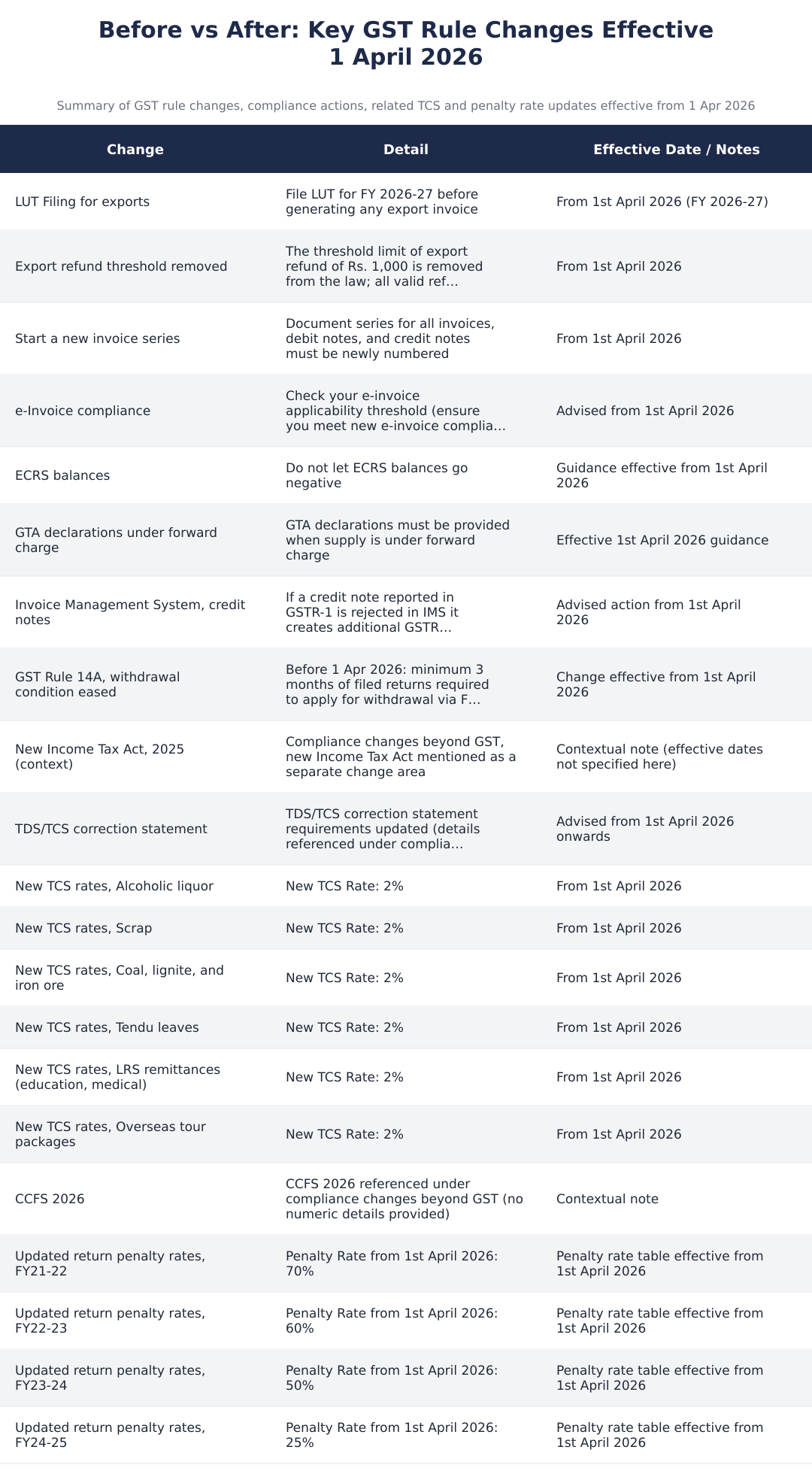
Yes, you must file a new Letter of Undertaking (LUT) for financial year 2026-27 before exporting under bond or LUT from 1st April 2026. The platform requires a fresh LUT for the new financial year so exporters who intend to zero-rate supplies without payment of IGST should file it before generating any export invoices for FY26‑27. If you fail to file the LUT in time, you may need to pay IGST on exports and claim refund later, which adds compliance and cash-flow burden.
Has the export refund minimum Rs. 1,000 threshold been removed from April 1, 2026?
Yes, the statutory minimum threshold of Rs. 1,000 for export refunds has been removed with effect from 1st April 2026, so all valid refund claims can be processed regardless of amount. This change means small-value refund claims previously ineligible can now be filed and processed, increasing administrative work but improving taxpayer benefit. Taxpayers should ensure accurate documentation for even small refunds to avoid processing delays or rejections.
Do I have to start a new invoice number series from April 1, 2026?
Yes, from 1st April 2026 you must start a new document series and renumber invoices, debit notes, and credit notes for the new financial year. Every taxpayer should restart numbering (for example, from 1 or a new prefix) for FY26‑27 to maintain clear audit trails and compliance with GST records. Ensure your billing software and accounting systems are updated to generate the new series and reconcile opening balances to avoid duplication or gaps.
Has the e‑invoice compliance threshold changed from April 1, 2026 and how do I check if I must comply?
Yes, e‑invoice compliance must be checked against the current turnover threshold effective 1st April 2026, and businesses whose aggregate turnover meets or exceeds the notified limit must generate e‑invoices. Verify your aggregate turnover (across PAN) for the preceding financial year(s) to determine applicability; if you cross the threshold you must generate IRN for B2B invoices and relevant documents through the e‑invoicing system. Review sales systems to ensure you can electronically push invoices to the Invoice Registration Portal (IRP) and capture IRN, QR code and signed JSON for GST filing and reconciliation.
What is ECRS and why shouldn’t my balances go negative after April 1, 2026?
ECRS (Electronic Credit Reference System) balances must not be allowed to go negative because a negative ECRS leads to reconciliation failures and compliance notices from the tax authorities. From 1st April 2026 taxpayers should monitor electronic credit ledgers carefully and avoid adjustments that create negative balances; if negative occurs, you may need to make corrective filings or payments to regularize the ledger. Ensure coordination between GSTR filings, matching with suppliers, and any credit note reversals so that ITC flows and ECRS posting remain correct to prevent penalties or blocked credits.
Do goods transport agencies (GTAs) need to submit declarations under forward charge from April 1, 2026?
Yes, from 1st April 2026 GTAs supplying services subject to forward charge must obtain and maintain the required declarations and documentation under the new forward charge protocol. Under forward charge GST, the consignee or recipient is liable to pay tax, but GTAs still need to issue proper invoices and collect declarations (where applicable) to ensure correct tax treatment and avoid disputes about tax liability. GTAs should update their billing templates and client agreements to capture recipient declarations and maintain records for audit and GSTR reconciliation.
What should I do if a vendor’s credit note is rejected in the Invoice Management System (IMS)?
If a vendor’s credit note is rejected in the IMS you must communicate and coordinate with the vendor immediately because a rejected vendor credit note reduces your ITC and can create additional GSTR-3B liability for the recipient. Rejected credit notes must be corrected, reissued or reversed as needed and both parties should update their GSTR-1/GSTR-2B reconciliations to avoid mismatches and potential demands; timely action prevents cascading liabilities and trade disputes. Maintain supporting documents and evidence of communications to defend your position in case of scrutiny by tax authorities.
What is the change to GST Rule 14A withdrawal condition from April 1, 2026?
From 1st April 2026 the condition to withdraw GST registration under Rule 14A has been eased, earlier you needed a minimum of three months’ filed returns to apply via Form REG-32, but now only one complete tax period’s filing is required. This simplifies the process to surrender or withdraw registration for taxpayers who cease operations or change business structure, reducing procedural wait times and compliance burden. However, ensure you meet other statutory conditions and clear outstanding liabilities before applying to avoid rejection.
What compliance changes beyond GST should businesses note from April 1, 2026, new TCS rates and updated penalty rates?
Businesses should note that new TCS rates of 2% apply to categories like alcoholic liquor, scrap, coal/lignite/iron ore, tendu leaves, LRS remittances for education/medical, and overseas tour packages from 1st April 2026, and updated penalty rates for delayed returns now apply by financial year (70% for FY21-22, 60% for FY22-23, 50% for FY23-24, 25% for FY24-25). These changes mean increased collection at source obligations and higher late-filing penalties for historic periods, so update billing, TCS deposit systems and penalty provisioning in your accounting. Also be aware of other concurrent changes like the New Income Tax Act 2025, TDS/TCS correction statement rules and CCFS 2026 that may affect overall tax compliance and reporting.
Need help staying GST compliant?
MoneyGence's AI Finance OS tracks your compliance, wallet share, and finances in one place, built for agencies and growing businesses.
Get started with MoneyGence