GST Compliance Rating: What It Means for Your Business
GST compliance ratings are a way to summarise how well a taxpayer follows the rules and timelines under the Goods and Services Tax system. This guide explains what a GST compliance rating aims to capture, why authorities or marketplaces might use such a score, how the assessment generally works, and what practical effects it can have for suppliers, buyers and intermediaries. You will learn the broad criteria that typically feed into a compliance rating, the potential benefits of having a higher rating, and the kinds of business processes and recordkeeping that tend to support better scores. The objective is to give business owners, finance teams and advisors a clear conceptual picture of GST compliance ratings so they can prioritise the right controls and responses without getting lost in technical detail. The guide is written for owners and finance professionals who want to understand the implications of being rated, how it may affect reputation, access to trade, and the administrative burden of responding to queries, and to help decide where to focus improvements in returns filing, tax payments, reconciliation and cooperation with tax authorities. Read on for practical explanations of what influences a rating and simple steps you can take to improve your standing within any rating framework you encounter.
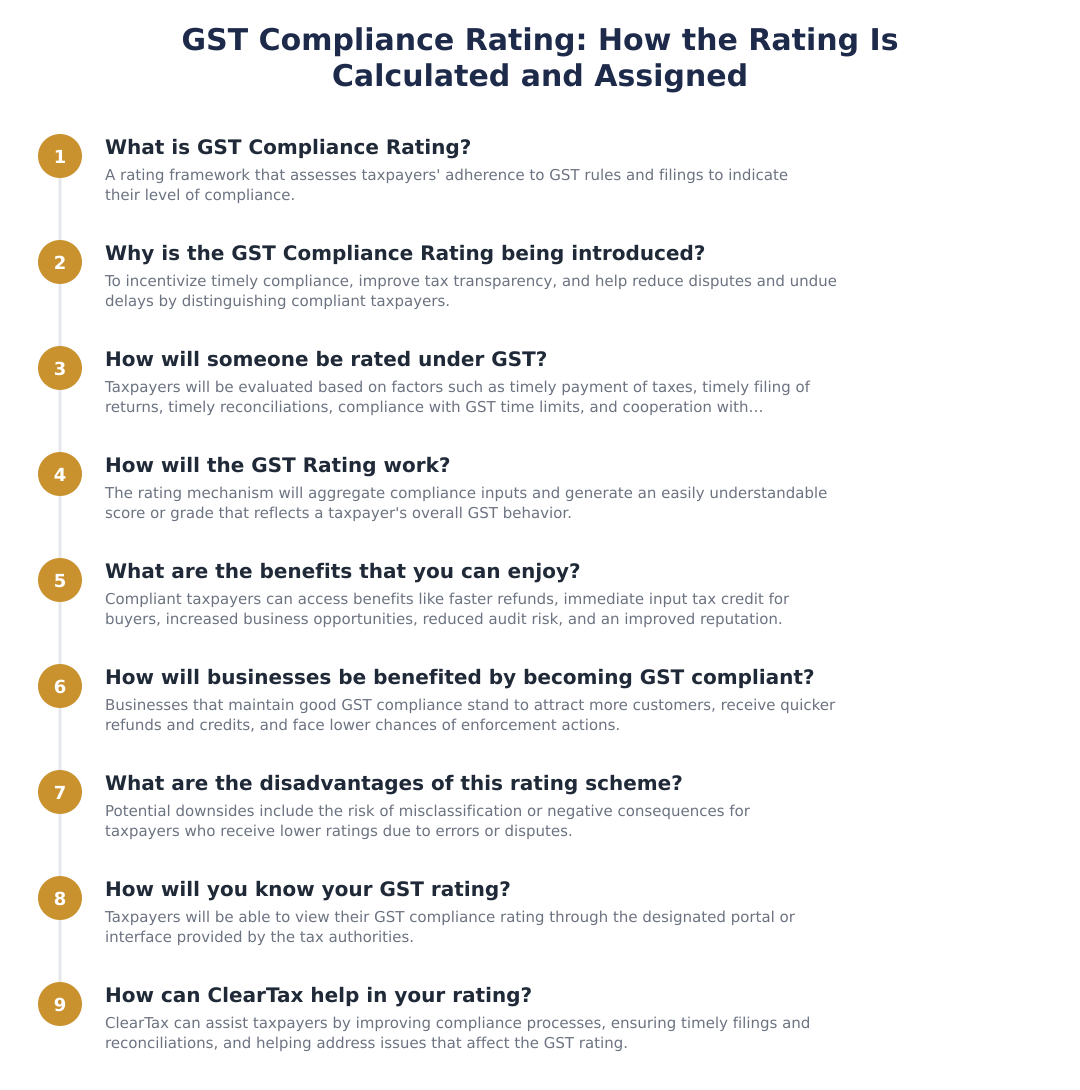
What is GST Compliance Rating?
A GST compliance rating is a consolidated measure that reflects a taxpayer’s adherence to GST-related obligations. Rather than being a single legal sanction, it is typically a summary of multiple compliance behaviours, for example, timely filing of returns, accurate reporting, reconciliation between books and filings, and responsiveness to notices. The rating is intended to provide a quick indication of how reliably a taxpayer meets the administrative and reporting expectations of the GST system.
For businesses, such a rating functions as a transparency tool. It helps counterparties, platforms and sometimes tax administrators gauge the compliance risk associated with a supplier or buyer. A good rating signals predictable compliance behaviour, while a lower rating indicates the need for closer scrutiny or remedial action.
Why is the GST Compliance Rating being introduced?
Compliance ratings are often introduced to promote better taxpayer behaviour and to make compliance performance visible. When compliance performance is measurable and comparable, businesses have an incentive to improve internal processes to achieve a better standing. Greater transparency can reduce information asymmetry between trading partners and make procurement and credit decisions easier.
From an administrative perspective, a rating can help authorities and platforms prioritise scrutiny and allocate resources efficiently. Instead of treating every case equally, stakeholders can focus on those with poorer compliance indicators, while businesses with better ratings may face fewer routine checks or faster processing in systems that use the rating as a filter.
How will someone be rated under GST?
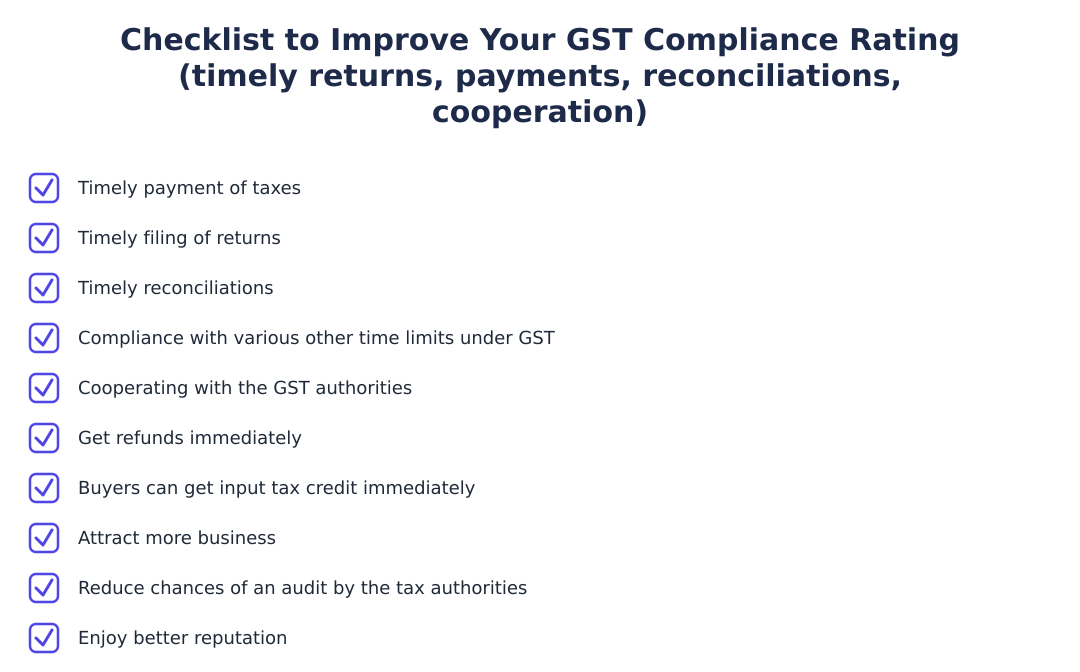
Ratings are typically based on a set of observable behaviours and records rather than subjective judgments. Common elements that feed into a rating include the regularity and timeliness of return filings, whether tax payments are made on schedule, the consistency between ledger records and statutory filings, and how the taxpayer responds to enquiries or notices.
Different rating systems may weigh these elements differently. Some frameworks may emphasise timeliness, while others place more weight on the accuracy of reported figures or the degree of reconciliation between outward supplies and inward credits. Regardless of the exact formula, businesses that maintain disciplined processes for filing, payment and reconciliation tend to perform better.
How will the GST Rating work?
A rating mechanism generally involves collecting compliance data, applying predefined rules to score that data, and publishing or sharing the resulting score with authorised stakeholders. Data sources can include filed returns, payment records and responses to notices. The scoring rules translate these records into an interpretable metric or grade.
Operationally, the rating may be updated periodically to reflect the most recent behaviour. Users of the rating, such as buyers, marketplaces or internal risk teams, can use the score to inform onboarding decisions, expedite routine processes for high-rated suppliers, or flag low-rated entities for additional verification. The exact modes of use will depend on who publishes the rating and for what purpose.
What are the benefits that you can enjoy?
A favourable compliance rating can have several practical advantages. It can improve the business’s reputation with buyers and platforms, making it easier to win contracts or be selected for preferred supplier lists. Higher-rated taxpayers may also experience smoother transactions when counterparties rely on the rating as part of their vendor assessment.
Beyond commercial benefits, good ratings can help reduce friction with administrative processes. For example, a clear record of timely filings and payments can shorten the time needed to resolve routine queries and may reduce the administrative burden of additional checks by counterparties who trust the rating as a signal of low risk.
How will you know your GST rating and how a compliance platform can help
Rating frameworks that are publicly published or shared with taxpayers typically provide a way for taxpayers to view their score through an official portal or through authorised intermediaries. Where such visibility exists, regularly checking the rating helps identify issues early, such as missed filings or reconciliation differences.
Compliance software and advisory services can support improved ratings by automating routine tasks, for example, tracking filing due dates, flagging reconciliation mismatches, and generating accurate returns based on bookkeeping data. They can also help by organising documentation and producing audit-ready reports that make it easier to demonstrate corrective actions if a rating needs to be improved.
A GST compliance rating is a practical summary of compliance behaviour that can influence commercial relationships and administrative interactions. Focusing on timely filings, accurate reporting, regular reconciliation and cooperative responses to authorities will generally support a stronger rating. Use ratings as a diagnostic tool: monitor them, identify the weak points they reveal, and invest in systems and processes that close those gaps to protect reputation and reduce transactional friction.
Frequently asked questions
What is GST compliance rating?
GST compliance rating is a performance score for every GST-registered taxpayer that shows how well they comply with GST provisions. It ranks taxable persons irrespective of their nature, size or turnover, typically on a numeric scale (for example 1 to 10) with higher numbers indicating better compliance; the exact scale and methodology are to be notified. The rating reflects timely filing of returns, payment of taxes, reconciliations and cooperation with authorities, and is meant to help buyers, sellers and tax administrators assess compliance behavior. It is intended to be objective and publicly available so businesses and customers can factor it into commercial decisions.
Why has the GST compliance rating been introduced?
The GST compliance rating has been introduced to incentivize timely and accurate compliance and to prevent delays in passing input tax credit across the supply chain. Under GST, buyers can claim input tax credit only when sellers file their sales returns and details reconcile, so late or non-filing by sellers blocks buyer credit and working capital; the rating aims to reduce such delays. By grading taxpayers, the system encourages on-time filing, payments and reconciliations, deters deliberate delays, and helps expedite refunds and credit flow for bona fide taxpayers. It also creates transparency so buyers can prefer higher-rated suppliers and reduces administrative burden for authorities in targeting non-compliance.
What factors will determine someone's GST rating?
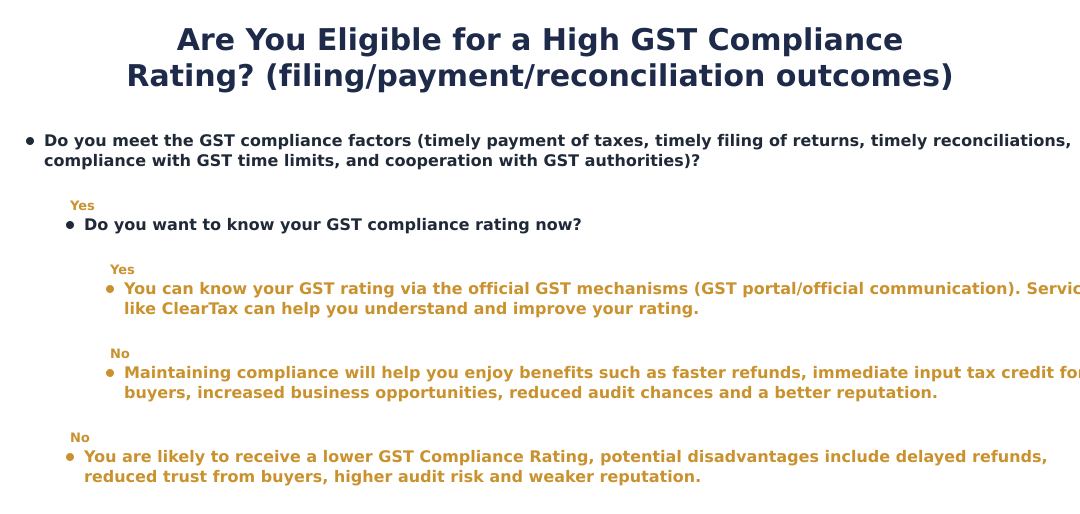
GST ratings will be based on quantifiable compliance behaviors such as timely payment of taxes, timely filing of returns, timely reconciliations between sales and purchase details, adherence to other GST time limits, and cooperation with tax authorities. Although the exact criteria and weights are yet to be officially prescribed, these factors are expected to form the core of the rating algorithm. A taxpayer who files GSTR-1 and GSTR-2 on time and reconciles invoices consistently will score higher, while repeated delays or mismatches will lower the rating. The design aims to be objective so different registrants (small or large) can be compared on compliance performance rather than turnover.
How will the GST rating work when claiming refunds?
GST ratings will determine the proportion of provisional refund a taxpayer can get instantly, the higher your rating, the larger the immediate refund proportion. For example, if a taxpayer with a rating of 8 is eligible for a Rs. 10,000 refund, they may receive an instant provisional refund of Rs. 8,000 (80%); the remaining Rs. 2,000 would be paid after scrutiny. Only taxpayers above a minimum rating threshold (for instance, 5 out of 10) may be eligible for provisional refunds; others will have to wait until full verification. Exact percentages, thresholds and rules are subject to notification by the authorities.
What benefits will a compliant taxpayer enjoy under the rating scheme?
A compliant, higher-rated taxpayer can enjoy immediate provisional refunds, faster availability of input tax credit to buyers, increased business opportunities, reduced chances of selection for audits, and an enhanced market reputation. Buyers prefer suppliers with higher ratings because timely seller compliance allows buyers to claim input tax credits without delay, improving buyer working capital. Higher ratings act as a competitive advantage when customers screen suppliers and can lead to more orders and commercial trust. Additionally, authorities may focus enforcement on lower-rated entities, thereby lowering audit frequency for consistent high performers.
How will businesses benefit commercially from being GST compliant?
Businesses that maintain good GST compliance will attract more customers, avoid blocked input tax credit for their buyers, and enjoy a stronger reputation that helps win contracts. For example, a buyer choosing between two vendors will prefer the one with a higher GST rating to ensure input tax credit is available promptly, directly translating to better sales for compliant sellers. Compliance also reduces disputes and delays in refunds and can lower the risk of enforcement action or lengthy scrutiny. Overall, high compliance becomes a market differentiator and can improve cash flow for both sellers and their buyers.
What are the disadvantages or risks of the GST rating scheme?
The rating scheme may burden resource-constrained small businesses that are new to GST, since errors or delays can lower their rating and hurt sales prospects; initial teething problems under a new tax regime can cause inadvertent non-compliance. A low rating can damage reputation, reduce customer trust and lead to fewer orders, while administrative mistakes or mismatches might trigger lower provisional refunds and increased scrutiny. There is also a risk of over-reliance on the score without considering legitimate business reasons for occasional delays, so transparent appeals or rectification mechanisms will be important. Authorities still need to notify detailed safeguards, remediation windows and grievance redressal procedures.
How will a taxpayer know their GST compliance rating and how often will it update?
Your GST compliance rating will be communicated to you and also published publicly, and the score will be updated periodically by the tax administration. The government will inform taxpayers of their current score, and that same score will be visible to prospective buyers or other stakeholders who check a supplier’s rating. Updates will reflect recent filing, payment and reconciliation behavior, so improving compliance should raise the rating over time; exact update frequency (monthly/quarterly) will be as per rules to be notified. Taxpayers should monitor their compliance dashboards and rectify mismatches promptly to protect or improve their score.
How can a GST software like ClearTax help improve my GST compliance rating?
GST software such as ClearTax can help improve your compliance rating by automating invoice capture, reconciling sales and purchase data, and auto-filling GSTR-1 and GSTR-2 to enable timely, error-free filings. By syncing with your accounting system, the software reduces manual mistakes, speeds up reconciliations and ensures returns and payments are filed on time, key factors that determine the compliance score. Tools like a GST-compliant bill book also help generate proper invoices that feed directly into returns, enhancing accuracy and audit readiness. Using such automation can therefore raise your rating, lower the risk of blocked input credits and improve chances of provisional refunds.
Need help staying GST compliant?
MoneyGence's AI Finance OS tracks your compliance, wallet share, and finances in one place, built for agencies and growing businesses.
Get started with MoneyGence