GST for Freelancers in India: Registration, Exemption & Rates
This guide explains how goods and services tax (GST) concepts apply to freelancers and independent professionals. It outlines when a freelancer might need to register for tax, what kinds of digital or remote services commonly raise registration and compliance questions, how simplified tax schemes compare with regular registration, the nature of tax rates and how they could apply, what invoicing obligations typically look like, whether a service provider can claim credits for taxes paid on purchases, and the need to file periodic returns. The objective is to give freelancers a practical framework to understand compliance responsibilities and the key areas to verify with a tax advisor or the official tax authority. By the end of this guide you will know which aspects to check when deciding whether to register, which features of digital services are treated specially in law, how invoicing and input tax credit generally operate for service providers, and why timely return filing matters. The guide does not replace formal tax advice but will help you identify the right questions to ask your accountant or the tax department and prepare the documents and records you will likely need for compliance. Freelancers who understand these basics can avoid common pitfalls such as late registration, incorrect invoicing, missed input credits, and non-compliance with filing norms.
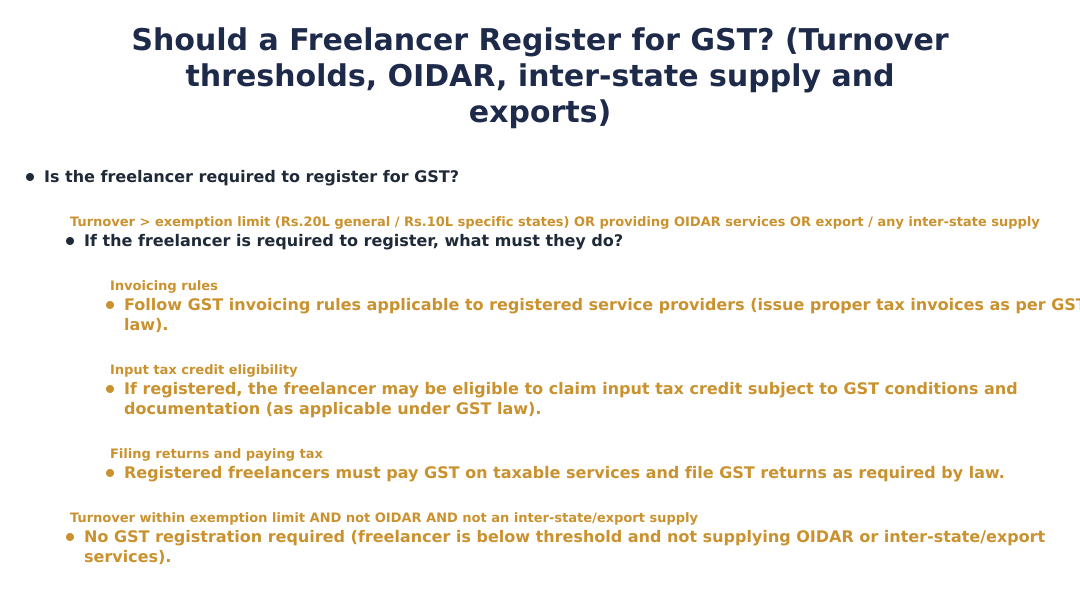
Whether a ‘Freelancer’ is liable to be registered?
Liability to register typically hinges on the nature of your supplies (goods or services), the place to which you supply, and the total value of those supplies over a prescribed period. Many freelancers provide purely domestic services, while others supply services across state borders or internationally; these distinctions generally affect registration requirements.
If you are unsure whether your work triggers registration, consider where your clients are located, whether your supplies cross territorial boundaries, and whether any specific rules apply to the type of service you provide. When in doubt, consult the formal guidance issued by the tax authority or seek professional advice so you can register proactively if required.
What are OIDAR services?
There is a category of services commonly referenced in indirect tax law that covers digital/online services delivered over the internet or an electronic network. These services often include things like online content, software delivered electronically, cloud-based offerings, and other remote or automated services.
Because such services are provided without a physical presence and may be supplied to recipients in different jurisdictions, tax rules frequently treat them differently from conventional offline services. If you deliver services online, you should check whether your services fall within any specialized digital-services category in the law and what that implies for registration and tax treatment.
Whether composition scheme is applicable to a freelancer?
Some tax systems offer simplified or composition schemes for small taxpayers which reduce compliance burden by allowing payment of tax at a prescribed concessional rate with relaxed filing or record-keeping norms. However, such schemes are usually subject to eligibility criteria and may exclude providers of certain types of services.
Freelancers should verify whether simplified schemes apply to their activities and whether opting for such a scheme is advantageous. Consider the trade-off between lower compliance and limitations such as inability to claim input credits or restrictions on supplying to certain types of customers.
What would be the rate of tax applicable?
Tax rates for services vary by the nature of the service, the place of supply, and whether any special classifications apply (for example, exports or digital services). Rates can differ for different service categories and may also depend on whether supplies are inter-state or intra-state.
Because rates and classifications are set by statute and subject to change, freelancers should refer to the current rate schedule published by the tax authority or obtain professional advice to determine the exact rate applicable to each service they provide.
What are the rules regarding invoicing?
Invoicing rules generally require that invoices contain specific information such as the identity of supplier and recipient, description of services, date of supply, and the tax charged. For digital or remote services, additional particulars about the place of supply or whether the supply is treated as export may also be relevant.
Freelancers should maintain clear, contemporaneous invoices for all supplies and ensure they follow any special invoice formats or electronic invoicing requirements that the tax authority prescribes. Keeping consistent invoice records makes compliance, audit responses, and return filing much smoother.
Is the service provider eligible for input?
Input tax credit typically allows a registered taxpayer to claim credit for tax paid on inputs used to make taxable supplies. Eligibility depends on whether the taxpayer is registered, the nature of purchases, and whether the outputs are taxable supplies under the statute.
Freelancers should document purchases and keep invoices and receipts to substantiate any claim for input credit. They should also understand any restrictions or blocked credits that may apply to certain categories of expenses or to suppliers who are not registered.
Should returns be filed?
Registered taxpayers are usually required to file periodic returns summarising outward supplies, input tax claims, and tax liabilities. Filing frequency and return formats may vary depending on the taxpayer category and any simplified schemes they have opted into.
Even if you do not expect to have significant tax liability, timely filing matters because late or non-filing can attract penalties or other compliance consequences. Keep a calendar for filing dates and work with an accountant or compliance tool to meet due dates consistently.
GST compliance for freelancers centers on understanding whether your services and turnover trigger registration, how digital services are classified, the implications of simplified schemes, invoicing obligations, input credit eligibility, and the need for timely returns. Because statutory thresholds, rates, and procedural details change, use this guide to identify the specific questions you must verify with current official sources or a tax professional before finalising your compliance approach.
Frequently asked questions
Do I need to register for GST as a freelancer in India?
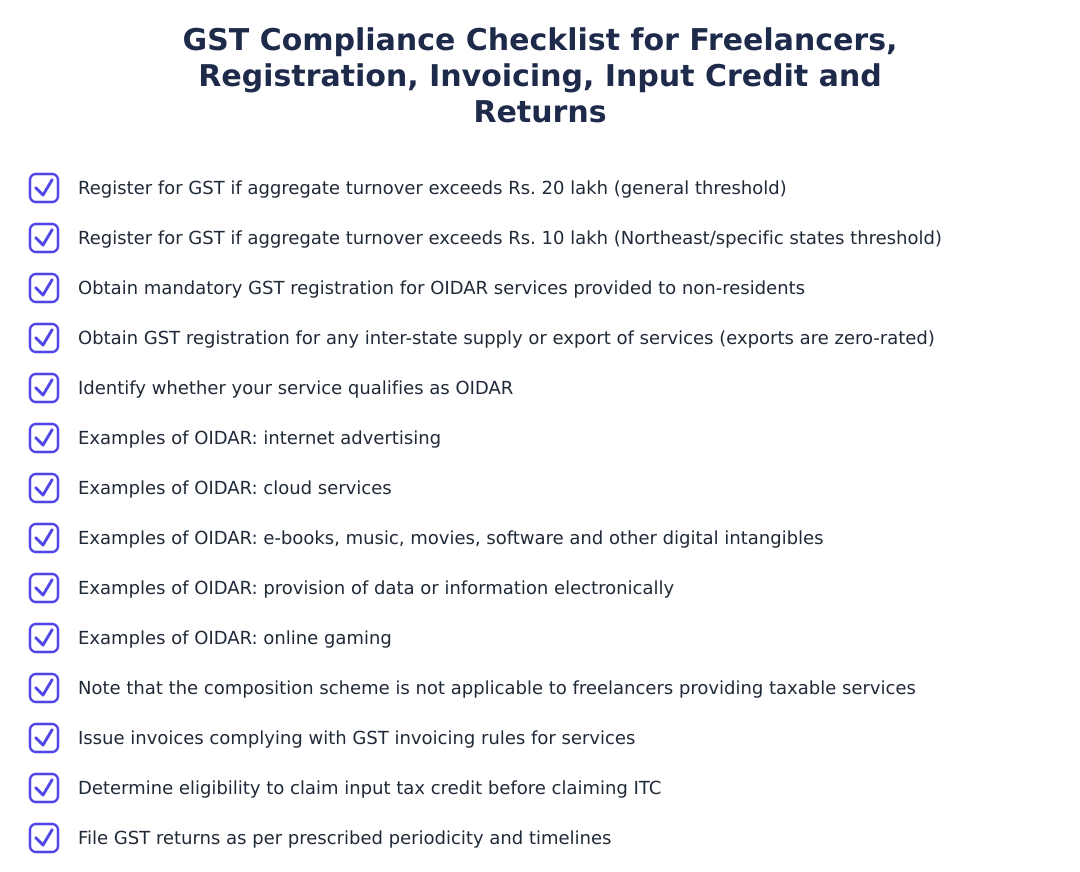
Yes, a freelancer must register for GST if any of the statutory conditions are met. Mandatory registration is required when annual turnover from taxable supplies exceeds Rs 20 lakh (Rs 10 lakh for specified North‑east states), for supplies classed as OIDAR services, and for any inter‑state supply including export of services (exports are zero‑rated and treated as inter‑state under IGST). Even if turnover is below thresholds, voluntary registration is possible and some clients or marketplaces may insist on a GSTIN.
What are OIDAR services and do they affect a freelancer’s GST obligations?
OIDAR (Online Information and Database Access and Retrieval) services are digital services delivered over the internet and include things like online advertising, cloud services, e‑books, music, movies, software, data/information delivered electronically, and online gaming. Freelancers supplying OIDAR to a recipient in India generally need to register for GST regardless of turnover threshold because these are specifically covered under GST rules. If the recipient is located outside India and the supply qualifies as export of service, it may be zero‑rated under IGST but registration is still required for inter‑state/exports.
Can a freelancer opt for the composition scheme under GST?
Yes, a freelancer providing services may opt for a notified composition‑type scheme if eligible, specifically a scheme (notified March 2019) for service providers with annual turnover below Rs 50 lakh. Under this scheme the freelancer pays a nominal tax at an aggregate rate of 6% (3% CGST + 3% SGST) on quarterly supplies, with simplified compliance and conditions similar to Section 10 composition. Note that composition rules have eligibility conditions and do not allow collection of tax from customers in the normal manner, so check restrictions (like inter‑state supplies or OIDAR) before opting in.
What GST rate will apply to my freelancing services?
Freelance services are taxed according to the GST rate slabs of 0%, 5%, 12%, 18% and 28%; if a specific rate for the service is not prescribed then 18% is the default taxable rate. The exact rate depends on the nature of the service (for example professional, technical, or digital services) and any specific notifications that classify a service into a particular slab. Always verify the Service Accounting Code (SAC) applicable to your service to determine the precise GST rate and consult notifications for exceptions such as export (zero‑rated) supplies.
What should I put on invoices when billing as a freelancer under GST?
The invoice issued by a freelancer must comply with GST invoicing rules and include the supplier’s and recipient’s name and address, GSTINs (if registered), the appropriate Service Accounting Code (SAC), invoice date, taxable value, tax rate and tax amount, and signature where applicable. If supplying inter‑state, IGST must be shown; for intra‑state, CGST and SGST should be shown separately. For exempt or zero‑rated supplies, the invoice should clearly state the exemption/zero‑rating references and for recipients who are unregistered, additional prescribed particulars may be required.
Can a freelancer claim input tax credit (ITC) on purchases used for providing services?
Yes, a freelancer registered under GST can claim input tax credit on GST paid for goods and services used in providing taxable services, subject to the usual ITC conditions (possession of tax invoice, receipt of services, tax paid to government, and usage for business). Examples include GST on purchases like laptops, internet services, software subscriptions and electricity used partly or wholly for providing services; partial use may require apportionment. Note that if you opt for the composition scheme, you are not eligible to claim ITC.
Do freelancers have to file GST returns and how many filings are required?
Yes, registered freelancers must file regular GST returns and, as per the guidance referenced, a total of 25 returns may be required which includes two monthly returns and one annual return among other specified returns and reconciliations. Returns capture outward supplies, inward supplies, input tax credit details and tax payments; frequency and number depend on registration type (regular, composition, or special schemes) and whether supplies are inter‑state or via e‑commerce. Non‑filing or non‑compliance can attract penalties, and even unregistered freelancers may be tracked by tax authorities via TDS or bank transactions, so timely filing or expert help is recommended.
Do I need GST registration if I export services as a freelancer?
Yes, exporting services is treated as an inter‑state supply under the IGST Act and requires mandatory GST registration even if your turnover is below the domestic threshold. Export of services, when it meets the conditions for export, qualifies as zero‑rated supply (meaning tax rate is effectively 0% with refund options), but registration and appropriate documentation (export invoices, LUT/bond, proof of receipt of payment in convertible foreign exchange) are still necessary. Failure to register or maintain export documentation can prevent claiming zero‑rating benefits and refunds.
Need help staying GST compliant?
MoneyGence's AI Finance OS tracks your compliance, wallet share, and finances in one place, built for agencies and growing businesses.
Get started with MoneyGence