GST Form SPL-02: Complete Guide on Eligibility & Filing
This guide explains GST Form SPL-02 in practical terms: what the form is for, who typically files it, the usual timeline and deadlines you should watch for, the step-by-step filing process, the documents you will need to attach, and the principal benefits of using this form. If you are dealing with a contested demand, an appeal, or a reclassification of a previously issued demand, SPL-02 can be part of the compliance route available to taxpayers. Understanding the form, the information it requires, and how the portal interacts with payment records reduces the risk of errors and helps ensure your submission is accepted without avoidable delays. This article is written to help accountants, tax practitioners and business owners prepare before they access the GST portal or consult a tax advisor. Because application rules, timelines and portal screens can change, this guide focuses on the practical steps and supporting documents you will typically need, and flags the checkpoints where you should verify the exact dates and procedural details with the official GST portal or with a qualified tax professional. Read on to learn the process flow and what you should prepare so filing SPL-02 becomes a routine administrative task rather than an uncertain exercise.
What is GST Form SPL-02?
GST Form SPL-02 is a portal-based application used in specific situations that arise from tax demands and related appeal or reclassification processes. The form provides a structured way for a taxpayer to present particulars about an existing demand order, the amounts involved, and any associated adjustments such as credit reversals or restorations. It acts as a formal record on the portal so that the tax administration can track voluntary payments, claims, or requests tied to the demand.
Practically, SPL-02 brings together details that connect the demand order, payment records (including voluntary payments), contested sums, and any downstream entitlements. Using the form helps ensure that the income tax or GST administration can reconcile payments and claims against the specific demand, and it creates an auditable trail of the taxpayer’s position. Because the form maps payments and denials/rectifications of input tax credit or similar adjustments, accurate completion reduces the need for follow-up clarifications from the tax authority.
Who can file GST Form SPL-02?
SPL-02 is generally used by taxpayers who are parties to a demand-related proceeding and who need to record details of that demand on the GST portal. Typical filers include taxpayers who have received a demand notice and are pursuing appeals, taxpayers who have had a demand order reclassified or revised, and taxpayers who have made voluntary payments against a demand and need to link those payments for reconciliation.
Eligibility to use SPL-02 is shaped by the procedural posture of the demand, for example, whether appeals have been filed and whether decisions or reclassification orders are pending. Because eligibility depends on the specific facts of each demand and the stage of any appeal or rectification, taxpayers should confirm whether SPL-02 is the appropriate route in their case by checking the official guidance on the GST portal or consulting a tax practitioner.
GST Form SPL-02 timeline
Like most procedural forms, SPL-02 operates within a timeline defined by the tax law and the portal’s process rules. There are normally two distinct timing considerations: the deadline for making any voluntary payment that the form will record, and the deadline for submitting the application itself. These time limits are important because missing them can affect the ability to claim relief or to have payments properly matched to the demand.
Because timelines and cut‑off dates can vary with the category of demand, the type of appeal, or the date of reclassification, it is essential to verify the exact dates that apply to your matter. The GST portal and official circulars/notifications are the correct sources for up‑to‑date deadlines. If you are uncertain, seek professional advice promptly to avoid losing entitlement or missing reconciliation windows.
Step-by-Step process to file GST Form SPL-02
Verify that SPL-02 is the correct form for your situation by checking the status of the demand and any appeals; consult the portal guidance or a tax advisor if unsure.
Collect the demand order number, issuance date, appeal reference numbers and any communication about reclassification or decisions to ensure accurate input.
Identify voluntary payments made against the demand and retrieve the corresponding payment acknowledgement or reference numbers so they can be linked in the form.
Fill in the required tables on the SPL-02 screen, basic GSTIN details, demand particulars, amounts claimed by financial year, and payment linkages, ensuring arithmetic and mapping are correct.
Validate all entries, attach required supporting documents, and submit the form via the GST portal. Retain screenshots or acknowledgement details after submission.
Documents required to file Form SPL-02
The typical supporting documents you will need are the demand order itself and any appeal orders or acknowledgements confirming that appeals have been filed. If payments have already been made against the demand, keep the payment acknowledgement or reference details handy so you can map them in the form.
Additional helpful documents include correspondence showing reclassification or rectification of the demand, evidence of any input tax credit adjustments that were reversed or restored as a result of the demand, and authorised signatory proof if the filing is being done through a tax practitioner. Always attach copies rather than originals and follow the portal’s specifications for file type and size.
Key benefits of filing GST Form SPL-02
Filing SPL-02 helps formally link payments and claims to a specific demand order on the GST portal, which simplifies reconciliation and reduces the risk of the demand remaining unresolved on the portal ledger. Properly completed, the form provides an auditable trail showing that voluntary payments were made and how those payments should be applied.
Another practical benefit is clarity: when the portal has accurate mapping between demand, payment and appeals, it lowers the probability of follow-up notices or administrative confusion. For taxpayers engaged in appeals or in cases of reclassification, using SPL-02 in the correct manner supports a cleaner case file and can assist in obtaining timely credit or rectification where appropriate.
Frequently Asked Questions
Q: Can I file SPL-02 after making a payment? A: In many cases the form is designed to record voluntary payments and link them to a specific demand; however, whether a particular payment can be mapped depends on the portal’s rules and the timing of the payment. Always check the portal guidance for post‑payment procedures.
Q: What if my appeal is still pending? A: If an appeal is pending, SPL-02 may still be the correct route to record payments or related facts, but the appropriateness depends on the stage of the appeal. Consult the official instructions or a practitioner to confirm.
Q: Will filing SPL-02 automatically waive interest or penalties? A: Filing the form records details and maps payments; whether interest or penalties are waived is a substantive legal outcome determined by the tax authority or by orders in appeals, and cannot be assumed simply because the form is submitted. Seek advice on the substantive consequences in your case.
SPL-02 is a procedural tool that helps taxpayers record demand-related data and reconcile payments on the GST portal. Preparing the right documents, mapping payments accurately, and confirming the form’s applicability to your facts will smooth filing and reduce follow-up. Because specific deadlines, eligibility categories and portal behaviors can change, always verify the current rules on the official GST portal or with a qualified tax professional before you file.
Frequently asked questions
What is GST Form SPL-02 used for?
GST Form SPL-02 is used to apply for a waiver of penalty, interest, or both levied in a tax demand under Section 73 (and certain reclassified Section 74 cases) where appeals are pending. The form lets eligible taxpayers request relief where no revision order has been passed on the first appeal u/s 107 or where second appeals are pending u/s 113, and it must be filed on the GST portal with details of the demand, amounts claimed, and related payments. Filing SPL-02 does not automatically waive the demand, it is an application to the proper officer and must include mapped payment details (DRC-03) or ARN evidence where relevant. The form contains multiple tables to capture GSTIN/contact details, demand order particulars, claimed amounts and ITC adjustments, and payment mapping so the tax authority can process the waiver request.
Who is eligible to file GST Form SPL-02?
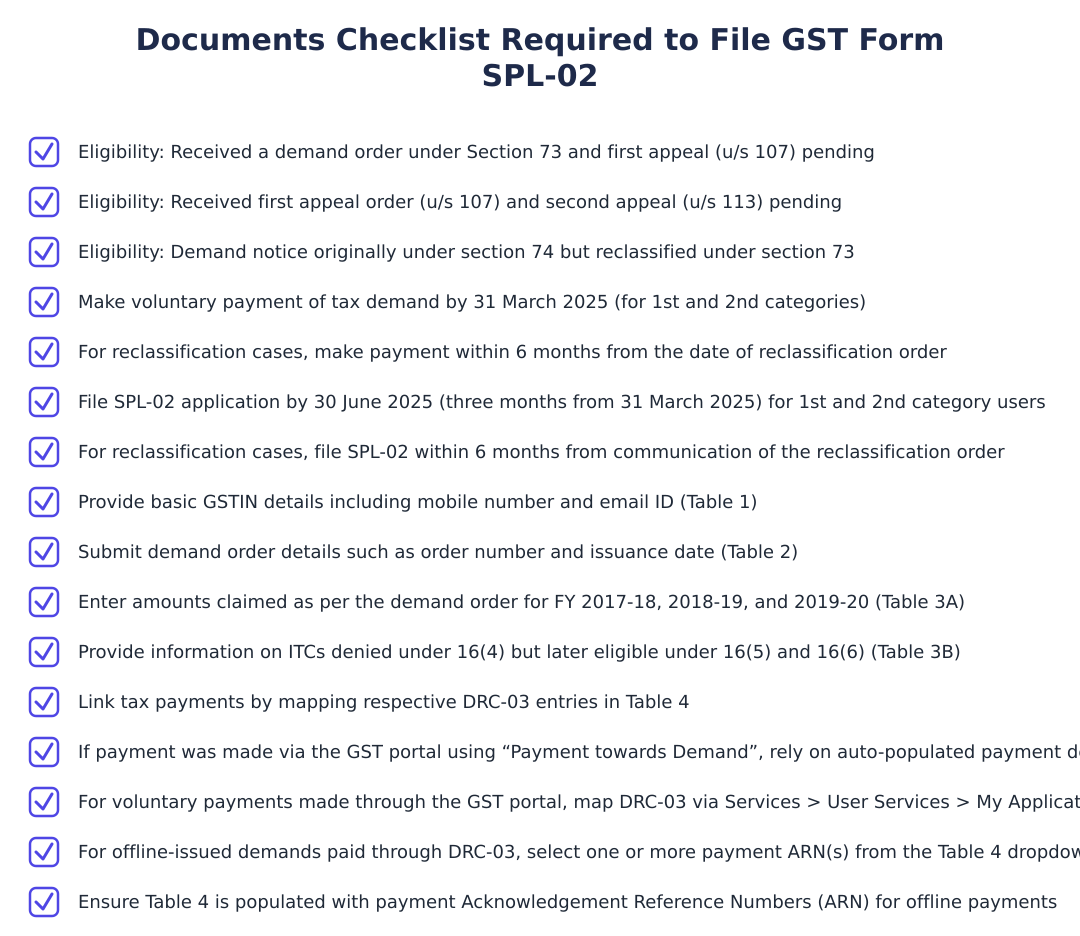
You are eligible to file SPL-02 if you fall into one of three categories under Section 128A(1): a taxpayer who received a demand under Section 73 and has filed a first appeal where no order has been passed u/s 107, a taxpayer who received a first-appeal order and has filed a second appeal where no order has been passed u/s 113, or a taxpayer who initially received a Section 74 demand that was later reclassified under Section 73. Only registered users on the GST portal meeting these conditions can apply for waiver of penalty and/or interest using SPL-02. Eligibility is strictly tied to the appeal/reclassification status and the statutory provisions referenced, so cases outside these scenarios are not eligible.
What are the important deadlines for paying the tax demand before filing SPL-02?
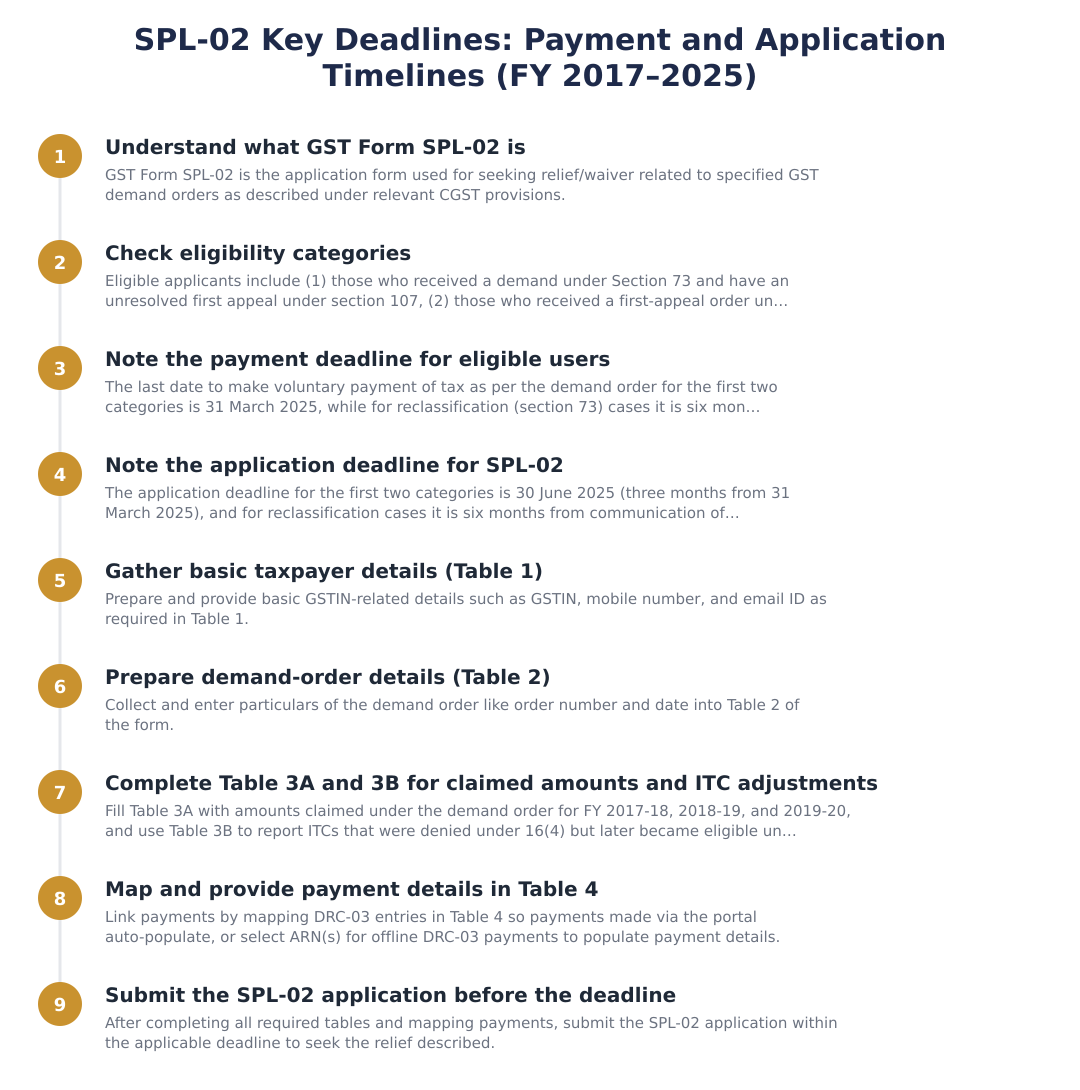
The deadline for voluntary payment of the tax demand for the first two categories of users (appeal pending u/s 107 or u/s 113) is 31 March 2025. For reclassification cases under Section 73 (those originally issued under Section 74), the last date for voluntary payment is the date ending the six-month period from the date of communication of the reclassification order. Payments made after these dates may affect eligibility or the outcome of the SPL-02 application, so timely mapping of payments (DRC-03) is important when filling Table 4 of the form.
What are the filing deadlines to submit GST Form SPL-02?
The application deadline to submit SPL-02 for the first two categories (appeals pending) is 30 June 2025, which is three months from 31 March 2025. For reclassification cases under Section 73, the application deadline is the date ending six months from the date of communication of the reclassification order, matching the six-month payment period for those cases. These statutory timelines must be adhered to; missing them will render you ineligible to apply under Section 128A(1) via SPL-02.
What are the step-by-step tables and fields I must fill in SPL-02 on the GST portal?
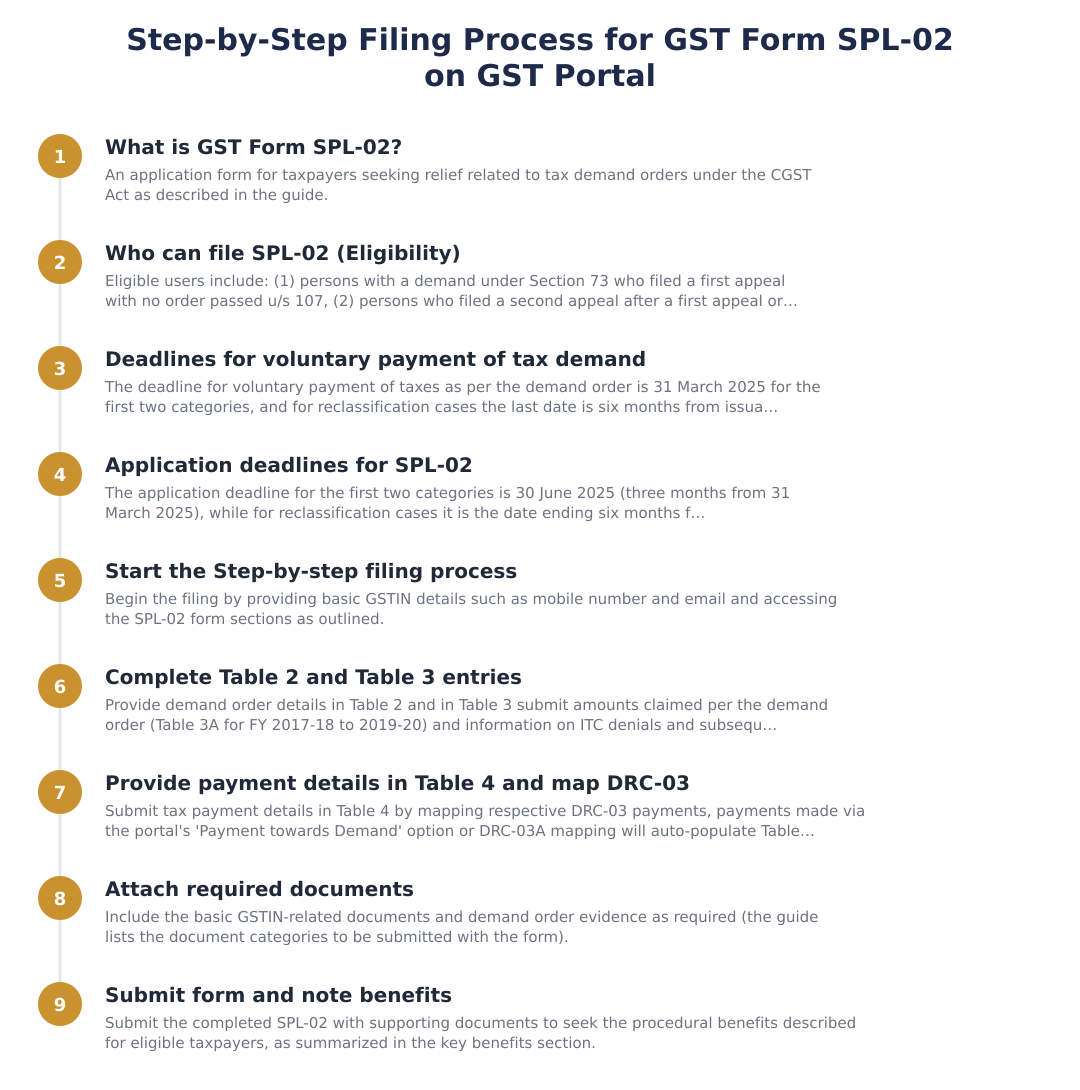
You must complete several tables in SPL-02: Table 1 for basic GSTIN and contact details; Table 2 for demand order particulars (order number, date, issuing authority); Table 3 which has subsections 3A for amount claimed as per the demand for FY 2017-18, 2018-19 and 2019-20 and 3B for ITC items denied under 16(4) but later allowed under 16(5)/16(6); and Table 4 for payment details linked to the demand (mapping DRC-03 entries or selecting ARN for offline payments). For portal-issued demands where payment used the “Payment towards Demand” option or DRC-03A mapping, Table 4 auto-populates; for offline demands you must pick the payment ARN(s) from a dropdown to link payments. Ensure amounts in Table 3A/3B reconcile with payments referenced in Table 4 and attach supporting documents where required.
How do I map or provide payment proof for the demand in SPL-02?
Payment evidence for the demand must be linked in Table 4 either by auto-population (for demands issued and paid through the GST portal’s “Payment towards Demand” option or via mapped DRC-03A entries) or by selecting the ARN(s) for voluntary payments made offline using DRC-03. For portal payments you can find DRC-03A details under Services > User Services > My Applications > FORM GST DRC-03A which, once mapped, auto-populates Table 4; for offline payments, choose one or more ARNs from the Table 4 dropdown to link the payment. Accurate mapping is crucial because Table 4 ties the waiver claim to actual payments and the portal will use this information when processing the SPL-02 request.
What documents should I upload when filing GST Form SPL-02?
You should upload authentic copies of the demand order (showing Section 73 or reclassification from Section 74), appeal filings or acknowledgement proving the appeal status, payment proofs or ARN for DRC-03 payments, and any documents supporting ITC adjustments claimed in Table 3B. Also include GST registration details and contact proof if requested by the portal; specific attachments depend on the entries in Tables 2–4 and the nature of your claim. Providing clear scanned copies and correctly mapped ARNs/portal payments speeds up verification and reduces queries from the tax officer.
What happens after I submit SPL-02, how is my waiver application processed?
After submission, the proper officer reviews the SPL-02 application, verifies the demand details, mapped payments (Table 4), and claimed amounts/ITC (Tables 3A/3B) and then decides whether to grant a waiver of penalty, interest, or both under Section 128A. The waiver is not automatic; the officer may ask for clarifications or reject the application if evidence or eligibility is deficient, and any decision will be communicated through the GST portal. If granted, the waiver will reduce or remove the interest/penalty components against the linked demand; if rejected, normal recovery and appeal routes continue.
What are the key benefits of filing GST Form SPL-02 for taxpayers?
The main benefits of filing SPL-02 are the possibility of waiver of penalty and/or interest levied under a Section 73 demand (or reclassified Section 74 cases), reduction in carrying costs of disputed liabilities, and administrative clarity by formally linking payments and ITC corrections through the form’s structured tables. Filing within prescribed timelines (payment by 31 March 2025 and application by 30 June 2025 for most cases) also preserves statutory relief options available under Section 128A(1). Additionally, the GST portal’s auto-population and DRC-03 mapping features can simplify filing and provide a clear audit trail for the waiver application.
Need help staying GST compliant?
MoneyGence's AI Finance OS tracks your compliance, wallet share, and finances in one place, built for agencies and growing businesses.
Get started with MoneyGence