GST Invoice Format: Rules, Types & Mandatory Details (India)
This guide explains what a GST invoice is, who must issue one, the mandatory particulars that must appear on a GST invoice, the recognised types of invoices under the GST framework, and where the law allows revision of invoices and notes. You will learn why a properly prepared GST invoice matters for legal compliance and for claiming Input Tax Credit (ITC), and which fields the CGST Rules specifically require on tax invoices. Understanding these points helps businesses stay compliant with GST law, avoid disputes with buyers, and ensure transactions are supported by appropriate documentary evidence. The guide draws only on the statutory role of GST invoices and the particulars prescribed by the CGST Rules, and it flags the key invoice/document types recognised under GST such as bill of supply, reverse charge invoices, aggregate invoices, debit notes and credit notes. It also summarises who is obliged to issue invoices under the CGST Act and notes that the law prescribes timelines to issue invoices and to revise invoices or issue debit/credit notes. Read on for concise, practical explanations of each topic and what they mean for a registered supplier.
What is a GST Invoice?
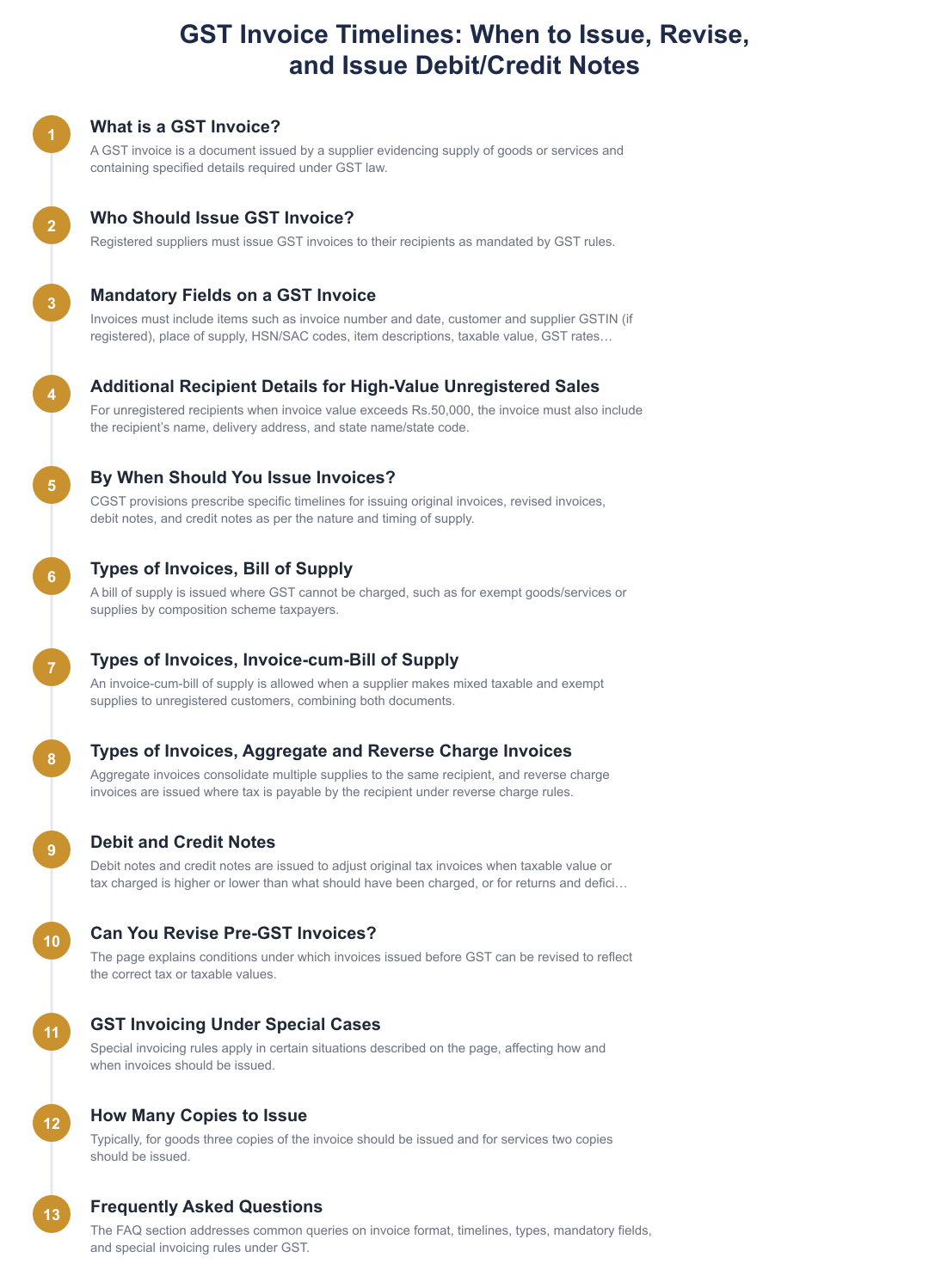
A GST invoice is an official document issued by a GST-registered enterprise on the sale of goods or services that contains the mandatory particulars prescribed by the CGST Rules. It functions as formal evidence of a taxable transaction between supplier and recipient under the GST regime.
Beyond recording the sale, a GST invoice serves important legal and commercial roles: it acts as documentary proof of the supply and, where applicable, enables the buyer to claim Input Tax Credit (ITC). Because of these consequences, accuracy and completeness of the invoice particulars are essential for both suppliers and recipients.
Who Should Issue GST Invoice?
Any business registered under the CGST Act must issue a GST-law compliant invoice when it makes a taxable supply of goods and/or services. This requirement flows directly from the statutory obligations imposed by the CGST Act on registered persons.
Issuing a compliant invoice is not optional for registered taxpayers: it is the primary mechanism by which tax liability is documented and communicated to the buyer, and it underpins downstream rights such as claiming ITC where admissible under the law.
What are the Mandatory Fields a GST Invoice should have?
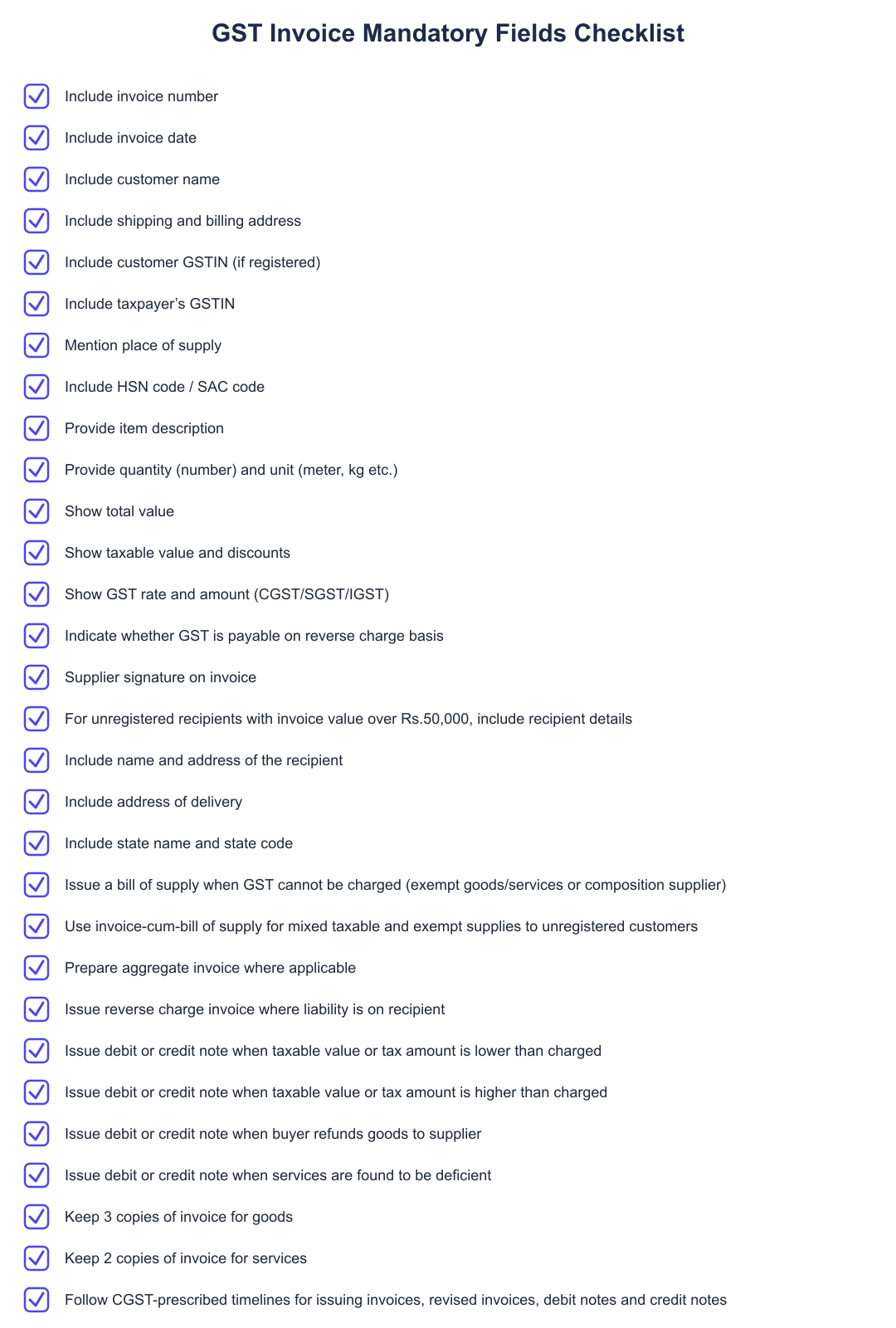
The CGST Rules prescribe specific mandatory particulars for tax invoices. These include the invoice number and date, the supplier’s and recipient’s GSTIN (where the recipient is registered), the place of supply, the HSN or SAC classification, item-wise details (description, quantity and unit), the taxable value, the tax rate and tax amount, an indication if tax is payable on reverse charge basis, and the signature of the supplier.
These particulars are required so that the invoice unambiguously identifies the transaction, the tax treatment applied, and the parties involved. Accurate capture of these fields is necessary both for meeting legal obligations under the CGST Rules and for enabling correct tax accounting and entitlement to ITC by recipients.
By When Should you Issue Invoices?
The GST Act and its rules set out time limits for issuing tax invoices, as well as for issuing revised invoices, debit notes and credit notes. These prescribed due dates are part of the compliance framework and determine when an invoice or adjustment document is considered timely.
Meeting the statutory timelines matters because delays can affect the legal standing of the documentation, the timing of tax liability recognition, and the ability of recipients to claim Input Tax Credit in accordance with GST provisions. Businesses should therefore be aware that the law contains defined timelines and ensure their billing processes align with them.
What are Other Types of Invoices?
The GST framework recognises several specialised invoice/document types in addition to the standard tax invoice. These include bill of supply, reverse charge invoices, aggregate invoices, as well as debit and credit notes. Each type serves a different purpose depending on the nature of supply and the applicable tax treatment.
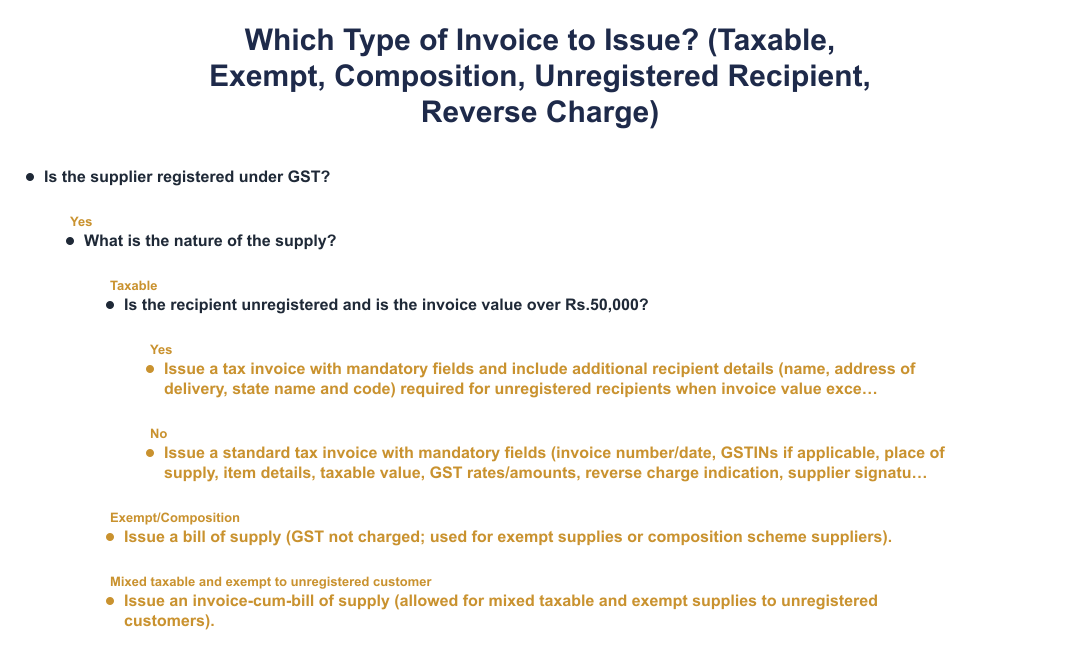
For example, a bill of supply is used where GST cannot be charged, such as supplies that are exempt or where the supplier has elected the composition scheme, while reverse charge invoices document supplies where the recipient is liable to pay tax. Aggregate invoices, debit notes and credit notes are also recognised under GST to record consolidated supplies or adjustments to earlier invoices.
Can you Revise Invoices Issued Before GST?
The GST law and rules provide mechanisms to issue revised invoices and to issue debit and credit notes where adjustments are necessary. The statute prescribes due dates and procedural points for issuing such revisions and notes to ensure clarity in tax accounting.
Where historical invoices or transactions require correction because the tax or taxable value recorded was not accurate, the appropriate GST documents (revised invoices, debit notes or credit notes) should be issued in line with the timelines and conditions set by the law. Adhering to the prescribed process preserves compliance and supports proper tax reporting.
GST Invoicing Under Special Cases
Certain situations call for specific invoice treatment under GST. As noted, bill of supply is the appropriate document when GST cannot be charged, for instance, for exempt supplies or for suppliers who have opted for the composition scheme. Reverse charge situations require the supplier to indicate that tax is payable by the recipient.
Other special-case documents such as aggregate invoices, debit notes and credit notes address consolidated billing and post-supply adjustments. Businesses operating in these scenarios must ensure they select and prepare the correct document type to reflect tax liability and to support any ITC claims or accounting adjustments.
A GST invoice is a legally significant document that registered suppliers must issue for taxable supplies, containing the mandatory particulars prescribed by the CGST Rules. It functions as evidence of the transaction and, where applicable, enables the buyer to claim ITC. The GST framework recognises a range of invoice types, including bill of supply, reverse charge invoices, aggregate invoices, debit notes and credit notes, and prescribes timelines for issuing invoices and any revisions. Ensuring invoices are complete, accurate and issued within the statutory timelines is essential for GST compliance and correct tax treatment.
Frequently asked questions
What is a GST invoice and why do I need one?
A GST invoice is an official bill a GST-registered business issues for supply of goods or services and it records the amount payable and tax charged. It serves as legal evidence of the transaction, helps determine the time of supply for tax purposes, and enables a buyer to claim Input Tax Credit (ITC) when applicable. A valid GST invoice must include prescribed particulars such as invoice number and date, supplier and recipient GSTIN (if registered), place of supply, HSN/SAC codes, item description, taxable value, and breakup of CGST/SGST/IGST. Without a compliant invoice, the buyer may be denied ITC and the supplier risks non-compliance penalties.
Who must issue a GST invoice in India?
Any person or business registered under the CGST Act must issue a GST-compliant invoice when making a taxable supply of goods or services. This requirement applies irrespective of business size, and buyers should obtain GST invoices from their vendors to claim Input Tax Credit (ITC) where eligible. Certain suppliers who cannot charge GST, such as those supplying exempt goods or those under the composition scheme, issue a bill of supply instead of a tax invoice. Unregistered persons cannot issue GST invoices for taxable sales under GST registration rules.
What are the mandatory fields that must appear on a GST invoice?
A GST invoice must include the invoice number and date, supplier and (if registered) recipient GSTIN, customer name and billing/shipping address, place of supply, HSN/SAC codes, detailed description of goods or services with quantity and unit, total value, taxable value after discounts, GST rate and tax amounts (CGST/SGST/IGST), indication if reverse charge applies, and supplier’s signature. If the recipient is unregistered and the invoice value exceeds Rs. 50,000, the invoice must also carry the recipient’s name, delivery address, state name and state code. These particulars are prescribed under the CGST Rules to ensure the invoice supports tax compliance and ITC claims.
By when should I issue a GST invoice after supplying goods or services?
You should issue a GST invoice by the time of supply as prescribed under GST law, which generally means at or before the time goods are removed/handed over or services are provided, with specific CGST Rules setting timelines for particular cases. The CGST Act also sets deadlines for issuing revised invoices, debit notes and credit notes; for example, invoices issued before receiving permanent GST registration must be revised and the revised invoice issued within one month of receiving the registration certificate. Timelines can vary depending on whether the supply is of goods or services and the nature of the transaction (e.g., continuous supplies), so follow the CGST provisions applicable to your transaction type.
What is a bill of supply and when should I issue it?
A bill of supply is a document issued when GST cannot be charged on a supply, typically when the goods or services are exempt from GST or when the supplier has opted for the composition scheme. It contains similar particulars to an invoice but does not show tax amount since no GST is charged, and it informs the recipient that Input Tax Credit cannot be claimed. Suppliers under the composition scheme or those making exempt supplies must issue a bill of supply instead of a tax invoice for such transactions.
What is an invoice-cum-bill of supply and when can I use it?
An invoice-cum-bill of supply is a combined document allowed when a supplier makes both taxable and exempt supplies to an unregistered person, enabling a single document to serve as a tax invoice for taxable items and a bill of supply for exempt items. This combined format avoids issuing two separate documents for the same transaction with an unregistered recipient, but the invoice must clearly indicate taxable and exempt goods/services and show tax details for taxable items. Use of invoice-cum-bill of supply is permitted under GST rules to simplify billing in mixed-supply scenarios to unregistered customers.
What are aggregate invoices, reverse charge invoices, debit notes and credit notes under GST?
An aggregate invoice consolidates supplies made to the same unregistered recipient during a day into one invoice, while a reverse charge invoice is issued when tax is payable by the recipient instead of the supplier under reverse charge provisions. A debit note is issued when taxable value or tax charged in the original invoice was understated (e.g., higher taxable value needed), and a credit note is issued when taxable value or tax charged was overstated or goods are returned or services are deficient. Each of these documents must follow GST rules regarding contents and timelines so they can correctly adjust tax liabilities and support ITC claims or refunds.
Can I revise invoices that were issued before GST was implemented?
Yes, invoices issued between the date of GST implementation and the date you received permanent GST registration can be revised by issuing a revised invoice within one month from the date of issue of the registration certificate. Dealers who obtained provisional registration and later received permanent registration must reissue or revise earlier invoices to reflect the correct GST registration details and comply with GST requirements. Failing to issue revised invoices within the stipulated period could affect compliance and the ability of buyers to claim Input Tax Credit on those supplies.
How many copies of a GST invoice should I give for goods and services, and what about e-invoicing?
For supply of goods you should typically issue three copies of the invoice, and for supply of services two copies, as per common invoicing practice under GST. Additionally, since 2020 the government introduced e-invoicing for specified B2B transactions where invoices are authenticated by the GSTN, which changes the process by requiring electronic reporting for affected suppliers. Check whether your turnover and transaction types fall under the e-invoicing mandate, because if they do you must generate invoices through the e-invoice system and still provide the required physical or electronic copies to the buyer as applicable.
Need help staying GST compliant?
MoneyGence's AI Finance OS tracks your compliance, wallet share, and finances in one place, built for agencies and growing businesses.
Get started with MoneyGence