GST Notices: Types, Reasons & How to Reply (Guide)
This guide explains GST notices: what they are, common reasons you might receive one, the main categories of notices that GST authorities issue, the valid ways a notice can be delivered, and practical steps to respond. For businesses and tax professionals in India, understanding GST notices is essential because a timely and accurate response can prevent escalation into formal recovery, assessment or dispute procedures. The guide uses official, practical signposts, reasons that trigger notices (such as return mismatches or incorrect input tax credit claims), the statutory channels through which authorities serve notices, and the specific role of the Directorate of Anti‑profiteering when benefits of tax rate reductions or ITC are not passed on. You will learn how to recognise why a notice was issued, where to look for it (physically or on the GST portal), and what factual information and records are typically relevant when preparing a reply. The aim is to give you a clear, actionable understanding so you can organise documents, engage your tax advisor promptly, and use the correct communication channels. While this guide does not replace professional advice for complex disputes, it will help you assess urgency, assemble the usual supporting material, and avoid common mistakes that lead to further compliance action.
What is a notice under GST
A GST notice is an official communication from a tax authority seeking information, clarification, or compliance action from a registered person or other stakeholder. Notices can range from routine requests for supporting documents to more formal show‑cause or demand communications. The purpose is to enable the tax authority to verify compliance, resolve discrepancies and ensure correct tax treatment.
Practically, a notice signals that the tax authority has identified an issue or requires verification. It is not automatically an accusation of wrongdoing, many notices arise from routine cross‑checks or data mismatches, but it does require timely attention because authorities use the information they have to progress assessment or recovery if there is no adequate response.
Most common reasons for GST notices
Tax authorities issue notices after data matching, audits or third‑party inputs reveal inconsistencies. Common triggers include mismatches between details reported in GSTR‑1 and GSTR‑3B, differences in input tax credit claims when comparing GSTR‑3B with auto‑populated records such as GSTR‑2A/2B, and long‑standing delays in filing returns (for example, consecutive periods of non‑filing).
Other frequent reasons are inconsistencies between returns and related systems (for example, e‑way bill declarations), incorrect or excess refund claims, incorrect input tax credit claims or failure to obtain registration where a business is liable. Notices may also arise from export reporting not matching customs data (for instance, ICEGATE shipping/bill of export records), from required information or record submissions, and from regular audits conducted by tax authorities.
Types of notices under GST law (categories to expect)
GST notices come in several practical categories: (a) scrutiny and mismatch notices arising from return and cross‑system comparisons, (b) refund‑related notices seeking justification where a refund appears incorrect, (c) registration‑related notices about eligibility or verification for registration, (d) demand or recovery‑oriented notices when tax appears unpaid or short‑paid, and (e) audit and assessment notices requiring production of books and records.
A distinct category is anti‑profiteering notices: the Directorate of Anti‑profiteering issues notices where a supplier has not passed on the benefit of input tax credit or reduced GST rates. In those cases, interested parties receive notices asking for details and evidence to support the claim that the benefit was or was not passed on. Recognising the category helps you gather the specific documents the authority will expect.
Valid modes of sending GST notices
GST notices can be served through several legally valid channels. Authorities may hand‑deliver a notice directly or through a messenger or courier, send it by registered post, speed post or courier with acknowledgement, communicate it by email, or make it available on the GST portal when you log in.
If the other modes are not feasible, notices can be published in a regional newspaper circulated in the taxpayer’s locality, or affixed at the taxpayer’s last known place of business or residence. As a last resort, if the authority considers affixture reasonable, a copy may be fixed on the notice board of the officer’s office. Knowing these modes helps you verify authenticity and ensures you do not miss an official communication.
Replying to GST notices and the effects of not replying
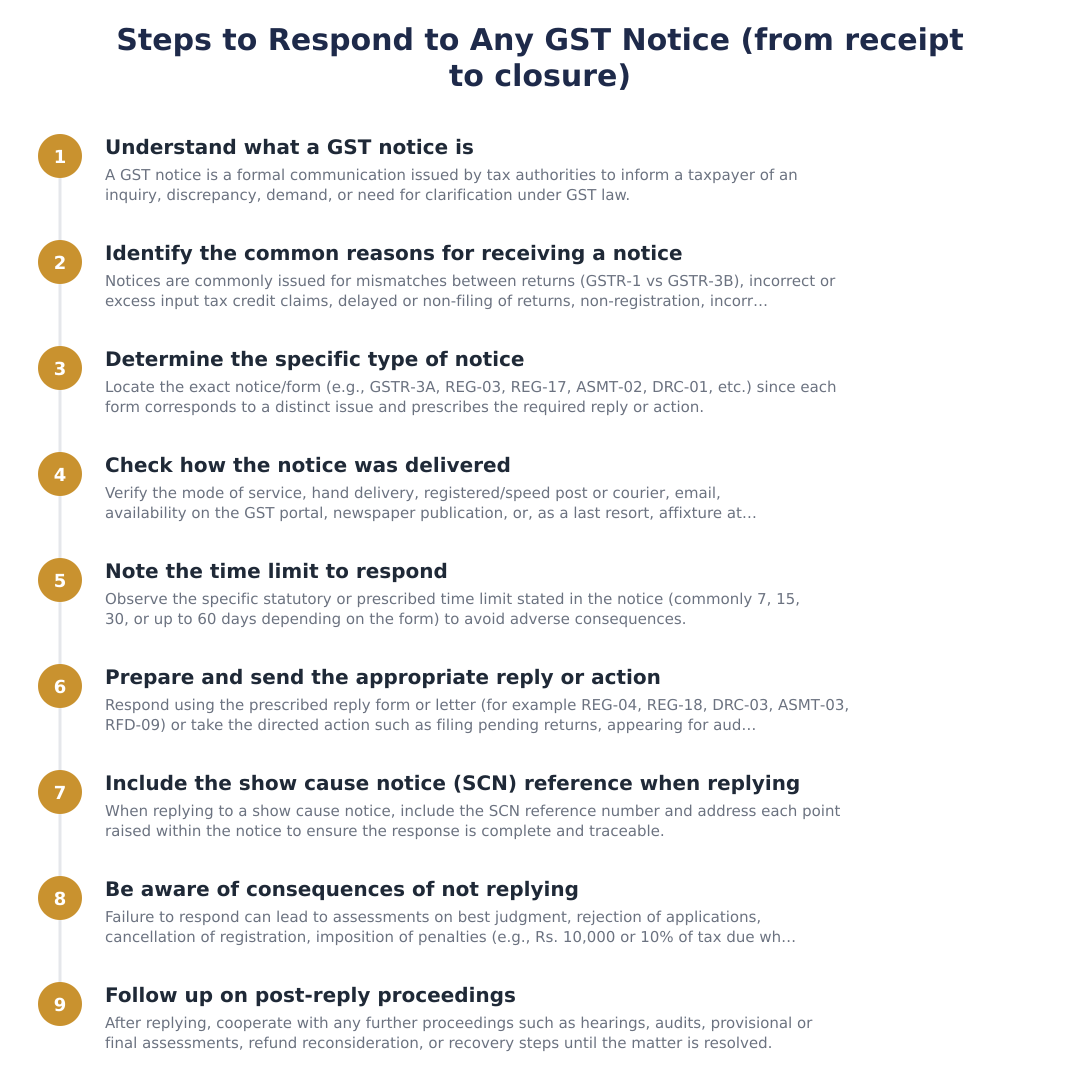
Respond promptly and substantively: identify the notice category, gather the supporting records that address the specific query (for example, invoices or export documentation for mismatches), and submit a reasoned reply through the appropriate channel, often the GST portal, or as specified in the notice. For anti‑profiteering notices, provide the evidence that demonstrates whether the benefit of ITC or reduced GST rates was passed on to customers.
Not replying or delaying a response increases the risk that authorities will proceed using the information they already have. That can lead to follow‑up action such as further notices, assessments or recovery steps. Timely cooperation and clear documentary support give the best chance of resolving the issue without escalation.
GST notices are a routine part of tax administration. By understanding common triggers, recognising the type of notice, checking the valid delivery modes, and responding promptly with relevant records, businesses can manage compliance risk and reduce the likelihood of adverse follow‑up. When in doubt, consult your tax advisor and act quickly to preserve options for a favourable resolution.
Frequently asked questions
What is a notice under GST and why would I get one?
A notice under GST is a formal communication from tax authorities seeking information, clarifying returns, demanding tax or initiating proceedings, and you may get one for discrepancies, non-filing or alleged non-compliance. Notices can be for registration verification, show-cause for demand or cancellation, scrutiny of returns, refund queries, audits, anti-profiteering checks or recovery actions; each notice cites a specific form or section (for example, GSTR-3A for non-filers or DRC-01 for demand). The notice will specify the action required and a time limit to respond, often 7, 15 or 60 days, and non-response can trigger best-judgment assessment, penalties or recovery steps. Always check the exact form and deadline on the notice and preserve the notice reference number for replies or appeals.
What are the most common reasons the GST department issues notices?
Common reasons include mismatches between GSTR-1 and GSTR-3B, differences in claimed input tax credit (GSTR-3B vs GSTR-2A/2B), consecutive non-filing of returns, non-reduction of prices when GST rates fall (anti-profiteering), short-payment or non-payment of tax, wrongly issued refunds, missing GST registration when liable, export reporting inconsistencies with ICEGATE, requests for records during audits, and failure to file required information returns. These triggers typically lead to scrutiny notices, show-cause notices or audit/enquiry notices depending on severity and intent. Timely reconciliation reports (GSTR-1 vs GSTR-3B, GSTR-3B vs GSTR-2A) and maintaining supporting documents reduce the risk of such notices. If a notice is issued, the taxpayer must follow the specified response form and deadline to avoid penalties or best-judgment assessments.
What are the main types of GST notices I should know about?
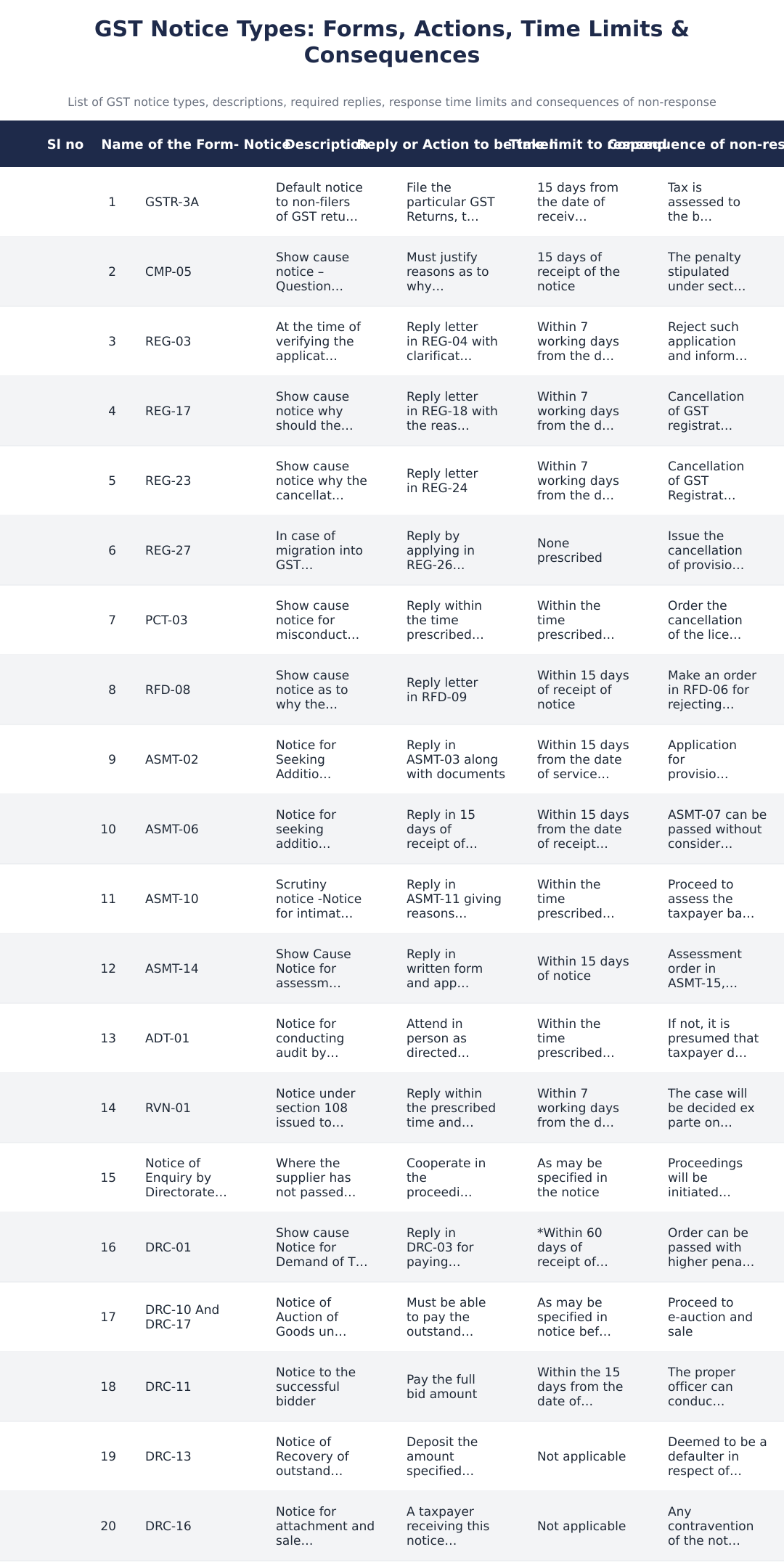
Main types include registration-related notices (REG-03/REG-17/REG-23), non-filer/default notices (GSTR-3A), composition scheme queries (CMP-05), refund show-cause (RFD-08), provisional and final assessment notices (ASMT-02/ASMT-06/ASMT-14), scrutiny notices (ASMT-10), audit notices (ADT-01), demand notices (DRC-01), recovery and auction notices (DRC-10/DRC-17/DRC-11/DRC-13/DRC-16), anti-profiteering enquiries, and practitioner misconduct notices (PCT-03). Each notice cites the relevant response form (for example REG-04 to reply to REG-03) and prescribes a time limit, commonly 7, 15 or 60 days, along with consequences for non-response like cancellation of registration, denial of composition, rejection of refund, assessment to best judgment or recovery actions. Knowing the specific form and statutory provision helps you prepare the correct reply and meet deadlines to avoid adverse orders.
How can I respond to a show cause notice (SCN) under GST and what should the reply include?
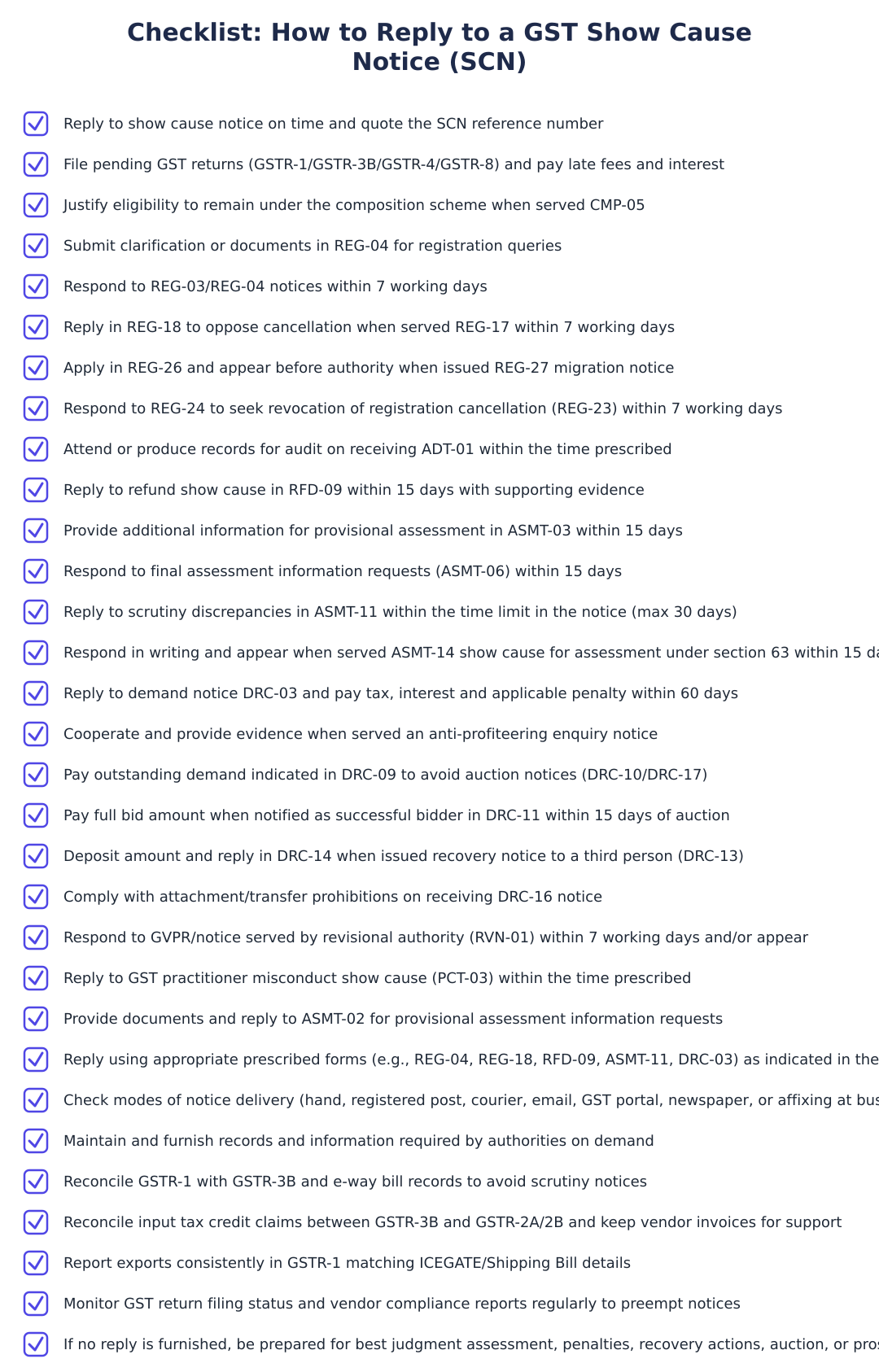
You must reply to a show cause notice by stating the SCN reference number, addressing each allegation with facts and supporting documents, and using the reply form specified in the notice (for example DRC-03 for demand notices or REG-18 for cancellation notices). The reply should directly answer the reasons for the notice, include reconciliations (like GSTR-1 vs GSTR-3B), payment evidence if admitting liability, legal or factual defenses if contesting, and request personal hearing where appropriate; always submit within the time limit stated (commonly 7–15 days). If the notice prescribes a particular reply form (e.g., RFD-09 for refund-related SCNs), use that form on the GST portal and retain proof of filing; late or no reply can lead to adverse orders including best-judgment assessments, penalties, rejection of refunds or cancellation of registration.
What are the valid ways the GST department can serve a notice to me?
A GST notice can be served by hand delivery (direct or via messenger/courier), by registered or speed post with acknowledgement, by email, by making it available on the GST portal after login, by publication in a regional newspaper, or by affixing it at the taxpayer's last known business/residence or the officer's office if other modes fail. The method used is important because statutory timelines for response begin from the date of service by that method; for example a portal notice is deemed served when made available after login. If you suspect service issues, check all channels (physical address, email, GST portal) regularly and keep records of communication addresses on the GST portal to ensure notices reach you.
What happens if I don't reply to a GST notice within the time limit?
If you don't reply within the prescribed time, the authorities may proceed ex parte and pass orders such as best-judgment assessment, cancellation of registration, rejection of refund, imposition of penalty, or initiation of recovery and prosecution depending on the notice type. Specific consequences include assessment to best judgment (GSTR-3A), denial of composition benefits (CMP-05/CMP-07), cancellation of registration (REG-19), rejection of refund (RFD-06), or recovery measures such as attachment and auction of goods (DRC-16). In some demand cases penalty becomes applicable if payment is after 30 days and prosecution can be initiated within statutory limits; therefore timely and substantive replies are critical to avoid harsher outcomes.
What are the typical time limits to respond to common GST notices?
Typical time limits include 7 working days for registration verification or cancellation notices (REG-03/REG-17), 15 days for non-filer and many show-cause or refund notices (GSTR-3A, CMP-05, RFD-08, ASMT-14), 15–30 days for scrutiny and assessment-related notices (ASMT-10 or ASMT-06), and up to 60 days for certain demand notices (DRC-01); some notices specify the time within the notice itself. The exact deadline and any working-day provisions vary by form, so always check the notice form and respond within the stated period to preserve remedies and avoid penalties. If a notice does not state a specific time, the notice will usually prescribe a reasonable time or the statutory period applicable to that proceeding.
Which GST forms are used for tax demand and recovery, and how should I act on them?
Tax demand and recovery use forms such as DRC-01 (show cause for demand with DRC-02 statement), DRC-03 (reply/pay demand), DRC-09/DRC-10/DRC-17 (auction notices), DRC-11 (notice to successful bidder), DRC-13 (recovery from third party), and DRC-16 (attachment of assets); you should reply in the specified form and either pay the demanded amount with interest/penalty or contest the demand with supporting records within the stated time. For DRC-01 demands you typically have 60 days to respond; failing which authorities can pass recovery orders, attach assets, or proceed to auction with statutory notice periods (auction notice must allow at least 15 days before sale). Always check the annexed DRC-02 statement for demand details, preserve payment challans if you pay, and use prescribed forms on the GST portal for replies to avoid further recovery steps.
How does a GST registration cancellation or revocation notice work and what reply is needed?
A notice under REG-17 asks why GST registration should not be cancelled and you must reply using REG-18 within 7 working days explaining reasons to prevent cancellation, while REG-23 is used when seeking revocation of an already cancelled registration and requires reply in REG-24 within 7 working days. Your reply should supply supporting documents, rectify deficiencies, show compliance steps taken, or demonstrate valid grounds for maintaining registration; failure to reply timely to REG-17 typically leads to issuance of cancellation order in REG-19. If registration has already been cancelled and you want revocation, timely and complete response to REG-23 with corrective evidence can lead to revocation rather than permanent loss of registration.
Need help staying GST compliant?
MoneyGence's AI Finance OS tracks your compliance, wallet share, and finances in one place, built for agencies and growing businesses.
Get started with MoneyGence