GST on Commission and Brokerage: Rules, Rates & Compliance
This guide explains how GST applies to commission and brokerage services, who qualifies as an agent under GST, when GST is payable, and how Input Tax Credit (ITC) works for brokers and commission agents. If you run a brokerage practice, act as an agent for buying or selling goods or services, or engage intermediaries, the tax treatment determines invoicing, compliance obligations, and whether you can claim credit for the tax you incur while providing your services. Understanding these points helps you price services correctly, avoid disputes with principals or recipients, and make accurate tax filings. You will learn what the law considers an agent or broker, the circumstances that make commission or brokerage services taxable, practical implications for claiming ITC on expenses and on commission paid to agents, and how attribution of supply affects liability between principal and agent. The content focuses on practical clarity rather than statutory citations: it will help you decide when GST is likely to be triggered on commission income and what evidence and business purpose you need to substantiate ITC claims. The guide is written to help proprietors, partnership firms, and service providers who rely on commission-based revenue or maintain agent networks to handle tax compliance with less friction and better commercial certainty.
Who is a Broker and Commission Agent Under GST?
Under the GST law an agent is someone who carries on the business of supplying goods or services on behalf of another person (the principal). The legal definition explicitly includes brokers, commission agents, factors, auctioneers and mercantile agents. That means a person acting in any of these capacities will generally be considered an agent for GST purposes.
In practice this classification matters because it determines whether supplies are treated as made by the agent, the principal, or as separate transactions. How invoices are raised, who appears as the supplier on documents, and how value is determined can flow from the agent/principal relationship. Businesses should therefore document the agency relationship clearly, agreements, authorisations and records of transactions, to demonstrate the commercial arrangement when tax authorities examine the transaction.
Applicability of GST for Brokers and Commission Agents
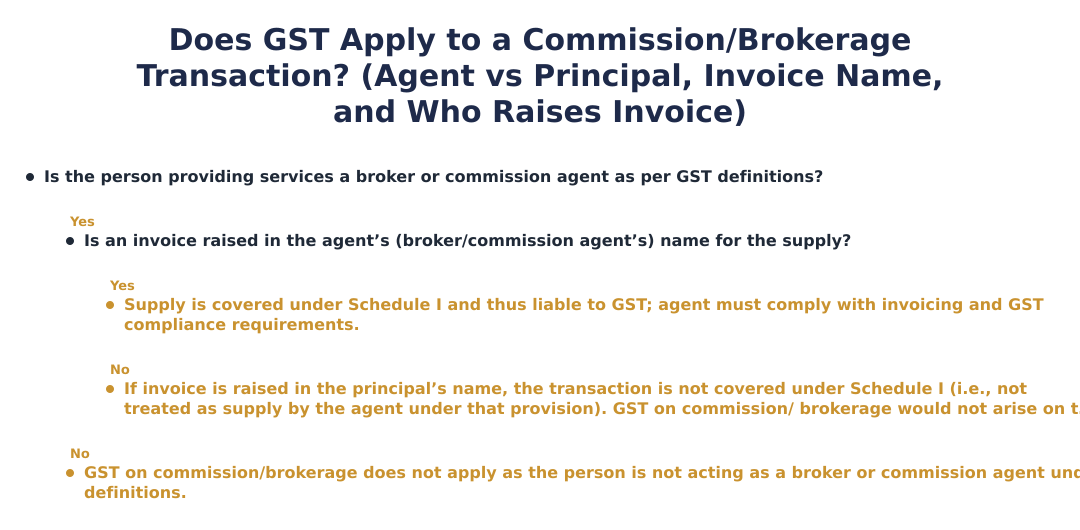
Whether commission or brokerage income attracts GST depends on the nature of the supply and the relationship between the parties. If an agent is carrying out the business of supplying goods or services on behalf of the principal, GST implications arise in line with the agency definition.
The commercial arrangement (for example, whether the agent invoices in his own name or in the principal’s name, and whether supplies are treated as made by the principal or agent) affects which person is liable to discharge GST. Because the law specifically recognises brokers and commission agents as types of agents, many typical brokerage arrangements are covered; businesses should assess each contract to determine the person on whose account the supply is treated as made.
Can Input Tax Credit be Claimed by Commission Agents and Brokers?
Commission agents and brokers can claim Input Tax Credit (ITC) on the GST they pay on inputs and input services that are used to provide their output services. This includes typical office overheads and office supplies incurred in the course of their brokerage or agency business. The availability of ITC helps avoid cascading tax on costs directly linked to supply of services.
To claim ITC, the commission agent must ensure the expense relates to business activities and satisfy regular GST conditions and documentation requirements (such as tax invoices and records). Maintaining clear records tying expenditures to the provision of commission services strengthens the claim and helps during assessments or audits.
Can ITC be Claimed on Commission?
Confirm the commission paid is incurred for business purposes and relates to taxable supplies or exempt supplies that permit ITC under the law.
Retain invoices and supporting documents that demonstrate the commission was paid and received for the stated business activity.
Ensure all general conditions and procedural requirements under GST are complied with before claiming ITC on commission.
Liability of Principal and Agent under GST
The legal classification of a person as agent or principal influences who is treated as the supplier for GST and therefore who is liable to collect and remit tax. When the agent is carrying on the business of supplying on behalf of the principal, that attribution shapes invoicing and tax liability.
Practically, parties should document whether the agent is transacting on behalf of the principal or in his own name. Clear contractual terms and consistent invoicing practices reduce ambiguity about liability and make it easier to determine which party should claim ITC or discharge GST.
GST Compliance for Brokers and Commission Agents
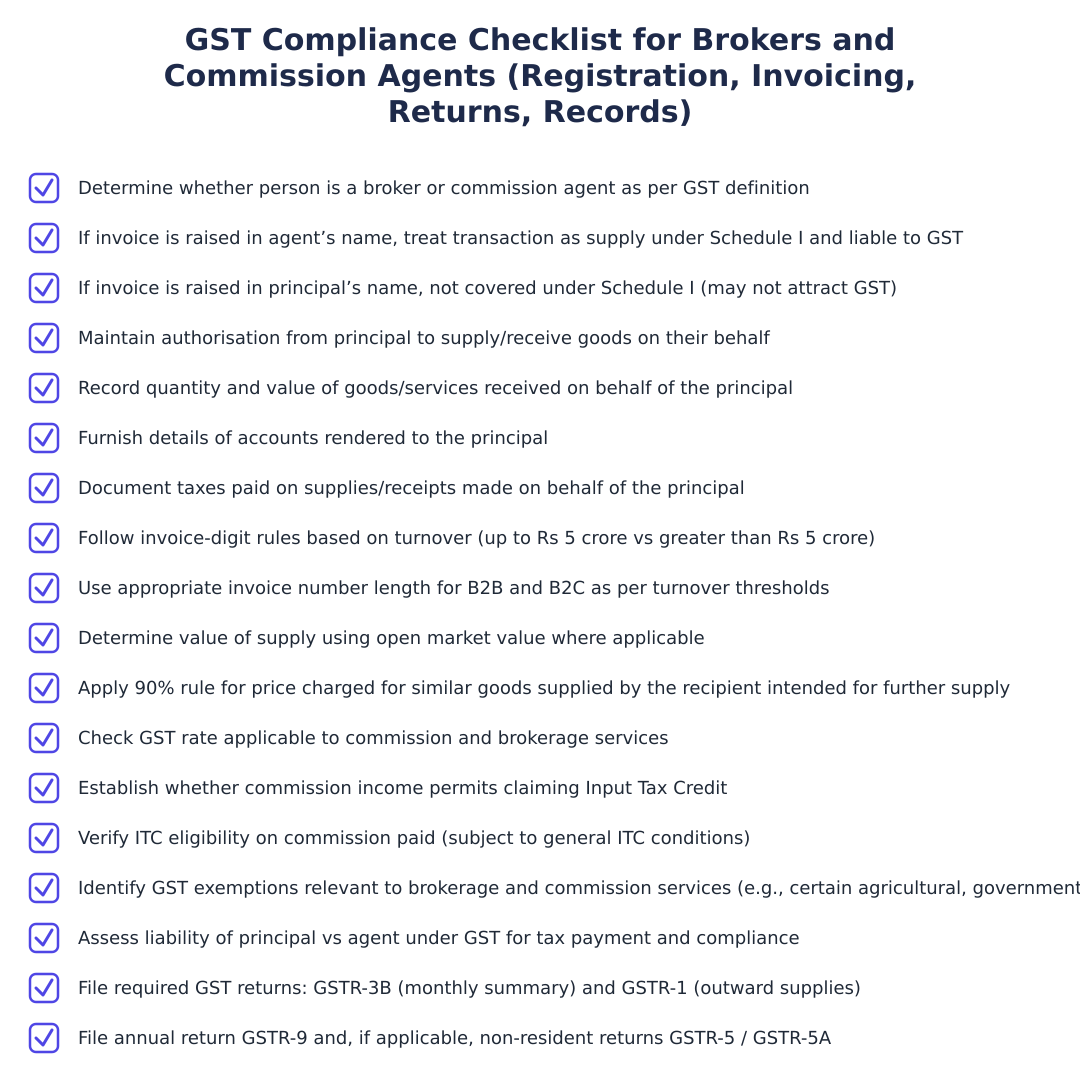
Brokers and commission agents should maintain books and records that support the agency relationship, show the value and nature of supplies, and record taxes paid on inputs and services. These records are necessary to substantiate ITC claims and to establish who supplied goods or services in a transaction.
Because ITC is available on business-related inputs and on commission paid when conditions are satisfied, agents should adopt robust documentation practices, retain authorisations from principals, proofs of supplies made, invoices for expenses and commissions, and details of accounts furnished to principals, to ensure compliance and reduce risk in assessments.
Agency and brokerage arrangements have specific GST consequences because the law expressly recognises agents (including brokers and commission agents). Commission income can attract GST depending on how the supply is structured, and agents can claim ITC on inputs and commission paid when the expenditure is for business purposes and statutory conditions are met. Good contracts and careful record-keeping are the practical safeguards that help brokers, agents and principals apply GST rules correctly and support ITC claims.
Frequently asked questions
Is commission paid to a broker or commission agent taxable under GST?
Yes, commission paid to a broker or commission agent is taxable under GST when the agent supplies services and issues an invoice in his own name or otherwise renders a taxable service. GST applies where the activity falls within the definition of supply (including Schedule I transactions) and the agent is carrying on business on behalf of the principal; the service will attract GST at applicable rates (commonly CGST + SGST). There are exceptions where the activity is specifically exempt (for example certain agricultural services or notified government supplies) or where the invoice is raised in the principal's name and the transaction does not constitute a separate supply by the agent. Always check whether the agent is acting as a pure agent or sole agent and whether specific exemptions apply to that service.
Who qualifies as a broker or commission agent under GST?
A broker or commission agent under GST is a person who carries on business of supplying goods or services on behalf of another person (the principal) and includes brokers, commission agents, factors, auctioneers and mercantile agents. Such persons act as intermediaries or agents in negotiating or concluding sales and may either invoice in their own name or on behalf of the principal, which affects tax treatment. The classification (agent, principal, pure agent, sole agent) determines valuation, invoicing, and tax liability under GST rules. Identification as an agent is based on the nature of contractual relationship and the manner of supply and invoicing.
What GST rate applies to brokerage and commission services?
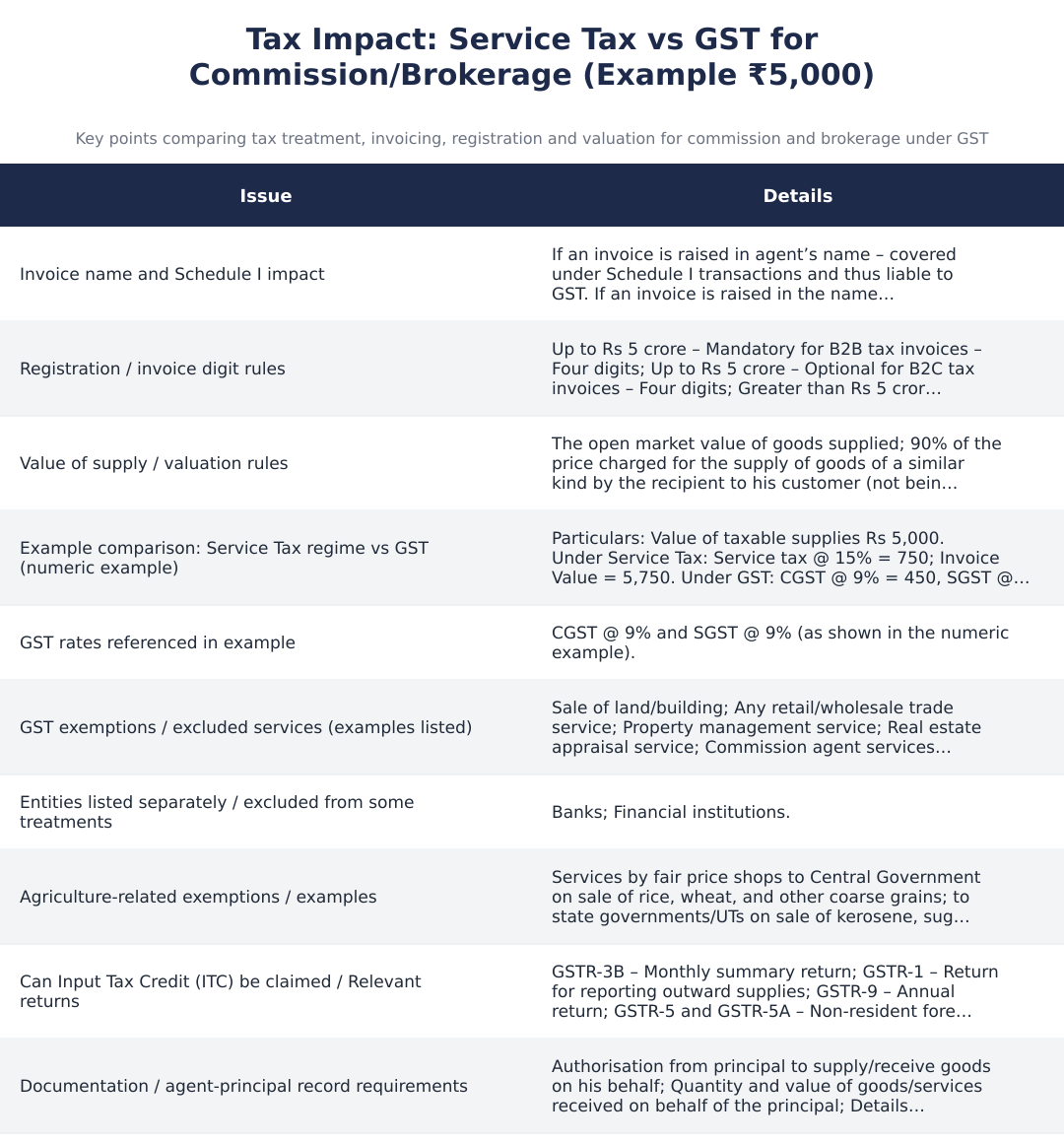
Brokerage and commission services are generally taxable under GST at the applicable service tax rates, commonly split as CGST and SGST, for example, CGST 9% and SGST 9% (total 18%) in typical cases. The exact rate depends on the nature of the service and any specific notifications or exemptions; some services related to agriculture, government supplies, or financial institutions may be treated differently or exempt. Where GST replaces prior service tax, the total tax incidence can change (e.g., old service tax 15% vs GST total 18%), so verify the current rate applicable to the specific commission service. If an agent provides exempt supplies or the transaction is out of scope, no GST will be charged.
How is the value of supply for a commission agent determined under GST?
The value of supply by a commission agent is determined under GST valuation rules and varies by role: as a sole agent the value can be the open market value of goods supplied or 90% of the price charged for similar goods by the recipient to his customer; as a pure agent expenditures reimbursed without markup are excluded from the value of supply. Rules such as Rule 29 (sole agent) and Rule 33 (pure agent) govern these calculations, and reimbursements made as a pure agent are not included in the agent's taxable value. Proper classification of the agent's role is crucial because it changes the taxable base and the GST payable.
Do brokers and commission agents need GST registration?
Yes, brokers and commission agents must obtain GST registration if their activities meet the definition of taxable supply and they exceed the turnover or other registration conditions prescribed under GST, or if they make B2B supplies requiring tax invoices. Invoicing norms differ by turnover: for entities up to Rs 5 crore B2B tax invoices require four-digit invoice numbering (optional for B2C), while those above Rs 5 crore require six-digit invoice numbering for B2B. Additionally, non-resident taxable persons (e.g., non-resident agents) must register and file returns such as GSTR-5 or GSTR-5A where applicable. Registration obligations also arise if the agent raises invoices in his own name or is otherwise treated as the supplier under GST law.
What invoicing requirements apply to brokers and commission agents under GST?
Brokers and commission agents must issue GST-compliant tax invoices when making taxable supplies, following invoice numbering rules that vary by turnover (up to Rs 5 crore: four-digit numbering for B2B mandatory and optional for B2C; above Rs 5 crore: six-digit numbering for B2B mandatory). Invoices should clearly state whether the supply is made by the agent or the principal and include details like authorisation from the principal when agent acts on behalf of the principal, quantity and value of goods, and taxes paid when the agent has paid taxes on behalf of the principal. Proper invoicing determines whether a transaction is treated as the agent's supply (taxable to the agent) or a supply by the principal, and affects the claimability of input tax credit and reporting in returns. Agents acting as pure agents should ensure reimbursed costs excluded from value are separately documented and supported by invoices.
Can commission agents claim Input Tax Credit (ITC) on GST paid?
Yes, commission agents and brokers can claim Input Tax Credit (ITC) on GST paid on inputs and input services used to provide their output services, provided all conditions under GST law are met and the input tax is not blocked by exclusions. This includes common overheads like office supplies and services used in rendering brokerage services, subject to normal ITC documentation and reversal rules. However, ITC cannot be claimed on supplies that are specifically exempt or on expenses that are disallowed under GST (for example, certain personal or non-business uses), and agents must have valid tax invoices and have reported the supplier's details in the returns. Agents acting as pure agents who merely pass through reimbursed costs without mark-up should treat those reimbursements according to valuation rules, ITC treatment will follow whether the reimbursements are part of the agent's taxable supply or excluded as pure agent reimbursements.
Are there any GST exemptions specific to brokerage and commission services?
Yes, certain brokerage and commission services are exempt from GST, notably services related to agriculture (direct agricultural operations, farm labour supply, harvesting, storage of agricultural produce, etc.) and specified government-related supplies such as sale of rice/wheat by fair price shops to the Central Government or sales of kerosene/sugar/edible oil to state governments. Additionally, some services like commission agent services that negotiate wholesale commercial transactions may be outside the exemption list and remain taxable, so each service must be checked against notified exemptions. Financial institutions and banks are often treated differently and some services to or by them may be exempt or differently taxed. Agents should verify whether their particular activity falls under the listed exempt categories before treating the commission as non-taxable.
Who is liable to pay GST, the principal or the agent?
Liability to pay GST depends on who is treated as the supplier under GST: if the agent issues the invoice in his own name and is considered to have supplied the service, the agent is liable to pay GST; if the invoice is raised in the principal's name and the principal is treated as the supplier, the principal bears the tax liability. Where an arrangement constitutes a Schedule I transaction (supply without consideration or certain agent transactions), GST may apply to the agent even if billed differently, whereas pure agent reimbursements excluded from value do not attract tax. Clear contractual documentation, authorisation from the principal, and correct invoicing determine which party must discharge GST and report the supplies in their returns.
Need help staying GST compliant?
MoneyGence's AI Finance OS tracks your compliance, wallet share, and finances in one place, built for agencies and growing businesses.
Get started with MoneyGence