GST on Construction Services: Rates, Applicability & HSN Codes
This guide explains how goods and services tax (GST) typically interacts with construction activities and construction materials. You will learn how GST applicability is determined for different construction services, where classification such as HSN/Service codes matters, why rates can differ between services and materials, and the practical implications for input tax credit (ITC). This matters because construction projects involve multiple elements, supply of services, supply of goods, composite contracts, sub‑contracts and pure labour contracts, and each element can be treated differently for GST purposes. Understanding the general principles helps developers, contractors, suppliers and buyers manage compliance, pricing and cash flow when engaging in construction work or purchasing building materials. The guide focuses on conceptual clarity, typical areas where special treatment arises, and the documentation and classification issues you should watch for when dealing with GST on construction.
Applicability of GST on Construction
GST treatment for construction depends on the nature of the supply and the contractual arrangement between the parties. Courts and tax authorities distinguish between pure supply of goods, pure supply of services (labour), and composite or mixed supplies where both goods and services are bundled together. Whether GST applies and at what rate often turns on how the contract allocates value between materials and services, and whether the contract is treated as a works contract.
Another key consideration is whether the supplier is providing only labour or also supplying materials. Contracts that are described as "labour-only" or "pure labour" are commonly treated differently from contracts where materials are supplied by the contractor. For buyers and owners, it matters because the tax point, taxability and entitlement to claim input tax credit can change based on that classification.
Finally, there are situations where specific policies or schemes provide special treatment for certain types of residential construction or social housing projects. Because these treatments depend on statutory notifications or policy definitions, it is important to check the applicable official circulars and notifications relevant to a particular project.
GST Rate and HSN Code for Construction Services
GST rates for construction services and the corresponding HSN or service codes are not uniform across all types of construction activity. Tax authorities classify various construction and works contract services under specific codes for identification and compliance. Proper classification helps in determining the applicable rate, invoicing requirements, and reporting in returns.
In many projects, the same broad activity may attract different tax treatment depending on whether it is an affordable housing project, a commercial development, a government contract, or an offshore project. The contractual terms, the start date of the project, and whether the contract qualifies as a composite supply can influence which rate or code is assigned.
For contractors and developers, it is crucial to map each line item of work to the relevant service code and to follow official guidance when issuing invoices. Misclassification can lead to disputes, interest, or penalties and may affect customers who rely on input tax credits.
How Much GST is Charged on Construction Materials?
| Material | Typical rate band / notes |
|---|---|
| Sand | Different types or forms of sand may attract different rate bands |
| Cement and similar hydraulic cements | Classification depends on the exact product specification or use |
| Bricks and masonry products | Rates can vary by product form and specific sub‑category |
| Stone, marble, granite (blocks vs processed items) | Unprocessed blocks and processed items are often treated differently |
| Steel and iron products | Construction grade metals are covered but exact rates depend on item |
| Tiles and finishing materials | Finished goods and industrial inputs may have different rates |
| Paints, varnishes and adhesives | Classification depends on composition and intended use |
| Electrical fittings and plumbing items | Some fittings may attract different rate bands than appliances |
ITC Availability on GST Paid During Construction
Input tax credit (ITC) on GST paid for inputs and services used in construction is governed by rules that distinguish between capital goods, inputs, input services and certain blocked categories. Whether ITC can be claimed depends on the nature of the supply, the purpose for which inputs are used, and whether the output supply is taxable.
Expenditure incurred on constructing immovable property for personal use or for supplying an immovable property as exempt may generally not entitle the recipient to claim ITC. Similarly, costs associated with the construction or acquisition of immovable property used for business where the output is exempt may be excluded from ITC. Conversely, where construction relates to a taxable output, ITC is generally available subject to conditions and documentation.
From a practical perspective, contractors and property developers should maintain robust records that segregate materials, subcontracted works, and input services. Invoices, work orders and contracts that clearly identify suppliers, GSTINs, and the nature of supply will support ITC claims and reduce the likelihood of disagreements during assessments.
Frequently Asked Questions
Q: How should I treat a contract where both labour and materials are supplied? A: Such contracts are often assessed as works contracts or composite supplies. The contractual allocation between goods and services and the relative value of each element can influence tax treatment. Clear invoicing and contract clauses help determine the tax impact.
Q: Is resale of an already completed property treated the same as construction for GST? A: Transactions in completed or second‑hand immovable properties are typically treated differently from works contracts. The timing of completion and the nature of transfer play crucial roles in taxability and compliance.
Q: Can subcontractors claim ITC on materials they purchase for a government contract? A: ITC entitlement depends on whether the subcontractor is making taxable supplies and on the specific rules applicable to government contracts and works. Proper documentation and classification are important for substantiating claims.
GST treatment in construction is complex because projects combine goods and services, use varying contractual models, and may receive special treatment under policy or notification. For each project, review the contract terms, maintain clear invoices and documentation, and consult the relevant official notifications or a tax professional to determine the correct classification, rate and ITC position.
Frequently asked questions
What GST rate applies to construction of affordable housing apartments from April 1, 2019 onwards?
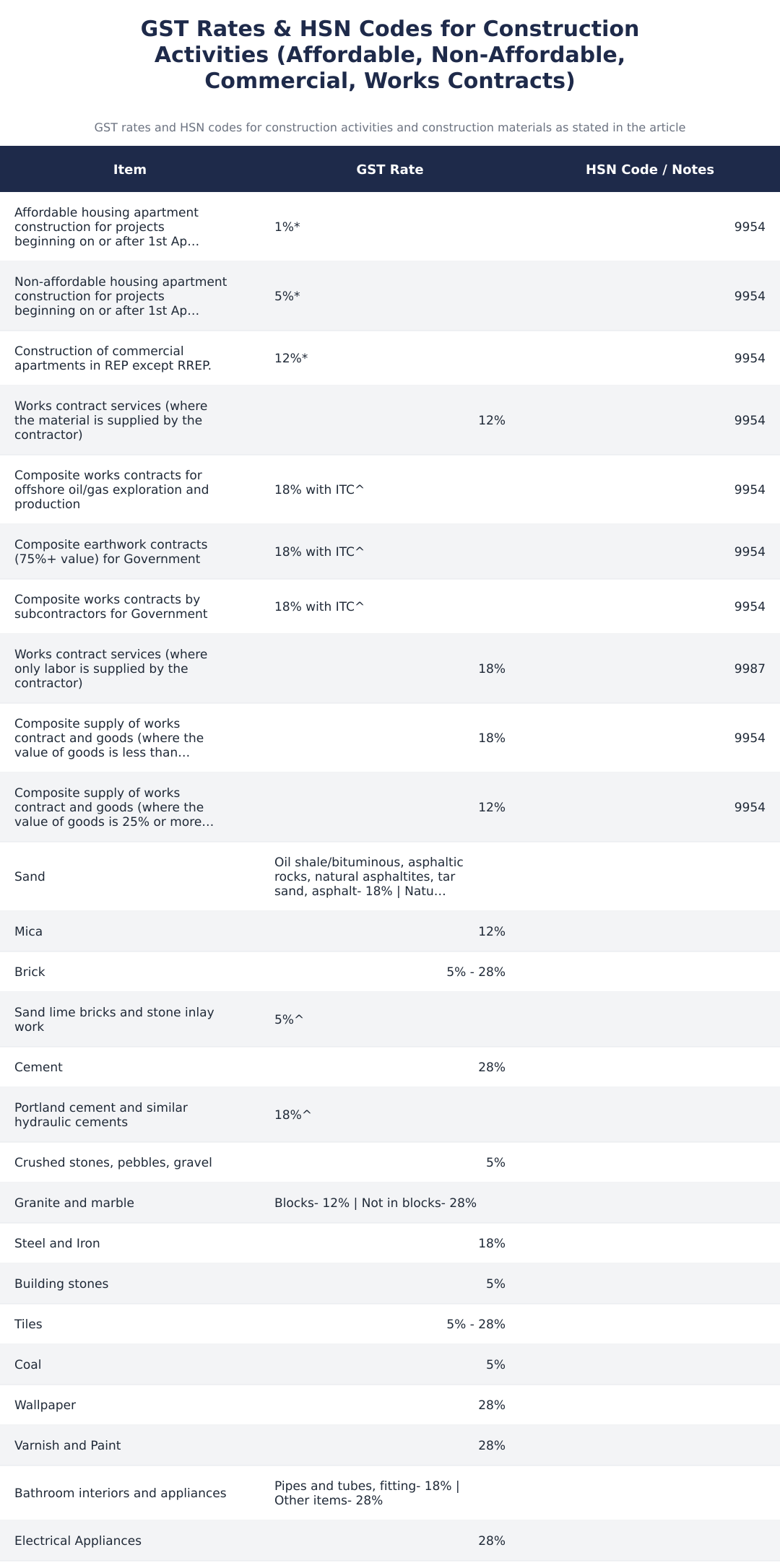
The GST rate for construction of affordable housing apartments for projects beginning on or after 1 April 2019 is 1%. This concessional rate applies to residential units defined as affordable housing, carpet area up to 60 sq. m in metros and up to 90 sq. m in non-metros, with unit value not exceeding Rs. 45 lakh. The supply falls under HSN/Service code 9954 and is subject to conditions specified by GST notifications; builders must ensure project commencement date and eligibility criteria to claim this rate. Note that resale of completed apartments or buying ready-to-move-in properties is outside GST and treated as a resale transaction.
What GST rate applies to non-affordable residential apartment construction started on or after April 1, 2019?
The GST rate for construction of non-affordable residential apartments for projects beginning on or after 1 April 2019 is 5%. This applies when the project does not meet the affordable-housing carpet-area/value limits and is charged under service/HSN code 9954 with the concessional rate. The 5% rate is for the supply of construction services (including works contract) where the apartment is sold before completion; buying a completed or resold apartment is not subject to GST. Developers should confirm project start date and invoicing to correctly apply the 5% rate and avoid misclassification.
Which GST rate applies when a contractor supplies both materials and services (works contract)?
When a contractor supplies both materials and services as part of a works contract, the applicable GST rate is generally 12% if the transaction qualifies as a works contract and the value of goods is not 25% or more of the total contract value. If the goods component is 25% or more of the contract value, the supply is treated as supply of goods and attracts 12% (as per the composite supply classification under 9954) or different rates based on the goods’ HSN. Some categories, such as composite works contracts for certain government or offshore projects, are taxed at 18% with ITC, and pure labour contracts (only manpower) are taxed at 18% under code 9987. Correct classification depends on the proportion of goods vs services and specific government notifications.
What GST rate applies when a contractor supplies only labour (pure labour contract) for construction?
If a contractor supplies only labour (pure labour contract) and no materials, the supply is treated as a service with GST at 18% under code 9987. Pure labour contracts for single residential units or parts of residential complexes are exempt from GST if they are pure labour contracts for construction of a single residential unit or provided under schemes like PMAY; however, typical pure labour contracts for commercial purposes will attract 18%. Builders and contractors must document that no materials or goods were supplied to claim exemption or apply the 18% rate appropriately.
Which construction-related supplies attract 18% GST with ITC, and when did rates change for offshore and government earthwork contracts?
Certain composite works contracts, such as offshore oil/gas exploration and production, composite earthwork contracts where earthwork is more than 75% of value for Government projects, and sub-contractor works contracts for Government projects, are taxed at 18% with input tax credit (ITC). These categories were revised from earlier rates (previously 12% with ITC) to 18% with ITC as part of rate changes; they fall under service/HSN code 9954. The availability of ITC means contractors can claim tax paid on inputs subject to standard restrictions, but ITC on immovable property for business is generally not allowed when it results in construction of immovable property except under limited circumstances.
How much GST is charged on common construction materials like cement, sand, bricks, steel and tiles?
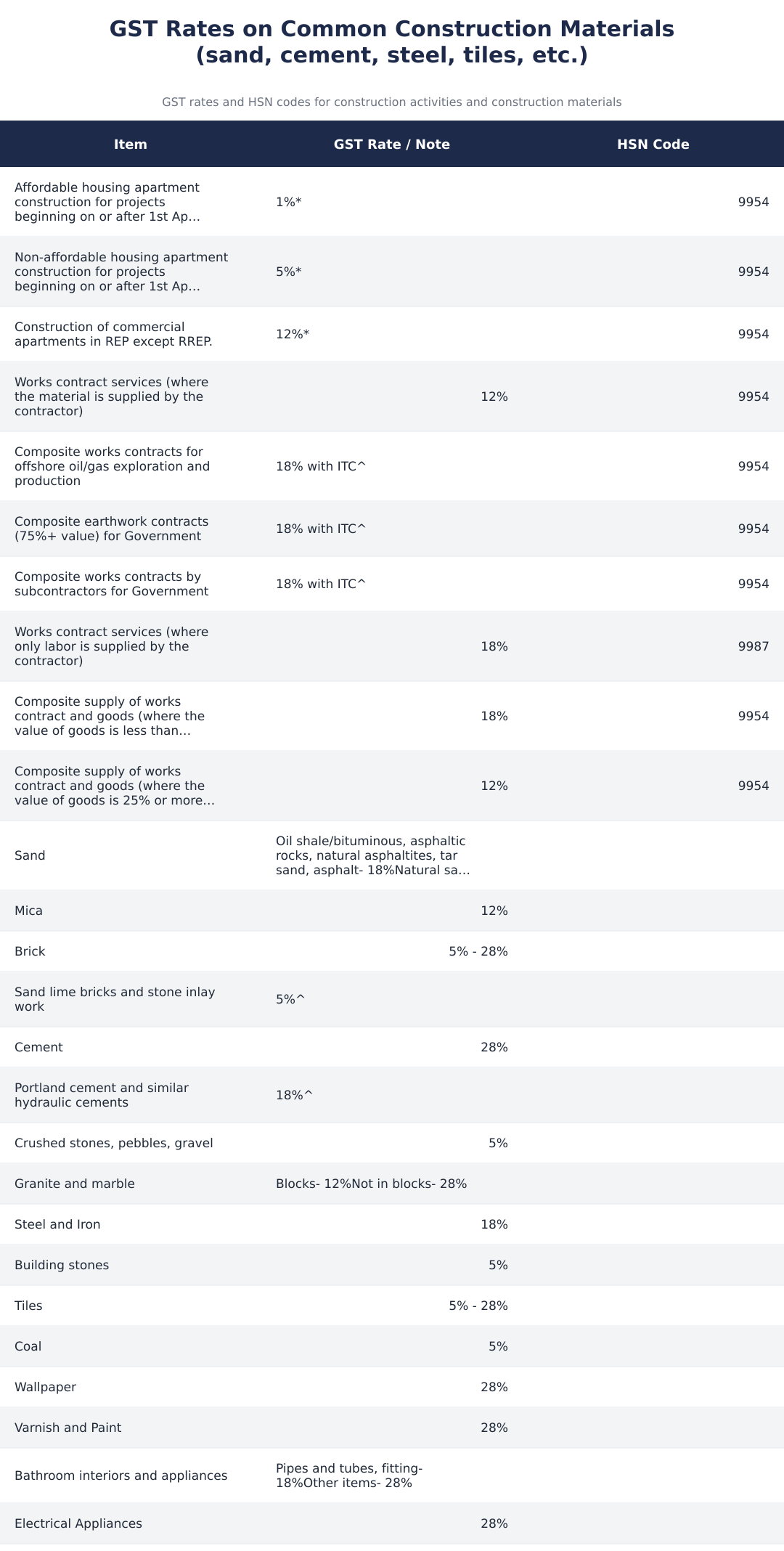
GST rates on construction materials vary by item: cement is generally 28% (with Portland cement and similar hydraulic cements at 18%), natural sand at 5% while oil-shale/asphaltic sands are 18%, bricks range from 5% to 28% depending on type, steel and iron are 18%, and tiles range from 5% to 28% depending on specification. Granite blocks are taxed at 12% while processed granite (not in blocks) attracts 28%; sand lime bricks and stone inlay work were reduced to 5%. These rates depend on the exact product classification (HSN) and notifications, so suppliers must choose the correct HSN to determine the precise GST rate.
Is Input Tax Credit (ITC) available on GST paid for construction, and what are the main exclusions?
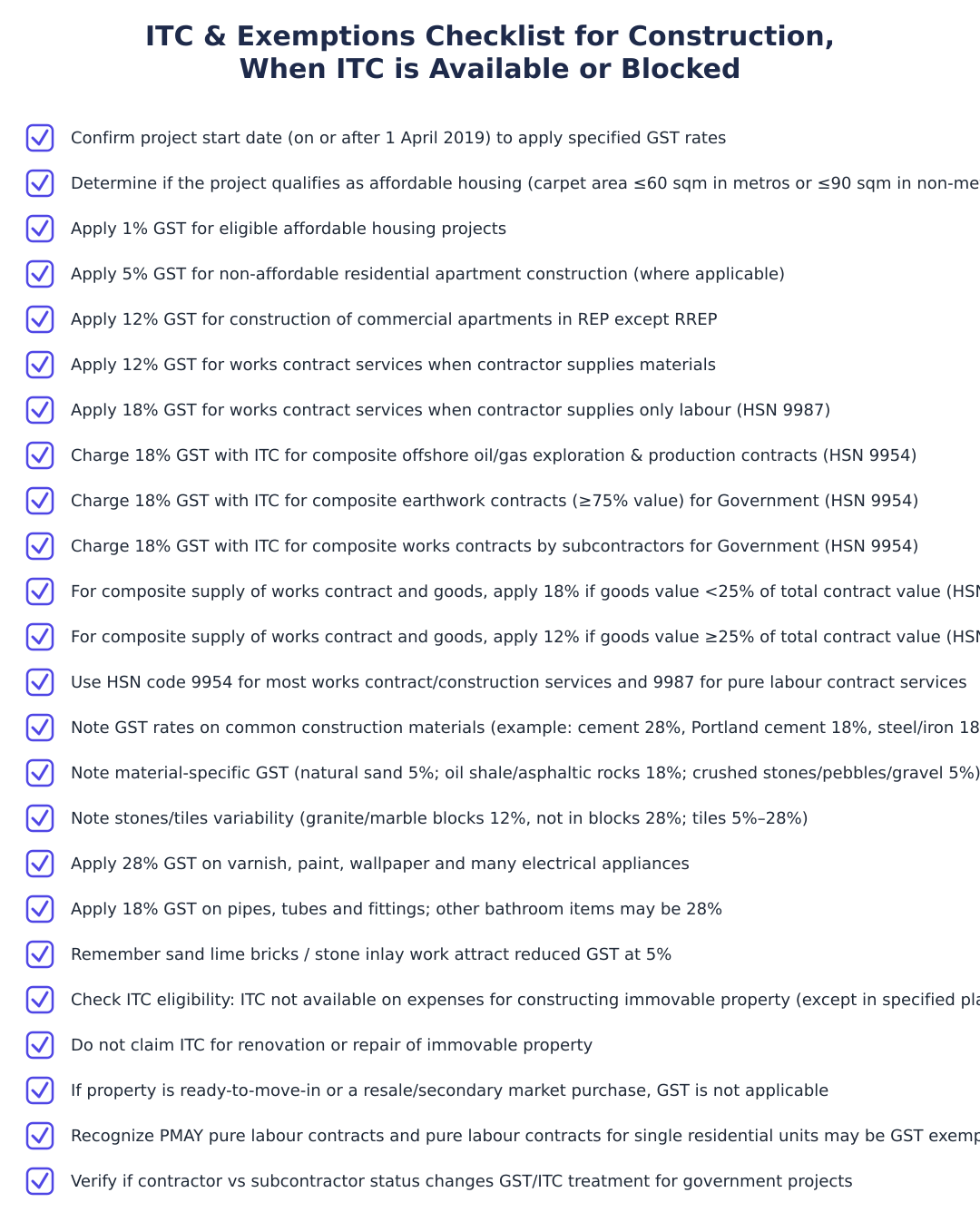
ITC is available on GST paid for construction inputs only to the extent the recipient is eligible under GST law, but ITC is not allowed for expenses incurred on construction of immovable property except where such construction is for further supply of works contract services or for plant and machinery. Specifically, ITC cannot be claimed for renovation or repair of immovable property used in business, and ITC on inputs related to private or exempt supplies is blocked. Developers and contractors must ensure the construction is not for self-use or capital immovable property (with limited exceptions) and should maintain invoices and documents to substantiate eligible ITC claims.
When is GST not applicable on property transactions like resale or ready-to-move-in purchases?
GST is not applicable on purchase of ready-to-move-in properties and on resale transactions of immovable property because such transactions are treated as sale of completed immovable property outside the scope of GST. GST applies primarily to construction services supplied before the completion certificate/occupancy and to new project sales by developers, but once the property is a completed, existing asset transferred in resale, GST does not apply. Buyers should verify whether the sale involves transfer of a completed property or pre-construction sale to determine taxability and ensure correct tax treatment at the time of transfer.
What HSN code should be used for construction services and related works contract supplies?
The HSN/service code commonly used for construction services and works contract supplies is 9954 for most works contracts and composite construction services; pure labour contracts (only manpower) are often classified under code 9987. Specific categories such as affordable and non-affordable housing, commercial construction, and government works are all typically invoiced under 9954, while services strictly limited to labour are reported under 9987. Correct coding is important to attract the right GST rate and to claim or disallow ITC appropriately, so contractors should map the nature of supply and goods component before selecting the code.
Need help staying GST compliant?
MoneyGence's AI Finance OS tracks your compliance, wallet share, and finances in one place, built for agencies and growing businesses.
Get started with MoneyGence