GST on Directors' Remuneration: Rules, Rates & Applicability
This guide explains how to treat directors' remuneration for tax and accounting purposes, and why the legal classification of a director (employee versus service provider) matters. You will learn the practical differences in TDS treatment, bookkeeping classification and the key decision points that determine whether payments are treated as salary or as fees/remuneration. Understanding these distinctions helps companies comply with TDS provisions, prepare accurate books of accounts and avoid downstream disputes with tax authorities. While this guide focuses on verified rules around employer–employee relationships, TDS provisions and accounting heads, you will also find guidance on how these classifications interact with indirect tax considerations and when to seek specialised GST advice.
GST Applicability on the Remuneration of an Executive Director
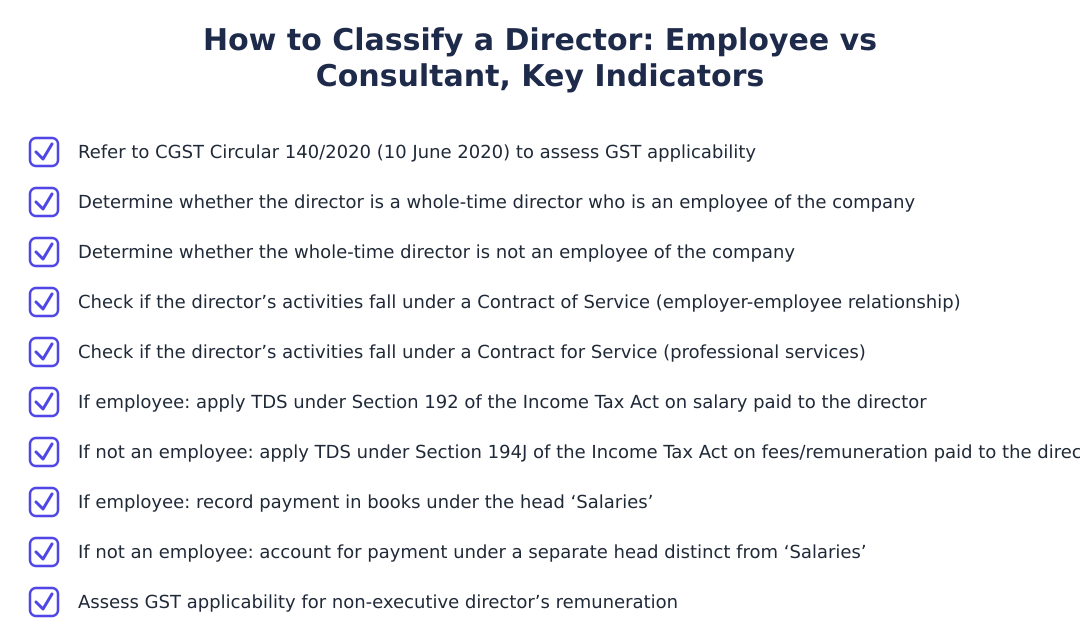
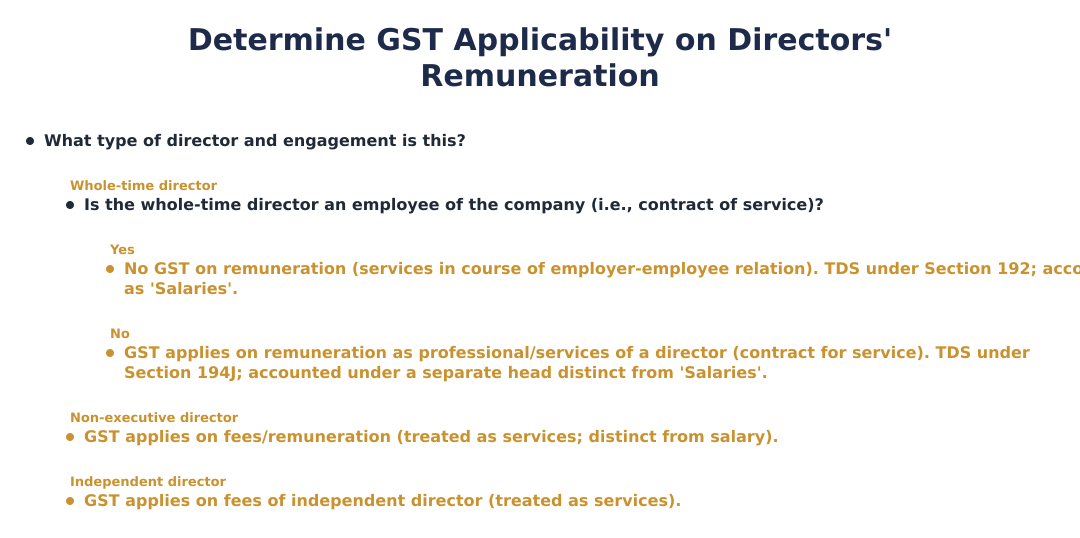
When dealing with the remuneration of a whole-time (executive) director, the starting point is to establish the contractual relationship between the director and the company. If the director is engaged under a contract of service and performs duties as an employee, this establishes an employer–employee relationship.
The legal classification as an employee has immediate tax and accounting consequences. For an executive director who is an employee, the payment is treated as salary in the company’s books of accounts, and the company must apply the TDS provisions that govern salaries.
Where the whole-time director is an employee of the company:
If a whole-time director is an employee, their activities are in the course of an employer–employee relation, this is described as a Contract of Service. The practical effect of this classification is that the director’s remuneration is salaried compensation rather than a professional fee.
For such directors, TDS treatment follows salary provisions under the Income Tax Act: TDS under Section 192 is applicable on the salary paid to a director who is an employee. In bookkeeping, these amounts are recorded under the head 'Salaries'.
Where the whole-time director is not an employee of the company:
A director who performs services for the company but is engaged under a Contract for Service, i.e., not in an employer–employee relationship, is treated as providing professional services as a director. The nature of the engagement, not just the designation or title, determines this status.
For directors in this category, different TDS rules apply: TDS under Section 194J of the Income Tax Act is applicable on the fees/remuneration paid to a director who is not an employee. These payments must be shown in the books under a head that is distinct from 'Salaries', reflecting their treatment as fees or professional remuneration.
GST Applicability on Non-executive Director’s Remuneration
Whether a non-executive director’s remuneration attracts GST depends on how the payment is characterised, as salary or as fees for services. The accounting and TDS treatment described in earlier sections are central to that characterisation.
Because GST treatment hinges on the underlying nature of the transaction, companies should first determine employment status and follow the relevant TDS and accounting rules. For definitive GST treatment and rate implications, consult GST-specific guidance or a tax advisor, since GST technicalities are outside the scope of the verified rules summarised here.
GST Applicability on Fees of Independent Director
Independent directors are typically engaged for their professional services and are commonly paid fees rather than salary; however, the critical test is the contractual relationship and the manner in which services are performed and recorded.
If an independent director is not an employee, the fees would follow the non-employee treatment noted above, TDS under Section 194J and accounting under a separate head from 'Salaries'. For GST-specific conclusions, seek GST law or advisory input because this guide only sets out the verified income-tax and accounting distinctions.
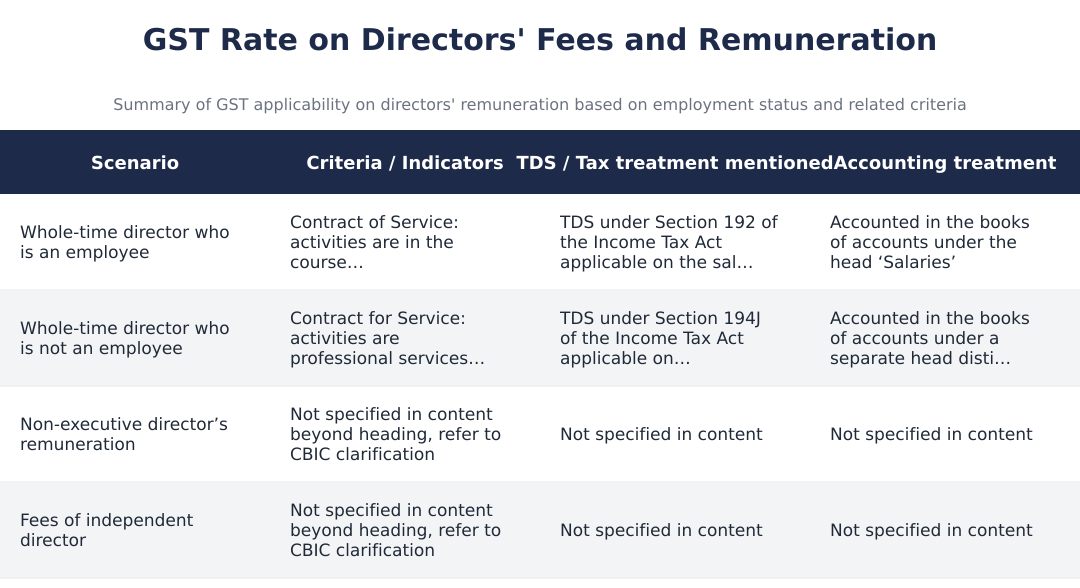
GST Rate on Directors' Fees
This guide does not set out specific GST rates. The GST rate applicable to directors’ fees or any payment depends on GST law and notifications which should be checked in current GST schedules and circulars.
Companies should therefore determine the nature of the payment (salary versus fee) using the employment and accounting tests described above, and then refer to up‑to‑date GST sources or a GST practitioner to identify the correct rate and compliance steps.
Frequently Asked Questions
Q: How do I decide whether a director is an employee or a service provider? A: Focus on the substance of the relationship, whether the director’s activities are carried out as part of an employer–employee arrangement (Contract of Service) or under a Contract for Service where the director offers professional services. The chosen classification affects TDS and accounting treatment.
Q: What TDS provisions apply in each case? A: For a director who is an employee, TDS under Section 192 applies on salary. For a director who is not an employee, TDS under Section 194J applies on fees/remuneration. Ensure your books reflect the correct head, 'Salaries' for employees and a separate fees/professional remuneration head for non-employees.
In summary, the key determinant for tax and accounting treatment of directors’ remuneration is whether the director is in an employer–employee relationship or engaged as a service provider. That determination dictates whether TDS under Section 192 or Section 194J applies and whether payments are recorded under 'Salaries' or a separate fees head. For GST consequences and rate-specific questions, consult current GST law or a specialist adviser after you have established the correct employment/engagement classification.
Frequently asked questions
Is GST chargeable on a director who is a whole-time employee of the company?
No, GST is not chargeable on remuneration paid to a whole-time director who is an employee of the company because such payments are in the nature of salary under a contract of service and not a supply of services under GST. The CBIC in Circular No. 140/2020 dated 10 June 2020 clarifies that where an employment relationship exists, the activities of the director fall within employer–employee service and are outside the scope of GST; TDS on such payments is under Section 192 of the Income Tax Act and amounts are accounted as ‘Salaries’ in books. If the company treats the director as an employee for statutory compliance (PF/ESI, payroll), GST should not be levied on his/her remuneration.
When is GST applicable on a whole-time director’s remuneration?
GST is applicable on a whole-time director’s remuneration when the director is engaged under a contract for service (i.e., not an employee) and the activities are in the nature of professional or managerial services supplied to the company. In that case the payment is treated as fees for services and attracts GST as it constitutes a taxable supply; TDS would normally be under Section 194J of the Income Tax Act and the amount should be accounted separately from ‘Salaries’ in the company’s books. The CGST Circular 140/2020 explicitly distinguishes this situation from employment to determine GST liability.
Do non‑executive directors have to pay GST on the fees they receive?
Yes, GST is generally payable on fees/remuneration paid to non‑executive directors because their services are not in the course of an employer–employee relationship and thus constitute a supply of services. The Circular 140/2020 confirms that non‑executive directors’ activities are treated as professional/contractual services and therefore taxable under GST, with TDS implications under Section 194J of the Income Tax Act. Companies should issue invoices for such fees and collect GST at the applicable rate unless a specific exemption applies.
Is GST payable on fees paid to independent directors?
Yes, fees paid to independent directors are subject to GST because independent directors provide services in a contractual capacity, which qualifies as a taxable supply under GST law. The CBIC clarification treats independent director fees as professional/contractual services, so GST must be charged and collected by the company unless an exemption specifically covers the transaction. TDS on such payments is typically required under Section 194J, and companies should record these fees separately from employee salaries.
What GST rate applies to directors’ fees and remuneration?
Directors’ fees and remuneration that are treated as supply of services under GST are normally taxable at the standard rate of 18%, unless a specific exemption or concessional rate applies. The usual practice after the CBIC circular is to levy GST at 18% on fees paid to non‑employees, independent directors, and consultants acting as directors; salary-like payments under employment remain outside GST. Businesses should verify whether any sector-specific exemption or reduced rate applies and correctly classify the supply to determine the applicable GST rate.
How do I determine whether a director’s activities are ‘in the course of employment’ for GST purposes?
You determine this by examining the substance of the relationship: if the director works under a contract of service, receives salary benefits (PF/ESI), is paid via payroll, and duties/tenure mirror employment, then activities are in the course of employment and outside GST. The CBIC’s circular uses employment indicators such as mode of payment (salary account), statutory compliance (PF/ESI), nature of appointment and accountability to decide the relationship; absence of these factors points to a contract for service where GST applies. Always document the terms (appointment letter, payroll records, statutory filings) to support the classification in case of scrutiny.
If a director is paid both salary and separate fees, is GST payable on the fees portion?
Yes, GST is payable on the fees portion if those fees relate to services provided outside the scope of an employment relationship, even when the director also receives salary. The salary component remains outside GST when it is paid under a contract of service and recorded as ‘Salaries’, while separate consultancy/board fees that reflect a contract for service are taxable and should attract GST and TDS under Section 194J. Companies should clearly apportion and document payments into ‘salary’ and ‘fees’ heads and maintain supporting agreements to justify GST treatment.
Does a director need to register for GST to receive fees from a company?
A director receiving taxable fees may need to be registered for GST if his/her aggregate taxable turnover (including professional services) exceeds the statutory threshold for registration or if the laws require registration irrespective of threshold (e.g., inter-state supplies). If the director is an individual and the fees are below the threshold, the company still has to charge GST on the supply, but the director as service recipient is not required to register unless he/she makes taxable supplies beyond the threshold. In practice, companies often treat director fees as taxable and charge GST on the invoice irrespective of the director’s registration status; the director can claim input tax credits only if registered and eligible.
What are the TDS implications when GST applies to directors’ remuneration?
When GST applies to directors’ remuneration (i.e., fees for services), TDS is typically deductible under Section 194J of the Income Tax Act on the gross fees before GST, whereas salary payments (employment) attract TDS under Section 192. The company should deduct TDS on the taxable fee amount and separately collect GST on the invoice; the GST component is not subject to TDS in most cases but must be reflected in accounting and tax filings. Clear documentation distinguishing salary from fee payments helps ensure correct TDS and GST treatment and avoids double taxation or compliance lapses.
Need help staying GST compliant?
MoneyGence's AI Finance OS tracks your compliance, wallet share, and finances in one place, built for agencies and growing businesses.
Get started with MoneyGence