GST on Flat Purchase: Rates, Calculation & Guidelines
This guide explains how Goods and Services Tax (GST) applies to flat purchases in India and why it matters to buyers, developers and housing societies. You will learn which types of residential property attract GST and which are exempt, how the tax regime for real estate changed with the introduction of GST, why the change matters for price transparency and formalisation of transactions, and what practical compliance issues buyers and builders should watch for. The guide summarises the pre-GST tax mix that applied to property, highlights the key distinction between under-construction and ready-to-move properties for GST purposes, and outlines practical steps that parties typically follow when working out GST on a flat. It also discusses the broader impacts and benefits that the GST regime brought to the real estate sector, including unified taxation, greater clarity in pricing, and the shift away from informal cash deals. Finally, the guide touches on compliance considerations for developers and the importance of accurate tax treatment to avoid future disputes. This is a high-level, practical overview based only on verified statements about GST and real estate taxation; it does not provide numerical rates or personalised tax advice. For transaction-specific calculations or tax planning, consult a qualified tax professional or refer to official GST notifications.
What is GST on Property Purchases in India?
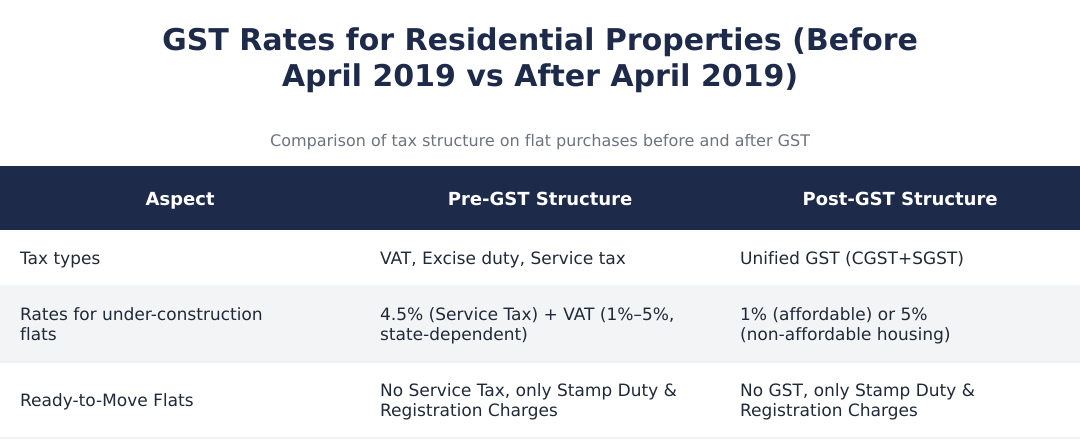
GST is the indirect tax framework that was introduced as part of the 2017 tax reforms to bring many indirect taxes under a single, unified regime. For real estate, GST replaced the previous multiplicity of taxes such as VAT, excise duty and service tax, moving to a consolidated structure under Central GST (CGST) and State GST (SGST).
A core practical distinction under the GST framework is between under-construction residential properties and ready-to-move-in properties. GST applies to under-construction residential properties, while ready-to-move-in properties are not subject to GST and instead continue to involve state-level charges like stamp duty and registration fees.
Pre-GST Taxes on Flat Purchases
Before GST, the tax treatment of property transactions involved multiple different taxes levied by central and state authorities. Developers and buyers had to contend with a mix of VAT, excise duty and service tax, depending on the nature of the supply and the state in which the property was located.
That multiplicity increased compliance complexity and made it harder for buyers to compare prices across projects and regions. One objective of switching to GST was to simplify this landscape by consolidating several indirect taxes into one framework, thereby reducing the multiplicity of taxes that previously applied to real estate transactions.
GST Rates on Residential Properties and Flat Purchases
The verified legal distinction to remember is that GST applies when a residential property is under construction, whereas ready-to-move-in properties are exempt from GST and continue to attract non-GST state-level charges such as stamp duty and registration. The move to GST unified taxation across earlier disparate levies under the CGST + SGST structure.
There was a notable change in the treatment of real estate around April 2019 that adjusted how GST applied to different types of residential supplies. That adjustment formed part of the ongoing calibration of the GST regime for the real estate sector following the initial roll-out in 2017.
Input Tax Credit (ITC) on Flat Purchases
Input Tax Credit (ITC) is a core feature of GST that allows businesses to offset tax paid on inputs against tax collected on outputs. In the context of property, developers’ ability to claim or pass on ITC has been an important element shaping pricing and compliance, and it is a frequent point of focus in developer–buyer transactions.
Because ITC affects how tax costs are reflected in the final price, buyers should pay attention to the tax disclosures and documentation provided by the developer. Accurate tax treatment and good record-keeping by developers are also essential to reduce the risk of future disputes or compliance issues.
How GST is Calculated on Flats
Determine whether the property is under-construction (subject to GST) or ready-to-move-in (exempt from GST).
List components of the transaction such as base price and any extra charges that relate to the under-construction supply and therefore fall within the GST framework.
Under GST the consolidated tax structure (CGST + SGST) applies to taxable supplies; ensure the developer’s tax treatment aligns with the GST rules in force at the relevant time.
Check invoices and disclosures to confirm GST has been correctly applied and that the developer maintains proper compliance to reduce future compliance risk.
Impact of GST Rates on Flat Buyers
The application of GST to under-construction properties changes the effective cost structure of such purchases compared with ready-to-move-in units, which remain outside the GST net and attract only non-GST state-level charges. This difference has influenced buyer preferences and project pricing strategies since GST was introduced.
Beyond immediate pricing effects, GST’s unification of taxes and push toward formalisation has broader market implications. The move to GST was intended to bring transparency, reduce the multiplicity of taxes and curb informal cash transactions, making the real estate sector more formal and easier to regulate.
Benefits of GST for Residential Real Estate
One of the principal aims of bringing real estate under GST was simplification: consolidating several previous levies (VAT, excise duty, service tax, etc.) into a single, unified tax structure. That unification helps both developers and buyers by making the tax component clearer and more consistent across states.
GST has also been associated with increased transparency in pricing and a reduction in cash-based informal deals. These changes promote more formal transactions and better documentation, which can improve market confidence and help buyers make more informed comparisons across projects.
GST on Government Housing Schemes:
Government housing schemes fall within the same GST policy ecosystem and their tax treatment follows the GST principles that apply to residential supplies. The broader policy intent behind these rules is to apply a uniform tax framework to under-construction supplies while leaving completed, ready-to-move properties outside the GST net.
As with private-sector projects, participants in government schemes should ensure that tax treatment and documentation are properly handled to reflect GST applicability where relevant, and to avoid downstream compliance issues.
Frequently Asked Questions
Q: Which residential properties attract GST? A: Under-construction residential properties attract GST; ready-to-move-in properties do not and are instead subject to state-level stamp duty and registration charges.
Q: When did GST begin to affect real estate taxation? A: GST was introduced as part of the 2017 tax reforms and the sector’s treatment saw notable adjustments around April 2019 as authorities calibrated the regime for property supplies.
Q: What are the broader benefits of GST for the property market? A: The verified benefits include unified taxation replacing multiple earlier levies, improved transparency in pricing, and a reduction in informal cash transactions, factors that together support more formal and comparable real estate transactions.
GST changed how India taxes residential real estate by bringing under-construction properties into a unified indirect tax system while keeping ready-to-move properties outside the GST net. The move replaced a patchwork of earlier taxes, aimed to improve transparency and formalise transactions, and required developers and buyers to be attentive to compliance and documentation. For transaction-specific calculations or to understand how GST will affect your purchase price, consult an official GST notification or a qualified tax professional.
Frequently asked questions
What is GST on property purchases in India?
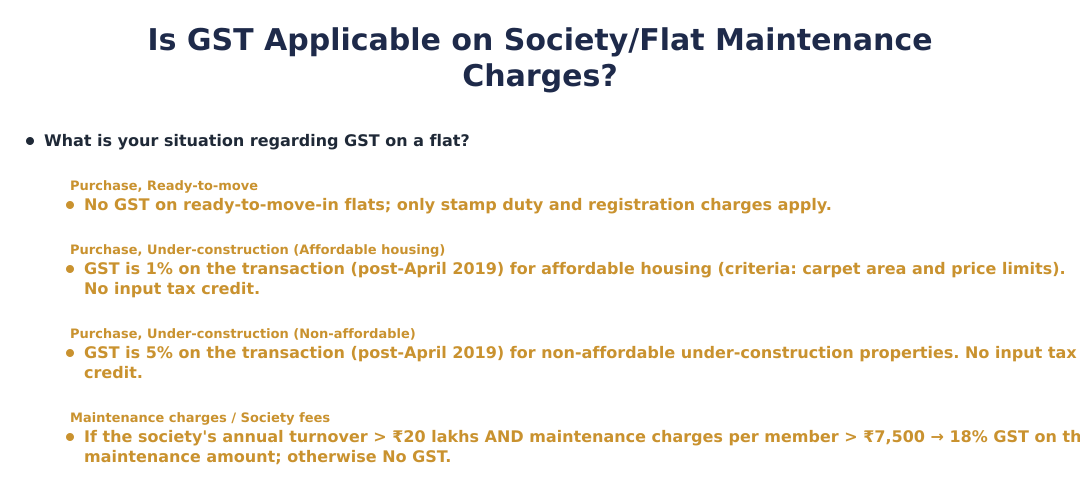
GST on property purchases is a unified indirect tax applied to under-construction residential properties, while ready-to-move-in properties are not subject to GST and only attract stamp duty and registration charges. Specifically, GST replaced the earlier fragmented taxes (VAT, service tax, excise) and applies at set rates to the sale of apartments or flats that do not have a completion certificate or are yet to be occupied. Government schemes and affordable housing get special lower rates (1% for affordable housing post-April 2019) and the rates can vary if input tax credit is allowed or not. Developers must charge GST on invoices for under-construction units; buyers should confirm the GST component before signing the agreement.
What GST rates apply when buying a flat in India?
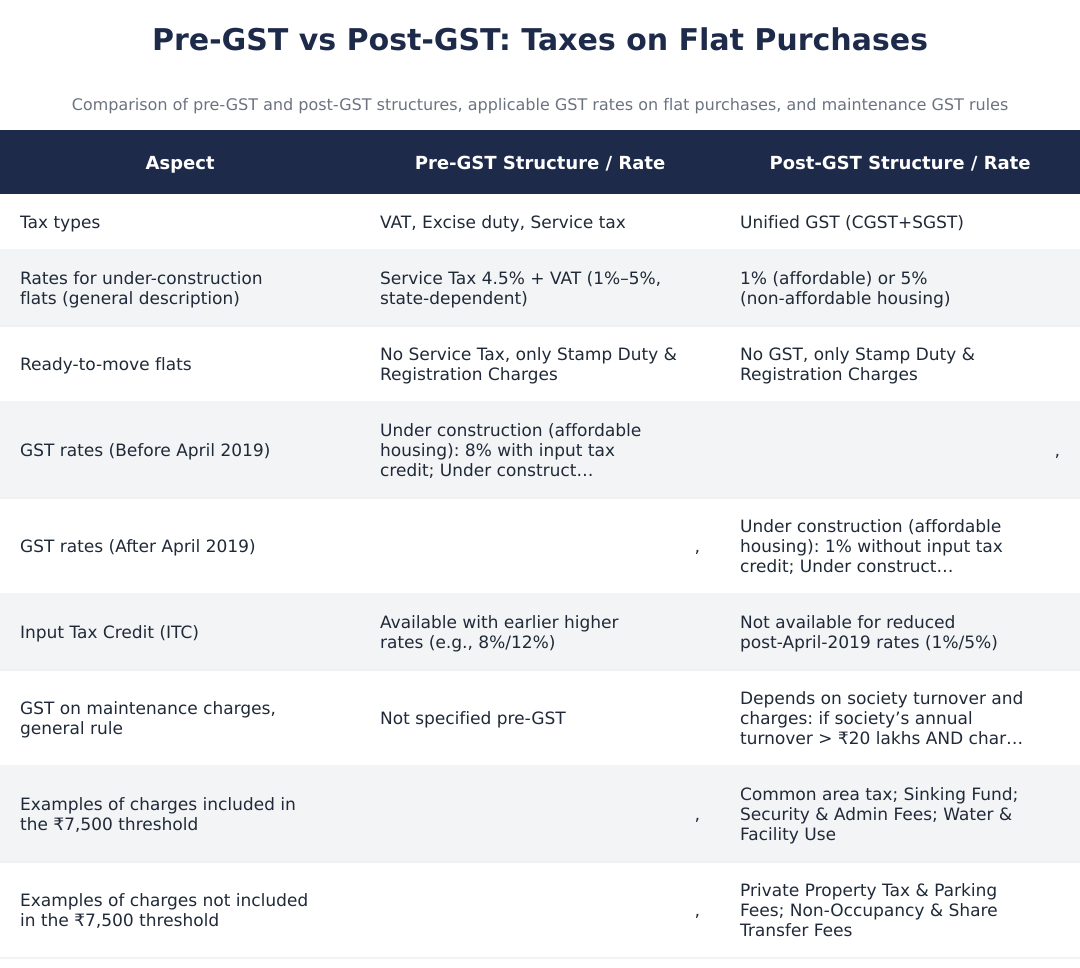
For under-construction residential flats the prevailing GST rates are 1% for affordable housing and 5% for non-affordable housing (both without input tax credit after April 2019), while ready-to-move-in properties attract no GST. Prior to April 2019 the effective rates were higher (8% and 12% respectively) and could include input tax credit for developers; the 2019 revision lowered rates and removed ITC for these categories. Affordable housing is defined as carpet area up to 60 sq. m in metro cities and 90 sq. m in non-metro cities with a specified value threshold; schemes and definitions determine eligibility. Always check whether the project qualifies as affordable or non-affordable before applying the rate.
Is input tax credit (ITC) available to buyers when they purchase a flat?
Buyers of residential flats do not get input tax credit on GST paid for under-construction properties when rates are levied without ITC (current standard practice: 1%/5% without ITC). Earlier GST slabs allowed developers to claim ITC and levy a lower effective tax, but post-April 2019 the government moved to 1%/5% slabs without ITC to simplify the regime and protect margins. For commercial components or developer services where ITC is claimed, developers may pass benefits indirectly, but end buyers generally cannot claim ITC on house purchases for personal use. If the purchaser uses the property for a taxable business, different rules and ITC eligibility may apply and should be checked with a tax advisor.
How is GST calculated on the purchase of a flat?
GST on a flat is calculated by applying the applicable rate (1% for affordable or 5% for non-affordable under-construction units) to the base price of the flat and to certain extra charges like parking, clubhouse and other common-area charges that are taxable. The calculation steps are: start with the basic cost of the flat, apply the GST rate to that base, add GST on taxable extras (parking, maintenance pre-occupation charges, clubhouse fees), and sum GST amounts to get total GST which is added to the final payable price. Ready-to-move-in flats do not attract GST, so only stamp duty and registration charges apply in those cases. Always verify which extra charges are taxable and whether any components (like private parking) are excluded per the developer’s agreement.
Does GST apply to maintenance charges for flats and housing societies?
GST applies to maintenance charges for flats only if the housing society’s annual turnover exceeds ₹20 lakh and the maintenance charge per member per month exceeds ₹7,500; in that case 18% GST is levied on the entire maintenance amount. If either the society’s yearly turnover is ₹20 lakh or less, or the monthly maintenance per member is ₹7,500 or less, then no GST is applicable on maintenance collected by the society. The ₹7,500 threshold includes common expenses like common area tax, sinking fund, security, admin fees and water/facility charges, but excludes private property taxes and parking or non-occupancy fees. Societies must monitor turnover and per-member charges to determine GST liability and register if required.
Are ready-to-move-in flats exempt from GST?
Yes, ready-to-move-in flats (projects that have received a completion certificate or are fit for occupation) are exempt from GST and attract only stamp duty and registration charges on sale. GST is specifically levied on under-construction properties where construction services are still being supplied; once the project is completed and ready for possession, the sale falls outside GST scope. This is why many buyers prefer ready flats to avoid the additional 1%–5% GST burden and subsequent increase in loan and EMI amounts. Make sure the developer provides a valid completion certificate or occupation certificate as evidence that GST does not apply.
How did property taxation work before GST and what changed after GST?
Before GST, flat purchases involved multiple taxes like VAT, service tax and possibly excise or entry taxes with varying state rates, while after GST a single unified tax (CGST+SGST) applies to under-construction properties simplifying compliance and rates. Under the pre-GST regime developers often charged service tax (~4.5%) plus VAT (1%–5% depending on state), which made pricing inconsistent and ITC claims difficult; GST consolidated these into nationwide slabs (notably 1%/5% for residential under-construction units after April 2019). Ready-to-move properties were generally not taxed in either regime, but GST improved transparency in invoicing and reduced hidden charges and cash transactions. The shift also standardized the tax burden on buyers and aimed to formalize the real estate sector.
What is the impact of GST on home loan amounts and EMIs?
GST increases the upfront price of under-construction flats by adding 1% or 5% on the base price and taxable extras, which raises the loan amount and monthly EMIs if the buyer finances the GST component. Since most home loans finance the total loan requirement including taxes, an additional GST of even 5% can materially increase EMI and borrowing costs over the loan tenure, affecting affordability and budgets. Many buyers therefore opt for ready-to-move flats to avoid GST or negotiate GST-inclusive pricing with developers; it’s advisable to include GST when calculating loan eligibility and monthly repayment plans. Check with your lender whether they finance GST and whether the GST paid can be included in loan disbursal timing (often before possession).
Are government housing schemes treated differently under GST?
Government housing schemes often receive special consideration under GST, and certain affordable housing projects backed by government policies may qualify for the lower 1% rate or specific exemptions depending on scheme criteria and carpet-area/value limits. The GST classification hinges on whether the project meets the definition of affordable housing (carpet area limits and value thresholds) and whether the project is under-construction; many public housing schemes designed for lower-income segments benefit from reduced GST rates. However, each scheme’s GST treatment depends on the exact project details and notifications, so confirming eligibility and applicable GST rates for a specific government scheme is necessary. Buyers should review scheme documentation and developer invoices to ensure the correct GST rate or exemption is applied.
Need help staying GST compliant?
MoneyGence's AI Finance OS tracks your compliance, wallet share, and finances in one place, built for agencies and growing businesses.
Get started with MoneyGence