GST on notified services by e-commerce operators u/s 9(5) | Guide
This guide explains how Section 9(5) of the Central Goods and Services Tax (CGST) Act applies to services supplied through e-commerce operators, and how it differs from the e-commerce TCS (tax collected at source) framework under Section 52. You will learn who bears the tax liability when certain notified services are supplied via an e-commerce platform, what being ‘‘treated as the supplier’’ means in practice, and the key compliance steps e-commerce operators must follow. Understanding the distinction between Section 9(5) and Section 52 is important for marketplaces, service providers using platforms, and tax teams, because the two provisions create different legal and reporting consequences for the operator and the underlying supplier. This guide also covers the registration requirement for operators who are liable under these provisions and the monthly return reporting that flows from e-commerce TCS obligations. The focus is on practical implications: who must register, who pays the tax, and how monthly reporting affects supplier records. Read on to get a clear, concise picture of liabilities and compliance responsibilities for e-commerce operators under these specific CGST provisions.
Applicability of Section 9(5) of CGST Act
Section 9(5) of the CGST Act applies where certain notified services are supplied through an e-commerce operator and the law specifies that tax must be paid by the operator rather than the underlying seller. In these cases the statute places the tax liability squarely on the e-commerce operator.
Practically, when an operator is covered by Section 9(5), the operator is treated as if it is the supplier of those services for tax purposes. This treatment changes who is legally responsible for discharging the GST on such supplies even though the underlying commercial relationship may remain between the original service provider and the end customer.
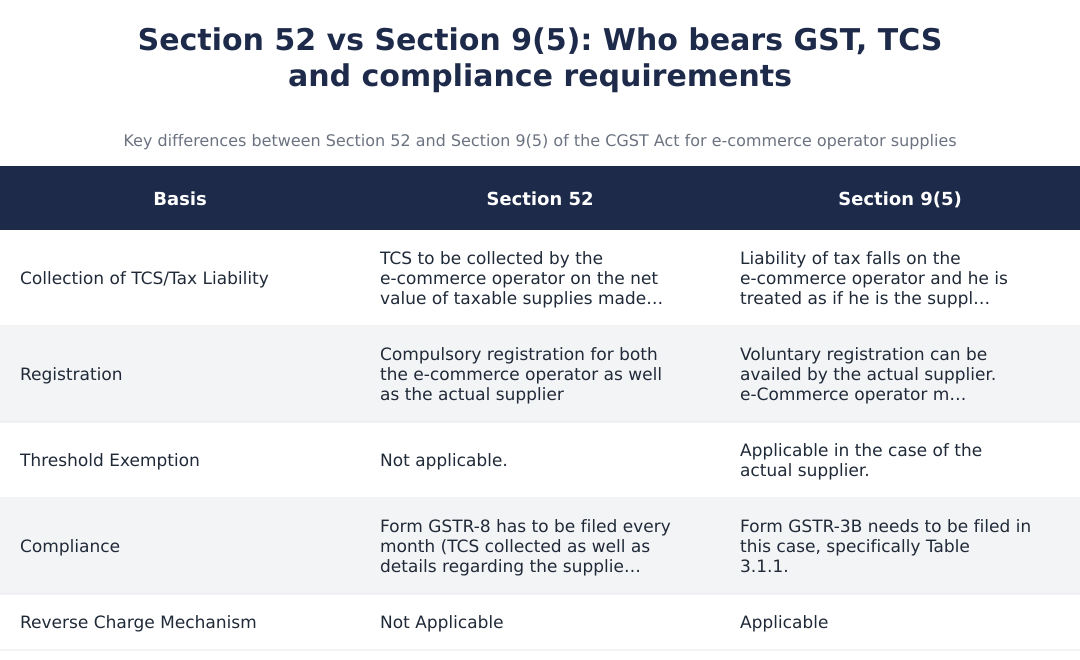
How is Section 9(5) different from Section 52 of the CGST Act?
| Basis | Section 52 | Section 9(5) |
|---|---|---|
| Collection of TCS/Tax Liability | E-commerce operators are required to collect TCS on the net value of taxable supplies made by other suppliers through them. | For certain notified services supplied through an e-commerce operator, the liability of tax falls on the e-commerce operator and the operator is treated as if he is the supplier of those services. |
| Registration | E-commerce operators must mandatorily obtain GST registration when they are liable under the relevant provisions. | E-commerce operators must mandatorily obtain GST registration when they are liable under the relevant provisions. |
| Reporting impact | TCS collected by e-commerce operators should be reported monthly through GSTR-8 and affects supplier records. | Where Section 9(5) applies, the operator bears the tax liability and will have the reporting and payment responsibility tied to being treated as the supplier. |
GST registration for e-commerce operators falling under Section 9(5)
Where an e-commerce operator is liable under the applicable provisions (whether under Section 52 or Section 9(5) as relevant), the operator must obtain GST registration. The mandatory registration requirement ensures that the operator is on the tax rolls and able to discharge the tax and reporting obligations that statutory treatment as supplier or collector entails.
For operators who become liable because Section 9(5) treats them as the supplier of notified services, registration is the legal foundation for paying tax and filing returns in their capacity as the supplier. Failure to register when required can impede the operator’s ability to comply with the reporting and payment mandates that follow from either provision.
Compliance and return filing for e-commerce operators under Section 9(5)
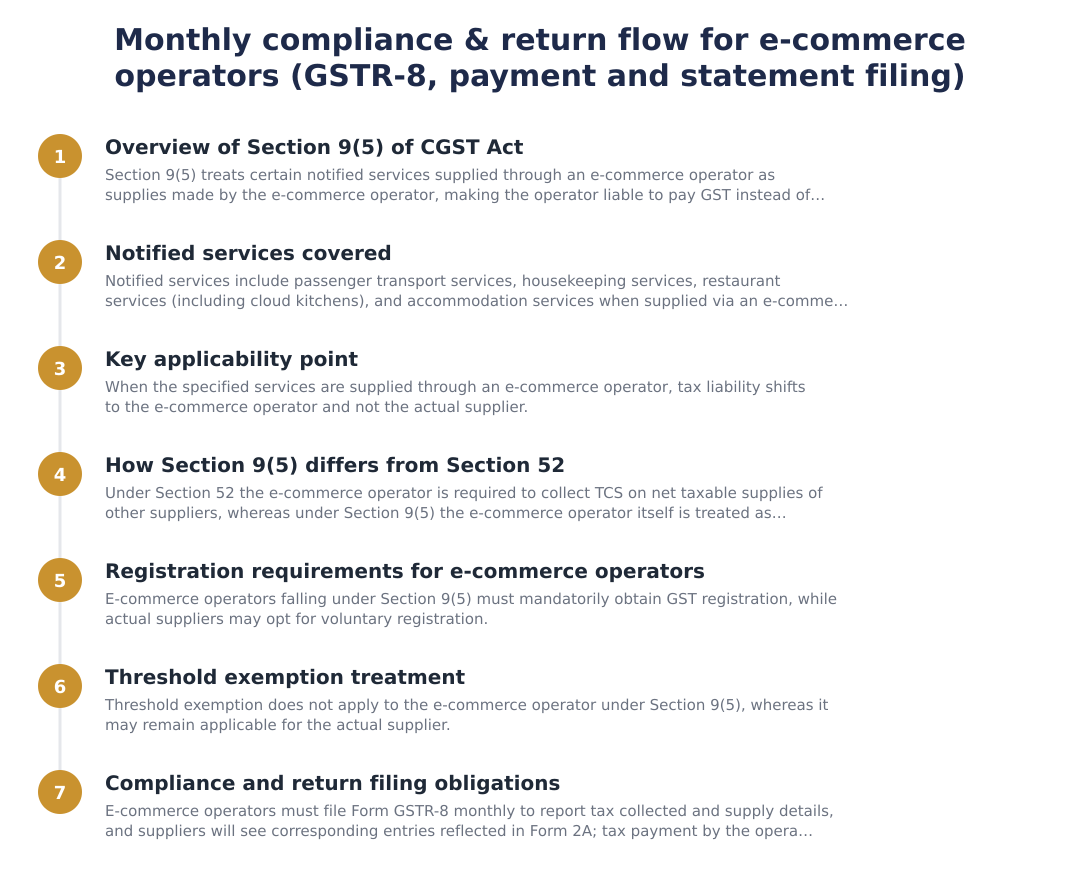
E-commerce operators must file Form GSTR-8 every month to report TCS collected and details of supplies made through the platform.
Information reported by the operator through GSTR-8 affects the records of the underlying suppliers, since the monthly reporting feeds into supplier-facing data.
Where Section 9(5) places the tax liability on the operator and treats the operator as the supplier, the operator’s reporting and payment responsibilities align with that status and must be reflected in the periodic filings.
In summary, Section 9(5) makes the e-commerce operator the tax-liable person for certain notified services supplied through its platform, whereas Section 52 requires operators to collect TCS on supplies by other sellers. Operators liable under either provision must obtain GST registration and comply with monthly reporting, primarily through GSTR-8 for TCS, because these filings drive supplier records and determine who ultimately bears and reports the tax liability.
Frequently asked questions
What does Section 9(5) of the CGST Act say about e‑commerce operators and notified services?
Section 9(5) makes the e‑commerce operator liable to pay GST on certain notified services supplied through its platform, treating the operator as if it is the supplier of those services. The supplier who actually provides the service will not discharge GST for these notified services when supplied through an e‑commerce operator; instead the operator must register, collect/pay tax and report the supplies. The rule applies only to services that are specifically notified (for example passenger transport, housekeeping, restaurant including cloud kitchens, and accommodation). If the operator fails to comply, usual interest and penalty provisions under GST apply.
Which services are notified to be covered under Section 9(5)?
The commonly notified services covered under Section 9(5) include passenger transport services, housekeeping services, restaurant services (including cloud kitchens), and accommodation services. These categories are specifically identified by the government for taxation to be borne by the e‑commerce operator when supplied through its platform. The exact list may be updated by notifications, so operators and suppliers should check the latest notifications before relying on a previous list. If a service is not in the notified list, normal GST rules between supplier and customer apply.
How is Section 9(5) different from Section 52 (TCS) of the CGST Act?
Section 9(5) makes the e‑commerce operator the person liable to pay GST and treats the operator as the supplier for specified notified services, whereas Section 52 requires the e‑commerce operator to collect TCS on the net value of taxable supplies made by other suppliers through its platform. Under Section 52 the operator collects tax at source and files monthly GSTR‑8 with TCS details (which appear in suppliers' Form 2A), while under Section 9(5) the operator must discharge the tax liability itself and report it in GSTR‑3B (Table 3.1.1). Registration rules and threshold exemption also differ: under Section 52 registration is compulsory for both operator and suppliers, while under Section 9(5) the operator must register but the actual supplier may have voluntary registration or claim threshold exemption where eligible. Reverse charge mechanism is not applicable under Section 52 but may be relevant under Section 9(5) depending on the underlying supply and notifications.
Does an e‑commerce operator have to register under GST if Section 9(5) applies?
Yes, an e‑commerce operator who supplies the notified services under Section 9(5) must obtain GST registration and cannot claim threshold exemption for that activity. The operator is treated as the supplier of those services and so must comply with registration requirements irrespective of turnover threshold. The actual suppliers who use the platform may still be eligible for threshold exemption or voluntary registration depending on their overall turnover and nature of supplies. Failure to register when required attracts penalties and may hinder filing of required returns like GSTR‑3B.
Who files returns and pays tax when Section 9(5) applies, the supplier or the platform?
When Section 9(5) applies, the e‑commerce operator (platform) files returns and pays the GST because it is treated as the supplier for those notified services supplied through it. The operator must discharge the tax in its regular returns (reported in Table 3.1.1 of GSTR‑3B) and maintain records of such supplies. The actual service provider does not pay GST on those notified supplies routed through the operator, though it should reconcile its sales with the operator’s records. For other supplies not covered by 9(5), normal rules (including TCS under Section 52) may still apply.
What compliance and return filing obligations does an e‑commerce operator have under Section 9(5)?
An e‑commerce operator liable under Section 9(5) must obtain GST registration, charge and pay GST on the notified services supplied through its platform, and report those supplies in its regular returns, specifically in GSTR‑3B (Table 3.1.1) where applicable. Unlike TCS under Section 52, these supplies are not reported in GSTR‑8; GSTR‑8 is used when the operator collects TCS under Section 52. The operator should also maintain detailed records to support tax payments and enable reconciliation with suppliers; non‑compliance can attract interest, penalties and scrutiny.
If an e‑commerce operator collects TCS under Section 52, does that affect Section 9(5) liability?
Collecting TCS under Section 52 does not substitute for or eliminate liability under Section 9(5) where the latter applies, the two provisions operate differently and apply to different situations. Section 52 requires TCS collection by the operator on supplies made by other suppliers through the platform and is reported via GSTR‑8, whereas Section 9(5) shifts the tax liability itself to the operator for specified notified services and is reported in GSTR‑3B. An operator must determine for each supply whether it falls within the notified categories under 9(5); if so, the operator must pay GST as the supplier rather than merely collecting TCS. Proper classification and documentation are essential to avoid double collection or disputes with suppliers.
Can the actual service provider claim input tax credit or file returns when Section 9(5) applies?
The actual service provider cannot discharge GST on notified services that are taxed under Section 9(5) when supplied through an e‑commerce operator, but it can still claim input tax credit for taxes it has legitimately paid on its inward supplies if eligible. The supplier should not include those specific outward supplies (covered by 9(5) and taxed by the operator) in its own tax liability, though it must maintain records and reconcile transactions with the operator. The supplier’s Form 2A/GST returns will reflect supplies differently depending on whether operator has reported/paid tax under 9(5) or collected TCS under Section 52, so regular reconciliation is important to avoid mismatches and ensure proper ITC claims.
What practical steps should an e‑commerce operator take to comply with Section 9(5)?
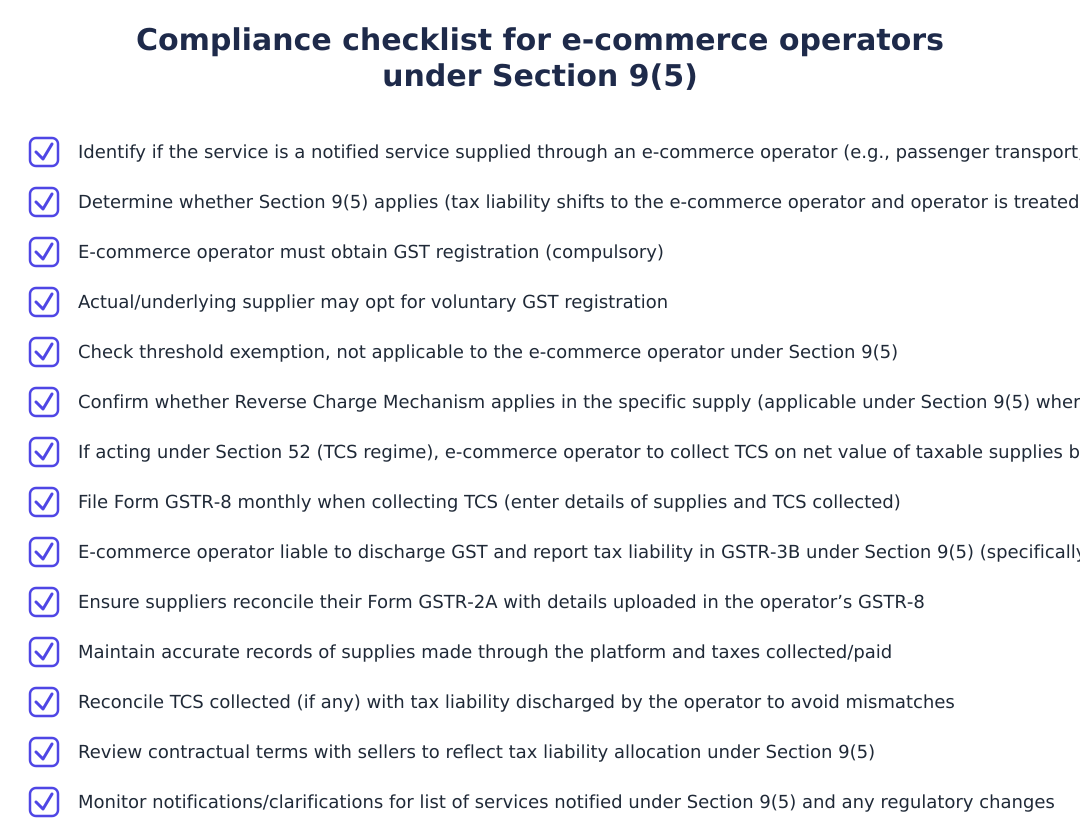
An e‑commerce operator should first identify whether the services offered on its platform fall within the notified list for Section 9(5), register under GST if liable, charge and remit GST as the supplier on those notified services, and report the supplies correctly in GSTR‑3B (Table 3.1.1). It should also update contracts and onboarding processes so merchants know which supplies the operator will tax, keep detailed transaction records for reconciliation with suppliers, and monitor notifications for changes to the notified services list. Regular reconciliation with suppliers and timely filing will reduce disputes and penalties arising from misreporting or late payment.
Need help staying GST compliant?
MoneyGence's AI Finance OS tracks your compliance, wallet share, and finances in one place, built for agencies and growing businesses.
Get started with MoneyGence