GST on Rent: Residential vs Commercial Property Rules
This guide explains how goods and services tax (GST) considerations typically apply when you rent out or take on rent residential and commercial property. Renting property is a common income source and an essential business cost for many firms. Knowing how GST treatment can differ based on the type of property, the identity of the parties involved, and the intended use helps landlords, tenants and accountants avoid compliance mistakes, allocate tax costs correctly and structure agreements appropriately. In this article you will learn how tax treatment is usually determined in property rentals, what practical issues to consider when drafting lease agreements and invoices, how registration status and the use of premises can affect who bears the tax burden, and what documentation and precautions landlords and tenants should maintain. The guidance is written to be practical for small landlords, property managers, and business tenants, helping you to identify the key factors that affect GST treatment and what to discuss with your tax advisor before finalising rent arrangements.
How GST treatment is ordinarily determined for property rentals
Tax treatment of renting usually depends on the nature of the immovable property (for example, whether premises are used for residential or commercial purposes), the GST registration status of the supplier (landlord) and the recipient (tenant), and the intended use of the rented premises. These characteristics together determine whether the supply is treated as taxable, exempt, or subject to a particular charging mechanism.
In practice this means the same physical property can attract different tax consequences depending on who is paying rent and how the space is used. For instance, a residential unit used as a dwelling will commonly be treated differently from a commercial shop or office. Similarly, whether the landlord or tenant is registered for tax can influence who is responsible for accounting for the tax.
Because of these multiple factors, landlords and tenants should not assume a single uniform outcome for all rentals. Instead, each contract should be reviewed on its facts: who supplies the service, who receives it, what the premises are used for, and whether either party is under any registration or compliance obligation.
Practical consequences for landlords
Landlords need to be mindful of how tax rules affect invoicing, registration requirements and the ability to collect tax from tenants. If the landlord is required to account for tax, invoices and records must reflect the tax treatment; if the liability rests with the tenant, landlords should still document arrangements clearly to avoid disputes.
Lease agreements should specify who bears any tax liability and whether rent is exclusive or inclusive of tax. It is also good practice for landlords to obtain information about the tenant’s registration status so both parties understand potential compliance steps. Maintaining clear records of lease terms, payments and any tax-related communications will help in case of future enquiries.
Practical consequences for tenants and businesses
For tenants, especially businesses that are registered taxpayers, the main consequences are cash flow and compliance: if the tenant must account for tax on rent, they need to budget for that outflow and ensure it is recorded correctly in their books. Tenants should also confirm whether they can claim any input tax credit for tax paid on rent, subject to the usual rules and restrictions that apply to their supplies and accounting.
Businesses taking premises on rent should obtain proper tax invoices or other documentary evidence of payments and the tax treatment agreed in the lease. Where the tenant is responsible for accounting for the tax, they should ensure timely fulfilment of return and payment obligations and coordinate with the landlord to ensure records match.
Documentation and clauses to include in rent agreements
A well-drafted rent agreement reduces future friction. Key elements to include are a clear statement of whether rent is quoted inclusive or exclusive of tax, which party is responsible for any tax, and a clause requiring the tenant to provide proof of registration if relevant. Where tax is to be borne by the tenant, include procedures for collection and remittance and for amendment if tax laws change.
Both parties should keep copies of invoices, receipts, bank statements showing rent receipts/payments, and correspondence about tax matters. If any tax is collected, the landlord should retain evidence of having collected and, where applicable, of remittance to tax authorities. Clear documentary trails make it easier to substantiate positions during audits or assessments.
Common issues and red flags
Common disputes arise from ambiguity over whether quoted rent includes tax, mismatches between what the tenant believes they must pay and what the landlord invoices, and failure to verify the registration status of the tenant or landlord. Another frequent problem is lack of matching documentation between landlord and tenant records.
Parties should also be cautious when tenants request tax invoices for rents that were not agreed as taxable in the lease; landlords should seek professional advice before issuing invoices or altering rent terms. If either party is uncertain about their responsibilities, obtain a formal opinion from a tax professional to avoid inadvertent non-compliance.
How to proceed: checklist before entering or continuing a lease
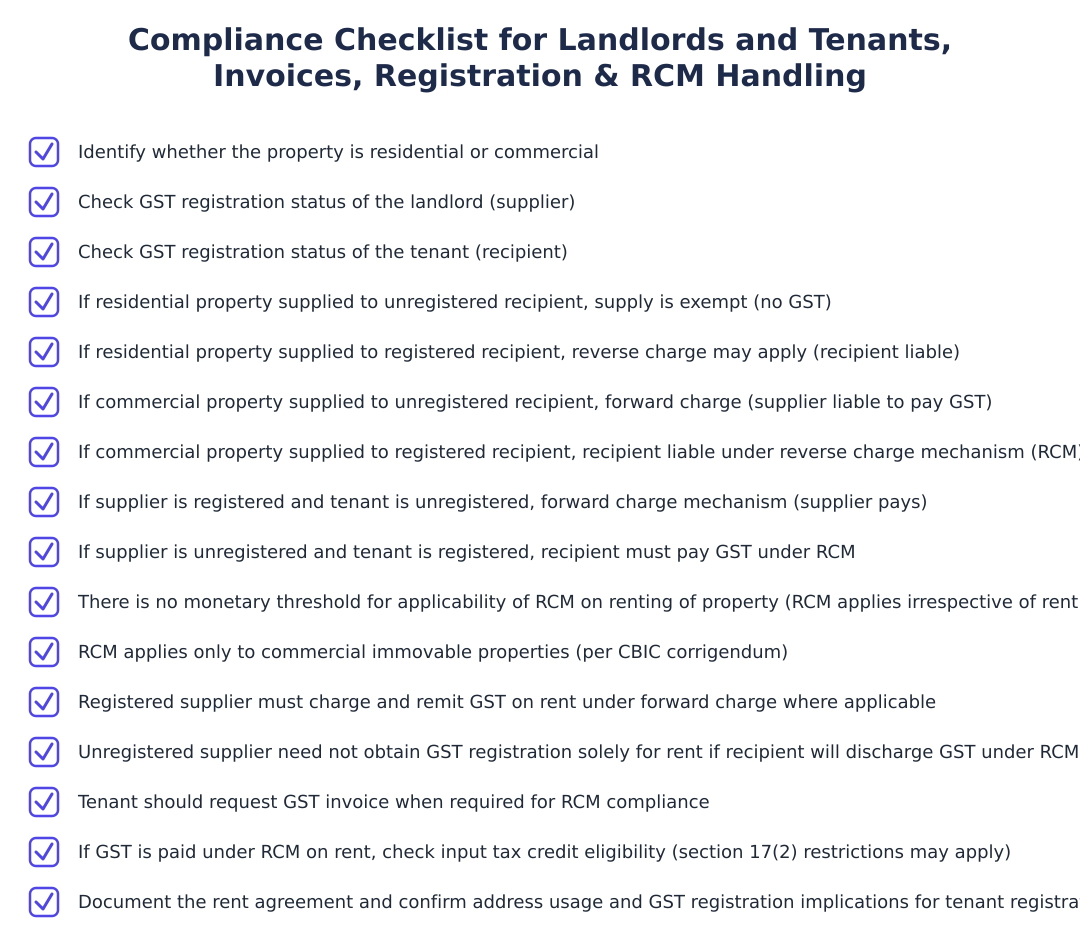
Before finalising or renewing a lease, both landlords and tenants should complete a short checklist: confirm the intended use of premises, determine each party’s registration status, agree in writing on who bears tax and whether rent is inclusive or exclusive of tax, and ensure appropriate invoicing and record-keeping procedures are documented.
Additionally, both parties should plan for future changes: include mechanisms to adjust rent or tax clauses if law or administrative guidance changes, and agree on cooperation for providing information needed for compliance. When in doubt, consult a qualified tax advisor who can review the lease and advise on the correct accounting and reporting treatment for the parties involved.
Tax treatment of renting residential and commercial property depends on multiple interacting factors. Clear agreements, correct documentation and early communication between landlord and tenant reduce the risk of disputes and non-compliance. For specific determinations in your situation, consult a tax professional who can apply the law to the precise facts of your lease and operations.
Frequently asked questions
Is rent of a residential property taxable under GST?
No, rent for purely residential use is exempt from GST when supplied to an unregistered person for residential purposes. This exemption covers renting of dwelling units used as a place of residence, and applies irrespective of the landlord’s registration status if the recipient is unregistered and the use is residential. However, if the residential premises are used for commercial purposes (for example, running a business from home) the exemption may not apply and GST treatment should be examined based on actual use. Also note that a registered recipient claiming business use may attract GST under reverse charge in specific scenarios for mixed or commercial use.
When does GST apply on renting of commercial property?
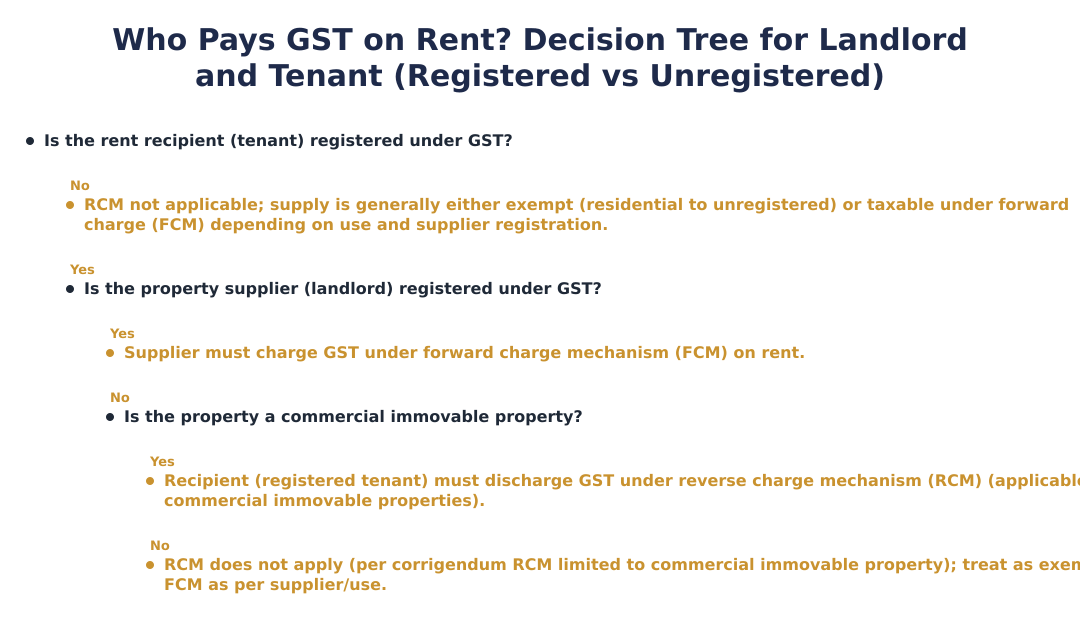
GST applies on renting of commercial property either under forward charge or reverse charge depending on who is registered: if the landlord (supplier) is registered under GST, he must charge GST on rent (forward charge); if the landlord is unregistered and the tenant (recipient) is registered, the tenant must pay GST under reverse charge. The government clarified that reverse charge applies only to immovable commercial property following a corrigendum stating “any immovable property”. There is no monetary threshold for RCM, it applies regardless of the rent amount if conditions are met.
What exactly is reverse charge (RCM) on property rent and when does it kick in?
Reverse charge means the recipient of the service (tenant) is liable to pay GST instead of the supplier (landlord); it applies when the supplier of commercial immovable property is unregistered and the recipient is a registered taxable person. Under this notification, the registered tenant must discharge GST on such rent directly to the government and cannot rely on the landlord to collect tax. RCM applies irrespective of the rent amount and even if the unregistered landlord is a person who otherwise does not need GST registration; exceptions arise if the supply is exempt (for example bona fide residential rent to an unregistered person).
If I am a registered tenant and my landlord is unregistered, do I have to pay GST on the rent?
Yes, if you are a GST-registered recipient and the landlord supplying commercial immovable property is unregistered, you must pay GST under reverse charge. You must self-account for the tax and deposit it through your GST return or challan as required, and disclose the liability in the appropriate return tables. Note that input tax credit availability should be checked (certain ITC restrictions under section 17(2) may apply), and the underlying supply must be commercial immovable property to attract RCM.
If the landlord is registered under GST, who pays the tax on rent?
If the landlord (supplier) is registered under GST, the landlord must charge and collect GST from the tenant under forward charge and issue a proper tax invoice. The supplier must include the rental GST in his outward supplies and return filings, and the recipient (if registered) may claim input tax credit subject to GST ITC rules. This holds whether the tenant is registered or unregistered, though if the recipient is unregistered they cannot claim ITC and the supplier still collects GST from them.
If both landlord and tenant are registered, is rent taxable and who files returns?
Yes, when both supplier (landlord) and recipient (tenant) are registered, GST on the rent of residential or commercial property will generally be treated as a forward charge supply (landlord charges GST) and the landlord files returns declaring output tax. The tenant, being registered, can claim input tax credit on the tax charged by the landlord subject to restrictions in section 17(2) and the nature of the tenant’s business use. Reverse charge does not apply where the supplier is registered and charging tax under forward charge.
Do I need GST registration if I only receive rental income from property?
Generally, GST registration is required only if your aggregate taxable supplies (including rent) exceed the prescribed threshold for your state or if you are otherwise liable (for example, if you are making interstate supplies or required to collect tax under special provisions); mere receipt of exempt residential rent does not trigger registration. If you only provide residential rental services that are fully exempt and have no other taxable supplies, you typically need not register, but if you rent out commercial property or provide taxable services and your turnover exceeds threshold you must register. Also note that even if unregistered, a registered tenant may still be liable to pay GST under reverse charge for commercial immovable property.
Can input tax credit (ITC) be claimed on GST paid for rent under RCM?
ITC on GST paid under reverse charge for renting of immovable property is subject to normal ITC rules and the exceptions in section 17(2); whether ITC is available depends on the tenant’s use of the property (business purpose) and the specific restrictions in law. For example, ITC is generally not available for certain blocked credits (like personal use or specific exempt supplies) but may be available if the rented premises are used for taxable business activities. Tenants should verify eligibility before claiming ITC and maintain documents supporting payment and tax compliance under RCM.
Is there any minimum rent amount below which RCM on property rent does not apply?
No, there is no minimum or threshold rent amount specified under GST for applicability of reverse charge on renting of commercial immovable property; RCM applies irrespective of the rent value whenever the notified conditions (registered recipient and unregistered supplier of immovable commercial property) are met. Therefore even small monthly rents can attract RCM if the parties fit the prescribed criteria, and recipients must comply with payment and reporting obligations. The only relevant limits are general registration thresholds and the nature of supply (residential exempt vs commercial taxable).
Need help staying GST compliant?
MoneyGence's AI Finance OS tracks your compliance, wallet share, and finances in one place, built for agencies and growing businesses.
Get started with MoneyGence