GST on Restaurants India: Rates, Rules & Impact
This guide explains how the Goods and Services Tax (GST) changed taxation of food and restaurant services in India, and what that means for consumers and restaurant owners. You will learn how GST simplified earlier multiple levies, why a restaurant bill used to show separate taxes for food and services, how service charges differ from government taxes, and the practical implications for pricing, input tax credits and compliance. Understanding these points helps restaurateurs set prices, claim available credits correctly, and communicate charges to customers in a transparent way. For customers, it clarifies which parts of a bill are taxes and which are discretionary charges retained by the restaurant. The explanations below focus on the structural changes introduced by GST, the distinction between government levies and restaurant-imposed service charges, and the operational impacts on billing and record-keeping. No specific numeric rates are cited here; instead the guide covers the principles and everyday effects businesses and patrons should expect under the GST framework. Whether you run a small eatery, a delivery service or a hotel restaurant, the guidance will help you spot tax items on bills, manage compliance, and avoid common misunderstandings about service charges and tax collection.
Understanding a Pre-GST Restaurant Bill
Before GST was implemented, a restaurant bill commonly showed separate taxes: one on the food portion and another on the services portion. Administratively, governments treated the ‘food’ element under VAT (or other state-level sales taxes) and the ‘service’ element under the central service tax regime. Businesses and customers therefore saw two different tax heads on the same invoice.
This bifurcation meant restaurants had to track and account for two different types of tax liabilities and related compliance requirements. For customers, the presence of two taxes could be confusing, it was not always clear which charge related to food consumed and which to the service provided by the restaurant staff or establishment.
GST Rules for Restaurants
One of the main design goals of GST was to replace multiple central and state levies with a single, unified tax on the supply of goods and services. For restaurants this meant consolidation of the previous VAT and service tax heads into one GST framework. That simplification aimed to reduce tax cascading and streamline invoicing.
Practically, restaurants now follow GST invoicing and compliance procedures applicable to their supplies. While specifics of classification and applicable GST rates can vary by type of supply and establishment, the important takeaway is that GST treats the total supply of food and related services under one law rather than splitting them between separate tax regimes.
GST Rate on Restaurant Services
Under GST, restaurants are classified according to the nature of their service and premises; this classification determines how tax is applied and whether input tax credit is available. Some restaurant supplies may allow the business to claim input tax credits on purchases, while others may be structured such that input tax credit is not available. Whether ITC can be claimed affects the restaurant’s cost structure and final pricing.
For restaurateurs, understanding whether their supplies are eligible for input tax credit is crucial for pricing and procurement decisions. If ITC is available, a business can offset taxes paid on inputs against its GST liability. If ITC is not available, the business has to factor the full tax cost into its pricing, which can affect margins and consumer prices.
GST Rate on Food Items
GST treatment of packaged and prepared food items varies depending on the nature of the product and how it is supplied. The tax structure under GST distinguishes between everyday essential food items and products classified as higher-end or luxury consumables, and rates can reflect that distinction.
Policy changes since GST’s introduction have tended to lower taxes on many staple and essential food items while increasing rates on certain luxury or discretionary food and beverage products. For businesses, this means that the tax incidence on different menu items can vary and should be considered when designing menus and prices.
Impact on Restaurant Business Owners
The move to GST simplified tax administration by bringing food and service supplies under a single law, which can reduce compliance complexity compared with managing separate VAT and service tax returns. For owners, this can translate into easier bookkeeping, single-format invoices and a clearer approach to claiming input tax credits where allowed.
However, the GST framework also made it important for restaurants to correctly classify their supplies and understand ITC eligibility. Proper classification affects whether they can claim credits on purchases such as ingredients, utilities or services. Mistakes in classification or record-keeping can lead to denied credits or disputes with tax authorities, so maintaining accurate invoices and documentation is important.
Separately, many customers see an item called a service charge on their bills. It is important to distinguish this from government taxes: a service charge is imposed and retained by the restaurant itself and is not a government levy. It should not be confused with taxes collected under GST or the earlier service tax regime.
Frequently Asked Questions
Q: Why did restaurant bills previously show two taxes? A: Prior to GST, the tax system split the tax on the goods (food) portion and the tax on services (restaurant services) between different tax regimes. This led to separate entries on the same bill for VAT (or sales tax) and service tax.
Q: Is a service charge the same as a government tax? A: No. A service charge is applied by the restaurant and is part of the restaurant’s earnings. It is not a tax collected for the government and should not be treated as equivalent to service tax or GST.
Q: Did GST simplify restaurant taxation? A: GST replaced the earlier dual tax treatment with a single framework, which simplified administration by bringing food and restaurant services under one law. This change aimed to reduce complexity and make invoicing and credit claims more straightforward.
GST brought restaurant taxation under a single, unified system, replacing the earlier split between VAT and service tax and clarifying the treatment of supplies. For restaurant owners the key implications are simpler single-law compliance, the need to classify supplies correctly and an understanding of when input tax credit is available. For customers, it helps distinguish between government taxes and restaurant-imposed service charges. Clear invoices and accurate records remain essential for both compliance and transparency.
Frequently asked questions
What GST rate do restaurants pay in India right now?
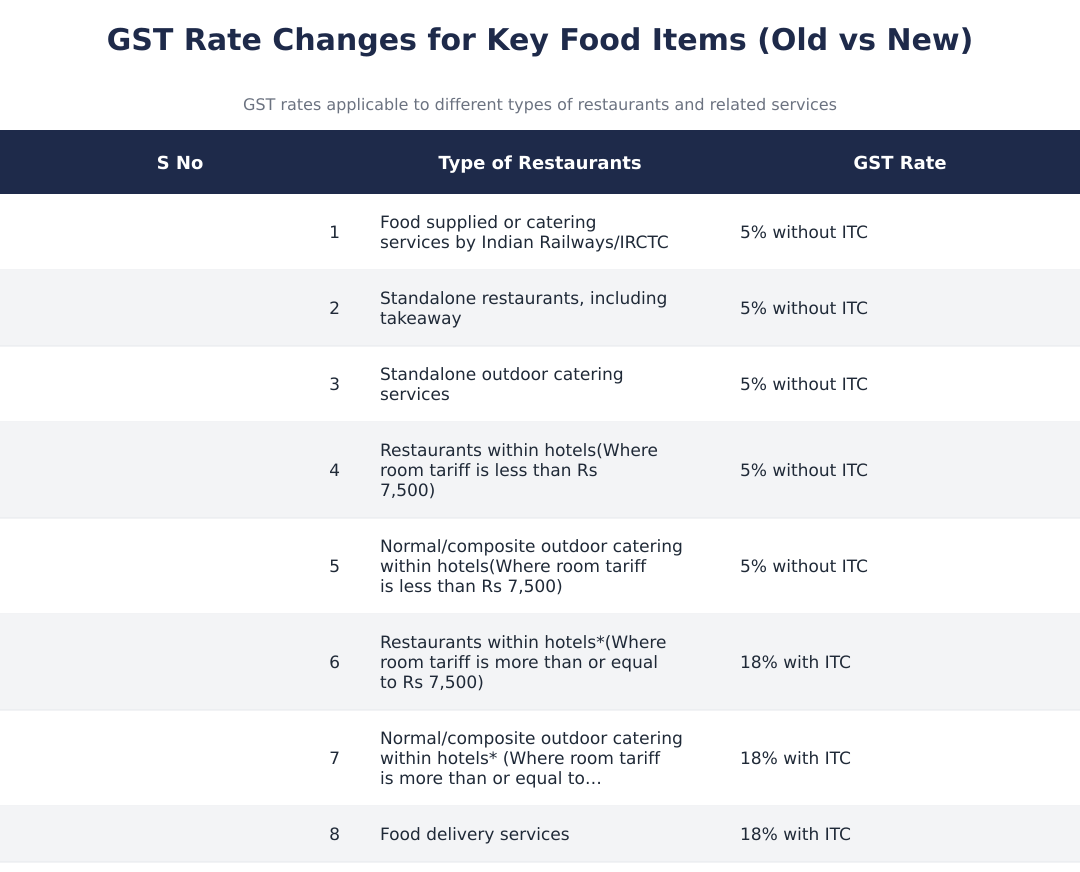
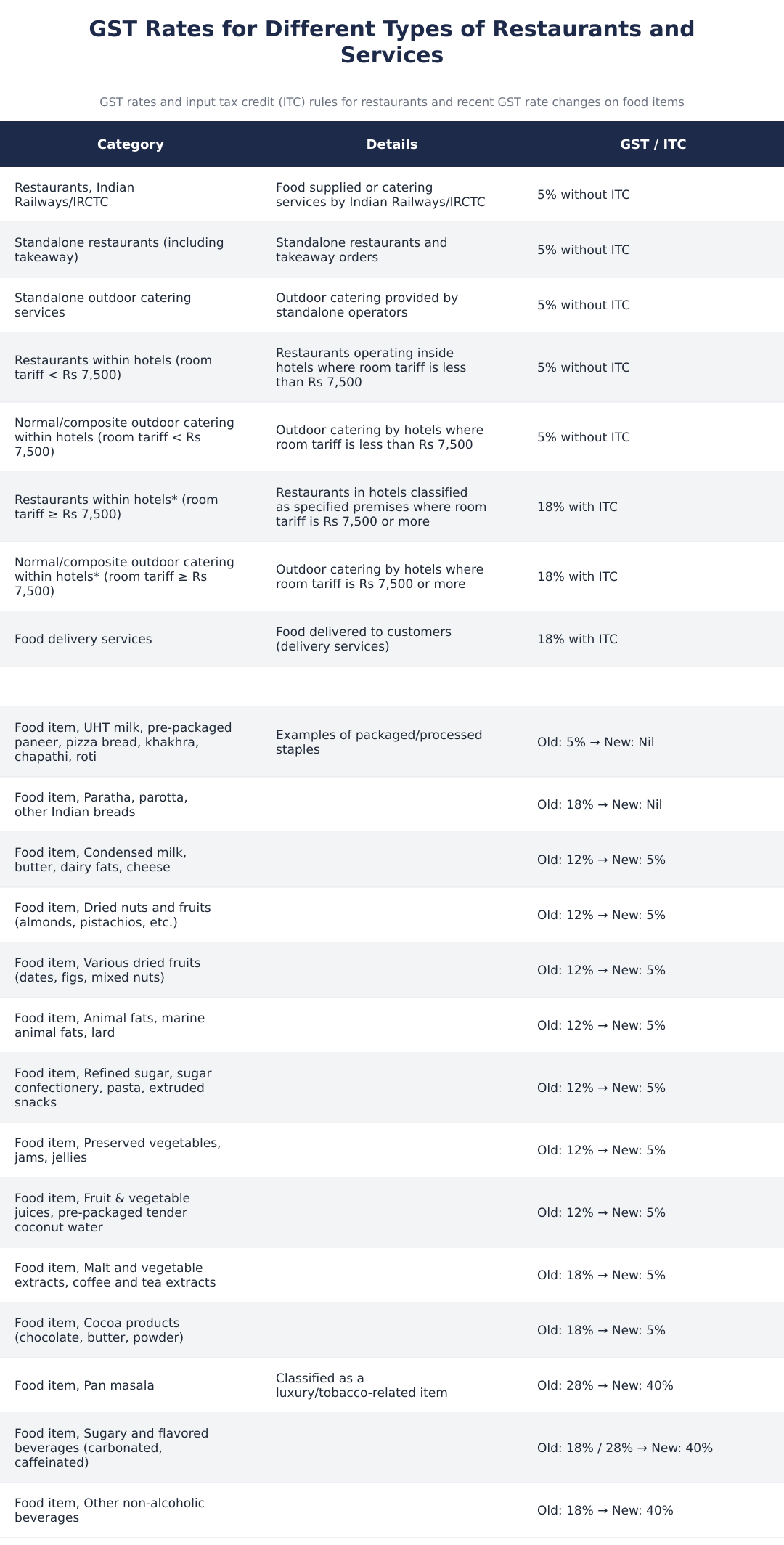
Restaurants in India generally pay either 5% GST without input tax credit (ITC) or 18% GST with ITC depending on the restaurant type and hotel tariff. Standalone restaurants, food supplied by Indian Railways/IRCTC, standalone outdoor catering and restaurants within hotels where the room tariff is below ₹7,500 attract 5% GST without ITC. Restaurants that are part of hotels where the room tariff is ₹7,500 or more are classified as specified premises and attract 18% GST with ITC; food delivery services attract 18% with ITC. Special categorisations (like IRCTC or outdoor catering) follow the same 5% without ITC rule unless otherwise specified by notifications.
Is input tax credit (ITC) available to restaurants on GST?
Input tax credit is not available for restaurants paying 5% GST without ITC, but it is available for those paying 18% GST with ITC. That means standalone restaurants and those in hotels with room tariffs under ₹7,500 cannot claim ITC for taxes paid on purchases, while restaurants in hotels with room tariffs of ₹7,500 or more can claim ITC. Food delivery services that charge 18% GST can also claim ITC subject to normal GST ITC rules. Businesses must maintain proper tax invoices and records to claim ITC where eligible.
Do food delivery services attract the same GST as dine-in restaurants?
No, food delivery services are taxed at 18% GST with input tax credit, which is different from many dine-in standalone restaurants taxed at 5% without ITC. This means orders placed through online aggregators or delivery platforms generally carry 18% GST and the supplier/delivery business can claim ITC subject to normal rules. The 18% rate applies regardless of whether the food is prepared by a standalone outlet or a hotel, unless specific notifications alter applicability. Consumers may therefore see higher GST on delivered food compared with some dine-in/takeaway bills.
Have GST rates on packaged food items changed recently and how?
Yes, several packaged and processed food items had rates lowered while luxury and sugary beverages were increased in recent updates. Items like UHT milk, pre-packaged paneer, paratha, and many Indian breads moved to nil GST in the new structure, while condensed milk, cheese, dried nuts, juices and many processed foods moved from 12–18% down to 5%. Conversely, pan masala rose from 28% to 40% and sugary or flavoured beverages moved from 18/28% to 40%. These changes mean essential and staple packaged foods are generally cheaper, while high-sugar or luxury items are costlier under GST.
Does the service charge on a restaurant bill count as GST or tax?
No, the service charge on a restaurant bill is not a government tax and is not GST; it is a charge imposed by the restaurant and constitutes income for the business. GST or the previous service tax/VAT were separate statutory taxes collected by the restaurant and paid to the government, whereas service charge stays with the hotel or restaurant unless stated otherwise. If a restaurant includes service charge, GST will still be calculated on the taxable supply as per law; customers should check the bill for clarity because service charge is optional in many cases. Restaurants must separately display taxes and service charge to avoid confusion.
How did GST change the total tax burden compared with the old VAT + service tax system?
GST generally reduced the combined tax burden on restaurant bills compared with the earlier VAT plus service tax regime for many customers, especially where a 5% GST without ITC applies. Under the old system a bill could carry VAT (e.g., 14.5%) plus service tax (e.g., 6%), producing higher aggregate tax and limited input credit, whereas under GST a 5% single rate significantly lowered the tax on the same bill. For restaurants that can claim ITC and fall under 18% with ITC, the net tax impact depends on the ability to offset input taxes; examples show final tax liability tends to be lower or similar after accounting for credits. The net effect varies by business structure, input costs and whether ITC is available.
Are restaurants in hotels always taxed at 18% GST?
No, restaurants in hotels are taxed at 18% GST with ITC only when the hotel room tariff is ₹7,500 or more; otherwise they attract 5% GST without ITC. In other words, restaurants located within hotels where the declared room tariff per night is ₹7,500 or above are treated as specified premises and get the 18% with ITC treatment. If the hotel’s room tariff is below ₹7,500, the restaurant within that hotel is taxed at 5% without ITC like other standalone restaurants. Businesses should check the hotel’s categorisation because tariff thresholds determine the GST treatment.
Can standalone takeaway orders get the 5% GST without ITC?
Yes, standalone restaurants, including takeaway orders from such establishments, are generally taxed at 5% GST without input tax credit. That classification covers dine-in and takeaway from standalone outlets; however, deliveries placed through third-party delivery platforms may be taxed differently (commonly 18% with ITC) depending on the service model. The key determinant is whether the restaurant is a standalone establishment or part of a specified premises like a hotel with a high room tariff; takeaway from a standalone outlet should attract the 5% rate without ITC. Restaurants must correctly invoice and disclose the GST rate to ensure compliance.
What should restaurant owners do to manage GST compliance and reduce tax costs?
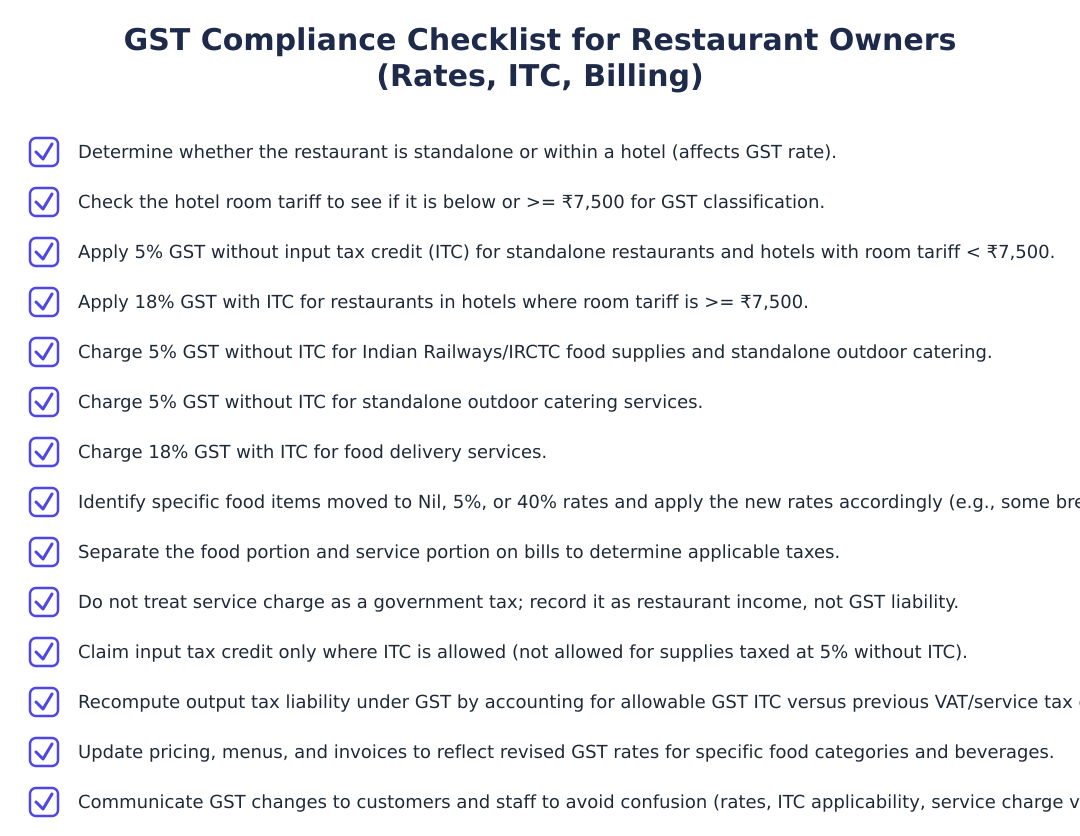
Restaurant owners should classify their establishment correctly, maintain detailed invoices to claim eligible ITC, and structure purchases and supplies to optimise tax outcomes. Specifically, if eligible for 18% with ITC (e.g., hotel restaurants with room tariff ≥ ₹7,500), they should preserve supplier invoices and reconcile GST paid on inputs; standalone restaurants on 5% without ITC should price accordingly and avoid claiming ITC. Owners should also update menus and billing systems to reflect changed rates for packaged foods and beverages (e.g., 40% on sugary drinks) and ensure GST is separately shown on customer bills. Regularly reviewing GST notifications and consulting a tax professional helps capture exemptions and avoid penalties.
Need help staying GST compliant?
MoneyGence's AI Finance OS tracks your compliance, wallet share, and finances in one place, built for agencies and growing businesses.
Get started with MoneyGence