GST on Stock Trading 2026: Rates, Applicability & Impact
This guide explains how GST applies to stock trading in India and what traders should know in 2026. You will learn which parts of a trade attract GST and which do not, how GST changes the effective cost of trading, and how different types of traders (long‑term investors, intraday traders and high‑frequency/derivatives traders) are affected. Understanding the distinction between the value of securities and the service charges around trading is crucial: securities themselves remain outside the GST net, while services that facilitate trading are taxable. That distinction affects bookkeeping, cost calculations and the pricing structure of brokerages and exchanges. Armed with this clarity, traders can better estimate transaction costs, assess the profitability of frequent trading strategies, and make informed choices about brokers and service plans. This guide focuses strictly on how GST operates relative to securities and trading-related services and highlights practical implications for trading behaviour and cost management.
Where Does GST Apply in Stock Trading?
GST in India is an indirect tax on consumption and applies to goods and services supplied for consumption. In the context of stock markets, this principle means that the tax applies to services provided to facilitate trading rather than to the securities themselves.
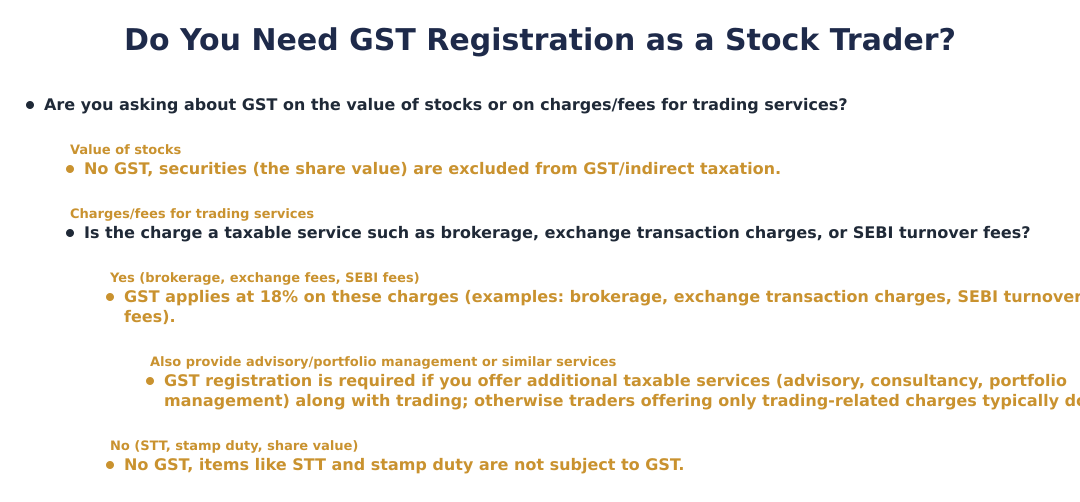
Concretely, the value of shares, stocks, bonds or similar securities bought and sold on an exchange is excluded from GST. The securities are not treated as taxable goods or services for GST purposes, so the principal buy or sell consideration for the security itself does not attract GST.
However, many ancillary charges that arise when executing trades are services, and therefore fall within the GST framework when they are taxable services. Examples include brokerage commissions and other service fees charged by intermediaries that enable access to markets or maintain accounts for clients.
GST on Charges and Fees (what attracts GST)
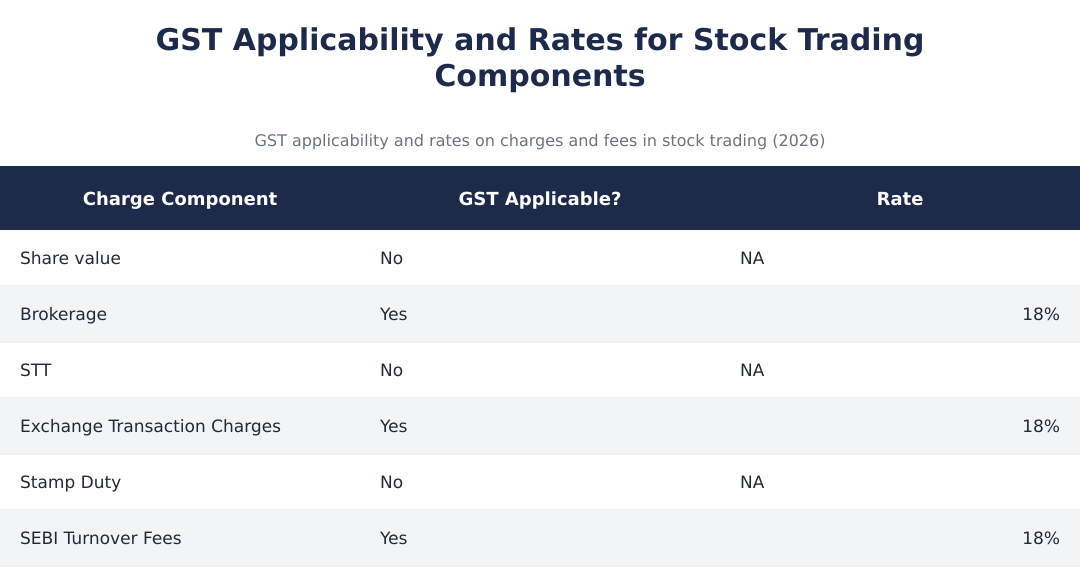
GST applies to the charges and fees for services that facilitate stock trading. Brokerage charges are explicitly taxable as a service, and other service-type charges related to trading, such as demat account maintenance and certain transaction facilitation fees, are also subject to GST when they are taxable services.
Not all charges connected to a trade are taxable under GST. For example, statutory levies imposed on transactions like Securities Transaction Tax (STT) and stamp duty are not subject to GST. Those are separate statutory charges outside the GST regime.
For traders and firms, the practical takeaway is to separate the components of a trade invoice: the net value of securities, statutory taxes/levies, and service charges. GST will apply only to the taxable service components, not to the securities’ value or to non-GST statutory levies.
GST Implications for Different Types of Traders
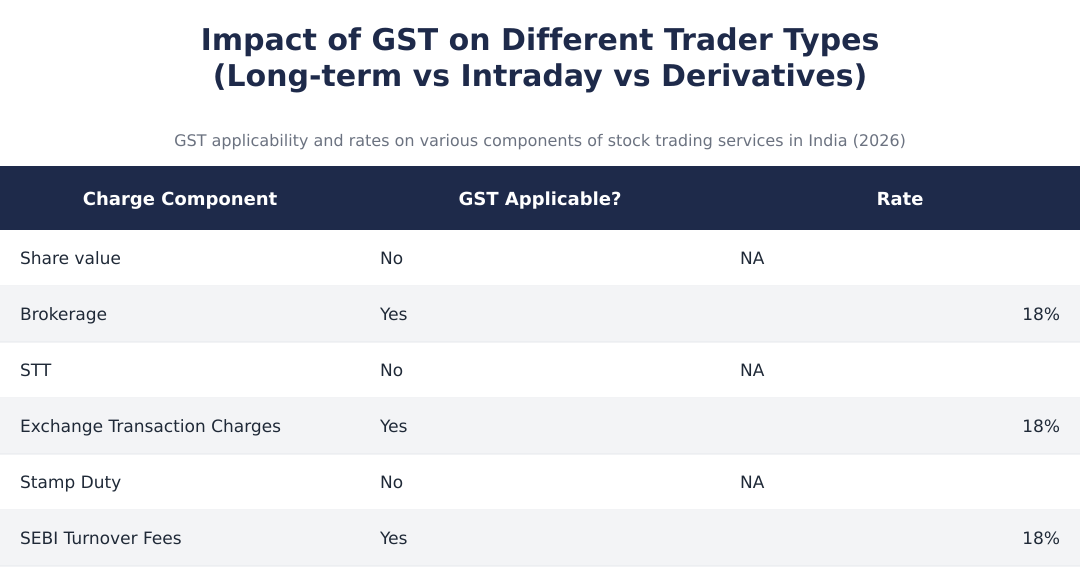
Long‑term investors: Because GST does not apply to the value of the securities themselves, buy-and-hold investors will generally face limited GST exposure relative to the size of their portfolios. Their taxable outgoings related to trading are largely restricted to occasional brokerage or account maintenance fees, which are service charges rather than a tax on the investment.
Intraday and high‑frequency traders: Traders who execute numerous trades in short time frames experience GST on every taxable service charge tied to each transaction. These cumulative service taxes increase overall trading costs and can materially reduce profit margins for strategies that rely on small per‑trade spreads.
Derivatives and leveraged trading: When trading derivatives or using leverage, transaction volumes and associated service charges typically rise. Because taxable service charges apply repeatedly, GST contributes to higher recurring costs for such strategies. It is important for active traders to factor these service taxes into breakeven and profitability calculations.
Impact of GST on Stock Trading Costs
GST raises the effective cost of services that enable trading, brokerage, demat account services and other facilitation fees. For traders who transact infrequently, this is a modest addition; for frequent traders the cumulative impact can be significant because GST applies on each taxable service charge occasioned by a trade.
From an operational viewpoint, traders should request clear invoices that break out service charges and any GST levied on them. This clarity helps in accurate P&L calculations and ensures compliance with accounting and tax reporting practices.
Brokers and intermediaries typically include GST on their service invoices; traders should compare not only headline brokerage rates but also the total cost including service taxes when choosing a broker or plan. Since GST affects service charges rather than securities or statutory levies, choosing lower-fee service plans or bundling services can reduce the GST burden.
Frequently Asked Questions
Is GST charged on the purchase price of shares? No. The value of the shares themselves is excluded from GST and therefore the base consideration for buying or selling securities does not attract GST.
Are statutory transaction levies like STT and stamp duty subject to GST? No. Securities Transaction Tax (STT) and stamp duty levied on securities are not subject to GST and remain separate statutory charges.
Does brokerage attract GST? Yes. Brokerage is a taxable service and attracts GST when it is a charge for services rendered in facilitating trades. Traders should anticipate GST being applied to brokerage and similar service fees.
GST in stock trading targets the service layer around trades, not the securities themselves. Traders should separate service charges from the value of securities when calculating costs, pay attention to GST on brokerage and related fees, and factor these service taxes into trading strategies, especially if trading frequently. Clear invoices and careful comparison of total service costs will help manage the GST impact on trading profitability.
Frequently asked questions
Is GST charged on the value of shares I buy or sell?
No, GST is not charged on the value of the shares themselves because securities (equity shares, bonds, mutual funds, debentures) are excluded from GST in India. GST applies only to services linked to trading, not to the underlying securities value or profit on sale. For example, you will not pay GST on the share price or on the Securities Transaction Tax (STT) levied on trades. This means the taxable base for GST in trading is the service fees, not the stock transaction amount.
On which charges in stock trading do I have to pay GST?
You have to pay GST on service charges that facilitate trading, such as brokerage fees, exchange transaction charges, SEBI turnover fees, demat maintenance and other service charges. Specifically, brokerage, exchange transaction fees and SEBI turnover fees attract GST; stamp duty, share value and STT do not. Examples of GSTable items include auto-square off charges, demat conversion fees and advisory/research fees when provided as a service. These service components are billed separately and GST is added at the time of invoicing.
What is the GST rate on brokerage and other trading service charges?
The applicable GST rate on brokerage and other exchange or regulatory service charges related to stock trading is 18%. This 18% rate applies to brokerage charges, exchange transaction fees and SEBI turnover fees levied as service components. For example, if your broker charges Rs.40 as brokerage, GST at 18% will add Rs.7.20 to that charge. Non-service components like stamp duty or STT remain outside GST.
Do I need to register for GST if I only trade stocks for myself?
No, individual traders who only buy and sell stocks for their own account are generally not required to register for GST solely because of trading activity, since trading in securities itself is not a taxable supply of goods or services under GST. However, if you provide taxable services along with trading (for example, paid advisory, portfolio management, or brokerage services to others), you must register and charge GST once your aggregate turnover meets the registration threshold. Also, businesses offering trading-related services professionally must follow normal GST registration rules.
How does GST affect intraday traders compared with long-term investors?
GST affects intraday traders more significantly because intraday trading involves many small trades where GST (18%) on brokerage and exchange fees repeatedly reduces thin profit margins. Long-term investors face negligible GST impact because they trade infrequently and GST applies only to service charges, not to the share value. For example, a typical intraday trade with brokerage Rs.40 and exchange fee Rs.4 attracts GST on both components, while a buy-and-hold investor paying the same one-time fees spreads that cost over a longer holding period, making the GST impact small.
Does GST apply to derivatives trading (futures and options)?
Yes, GST applies to the service charges and fees associated with derivatives trading, such as brokerage and exchange transaction charges, at the same 18% rate; the underlying derivative contract value itself is not taxed under GST. Because derivatives trading is typically high-volume and leveraged, GST on frequent service charges can substantially raise overall transaction costs. For example, a derivative trader paying brokerage and exchange fees on every contract will see GST add 18% to those fees, increasing the effective cost per trade.
How does GST change the total cost of a trade, can you give a simple example?
GST increases the total trading cost by 18% on the service component (brokerage, exchange fees, SEBI fees), not on the share price; so a Rs.40 brokerage plus Rs.4 exchange fee attracts 18% GST on Rs.44, adding Rs.7.92 to the bill. Using that example, your service charges net of GST would be Rs.44 and gross with GST Rs.51.92, which reduces net trading profits, especially for small-margin intraday trades where such added cost is proportionally large.
Can traders claim input tax credit (ITC) for GST paid on brokerage and other trading fees?
Generally, traders cannot claim input tax credit for GST paid on brokerage and exchange charges for purchasing and selling securities for their own investment because transactions in securities are treated as exempt or outside the scope for supply, making related GST not eligible for ITC. ITC is available only when the recipient uses taxable outward supplies and meets GST rules for credit; so a business that provides taxable services alongside trading may be able to claim ITC subject to normal restrictions. In short, pure investors usually cannot offset GST on trading fees against output GST because their outward supplies are not taxable under GST.
Which common trading charges are not subject to GST?
Charges not subject to GST include the value of the shares traded, Securities Transaction Tax (STT), and stamp duty levied on securities transactions; these are outside GST scope. GST only applies to service elements such as brokerage, exchange transaction fees and SEBI turnover fees, which are separately invoiced. For example, STT and stamp duty are statutory taxes/charges imposed on the trade and are not taxed again under GST.
Need help staying GST compliant?
MoneyGence's AI Finance OS tracks your compliance, wallet share, and finances in one place, built for agencies and growing businesses.
Get started with MoneyGence