GST on Used Cars: Rates, Applicability & HSN Code (India)
This guide explains how GST can apply to the sale of used cars in India, what factors determine whether tax is payable, and how buyers and sellers should approach classification and input tax credit (ITC) issues. Because sales of second-hand vehicles can involve businesses, dealers and private individuals, the GST treatment varies based on the nature of the transaction, whether the seller is a taxable person, whether the vehicle is sold as part of an ongoing business, and whether any prior GST benefits were claimed on the vehicle. Understanding these distinctions helps buyers and sellers avoid unexpected tax liabilities, ensures correct invoicing, and clarifies when reverse charge or margin schemes may be relevant. This article walks through the concepts you should consider (seller and buyer registration status, treatment of margins versus full value, HSN classification considerations, and ITC eligibility), outlines a practical checklist you can follow before completing a sale, and answers frequently asked questions so you know when to consult a tax advisor or check the latest notifications. It does not substitute for professional advice or the latest government notifications, so always verify current law and rates before transacting.
Understanding GST on Used Cars
GST on the sale of used cars is not a single uniform outcome; it depends on the circumstances of the sale. Key determinants include whether the seller is a registered taxable person, whether the sale is made in the course or furtherance of business, and whether any GST credit was previously claimed on the vehicle when it was purchased. These factors influence both the taxable event and the method of calculating tax.
From a practical standpoint, dealers and businesses typically treat used-car sales differently from private sellers. Dealers selling cars as part of their business must consider GST compliance, invoicing, and potential tax collection obligations. Private owners selling personal vehicles usually do not fall within the same compliance requirements unless the sale is part of a business or trade.
Applicability of GST on the Sale of Old Cars
Whether GST applies to a particular used-car sale hinges on the status of both parties and the purpose of the sale. Sales made by registered suppliers or by businesses as part of their commercial activity are the typical situations where GST considerations arise. Conversely, a casual sale by an individual for personal reasons is generally treated differently.
Other practical triggers for GST include organised activities such as auctions run by dealers, sales involving exchange schemes, or transactions that form part of a dealer’s stock-in-trade. It’s important to document the nature of the transaction clearly, invoices, bills of sale, and records of whether the vehicle formed part of business assets, because those documents determine the correct tax treatment.
GST Rates and HSN Codes for Used Cars
HSN classification and applicable GST rates for motor vehicles are governed by the GST law and its tariff schedule. Classification affects whether a vehicle falls under a particular heading for tax purposes, which in turn determines the applicable rate and any associated cesses. Because rates and classifications may be updated by notifications, always confirm the current HSN headings and rates from the official tariff or a reliable tax source before concluding a sale.
In addition to standard rate determinations, some supplies of used goods may be eligible for special treatment such as taxation on the margin (profit) instead of on the full value, this depends on whether the supplier opts for, or is required to use, a margin scheme permitted under GST rules. Whether margin taxation or full-value taxation applies has a direct effect on the invoice value on which GST is computed and collected.
Input Tax Credit Claims
Eligibility to claim ITC on motor vehicles depends on the intended use and whether the purchaser is engaged in a business activity that qualifies for credit. Vehicles acquired as capital assets or for making taxable supplies can present different ITC outcomes than vehicles used for personal purposes or for supplies that are specifically excluded from ITC under the law.
Practically, buyers should determine at the time of purchase whether they intend to use the vehicle for taxable business activities and should retain documentation to support any ITC claims. Sellers should disclose if ITC was previously claimed on the vehicle, as that fact can affect the GST treatment on subsequent sales.
Steps to Determine GST Applicability for a Used-Car Sale
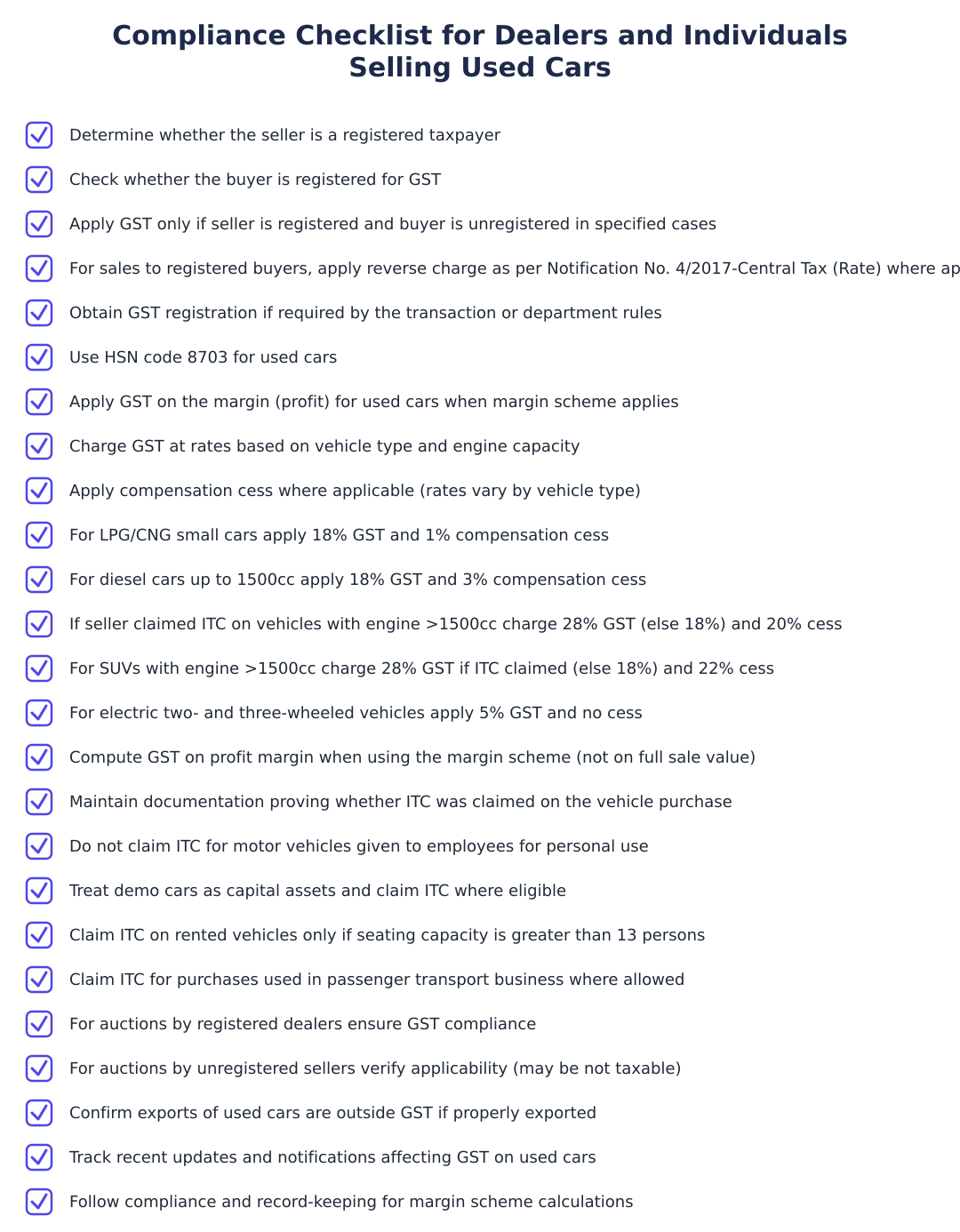
Confirm whether the seller is a registered taxpayer or an unregistered individual; registration status is a primary determinant of GST obligations.
Establish whether the sale is in the course of business (e.g., dealer inventory, part-exchange) or a casual personal sale; business sales are more likely to attract GST.
Determine if the seller had claimed input tax credit on the vehicle earlier, as that can influence whether tax is chargeable on margin or full value.
Refer to the latest tariff schedule and official notifications to identify the correct HSN heading and applicable GST rate for the vehicle.
Prepare a proper tax invoice or bill of sale reflecting the applicable tax treatment, and retain supporting documents for future scrutiny.
Frequently Asked Questions
Q: Do private owners always have to charge GST when they sell a used car? A: Not necessarily, casual personal sales are treated differently from sales made in the course of business. Whether GST is due depends on factors such as the seller’s registration status and whether the sale is part of a trade or business.
Q: Can a buyer claim ITC on a used car? A: ITC eligibility depends on the buyer’s business purpose for the vehicle and whether the purchase is used to make taxable supplies. Proper documentation and substantiation of business use are essential if claiming credit.
Q: If I am unsure about the correct rate or classification, what should I do? A: Consult the latest government notifications or a qualified tax professional before finalising the transaction. Laws and notifications can change, and professional advice helps avoid inadvertent non-compliance.
GST treatment of used cars depends on facts specific to each transaction: seller and buyer status, business purpose, any prior ITC claims, and current tariff classifications. Because rates, HSN codes and procedural notifications can change, use this guide as a checklist and verify the latest official notifications or consult a GST practitioner before completing a sale.
Frequently asked questions
When is GST applicable on the sale of a used car in India?
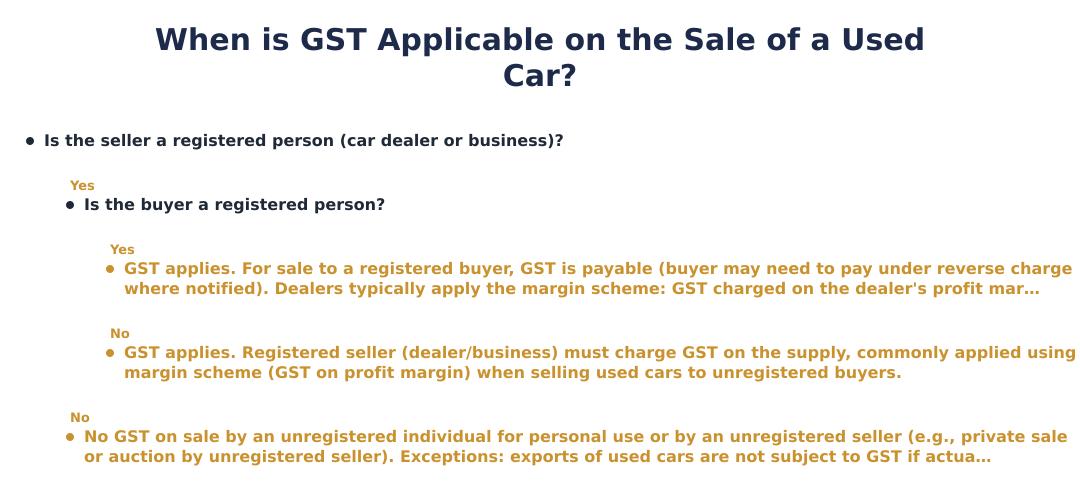
GST is applicable on the sale of a used car only when there is a positive margin on the transaction. For registered dealers selling second-hand cars under the margin scheme, GST is charged on the profit (selling price minus purchase value or depreciated value) rather than the full sale consideration; if the margin is negative (a loss), no GST is payable. Sales to registered buyers may attract reverse charge under Notification No. 4/2017-CT(R) where the buyer pays GST, while sales to unregistered buyers typically do not attract GST from the seller's side. Certain transactions such as exports or sales by individuals for personal use are outside GST scope or exempt as noted in practice.
How do dealers calculate GST on a used car under the margin scheme?
Dealers calculate GST on a used car under the margin scheme by applying the applicable GST rate to the positive margin (selling price minus purchase price or written down value), not on the full sale price. For example, if a dealer bought a car for Rs. 6 lakh and sells it for Rs. 7 lakh, GST is charged on the Rs. 1 lakh margin at the relevant rate for that vehicle category. The margin scheme is available to registered dealers of second-hand goods and special rules apply if the seller had claimed Input Tax Credit (ITC) on the original purchase, which can affect the applicable GST slab and cess. Documentation to substantiate purchase price and margin should be maintained for compliance and audit purposes.
What are the current GST rates and HSN code for used cars?
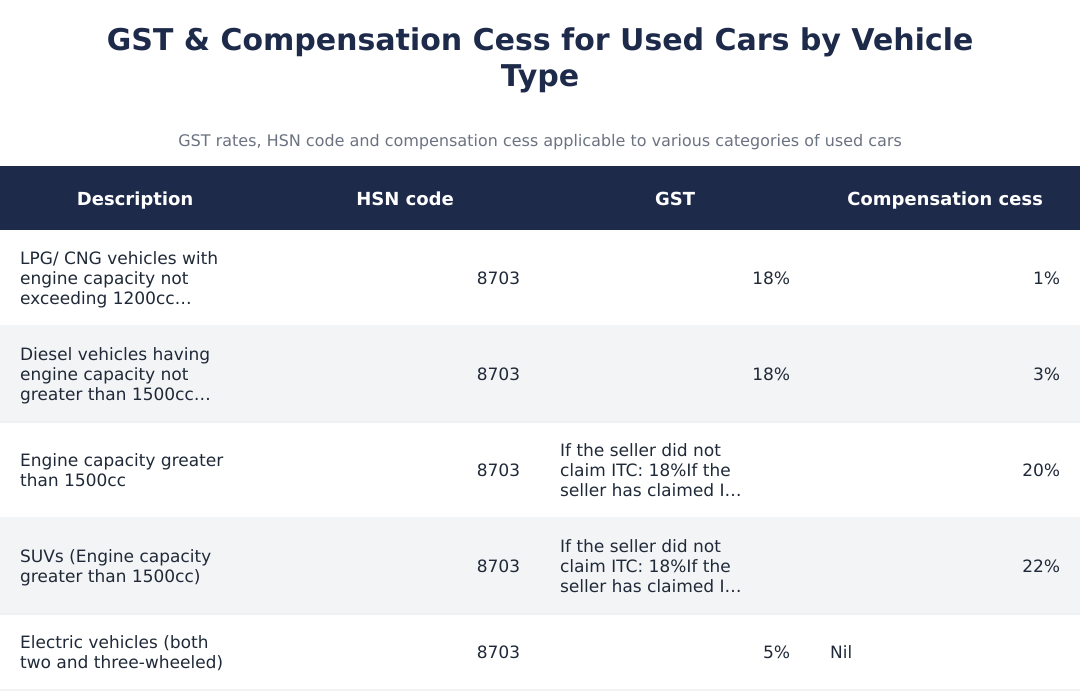
The HSN code for used cars is 8703 and GST rates vary by vehicle type and whether ITC was claimed: typical GST is 18% for many small petrol/LPG/CNG cars, 18% or 28% for larger petrol/diesel cars depending on ITC claim, and 5% for electric vehicles. Compensation cess also varies: small LPG/CNG cars attract 1% cess, certain diesel cars 3%, larger engine cars/SUVs can attract 20–22% cess depending on ITC claim, while electric vehicles have nil cess. Always confirm the exact GST and cess applicable based on engine capacity, vehicle length and whether the seller claimed ITC, since these determine the correct slab.
Does claiming Input Tax Credit (ITC) on the original purchase affect GST on resale of a used car?
Yes, if the seller had claimed ITC on the original purchase of the motor vehicle, the GST rate on resale may be higher (for some categories it can move from 18% to 28%). The presence or absence of ITC on the original purchase is a key factor in determining the applicable GST slab and compensation cess for the resale of used vehicles, particularly for cars with engine capacity greater than 1500cc and SUVs. Dealers must disclose whether ITC was claimed and maintain records proving ITC claims, because incorrect classification can lead to reassessment and penalties. Note that ITC cannot be claimed for motor vehicles given to employees for personal use or for demo cars treated as capital assets, except in specified business use cases like passenger transport with seating over 13.
Are electric used cars taxed differently under GST?
Yes, used electric cars fall under HSN 8703 with a GST rate of 5% and nil compensation cess. Electric vehicles (including two- and three-wheeled EVs) attract a concessional GST rate compared with petrol/diesel vehicles, making them cheaper from a tax perspective on resale. This preferential rate applies whether the vehicle is new or used, provided the classification as an electric vehicle is clear and documented. Dealers should still apply the margin scheme (GST on positive margin) when reselling used EVs if they are registered dealers of second-hand goods.
What happens if a dealer sells a used car at a loss (negative margin)?
If a dealer sells a used car at a loss (negative margin), GST is not applicable on that sale. The margin scheme requires a positive margin for GST to be levied; when the selling price is lower than the purchase/depreciated value, there is no chargeable margin and therefore no GST. This rule applies to registered dealers dealing in second-hand motor vehicles and should be supported by purchase invoices and valuation records to demonstrate the negative margin. However, other compliance requirements like invoicing and record-keeping still apply even when no GST is charged.
When is reverse charge applicable on the purchase of a used car from a dealer?
Reverse charge is applicable when a registered buyer purchases a used car from an unregistered dealer under Notification No. 4/2017-CT(R), meaning the buyer (recipient) must pay GST. Specifically, if a registered person buys a used car from a supplier who is not registered, the buyer may be liable to pay GST under reverse charge; if the buyer is unregistered, the government department or designated authority may need to obtain registration and pay tax. Sales to exporters or personal-use sales by individuals are typically outside GST or not taxable under these reverse charge rules. Always check the exact notification wording and registration status of parties to determine reverse charge applicability.
Are sales of used cars by individuals taxable under GST?
No, sales of used cars by individuals for personal use are generally not subject to GST if the seller is not carrying on business in used cars. The GST regime targets supplies made in the course of business; casual or one-off private sales by an individual do not normally attract GST. However, if an individual is selling cars as part of a business or regularly dealing in used vehicles (i.e., as a car dealer), GST rules including the margin scheme and registration requirements will apply. Documentation like proof of business activity and frequency of transactions is used by tax authorities to determine whether GST should apply.
What compliance and documentation should dealers maintain when selling used cars?
Dealers should maintain purchase invoices, sale invoices showing GST charged on the margin, records proving whether ITC was claimed on the original purchase, and valuation details used to compute the margin. These records support the margin calculation, GST rate classification (including engine capacity/vehicle type and applicable cess), and any reverse charge or exemption decisions; failure to keep them can trigger reassessment or penalties. Additionally, dealers must issue proper tax invoices, file GST returns reflecting margin supplies, and comply with notifications relevant to reverse charge and second-hand goods rules. Keeping clear evidence of vehicle specifications (engine capacity, length, fuel type) helps determine the correct HSN classification (8703) and applicable cess.
Need help staying GST compliant?
MoneyGence's AI Finance OS tracks your compliance, wallet share, and finances in one place, built for agencies and growing businesses.
Get started with MoneyGence